Category: General news

Managing director of Ebono Institute and major sponsor of The Generator, Geoff Ebbs, is running against Kevin Rudd in the seat of Griffith at the next Federal election. By the expression on their faces in this candid shot it looks like a pretty dull campaign. Read on

  • The Budget, The Verdict The Australia Institute

    1 of 8

    The Budget, The Verdict

    Inbox
    x

    The Australia Institute <mail@tai.org.au>

    4:21 PM (1 hour ago)

    to me
    The Australia Institute

    Dear Neville,

    Joe Hockey’s second budget was much better armoured than his first. The brazen nature of the first budget made the task of those critiquing it pretty easy. This one took more time and detailed analysis to break down.

    Our verdict: The 2015 Federal Budget doesn’t fit the 2015 Australian economy. It ignores obvious and major issues, and attempts to solve problems that don’t exist. Creating a political document is easy, and by doing so Abbott and Hockey have missed opportunities and this will harm the economy, environment and people of Australia for many years to come. In a word, the Budget is ‘lazy’.

    Last week, we described Joe Hockey’s pre-budget message as ‘more than mixed, it’s pureed’. And this Budget proved to be a mish-mash of measures, with no coherent economic strategy.

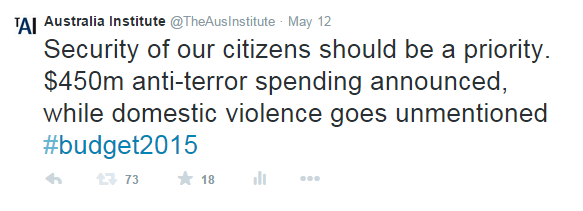
    Security_tweet.png

    Thank you for the many responses to our offer to join us in the lockup; they helped guide our work as we poured through the Budget Papers. We have addressed some of the most frequently raised issues below. Some items remained unchanged from last year to this, keeping the issues out of the news, but we note that in a lot of cases that means cementing the cuts of last year’s horror-budget.

    1. The Lazy Budget
    2. One Handout Washes the Other
    3. Joe Jilts Austerity and Stumbles on Stimulus
    4. Everything’s Bigger in Taxes
    5. Unpacking the Small Business Package
    6. TAI Budget Media

    The Lazy Budget

    Rubbery figures

    It seems every budget over the last few years has claimed that there will be decreasing budget deficits in the out years. This budget is no different. While there is no surplus claimed in any of the years the government does claim that by 2018-19 the budget deficit will fall to $7 billion.

    It is important to remember that this time last year the government was claiming this year’s budget deficit would be $17.1 billion. On Tuesday they said $35.1 billion. If the budget deficit can double in just one year imagine how much it can change in four years.

    The current guess for this year’s budget deficit is based on a bunch of savings that have been rejected by the senate. We found $2 billion worth that the senate have vowed to block. If they do then this year’s deficit will increase by $2 billion to $37.1 billion.

    It is important to remember that all these figures are rubbery. Nothing highlights this more than the government announcement that $90 billion in revenue has been written off the forward estimates. If Treasury can lose $90 billion dollars what chance does a $7 billion deficit in four years’ time have?

    Iron Ore Poor

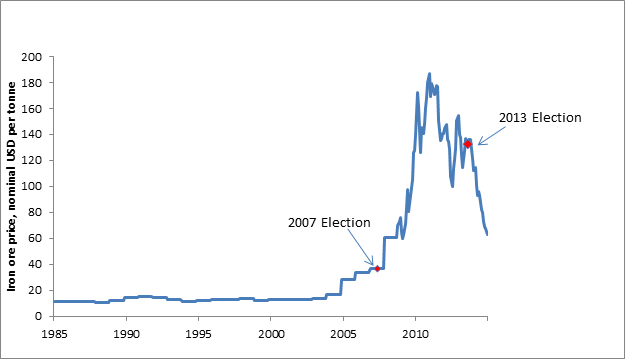
    In the 20 years from 1985 to 2005 iron ore averaged $13.17USD per tonne. The revenue streams in Joe Hockey’s budget into the future are based on a price of iron ore of $48USD per tonne. This might be true, and there’s an argument that given Australia’s dominance of the world market, we could even have some say in that. However, it does go to show the dangers of spending billions of taxpayer funds to assist mining companies, rather than investing in say health, innovation and education.

    Iron ore prices: What goes up…

    Iron_Ore_Price.png


    One handout washes the other

    When is a handout not a handout?

    The Treasurer has a unique spin on what a hand out actually is. When Leigh Sales on 7.30 described the budget as giving handouts, the Treasurer angrily responded that $20,000 in instant tax write offs was not a hand out because the government was simply giving people back their own money.

    This is ideological spin pure and simple. There is no difference between a government giving someone $100 in cash and giving them an extra $100 on their tax refund. The Treasurer is inventing the distinction so he can imply that people who get government largess by paying less tax are more virtuous than those that rely on government payments.

    If the Treasurer’s distinction is actually true then why was he claiming a crackdown on tax minimising multinationals? Surely they are just claiming back their own money.

    While this budget had less crass us-and-them analogies like the ‘lifters and leaners’ of the last budget, it is clear that the Treasurer has not learnt very much. He seems to think tax loopholes are good and virtuous and those that rely on government payments are not. What a coincidence that it is mainly high income earners who take advantage of tax loopholes and low income earners who rely on government payments.

    Joe Jilts Austerity and Stumbles on Stimulus

    The absence of action can be as powerful as any act, particularly in changing times. Economic debate since the GFC has often been put in terms of Austerity vs Stimulus. Joe Hockey, on the surface, appears to have done neither. However, analysis by TAI senior economist, Matt Grudnoff, has found that the dabbling done in these areas will leave nasty legacies.

    Austerity – The Budget’s bad houseguest lingers

    The budget has downgraded growth forecasts again. The economy is expected to grow by only 2.75% next year down from 3% which was estimated just 6 months ago. Unemployment is now expected to increase to 6.5% next year up an estimated 6% just 6 months ago. The Reserve Bank just lowered interest rates to record lows. All this points to a weaker economy and it requires a strong government response.

    What we got in the budget was an optimistic Treasurer who is not very keen to do anything and a nothing budget. In fact this budget has changed significantly from last year’s budget. But rather than heading in the right direction we have lurched from one bad budget to another.

    In opposition and then up until very recently the government had been running a very strong argument for austerity. We were constantly being told that we can’t live beyond our means. We had a budget emergency and the biggest crisis facing Australia today was the debt and deficit disaster.

    This has completely vanished in this year’s budget. Some of the old rhetoric is still being pulled out but this is not a budget from a government that is concerned about the size of the deficit.

    Stimulation, Joe’s new to it

    In the budget papers we even see small signs of what might be stimulus. But given its size it could just as easily be mistaken for electoral pork barrelling. The small business package that allows purchases of up to $20,000 to be written off against tax seems to be aimed to encourage spending to stimulate growth and employment.

    Of course stimulation only works if you’re adding extra money into the economy. If you put $2 billion in one program but then take out $2 billion in another program the net effect is likely to be zero. The Treasurer has been proudly telling everyone who will listen that all his new spending measures are being offset by savings measurers. Not a particularly smart move if you’re trying to stimulate the economy (as the Reserve Bank is doing).

    A close reading of the budget papers reveal that the Treasurer is not actually correct. New spending measures are expected to increase by $10 billion over the next four years. This is partly offset by $2 billion extra revenue in new revenue measures. This means that we have an addition of $8 billion over four years being injected into the economy or an average of $2 billion per year.

    $2 billion in an economy of $1,560 billion is hardly likely to have much effect.

    Everything’s bigger in Taxes

    Can you feel your bracket creeping?

    At the release of the Intergenerational Report earlier this year the Treasurer told us that one of his biggest concerns was bracket creep. He claimed that it was unacceptable that someone on average earnings would be in the second highest tax bracket.

    So what has the Treasurer done about it? Well…nothing.

    In fact bracket creep is what the Treasurer is hoping will bring his budget back to surplus. This is the laziest tax policy. Bracket creep disproportionality impacts on low income households.

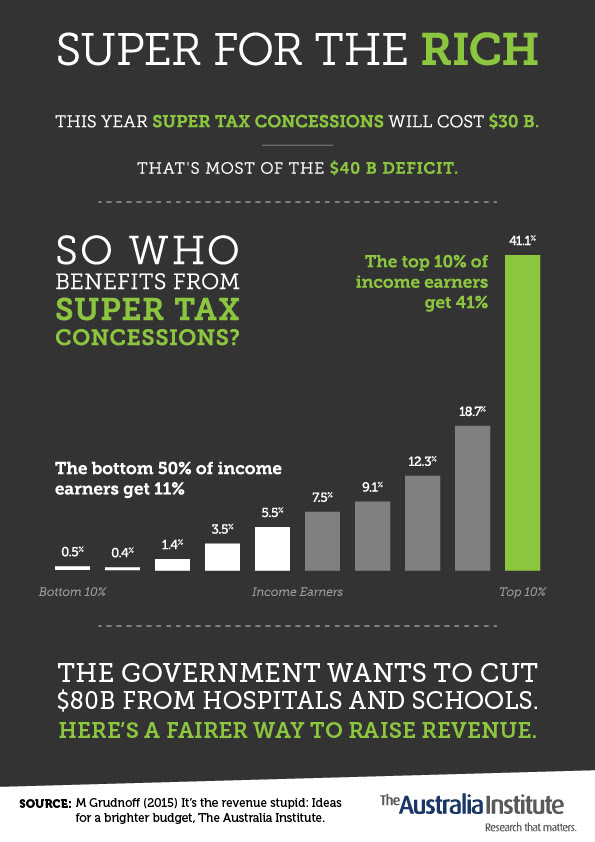
    This is a massive missed opportunity. Instead of taxing smarter the government is being lazy. We could have wound back negative gearing and abolished the capital gains tax discount. This could raise $7.4 billion a year, help reduce speculation in the property market and make it more affordable to buy or rent a home.

    The government could tackle rapidly growing super tax concessions. It could repurpose super tax concessions so that they do what they were designed to do, reduce pressure on the age pension. This could raise $10 billion or more.

    This money could then be used to offset bracket creep. This budget has completely ignored tax reform.

    $30 billion+ of savings, ignored:

    SuperannuationFinal-1V2.jpg

    They raised the GST and no one cared or noticed

    Over the years the GST has been the most divisive of tax debates. What a surprise then to find the coalition break a promise not to change the GST and have virtually no comment on it at all.

    In the budget, the government extended the GST to include imported digital products. It is expected to raise $350 million over two years.

    With such a muted reaction to small changes in the scope of the GST maybe the government should consider extending it to private schools and private health insurance. A TAI paper found that this could raise $2.3 billion, a third of which would come from the highest income households.

    That small business package

    The government has put together a package of goodies for small business but to distract from it looking like a political ‘handout’ they have attempted to sell it as a jobs package.

    The main items assisting small business are:

    • Tax cuts for businesses with turnovers up to two million dollars which involve:
      • cutting the company tax rate from 30 to 28.5 per cent and
      • a five per cent discount in tax paid by unincorporated small business up to a maximum of $1,000 pa.
    • Accelerated depreciation so that items worth up to $20,000 can be immediately deducted rather than written off over time.

    These two measures cost $3.3 billion and $1.8 billion over the next four years. In addition there are some very minor concessions for exemption from capital gains tax for changes to an entity’s structure, immediate deduction for professional expenses involved in setting up a business, and changes to small business fringe benefits tax arrangements for mobile phones and the like.

    Tax cuts for business are unlikely to have much impact on their employment and growth plans.[1] Giving small business more money does not increase demand for their product. They will only employ more people when they need to sell more stuff.

    The accelerated depreciation measures may encourage further spending on office furniture, machinery and office equipment.  This may well generate some new spending but it is more likely to just bring forward planned spending on the part of small business. It is also likely to appeal to all those tax avoiders who seek to disguise private spending as tax-assisted business expenses.  In any event it is not sufficient to prevent unemployment increasing from 6.25 to 6.5 per cent between the June 2015 and June 2016 quarters as shown early in Budget Paper no 1.

    So if the government’s handout to small business is not likely to have much of an impact on jobs, is the government serious about growing employment? There are some relatively minor employment measures mainly with the Youth Employment strategy. But despite this, in budget paper no 1, table 16, there is only small increase in spending on ‘Labour market assistance to job seekers and industry’ and a very flat level of funding for ‘vocational and industry training’. Hardly the results you would expect for a government trying to reduce unemployment.

    The government has been forced to abandon its policy of making people under 30 wait 6 months for unemployment benefits because the senate refused to pass it. This has not deterred them from punishing the victims of the sluggish economy. They have simply reduced it to those under 25 and reduced their wait time down to 4 weeks. While the government seems to think this is an employment strategy it is hard to see how forcing people into poverty will increase the number of jobs.

    One of the most remarkable measures in the growing jobs and small business package is ‘further strengthening the job seeker compliance arrangements’ which will spend $24.9 million in the departments of Human Services and Employment on measures that will save $6.9 million in payments to those on unemployment benefits! Put simply they are hoping to crack down on those who receive unemployment benefits. Again it’s hard to see how this will grow the economy and create more jobs.

    Putting some of these things together gives us a boost in after-tax incomes for people with business interests , nothing that improves the lot of the unemployed or their likelihood of finding work and a further attempt to use sticks to encourage them to look for the jobs that just are not there. This and other parts of the 2015 Budget will worsen the distribution of income in Australia.

    TAI Budget Media

    Crikey – Talk to the hand: Hockey is living in a budget fantasy land

    The Age – The real budget winners: Wealthy retirees

    The Wire – A lack of long term solutions in a ‘soft’ budget  

    ABC – Budget 2015: $20,000 small business tax break explained

    The Conversation – Path to budget surplus built on shifting foundations

    2SER – On the Money pre-budget special


    [1]
    Richardson D (2014) ‘The taxation of capital in Australia: Should it be lower?’ In Schroeder SK and Chester L (Eds) Challenging the orthodoxy: Reflections on Frank Stilwell’s contribution to political economy, Springer, pp 181-202.

  • Sheer courage. A message from the Pacific Climate Warriors

    Click here to enable desktop notifications for Gmail.   Learn more  Hide
    Something’s not right.
    We’re having trouble connecting to Google. We’ll keep trying…
    Errors: 101
    More

    1 of 8

    Sheer courage. A message from the Pacific Climate Warriors

    Inbox
    x

    Aaron Packard – 350.org <aaron@350.org> Unsubscribe

    3:34 PM (11 minutes ago)

    to me

    Dear friends,

    It’s 6 months ago now that the Pacific Climate Warriors paddled out in traditional canoes, followed by hundreds of Australians to blockade the world’s largest coal port: Newcastle.

    That day will be forever etched in my mind – those gigantic coal-laden ships ground to a halt by those tiny canoes and kayaks. What the canoes and kayaks lacked in size, they made up for in the incredible strength of courage and determination of our people out on the water.

    Today we are excited to release a film that tells the story of the canoe blockade – through the voice of the Pacific Climate Warriors.

    Watch it here – or by clicking on the image.
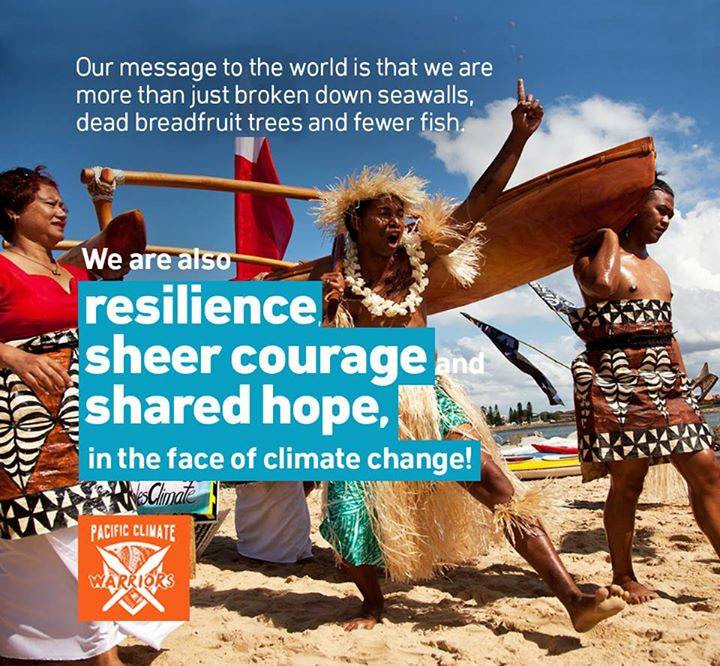
    We believe this is a story that needs to be heard around the world. If you agree, please share this page as widely as you can – click here for the link to share.

    The flotilla put the spotlight on the brilliant, unique cultures of the Pacific Islands, and the loss and damage they face from the continued expansion of coal exports from Australia. It also showed the power of Australians standing together in solidarity with the Pacific Islands.

    350.org would like to acknowledge the local community of Newcastle and the Hunter Valley for building the foundation for success of the 2014 Pacific Climate Warrior’s Flotilla. Through unfunded grassroots organising local people held 7 vibrant and effective “People’s Blockade’s of the World’s Biggest Coal Port” events from 2006 – 2012. These events and broader associated coal campaigns built a rich and diverse history of involvement in peaceful climate action.

    This is the type of self-organised action that 350 endeavours to support, inspire and replicate.

    Thank you for all the support and solidarity – it means everything to the 350 Pacific movement.

    Onwards we go!

    Aaron for 350.org

    P.S. – The Pacific Climate Warriors are preparing for the next phase of the fight to keep the Pacific Islands above water. You can follow them on Facebook, Twitter and through the 350 Pacific website here.


    350.org is building a global climate movement.You can connect with us on Facebook, follow us on Twitter, and become a sustaining donor to keep this movement strong and growing.

  • An update on Bjorn Lomborg’s “Consensus Centre”

    1 of 22

    An update on Bjorn Lomborg’s “Consensus Centre”

    Inbox
    x

    Climate Council – Amanda McKenzie via sendgrid.info 

    2:15 PM (4 minutes ago)

    to me
    Hi Inga,
    Recently, we emailed you about the Australian Government’s planned funding of Danish climate contrarian Bjorn Lomborg’s “Consensus Centre” at the University of Western Australia. We were overwhelmed at the response we received – you’re clearly just as passionate as we are about Australians having access to climate change information that is based on the best science available.

    It’s thanks to you, and others nationwide, that the University of Western Australia announced last Friday that it would no longer house Bjorn Lomborg’s “Consensus Centre” – a fantastic outcome for science. So thank you!

    Unfortunately, Lomborg’s Centre is still trying to establish itself in Australia, and this is deeply troubling. We’re concerned that the Centre would be focused on spreading misinformation presented as fact. This article outlines those concerns and we invite you to share it with your networks.

    Misinformation is harmful. Just as false information about the ‘benefits’ of tobacco misled the public and damaged health, so false information about climate change and its impacts can mislead the public and decision-makers. Allowing it to go unchecked has already delayed much needed action to stabilise the climate system, so thank you again so much for your support.

    Yours sincerely,

    Amanda McKenzie
    CEO, Climate Council

    P.S In case you missed it, some of our youngest members starred in a particularly lovely Mother’s Day video over the weekend. We hope you enjoy it!

  • [New post] Senate reform – questions that need answering

    Click here to enable desktop notifications for Gmail.   Learn more  Hide
    Something’s not right.
    We’re having trouble connecting to Google. We’ll keep trying…
    Errors: 101
    1 of 23

    [New post] Senate reform – questions that need answering

    Inbox
    x

    The Tally Room <donotreply@wordpress.com> Unsubscribe

    9:16 AM (35 minutes ago)

    to me

    New post on The Tally Room

    Senate reform – questions that need answering

    by Ben Raue

    Two weeks ago I wrote a piece for the Guardian putting the case for reform to the system of Senate group voting tickets, in response to a number of pieces arguing against reform on the basis of who is for the reform, or who supposedly will be favoured.

    Today I want to write about a few points I didn’t get to cover in my post, and respond to stories about politicians (primarily in Labor and the Greens) expressing hesitation about supporting the reform seemingly due to concerns about the partisan impact on their parties, and the proposal of a (very bad) idea to keep group voting tickets but impose a minimum vote threshold of 4% for any candidate to be elected.

    Antony Green has previously conducted an analysis of how the proposed system of above-the-line preferencing and optional preferential voting would likely change the make-up of the Senate, assuming no major change in voter behaviour. His predictions would have seen Labor and Coalition each hold two additional seats in the current Senate. The Greens would hold one less seat, with a number of other crossbenchers missing out. Nick Xenophon would have likely been joined by his #2 candidate under the proposed system.

    It seems some people in Labor and the Greens seem to think that their respective party could be disadvantaged by these reforms. The problem with making predictions about how the system would work (as acknowledged by Antony Green) is that a change in system will change the behaviour of parties, candidates and voters. The changed system would likely result in fewer parties running, and over time this could see different voting blocks developing. A smaller ballot paper would likely have hurt the Liberal Democratic Party, who won in NSW on the back of substantial confusion over their name.

    While it looks like the Coalition would have been the chief beneficiary of no group voting tickets in 2013, at other times the reforms would have more likely benefited Labor. This has been explained by Kevin Bonham.

    Others have opposed these reforms because they have been pleased with the impact of Ricky Muir and others on the Senate crossbench. Like with any lottery, it’s possible for it to produce a positive result, but that doesn’t mean it is fair or that it can be predicted to produce another result you like in the future.

    Ultimately, you need to make your judgement about Senate reform on its impact on the system as a whole, and whether it is fair, not whether it advantages your side, or politicians that you like. That may seem naive, but in the medium term it’s the only sensible approach to electoral reform.

    We have seen the impact of short-term thinking in New South Wales and Queensland, where past Labor governments introduced optional preferential voting, in part to benefit from division between Liberal and National candidates (and Queensland Labor went further in benefiting from vote-splitting between the Coalition and One Nation in 1998, encouraging voters to ‘Just Vote 1’).

    Since then, the Liberal and National parties have merged in Queensland and gotten better at avoiding three-cornered-contests in other states, and One Nation has disappeared, while the Greens now take a much larger part of the left vote, and those same ‘Just Vote 1’ messages first used by Peter Beattie were used by Campbell Newman for the opposite effect earlier this year.

    In addition to us not being able to make any certain or long-term predictions about the partisan impact of a reform, there are deeper issues with the current Senate system, beyond which candidates might win.

    The group voting ticket system, with full preferences and almost-complete control of those preferences by parties, tends to produce results where the exact order of elimination of candidates is critical to the result, and small changes in the order can produce dramatically different results. We saw this in Western Australia in 2013, when a gap of 14 votes (or was it 12 votes?) changing who won two Senate seats.

    This problem hasn’t gone away, and if we continue down the current trend of increasing numbers of parties and candidates, it will continue to get worse. We may well see another very close contest at the next election, resulting in another recount and more pressure on the AEC to go above and beyond its normal responsibilities.

    So this isn’t just about who wins and who loses, this is about having a democratic process which is understood, respected, and not seen as producing arbitrary results which have little to no relationship to the votes cast.

    Finally, a number of media outlets have reported that some in the Greens including new leader Richard Di Natale are open to an alternative reform, which would keep the current system but exclude from election any candidate from a party that polled less than 4%.

    This is a terrible idea, and would be worthy of the criticism that minor parties have directed at the reform process so far. It would be a bald-faced case of the major parties using their position to entrench their power at the expense of small parties, and would not fix the problem.

    Preferences are not only abused by small parties – they can be abused by larger parties. In 1984, the major parties effectively used the new group voting ticket system to starve Peter Garrett (then of the Nuclear Disarmament Party) of preferences, and have often directed preferences away from the Greens.

    A threshold system would be particularly bad for the Greens, who would still be vulnerable to losing Labor preferences.

    Using thresholds would also completely fail to deal with the lack of transparency in the current system, and allow backroom deals to continue to be made, with results that are very hard to predict.

    While the above-the-line voting system is unlikely to elect anyone with less than 4% of the vote, it keeps the option open, as down the track parties get better at encouraging their voters to mark preferences. It’s also completely out of keeping with the Australian system to impose an arbitrary threshold, where 4.1% makes you eligible to win and 3.9% means you can’t win.

  • What you should know about the Budget SAM GET UP

    Click here to enable desktop notifications for Gmail.   Learn more  Hide
    Something’s not right.
    We’re having trouble connecting to Google. We’ll keep trying…
    Errors: 101
    3 of 9

    What you should know about the Budget

    Inbox
    x

    Sam – GetUp!

    4:15 PM (5 hours ago)

    to me
    Dear NEVILLE,

    Last year it was ‘The Age of Entitlement’. This year they’re calling it ‘Responsible, Measured and Fair’.

    They may have a different slogan, but this year’s budget papers tell the same story: The Abbott Government is continuing its attack on the fair go.

    Whether it’s giving mums a massive cut to paid parental leave on Mother’s Day, or pushing ahead with $80 billion in cuts to our schools and hospitals, we know this leopard isn’t changing its spots.

    For a quick review of this year’s Federal Budget, and three reforms that should have been included, watch this video straight from Parliament House last night.

    While there’s still a big fight to win back the future of the fair go, this new Budget also shows what GetUp members and our allies have won by fighting together over the last 12 months:

    • GP Co-payment: “Dead, buried and cremated.”1
    • Cuts to indexation of the pension: Gone.
    • University deregulation: Still stalled in the Senate.
    • Young jobseekers forced to wait 6 months for Newstart: Clawed back to 4 weeks.

    Unfortunately, we have new attacks on Australian families, with cuts to Paid Parental Leave for 80,000 families, along with the old attack on benefits for 700,000 families with children over 6.2 And some of the worst measures are still with us: $30 billion in cuts to schools, which dims the future for our students, and $50 billion in cuts to our hospitals, which puts the health of ageing Australians at risk.3

    But we know now that if we fight for a better budget, and a brighter future for Australia, we can win. Check out this video to see how: https://www.getup.org.au/brighterbudget

    Thanks for all that you do,
    Sam, for the GetUp team.

    PS – Recently, our Prime Minister threw down the gauntlet when he said, “… to all of the critics: if you don’t like what we’re doing come up with your alternative.”4 GetUp members responded: funding a report from The Australia Institute, which features eight fully-costed alternative policies that would raise revenue fairly, without hurting low income earners. Click here to be a part of this groundbreaking campaign.

    References:
    [1] “GP co-payment fee is ‘dead, buried and cremated’: Tony Abbott”, Sydney Morning Herald, 3 March 2015.
    [2] “Federal budget 2015: Almost 50 per cent of mums to lose government paid parental leave entitlements”, Sydney Morning Herald, 11 May 2015.
    Community Affairs Senate Committee, Report on Social Services 2014 Budget Measures, page 52.
    [3] “Don’t shed a tear for the states: Joe Hockey confirms school, hospital cuts”, Sydney Morning Herald, 12 May 2015.
    [4] “Prime Minister Tony Abbott defends reforms to GP visits”, news.com.au, 14 January 2015.


    GetUp is an independent, not-for-profit community campaigning group. We use new technology to empower Australians to have their say on important national issues. We receive no political party or government funding, and every campaign we run is entirely supported by voluntary donations. If you’d like to contribute to help fund GetUp’s work, please donate now! To unsubscribe from GetUp, please click here. Our team acknowledges that we meet and work on the land of the Gadigal people of the Eora Nation. We wish to pay respect to their Elders – past, present and future – and acknowledge the important role all Aboriginal and Torres Strait Islander people continue to play within Australia and the GetUp community.

    Authorised by Sam Mclean, Level 14, 338 Pitt Street, Sydney NSW 2000.

    Click here to Reply or Forward
    0.04 GB (0%) of 15 GB used
    Last account activity: 34 minutes ago

    Details

    Related Google+ Page
    GetUp! Australia's profile photo
    GetUp! Australia
  • climate code red

    Click here to enable desktop notifications for Gmail.   Learn more  Hide
    1 of 11

    climate code red

    Inbox
    x

    Climate Code Red <noreply+feedproxy@google.com>

    6:33 PM (19 minutes ago)

    to me

    climate code red


    The transformative power of climate truth

    Posted: 12 May 2015 08:40 PM PDT

    by Margaret Klein Salamon

    The Climate Mobilization launched seven months ago, when we began spreading the Pledge to Mobilize at the People’s Climate March in New York City. Our mission is to initiate a WWII-scale mobilization that protects civilization and the natural world from climate catastrophe. Climate truth is central to this mission. We believe that the climate movement’s greatest and most underutilized strategic asset is the truth: That we are now in a planet-wide climate crisis that threatens civilization and requires an immediate, all-out emergency response.

    The Pledge to Mobilize, a one-page document that any American can sign, is our tool for spreading climate truth and channeling the emotions it inspires into political power. The Pledge is a public acknowledgment that the climate crisis threatens the collapse of civilization, as well as a call for the United States to initiate a World War II-scale mobilization to eliminate our national net greenhouse gas emissions by 2025 and enlist in an international effort to restore a safe global climate. (Please see The Case for Climate Mobilization, for a detailed scientific and economic explanation of our demands).

    The Pledge also contains a set of political and personal commitments to build the social mobilization required to achieve these demands. When you sign the Pledge, you agree to:

    1. Vote for candidates who have also signed the Pledge to Mobilize over those who have not.
    2. Support candidates who have signed with time, money, or both.
    3. Spread the truth of climate change, and the Pledge to Mobilize, to others.

    It is still early days for The Climate Mobilization, but our progress is quite promising. The Pledge to Mobilize has been signed by more than 1000 Americans, a number that is growing every day. We encourage people, once they have signed, to recruit friends and family, and to advocate for mobilization in public. Mobilizers have begun a variety of actions such as giving presentations on the climate crisis and need for mobilization, tabling, or holding discussions in their homes. In March, 375 people marched to the San Diego Federal Building, where they posted the Pledge to Mobilize. On June 14th, we will have our first National Climate Mobilization Day, holding rallies and other Pledge-spreading events across the country that will call on our fellow citizens, as well as national political representatives to mobilize in defense of civilization. Former congressman Jim Bates will kick off the day at Midnight, acting as a modern-day Paul Revere, riding horseback through the San Diego streets warning that “Climate change is coming, Mobilize!” and will conclude his ride at a nighttime rally for Mobilization.

    The Climate Mobilization plans to be extremely active during the 2016 campaign season, using it as an opportunity to bring climate truth into the front of the public mind, and make every candidate answer whether they understand that climate change poses the greatest challenge we have ever faced, and whether they have the competence and strength of character to sign the Pledge and mobilize.

    This paper explores the transformative power — and strategic necessity— of climate truth. It explains why we believe the Pledge to Mobilize approach contains such incredible potential for change. This paper will also address the concern that The Climate Mobilization should be less frank and frightening about the climate crisis, and push for a more appealing and “realistic,” though inadequate, solution. 

    The Power of Truth for Individuals

    Humans have a remarkable capacity for imagination and fantasy. This is a precious gift, which allows us to create technological breakthroughs and captivating, brilliant works of fiction. Our imagination gives us the capacity to re-make the world, a uniquely powerful ability that no other animal can come close to rivaling. The downside, however, is that our minds are such powerful and flexible creative forces that they can also easily deceive us.

    Socrates advocated that individuals must work to discover personal truth, encapsulated in his statement, “The unexamined life is not worth living.” Guatama Buddha, a near contemporary of Socrates, created a spiritual system that also emphasizes seeking personal truth and staying in touch with reality. This is no easy task—distinguishing reality from fantasy is a life-long developmental challenge. The child, for example, must learn that monsters and fairies are not real. As the child grows, she must continue to determine what is real about herself, her family, and the world — including recognizing the truth of her capacities, or strengths, proclivities and limitations. She must also recognize what family stories have been distortions of reality, i.e. “In this family, everyone always gets along.”

    There are two basic reasons why it is critically important that individuals separate truth from distortion and fantasy. The first is very practical. If someone does not adequately understand themselves and the world, they will have a very difficult time navigating it, or growing in response to it. For example, if a teenager believes himself to be invincible, he may break bones or worse before coming to terms with the reality of his vulnerability. Or if he has been told his entire life, and now believes, that he can accomplish any goal easily, he might be in for a rude awakening when he enrolls in advanced courses for which he is unprepared. If he can’t accurately evaluate his talents honestly, he denies himself the chance to utilize his strengths and bolster his weaknesses!

    The second reason was discovered by Freud, and used during the past century by psychoanalysis and the related psychotherapies to relieve individual suffering and enhance individual lives. The truth is inherently energizing and enhancing to the individual because the truth is often known, but defended against—repressed, dissociated and denied. This avoidance of the truth takes continual effort and energy. Take, for example a woman who finally admits to herself that she is a lesbian after years of fighting this knowledge. When the truth is finally embraced, a weight is lifted and a new level of personal freedom is accessed. The woman feels as though she has a new lease on life, and indeed she does, because she has integrated an important truth, which is inherently invigorating and opens up new frontiers of possibility.

    Sexual orientation is only one example. We all shield ourselves from unpleasant truths; it is a basic part of human mental functioning. That is why actively examining oneself is critical. Psychotherapy is one such process of active examination, and the results can be staggering. First the client’s depression lifts, then their interpersonal relationships improve, then they make a career change that is more rewarding. Increased understanding and honesty bear many fruits.

    The Power of Truth in Social Movements

    All of the great social movements throughout history have successfully applied the transformative power of truth en masse. The transformative truths of social movements are widely known before the emergence of the movement, but they are repressed, denied, and ignored. The institutions of society—the government, media, academy and religious institutions often collude in denying the truth, failing the people they are meant to serve. Successful social movements take the truth into their own hands and force individuals, institutions, and especially governments to reckon with, accept, and ultimately act on the truth.

    Vaclav Havel championed “Living in Truth” rather than complying with the corrupt, repressive actions of the Soviet Union. His work helped cause the non-violent Velvet Revolution in Czechoslovakia, after which he became the first democratically elected president of Czechoslovakia in 41 years. Havel described the strategic power of truth:

    (The power of truth) does not reside in the strength of definable political or social groups, but chiefly in a potential, which is hidden throughout the whole of society, including the official power structures of that society. Therefore this power does not rely on soldiers of its own, but on soldiers of the enemy as it were—that is to say, on everyone who is living within the lie and who may be struck at any moment (in theory, at least) by the force of truth (or who, out of an instinctive desire to protect their position, may at least adapt to that force). It is a bacteriological weapon, so to speak, utilized when conditions are ripe by a single civilian to disarm an entire division…. This, too, is why the regime prosecutes, almost as a reflex action, preventatively, even modest attempts to live in truth. (1978, emphasis added.)

    The lies of the Soviet state in Czechoslovakia collapsed when confronted with the force of the truth. This was possible because, as Havel describes, the power of truth exists in everyone, including the army, governmental leaders, and other elites—we all “know” the truth on some level—but it is buried under layers of defenses, fear, and doubt. However, when people advocate for the truth with clarity and moral certainty, the truth comes to the forefront of people’s minds; it cuts like a spear through layers of denial and self-deception.

    Gandhi pioneered the movement strategy called “Satyagraha” which means “Truth force” and has connotations of love and inner strength. Rather than using violence to create change, practitioners of Satyagraha used their inner resources to march, fast, and otherwise demonstrate the truth of their message that colonialism was inherently degrading and that India needed to govern itself. Satyagraha was instrumental in helping India achieve independence.

    Martin Luther King utilized Gandhi’s teachings and preached about the need for “soul force” in the struggle for racial equality. Before the civil rights movement, America rationalized, ignored, and passively accepted the brutal Jim Crow system. The civil rights movement brought the ugly truth of Jim Crow to the center of American life. When non-violent protesters were met with hateful violence, and these confrontations were broadcast into living rooms across America, the truth could no longer be denied and ignored: the status quo was seen as morally bankrupt. Major, immediate changes were plainly necessary. When a powerful truth is effectively communicated, change can happen very rapidly.

    The Truth Allows Us to Grow

    Grappling with the truth makes us, as individuals and societies, healthier and more resilient. It allows us to approach problems with rationality and creativity and energy that would otherwise be sapped by denial and avoidance. Social movements invite us to put truth into practice — to be changed by the truth and to share the truth with others. This takes dedication and courage. In successful social movements, these traits are found in abundance. When people become agents for truth and vital change, they are elevated, enlarged, and lit up. The truth, and their role in advancing it, affects how they view themselves, what occupies their mind, and how they conduct their affairs. The power of truth allows them to transcend their limitations and what they once thought possible for themselves.

    Psychologist and climate activist Mary Pipher puts it this way:

    We cannot solve a problem that we will not face. With awareness, everything is possible. Once we stop denying the hard truths of our environmental collapse, we can embark on a journey of transformation that begins with the initial trauma —the ‘oh shit’ moment — and can end with transcendence. In fact, despair is often a crucible for growth. When our problems seem too big for us to tackle, there’s really only one solution, which is: We must grow bigger.

    The Most Powerful Truth of All

    We are living in a state of planetary emergency and must mobilize our society on the scale of World War II in order to rapidly bring greenhouse gas emissions to net zero in order to have a chance of averting the collapse of civilization and the destruction of the natural world. The fact that we have warmed the world this much, and show little sign of stopping, is evidence of widespread institutional failure. We cannot expect anyone else to save us. We must do it ourselves.

    This truth, while deeply unwelcome, has the potential to be the most powerful, transformative truth of all. Climate truth has the potential to be more powerful than any country’s independence; more powerful that overthrowing authoritarian states; and more powerful than civil rights or any group’s struggle for safety, recognition and equality. Climate truth contains such superordinate power because all of those causes depend on a safe climate.

    If we do not solve climate change, we will never be able to build a just, free, healthy, loving society. It will be “game over”— the experiment of humanity organizing into civilizations will have failed. This will mean the deaths of billions of people and the loss of safety and security for the rest. It will be a miserable, deplorable fate. If we accept climate truth, we can channel the enormous power of our values, passions, empathy and hopes for humanity towards our fight for a safe climate.

    Some people will feel that the climate crisis is not ‘the most powerful truth of all,’ a distinction that should be reserved for the existence of God. Some even feel that the existence of God lessens or negates the need to act on the climate crisis. I am not a theological expert or religious person, so I can’t confidently speak to the matter. I can say that I have come across a good number of deeply religious climate activists who believe that separating God from creation is not possible, and to honor him, we must protect the planet and ourselves. Further, I know that every major religion considers both suicide and murder deeply wrong. Allowing climate change to unfold without mobilization is suicide, homicide, and ecocide on a massive scale. Though the intent to harm is lacking, passivity on climate is complicity with these deaths. As the growth of faith-based climate efforts grow, perhaps most notably the statements of Pope Francis, we see that there is no contradiction between religious faith and climate truth. Indeed, there is a contradiction between professed belief and passive acquiescence as humanity destroys itself and the natural world.

    The fact that climate change threatens the collapse of civilization is not only known by scientists and experts. It is widely known—and defended against. Many Americans are willfully ignorant—they know that climate change, and the institutional failure it represents, is scary, so they keep it out of their focus. They never read about it, perhaps telling themselves that they aren’t interested. Another common defensive reaction is to intellectually accept the “facts” of climate change, but not to connect emotionally with its implications. This attitude can be seen by those who calmly, cynically state, “We are fucked,” and remain utterly passive.

    Though climate change ranks low on most Americans’ lists of stated political priorities, our collective anxiety is apparent. Witness the popularity of learning survival skills and packing “go bags”—people harbor the fantasy that in a collapse scenario, they would be able to successfully take their safety into their own hands. Or look at the profusion of apocalyptic movies, TV shows and video games that have been popular in recent years.

    If we look squarely at the climate crisis, we realize that these portrayals of destruction are not as fantastical as they seem; that they are imaginative forecasts of the climate ravaged planet that we are careening towards. This understanding can, to borrow Naomi Klein’s phrase, “change everything.” Letting climate truth in can affect not only your civic and political engagement, but also your priorities, goals, and sense of identity. You are not, as American culture has told you, an isolated actor, living in a stable country on a stable planet, whose main purpose in life is to pursue personal success and familial satisfaction. Rather, you are living in a country, and on a planet, in crisis. Your primary moral responsibility is to fight for your family, your species and all life on earth. You didn’t ask for it, you didn’t cause it, and you probably don’t like it. But here you are.

    Here we all are, in personal and collective danger. Climate change is already killing 400,000 people a year, a number that we should expect to rise quickly and abruptly as climatic and civilizational tipping points (i.e. the breakout of water wars and food riots) are reached. Climate change is a matter of life and death for billions of people, and for civilization as a whole. If we allow ourselves to feel that reality, then our survival instincts can kick in. We must be like the mother who lifts a truck to pull out her baby, or perhaps more aptly—a man who comes perilously close to drinking himself to death, but emerges from hitting rock bottom resolved to courageously face his problems rather than fleeing them. Our love for life and for each other can urge us to great feats.

    The Pledge to Mobilize: Harnessing the Power of Climate Truth

    I have witnessed the transformative power of climate truth. I have seen people go from passive and disengaged to mobilized, working with dogged determination to fight climate change and spread climate truth to others. These transformations are vitally important, because only people who allow themselves to be transformed by climate truth can provide the fuel for a heroic, fully dedicated, and ultimately successful social movement.

    The Pledge to Mobilize provides people with a point of entry into the global climate crisis—it provides a roadmap for how any one individual can build power and affect change in the arena of national politics. The knowledge that you can effect meaningful impact on the climate crisis—call it agency, empowerment, or active hope—is critical for accepting climate truth. Without agency, the scope of the crisis can cause despair, cynicism, or an obsessive focus on assigning and avoiding blame. Without the Pledge— or some other comprehensive political platform and social movement strategy that clearly and effectively tackle the climate emergency—people’s alarm and despair about climate change are largely inert. With the Pledge, this emotional energy can be channeled into dedicated, effective action.

    Kat Baumgartner exemplifies this. Kat had been concerned about climate change for several years, but felt largely hopeless and was not engaged in any political or organizational work. After several months of increasing engagement and leadership, Kat described her experience of signing the Pledge and joining the Climate Mobilization in a letter to friends, asking them to sign:

    After retiring from the fire department and being lost for awhile, I am so grateful to have found another purpose in life. I didn’t think it was possible for me to find anything that I could feel as passionate about as I did about being a firefighter…. Our Pledge calls on the Federal Government to respond to the crisis we are facing in a way very similar to the response to World War II. Experts agree that only this type of response will save civilization from collapse and we believe that the Pledge to Mobilize strategy can fundamentally alter what is politically feasible!

    Endemic Avoidance of Climate Truth

    The Pledge to Mobilize is dedicated to bringing climate truth into the mainstream because, today it is difficult to find. As leading environmental analysts Jorgen Randers and Paul Gilding put it in 2009:

    It’s like belonging to a secret society. Conversations held in quiet places, in cafes, bars and academic halls. Conversations held with furrowed brows and worried eyes. Conversations that sometimes give you goose bumps and shivers, and a sense of the surreal – is this conversation really happening? This is what it’s felt like over the past few years, to spend time with some of the world’s leading thinkers and scientists on issues around climate change and sustainability. In public this group generally puts a positive, while still urgent interpretation of their views… But in private, often late at night, when we reflect on what we really think and wonder if the battle is lost, it’s a different conversation. The talk goes to the potential for self-reinforcing runaway loops and for civilization’s collapse. We discuss geopolitical breakdown, mass starvation and what earth would be like with just a few hundred million people.

    This is an incredible, crucial statement. Even leading scientists and thought leaders aren’t being totally candid. Instead of frank discussions of the crisis, conversations are awash in confusion, denial and fixation on irrelevancies. Much of this is due to the billion dollar misinformation campaign that the fossil fuel industry has waged to cast doubt upon settled science. Another substantial contribution comes from the media, particularly the American media, which has consistently misapplied the concept of “balance” to give rogue climate deniers a place at the discussion table, and underreported the extent to the crisis.

    However, these are far from the only causes — climate truth is avoided by almost everyone. A recent Yale poll shows that only 16% of Americans hear discussion of climate change from people they know once a month or more, while 25% report never hear people they know talk about climate change! Even when climate change is discussed the full extent of the crisis, is avoided. Instead of being communicated truthfully, climate change is communicated with a huge variety of distortions that make the situation appear less dire, and the solution less drastic.

    We are told that there is still carbon “in the budget,” even though the level of greenhouse gases in the atmosphere today is enough to cause a climatic catastrophe, and eventually lead to global warming far above levels that could plausibly be considered safe.
    We are told to worry for “our grandchildren,” implying that we, ourselves are not in danger. Sometimes we are given the baffling message that climate change is an acute, global crisis, but the solution is minimal! We are told that changing our individual consumer decisions is a meaningful response to the crisis, and that gradual carbon-pricing policies can solve climate change on their own while allowing business as usual to continue. David Spratt elaborates on these obfuscations in his very worthwhile paper, “Always look on the bright side of life: bright siding climate advocacy and its consequences.”

    That we are in an acute crisis, and need an emergency response, similar to how we mobilized to meet the emergency of World War II — is considered too hot to handle. Americans are considered too weak, ignorant, and ideologically rigid to be able to deal with it. Instead, messages are tested on focus groups and refined in order to achieve a desired level of comfortable acceptance. A cottage industry of climate psychology warns of the danger of apocalyptic rhetoric and implores climate communicators to “focus on solutions” (without honestly confronting the problem) to avoid “turning people off.”

    The fact that this communications approach has become normative in American politics does not make it less harmful. Philosopher Harry G Frankfurt, describes this way of relating to the truth, which is the premise of his book, “On Bullshit”:

    Bullshitters, although they represent themselves as being engaged simply in conveying information, are not engaged in that enterprise at all. Instead, and most essentially, they are fakers and phonies who are attempting by what they say to manipulate the opinions and the attitudes of those to whom they speak. What they care about primarily, therefore, is whether what they say is effective in accomplishing this manipulation. Correspondingly, they are more or less indifferent to whether what they say is true or whether it is false.

    This patronizing approach is doomed for failure. While acknowledging that people who discuss climate change in this truth-bending style mean well, we must also realize that they are making a critical error. We are in an emergency. We need an emergency response. We cannot possibly hope to achieve one without frank and brutal honesty. If there is a fire, should we coax people to leave the building through euphemistic half-truths?—“Its getting hot in here, let’s go outside where its nice and cool?”—Or should we tell them the truth, and direct them to safety?

    Further, there is a fundamental difference between telling the truth and distorting it. The difference can be heard and felt by the listener. Even if one’s intentions in bending or avoiding the truth are good—subtle dishonesty is perceived by the recipient, whose “bullshit detector” goes off.

    Considering that most of what Americans are told about climate change is either euphemistic understatement or outright lies, is widespread apathy really surprising? Is it any wonder that so many Americans conclude that everyone has an agenda and choose not to engage with the climate crisis?

    The Pledge to Mobilize, rather than assuming that people “can’t handle” the truth of climate change, attempts to help people handle and process that truth. The Pledge challenges them to grow, cope with the truth, and become active agents for effective change, spreading climate truth and the Pledge to Mobilize to others. Using the World War II metaphor, we provide an example of a time in which the United States successfully mobilized against an existential crisis; it provides hope without denying the severity of the situation; it invites Americans to look at the climate crisis squarely and rise to the challenge of their time.

    The most common criticism we have received about the Pledge’s demands is that it is not “politically realistic” to demand a 100% reduction of US net greenhouse gas emissions by 2025. Some believe that this timeline is too rapid to possibly be achieved, even in the context of a full-scale climate mobilization. These critics recommend that we should weaken our demands in order to be more mainstream. Of course, anyone who has studied climate change knows that these emissions cuts will give us our best possible chance of saving civilization. People don’t argue that the Pledge doesn’t state the truth; they argue that the truth needs to be avoided! Stating the truth plainly—both of the extent and immediacy of the crisis and the enormous scale of the needed solution—makes them too uncomfortable.

    Popular climate blogger David Roberts characterized humanity as “stuck between the impossible and the unthinkable.” Our job is therefore to achieve the ‘impossible’! As Joe Uehlein, Executive Director of the Labor Network for Sustainability put it recently in a Facebook discussion of the Pledge’s ambitious timeline and the need for a WWII-scale Mobilization:

    It may or may not be possible, but that is what the timeline science tells us we’re on requires…I totally understand your criticism (that the Pledge’s emissions timeline is unrealistic). It’s just that 30 years of realism, realistic approaches, reaching for what’s achievable got us exactly nowhere. Even if all the countries do what they pledge to do in terms of carbon emissions, we still fail. That reality has to be emphasized so people will reach beyond realistic. I believe this is the only path to winning the war. At least that’s what my experience tells me — 15 years on the UN Commission on Global Warming, and 40 years in the labor movement. We’re losing the climate fight, and we’re losing the workplace justice and income inequality fight. This is why “that’s not realistic” does not resonate with me any longer.

    Joe has given up on political “realism” that cannot deliver protection from climate change, and embraced climate truth. We need a massive solution to a massive problem, and to accomplish it we need to reach beyond defeatist “realism” and reclaim our institutions. We need to unleash the transformative power of truth.
    Martin Luther King confronted a similar challenge when leading non-violent direct action to expose and challenge the brutal truth of segregation. His “Letter from a Birmingham Jail” was a response to the white religious leaders who called on him to go slower and tone it down. King answered,

    I must confess that over the past few years I have been gravely disappointed with the white moderate. I have almost reached the regrettable conclusion that the Negro’s great stumbling block in his stride toward freedom is not the White Citizen’s Counciler or the Ku Klux Klanner, but the white moderate, who is more devoted to “order” than to justice; who prefers a negative peace which is the absence of tension to a positive peace which is the presence of justice; who constantly says: “I agree with you in the goal you seek, but I cannot agree with your methods of direct action”; who paternalistically believes he can set the timetable for another man’s freedom; who lives by a mythical concept of time and who constantly advises the Negro to wait for a “more convenient season.” Shallow understanding from people of good will is more frustrating than absolute misunderstanding from people of ill will. Lukewarm acceptance is much more bewildering than outright rejection.

    Similarly, we must realize that it is not merely “deniers” who distort climate truth and stand in the way of the climate mobilization that we need, but anyone who privileges political “realism” over scientific realism and moral responsibility, clings to false-optimism, or advocates “politically fashionable carbon gradualism. ”

    The Challenges of Climate Truth

    Climate truth is rare because it is hard. It makes us feel immense fear, grief, and anger. It has radical implications, for our society and for us as individuals. Personal change, psychotherapists know, should ideally come gradually, so a stable sense of identity and safety can be maintained. Climate truth challenges us to our core— we worry how we can maintain who we are after taking it in! Should we change careers? Move to the country and start a farm? Climate truth makes us doubt ourselves: We worry that we don’t have it in us; that we won’t measure up; that we will lose.

    Fighting climate change requires deep, sustained commitment, rather than a brief burst of passion. We would like to make it our absolute top priority. Yet we also need to pay our bills and raise our families. There are only so many hours in the day – how many should be spent fighting climate change? Mobilizers report that this problem —balancing the workload of their personal mobilization with life’s other demands — is the hardest part of participating.
    Every person, every Mobilizer, must find their own solutions to these issues; their own balance.

    Climate truth also offers interpersonal challenges. We are messengers of painful, challenging news. It elicits fear—even terror, grief, and a crisis of conscience. When we speak climate truth, we convey to others, “The life you thought you were living, with big plans and a bright future, a life in which your main responsibility is to pursue your own satisfaction, is over, or at least on hold until the climate crisis is solved. We are in a global crisis, and to live a moral life, you must respond.”

    When we speak climate truth, we are sometimes met with blank stares, palpable recoiling, or even outright hostility. The people we are speaking to might become anxious, which makes us feel guilty—as though the painful feelings the listener is experiencing are our fault, as though speaking climate truth is mean-spirited, rather than absolutely necessary. In order to stay in denial, some people might prefer to avoid us or ridicule what we are saying. We may find ourselves feeling alone. 

    The Rewards of Climate Truth: We Must be Heroes

    Climate truth is not easy news to receive or deliver, and it takes fortitude to spread it. However, it is a message that people are increasingly ready to hear. Mobilizers are often surprised by how well people respond to discussions of climate truth, especially when structured through the lens of the Pledge to Mobilize. People are often grateful and relieved to talk—climate anxiety had been weighing on them— and they had found little opportunity to discuss it with others. People also express gratitude and respect for our efforts. Nothing is more gratifying, or more strengthening to a relationship, than when someone joins you in climate truth, as a champion of civilization and the natural world.

    Further, taking on the mantle of climate truth gives individuals a strong, clear sense of meaning in life. It expands who we are and how we think about ourselves. Ranae Hansen, took on the role of “Point Person” for Minnesota, wrote this introducing herself to Minnesota Mobilizers:

    Because I am convinced that the US has to step up boldly, I agreed to this role a month ago. And then, I was hospitalized for sudden adult onset Type I diabetes. Rather a set back for my organizing! However, once it was clear that I would survive this shock, I realized even more deeply that working to preserve the planet for plants, animals, and humans was the way I wanted to pay back the gift of a continued personal life.

    Fred Branfman spent his life dedicated to humanity, and to truth. As a young man he exposed America’s secret bombing campaign of Laos during the Vietnam War. Decades later, he helped develop the Climate Mobilization concept, and would have been one of our co-founders had he not become terminally ill and passed away a few days after the People’s Climate March. The other co-founders of The Climate Mobilization, including myself, are in our twenties. We feel viscerally afraid of how climate will wreak havoc in the coming decades — we fight not only for “future generations” or for the natural world, but also for our own safety and security. Fred, in a totally different stage of life, did not worry about his own safety in regards to climate change. Rather, he spoke about the opportunity for great and enduring heroism:

    We have clearly arrived at an evolutionary watershed: the first time that our species is heading toward species-suicide by its own hand. If we act politically to try and save it we will know a heroism that none before us have experienced. Our inner desire to live lives of meaning will be remembered for all time to come, as long as humans in whatever number still walk this earth….We have thus been offered the most sublime human opportunity of all: To participate in an heroic movement to preserve all human achievement and make possible its continuation for all human time to come…We are clearly in the early stages of the worst and most prolonged crisis humanity has ever faced. It can only be met if millions of us…decide that we cannot live with ourselves if we do not act politically to try and avert this crisis.

    Our “sublime opportunity” for heroism faces its next great phase in the run-up to the 2016 elections, in which we will elect a new President and much of a new Congress. Let all of our motivating desires — to be safe, to protect our loved ones and the extended human family, now and in the future, to protect the glorious natural world, and to be remembered — push us to sustained, heroic activism for the next 19 months. The Pledge to Mobilize can channel this energy into a transformation of the campaign and national discourse on climate change. Rather than discussing whether candidates “believe in” climate change, we must make them answer whether they understand that climate change poses the greatest challenge we have ever faced, and whether they have the competence and strength of character to mobilize against it. We will make them confront climate truth directly, and judge them by their response. This is what The Climate Mobilization is dedicated to achieving. Our goals reach beyond the “realistic” to what is necessary and true. We hope you join us.

    Margaret Klein Salamon, Phd is co-founder and director of Climate Mobilization. Klein earned her doctorate in clinical psychology from Adelphi University and also holds a BA in Social Anthropology from Harvard. Though she loved being a therapist, Margaret felt called to apply her psychological and anthropological knowledge to solving climate change. Follow her and Climate Mobilization on Twitter: @ClimatePsych / @MobilizeClimate