
Category: Energy Matters

The twentieth century way of life has been made available, largely due to the miracle of cheap energy. The price of energy has been at record lows for the past century and a half.As oil becomes increasingly scarce, it is becoming obvious to everyone, that the rapid economic and industrial growth we have enjoyed for that time is not sustainable.Now, the hunt is on. For renewable sources of energy, for alternative sources of energy, for a way of life that is less dependent on cheap energy. 

  • Solar and batteries now cheaper than the grid

    Solar and batteries now cheaper than the grid

    Leigh Storr at Biosolar
    Leigh Storr talks to The Generator at his office in Woolloongabba

    As predicted by The Generator in August 2014 a combination of domestic solar power and local storage has fallen below the price of grid power. South Australia will ramp up its incentives to owners of household solar power. While this price advantage makes it attractive to customers in all states to leave the grid, sonme governments and power companies are colluding to make that difficult. Indeed it may also be socially responsible as well as more secure to remain connected to the grid despite the commercial disadvantages forced on the homeowner by pricing policies and regulation. The Generator August 2014 article outlines a guerilla disconnection process that allows users to sidestep regulations preventing disconnection flagged in Queensland at the time of writing.

    Tesla battery + solar now significantly cheaper than greed power.
    Analysis has shown that households are better off installing 5 kW solar and a battery rather than relying on grid only supply. South Australia’s consumers bought 20% less electricity from the grid in 2017 than they did in 2010. I imagine that by 2025 the amount will be at least 20% less again.
    Battery storage leaves fossil fuels and regulators in state of intertia
    Ever since the opening of the Tesla big battery next to the Hornsdale wind farm in South Australia last month, it is as though a new era has dawned for the management of Australia’s electricity supply. This is not just about flexibility, smoothing out renewables, or responding to peak demand and speed of response – it is also about grid security and grid stability. And it is causing a massive re-think. Here’s why:
    Jay Weatherill to ramp up SA target to 75% 
    South Australian premier also promises country’s first renewable energy storage target in a ‘rejection of the federal government’s approach’.
     https://thewest.com.au/politics/sa-govt-launched-plan-for-solar-network-ng-s-1825740
  • Million barrel oil spill heads for Japan

    Million barrel oil spill heads for Japan

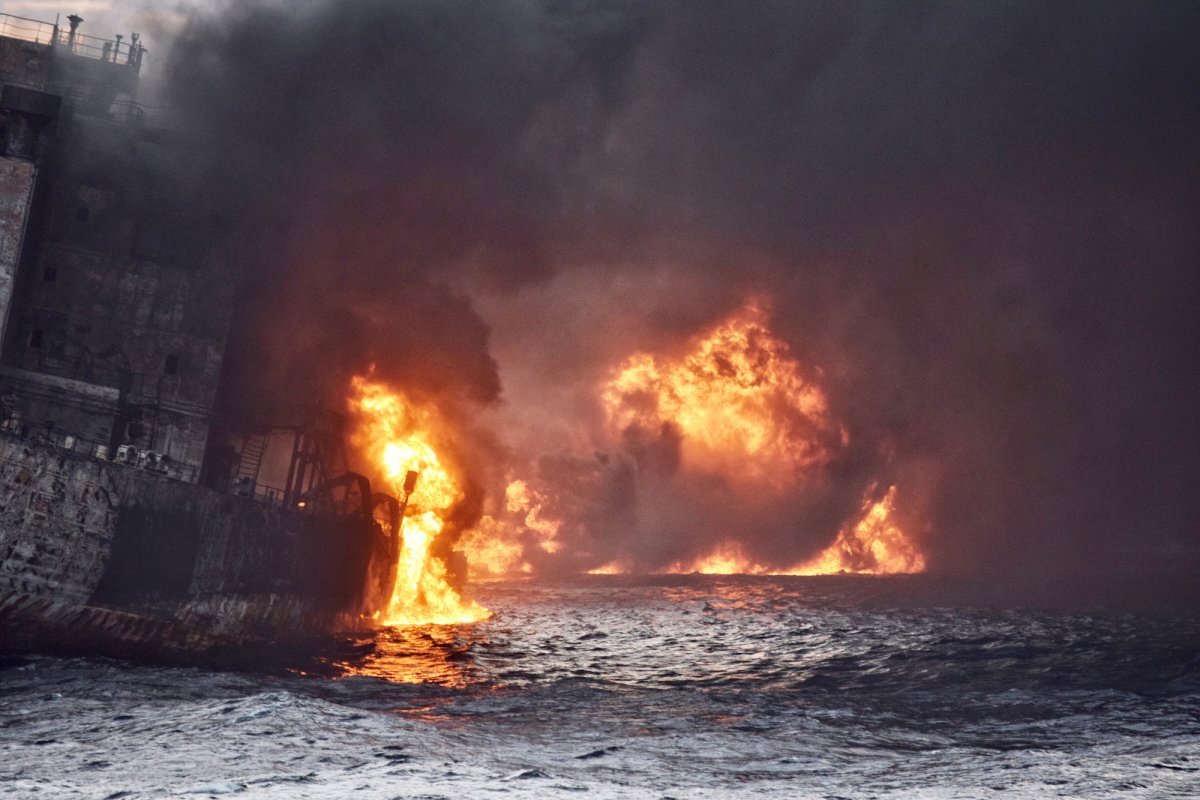
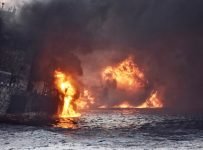
    Sanchi on fire
    The Iranian owned Sanchi on fire with 1 million barrels of jet fuel on board

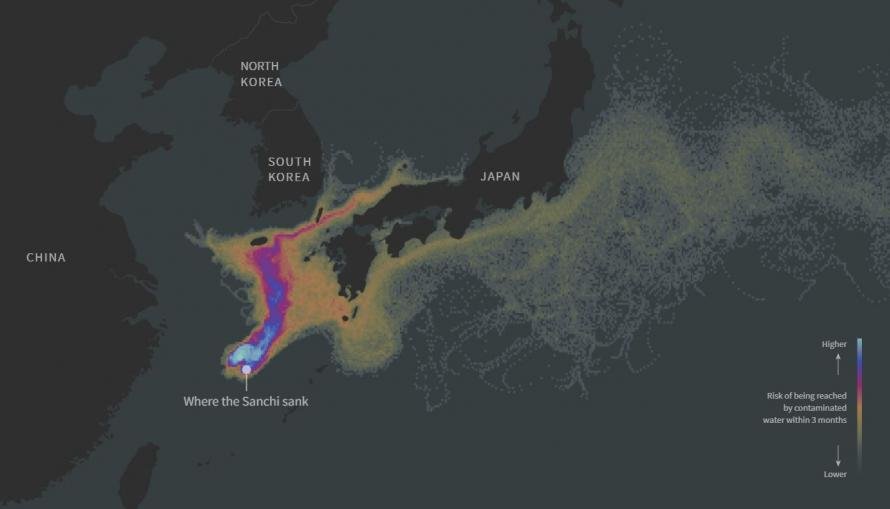
    The oil from sunken tanker Sanchi is heading for Korean and Japanese fisheries according to the British National Oceanography Centre.

    The tanker sank two weeks after crashing with a cargo ship in the East China Sea on January 6th. Registered in Panama and owned by Iranian interests the Sanchi was carrying 136,000 tonnes (960,000 barrels) of ultra-light crude as well as its own heavy diesel fuel. 30 Iranians and 2 Pakistanis on board the ship died in the accident. The ship burned for a week before it sank. This is almost as large as the Exxon Valdez and the largest oil spill since the BP Deppwater Horizon disaster in the gulf of Mexico.

    Oil spill from Sanchi
    The plume of oil from the sunken Sanchi spreads around the Korean and Japanese coast

    The ultra light crude is difficult to clean up as it is highly flammable. Also known as condensate, it is used to create fuel for jet and rocket engines. At the time of the disaster it was hoped it would evaporate, or mix with the sea water and dissipate.

    While the greatest danger to the Japanese and Korean shoreline remains the heavy diesel fuel from the ship, the impact of the highly toxic condensate under the water is yet to be determine. The British oceanographers are concerned about the impact on the coral reefs and fisheries in the area which are important food sources for both the Korean and Japanese people.

    http://www.businessinsider.com/sanchi-oil-spill-china-images-2018-1/?r=AU&IR=T/#condensate-also-doesnt-form-a-containable-oil-slick-for-long-the-toxic-substance-can-evaporate-into-the-atmosphere-or-dissolve-in-water-5

    https://www.zerohedge.com/news/2018-01-28/sanchi-oil-slick-could-reach-japan-within-month


  • Huge increase in Australian renewable energy this year

    Huge increase in Australian renewable energy this year

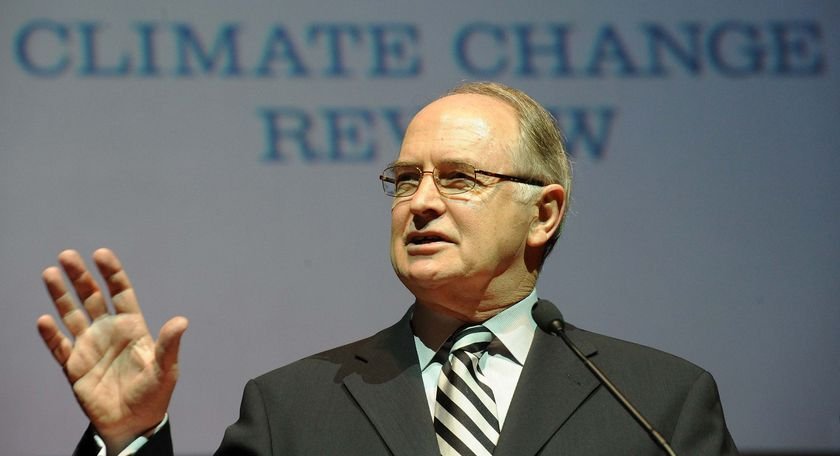
    Professor Ross Garnaut
    Professor Ross Garnaut has conducted two federal reviews of renewable energy and is Chairman of Zen Energy

    Australia has the opportunity to be a renewable energy superpower, Professor Ross Garnaut said last week. “Nowhere else in the developed world are wind and solar so abundant,” he told and Energy Conference in South Australia.

    Separately, the renewable energy economic newspaper, RenewEconomy, predicted that the renewable energy market will explode during 2017 with the costs of domestic and industrial solar generation falling well below traditional forms of electricity.

    Leigh Storr, the CEO of Biosolar, told The Cage in 2014 that this year would be a water-shed year as domestic panels and battery storage would become cheaper that retail electricity.

    A number of times this month, industry and the resource sector have demanded stable, long=term energy policy from politicians.


    Australia positioned to be renewable energy superpower

    The economics has shifted decisively in favour of renewable energy. Professor Ross Garnaut​ said, “Nowhere in the developed world are solar and wind resources together so abundant as in the west-facing coasts and peninsulas of southern Australia. Play our cards right, and Australia’s exceptionally rich endowment per person in renewable energy resources makes us a low-cost location for energy supply in a low-carbon world economy. That would make us the economically rational location within the developed world of a high proportion of energy-intensive processing and manufacturing activity. Play our cards right, and Australia could become a superpower of the low-carbon world economy.”

    http://www.smh.com.au/business/comment-and-analysis/australia-positioned-to-be-renewable-energy-superpower-20170216-guf55r.html

    Big solar market headed for “huge” 2017, as costs continue to plunge

    Solar costs have plummeted by 58% in just five years and look set to continue to fall by somewhere between 40 and 70% by 2040. Already solar plants are delivering electricity far cheaper than new coal, gas or nuclear,

    http://reneweconomy.com.au/big-solar-market-headed-for-huge-2017-as-costs-continue-to-plunge-99945/

    /solar-panels-and-batteries-to-be-cheaper-than-the-grid/

  • Radiation from Fukushima reactor peaks

    Radiation from Fukushima reactor peaks

    Fukishima robot breakdown
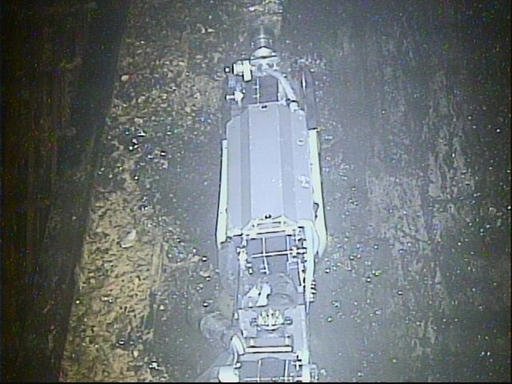
    This Feb. 16, 2017 photo released by Tokyo Electric Power Co. (TEPCO) shows a remote-controlled “scorpion” robot inside the Unit 2 reactor’s containment vessel at Fukushima Dai-ichi nuclear power plant in northeastern Japan. (TEPCO via AP Photo)

    One week after a hole in chamber 2 of the Fukishima nuclear reactor was discovered to be leaking highly toxic waste into the groundwater, radiation levels 9 times higher than those immediately after the disaster have been detected inside the reactor. A robot used to explore the internal chambers was destroyed by radiation over one hundred times more powerful than the level required to kill a human. Recent reports of an alarming increase in the global threat from the radiation appear to be misleading. The overall radiation levels in the immediate area and surrounding sea are declining. On the other hand, there is still no viable plan to contain or decommission the reactor which will remain toxic for hundreds of thousands of years.

    https://phys.org/news/2017-02-robot-probes-japan-reactor-cleanup.html

    http://gizmodo.com/radiation-levels-are-soaring-inside-the-damaged-fukushi-1791958714

    http://www.neonnettle.com/news/1876-fukushima-japan-declares-state-of-emergency-reactor-leaks-into-ocean

    Fukushima: Japan Declares State Of Emergency, Reactor Leaks Into Ocean

    Record high amount of radiation recorded by scientists

    http://dailycaller.com/2017/02/17/fukushima-nuclear-meltdown-worse-than-expected/

  • Industry and activists demand bipartisan energy policy

    Industry and activists demand bipartisan energy policy

    Inustry wants renewables
    Members of seven peak industry bodies have joined forces to demand a coherent and stable renewable policy

    Energy producers and consumers including the Aluminium Council of Australia and the Cement Industry Federation have jointly written an open letter demanding stable, long-term, non-partisan energy policy.

    Head of the Aluminium Council, Bruce Cox, said that the industry is not concerned how energy is produced, only that it is reliable. “The aluminium industry in Tasmania is very profitable and Tasmania uses around 85% renewables,” Cox told ABC Radio this morning.

    The Federal Minister for Energy, Josh Frydenberg immediately blamed the Labor Party for being too focused on renewable energy.

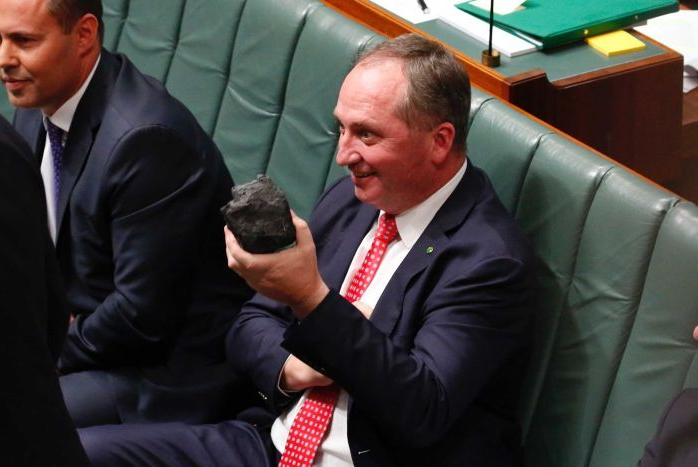
    COALition politicians take the farcical approach to debate

    http://www.smartcompany.com.au/business-advice/politics/82728-business-groups-join-plea-politicians-energy-stop-brawling/

    http://www.abc.net.au/news/2017-02-14/energy-australia-boss-worried-about-power-bills/8267070


  • Iran bans US dollar in retaliation to immigration laws

    Iran bans US dollar in retaliation to immigration laws

    Graffit in Tehran
    Official graffiti in central Tehran is constantly maintained by the Iranian government

    Iran announced earlier this month that it will stop reporting its financial affairs in US dollar from the end of its Fiscal year in March.

    The nation also tested a ballistic missile causing Israel to demand firm action from the US. Iran immediately suspended all future visas for American citizens in direct response to President Trump’s ban on immigration from seven Muslim countries.

    By agreement with OPEC, all oil in the world is traded in US dollars, complicating Iran’s oil trade worth 41 billion US dollars and leading to currency exchange losses. US pundits are concerned that trading oil in other currencies will to lead to a collapse of the US economy.

    US Muslims Sue Trump Over ‘Racist’ Refugee Ban
    The legal challenge will attack the constitutionality of Trump’s ban while allowing Christian refugees applying from the same countries because “its apparent purpose is to ban people of the Islamic faith…from entering the US.”
    Executive Order Could Block 500,000 Legal US Residents From Returning to the US 
    Since the order’s travel ban applies to all “aliens” — a term that encompasses anyone who isn’t an American citizen — it bars those with current visas or green cards from returning to the US.
    Travel ban causes chaos and protests
    Homeland security says green card holders included while ACLU files lawsuit after two Iraqi men detained at New York’s JFK airport despite having valid visas.
    Iran to stop using US dollar in response to Donald Trump’s ‘Muslim ban’
    the country would switch to another common foreign currency or a basket with a ‘high degree of stability” for all financial and foreign exchange reports. The decision will go into effect at the beginning of the new fiscal year in March.

    https://www.democracynow.org/2004/11/9/confessions_of_an_economic_hit_man