Category: Energy Matters

The twentieth century way of life has been made available, largely due to the miracle of cheap energy. The price of energy has been at record lows for the past century and a half.As oil becomes increasingly scarce, it is becoming obvious to everyone, that the rapid economic and industrial growth we have enjoyed for that time is not sustainable.Now, the hunt is on. For renewable sources of energy, for alternative sources of energy, for a way of life that is less dependent on cheap energy. 

  • Canberra first to see electric car network

    Canberra first to see electric car network


    Posted 47 minutes ago


    The ACT Greens have welcomed moves to set up an electric car network in Canberra.


    Infrastructure provider Better Place Australia has chosen Canberra as the first site in the country to roll out its network of charge stations and battery swap points.


    The company will start building the network in two years and expects cars to come online in 2012.


    Greens MLA Amanda Bresnan says it is a positive step, but only part of the solution.


    “This is one thing we can do, but obviously public transport is that other major thing we have to do because not everybody is going to be able to afford to purchase electric cars,” she said.


    “We need to actually be putting in infrastructure that addresses the larger part of the population and also people on lower incomes.”

  • Prius takes a ride to the US aboard solar-powered container ship

    Prius takes a ride to the US aboard solar-powered container ship


    Green freighter makes maiden Japan-US voyage to deliver Toyota hybrids. From BusinessGreen.com, part of the Guardian Environment Network


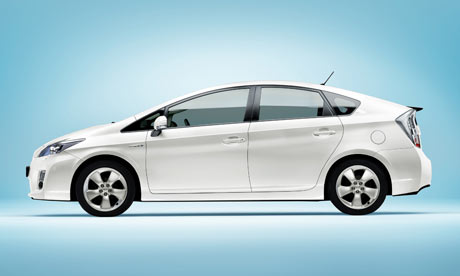
    The 2009 Toyota Prius

    The new Toyota Prius, due to launch in the UK for summer 2009. Photograph: PR


    As the manufacturer of the world’s most famous hybrid car, it seems only fitting that Toyota has now begun shipping its Prius cars to the US using a container ship that could also qualify as a hybrid.


    The Auriga Leader, the world’s first freighter to be partly powered using solar energy, has made its maiden voyage to the US from Japan, arriving at California’s Port of Long Beach earlier this month with a consignment of Prius cars and other Toyota vehicles.


    Launched in December, the ship is equipped with 328 solar panels on its car carrier which can generate up to 40kW of energy.


    The Auriga Leader’s solar array provides a supplementary source of clean energy to the ship, helping to reduce the load on its auxiliary engines. They also serve a double duty by helping to protect the vehicles from salt water, wind pressure and vibrations while at sea.


    The freighter is a joint project from Japanese companies Nippon Yusen Kaisha and Nippon Oil Corp – which invested $1.68m (£1m) in the solar panel system – and is contracted exclusively to Toyota.


    The Japanese automaker will use the Auriga Leader, which can carry up to 6,400 vehicles, to make bi-weekly trips between Japan and California.


    In addition to having a green mode of overseas delivery, most Prius cars are produced in a solar-powered factory in Tsutsumi, located in central Japan. Its rooftop array produces 2MW of electricity per hour, meeting about half the plant’s energy requirements.


    The latest version of the iconic car, which was launched in Japan in May and is expected in the UK this summer, also features a rooftop solar panel designed to provide power for the car’s cooling systems.


    • This article was shared by our content partner BusinessGreen.com, part of the Guardian Environment Network

  • Nissan’s plug-free electric car

    Nissan’s plug-free electric car


    The Japanese carmaker’s wireless system employs the same electromagnetic field technology used to charge an electric toothbrush


    Nissan has developed a revolutionary plug-free technology that it claims will make charging electric cars easier and faster. The wireless charging system is based on the concept of inductive charging, the same electromagnetic field technology used to charge an electric toothbrush. Nissan has scaled it up for use in their Zero Emission Vehicle (ZEV) electric car, which can charge in a compatible parking bay without the need for wires. Today’s electric car owners, by contrast, have to carry a mains plug aboard to recharge.


    David Bott, director of innovation programmes at the Technology Strategy Board, said: “If you look at handheld gadgets, inductive charging is a proven technology – the fundamental science says that it will work. I suspect you’ll end up plugging electric cars in at night for efficiency, and by day using inductive for on-the-go recharging.”


    Nissan has ambitions beyond mere wireless charging bays. It hopes to scale the technology up even further as a series of plates laid into the surface of designated electric vehicle lanes on our roads and motorways, theoretically enabling motorists to charge as they drive. However, Nissan admits that it still has no idea on how much it would cost, how long the designated lane would have to be, or how fast the battery could be recharged.


    Bott said he was sceptical that such charging lanes would be practical: “It’s scientifically feasible, but it’s whether it’s scalable and feasible is another matter.”


    Nissan is grappling with its recent consumer research, which revealed that 61% of potential electric car customers were most worried about the inconvenience of recharging. As well as inductive charging, its technological solutions include developing fast-charging facilities, which they hope to see in place in shopping car parks and motorway service stations. “So while you’re shopping, or having a cup of tea, the battery will refill to 80% of its capacity, in about 25 minutes,” explained Larry Haddad, general manager of product strategy and planning at Nissan Europe.


    In addition to these charging innovations, Nissan believes the ZEV has what it takes to compete against established electric models such as the TH!NK City and G-Wiz. Nissan claims it will be the first “dedicated” electric car on the market, arguing that most rival cars have been rehashes of existing models.


    The ZEV is a five-seater family-sized car with a top speed of 90mph, a battery range of around 100 miles and surprisingly impressive acceleration. Redmer van der Meer, Nissan’s European electric vehicle product manager, said that he is confident the range will be significantly extended in the next few years, and that cars will be built so new, improved batteries can be retro-fitted. Van der Meer said the car is deliberately conventional in style: “We don’t want to make a shock in the market, an egg-shaped car or something. We want to make a transition. You could do mad things but we really don’t want to.”


    Nissan’s electric car is set to go on sale in the US and Japan next year, before arriving in the UK and rest of Europe by 2012. Pricing is yet to be announced.

  • Radar beams could protect bats from wind turbines

    Radar beams could protect bats from wind turbines


    A stationary beam reduces bat activity near turbines by almost 40%, research shows


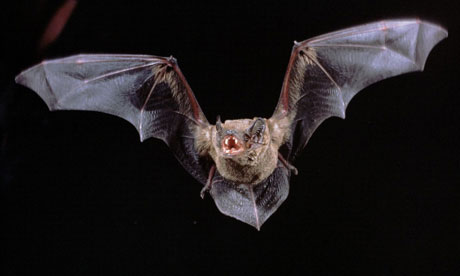
    A noctule bat in flight. Photograph: Dietmar Nill/Nature Picture Library/Rex Features

    The bats appeared to be unharmed by the radar and returned once it had been switched off. Photograph: Dietmar Nill/Nature Picture Library/Rex Features


    Radar beams that irritate bats could be used to prevent the animals from being diced by the spinning blades of wind turbines, according to a study of how the animals react to radar signals. The researchers discovered that a stationary beam reduced bat activity near the turbines by almost 40%.


    Bat and bird populations can be significantly effected by collisions with turbines. A six-week study at two wind farms in the US recorded more than 4,500 bat deaths and the Peñascal wind farm in southern Texas is currently using radar to prevent migrating birds from flying into it.


    “This is a major problem in the States, especially during the bats’ migratory period,” said Paul Racey of the University of Aberdeen, which undertook the study. The Department for Environment, Food and Rural Affairs recently commissioned a three-year study to gather data on the effect wind farms are having on bats in the UK.


    Racey, who co-authored the research, outlined three ways to deter bats using radar in a paper published today in the journal PLoS One. One method employs a rotating antenna similar to those used in air traffic control – bats are known to avoid these large installations and the researchers hoped to replicate the effect with a smaller device. The team also tested a stationary antenna that used two different radar signals that used different pulse lengths.


    His results showed that a fixed antenna was most effective at keeping the bats away. Radar signals led to a drop in bat activity of 38.6% in an area 30 metres from the device. The animals appeared to be unharmed by the experience and returned once the radar was switched off. With refinement and purpose-built radar transmitters, the effect could be even greater, said the researchers. “We want 80- 90% reduction in bat activity,” said Racey.


    Scientists don’t know why bats avoid radar signals. One explanation is that radar energy warms the bats’ wings “like a kitchen microwave” said Racey. Another theory suggests the bats’ ears heat up, causing them to “hear” the radar signal as a clicking sound.


    The research comes a day after the energy and climate change secretary, Ed Miliband, announced a target of the UK producing 31% of its energy from renewable sources by 2020, which includes 3,000 new wind turbines. Racey said that these additional turbines should only be built if they satisfy conservation laws intended to preserve bat habitats, and mounting the radar devices could solve this problem.

  • With Push Toward Renewable Energy, California Sets Pace for Solar Power

    With Push Toward Renewable Energy, California Sets Pace for Solar Power


    Noah Berger for The New York Times

    Richard Halvorsen of Akeena Solar at a home in Saratoga, Calif. There are some 50,000 solar-panel installations in the state.


    Published: July 15, 2009


    SAN FRANCISCO — A decade ago, only 500 rooftops in California boasted solar panels that harvest the sun’s energy. Today, there are nearly 50,000 solar-panel installations in the state, according to a report to be issued Thursday by the research and lobbying group Environment California.


    As a result, California, the longtime national leader in solar energy, has a capacity of more than 500 megawatts of solar power at peak periods in the early afternoon — the same as a major power plant.


    The solar capacity in California grew by a third from 2007 to 2008. It now represents about two-thirds of the national total, according to a different report that is being prepared by the Interstate Renewable Energy Council, a nonprofit group promoting expansion of solar energy.


    As the Obama administration pushes for a national shift to more renewable energy sources, California’s example is therefore being closely watched. Nationally, the states in which solar installations are spreading fastest are those that provide the most generous subsidies for them, industry experts agree.


    Two long-term statewide programs in California provide rebates and other financial incentives to encourage rooftop solar panels, and individual municipalities like Berkeley are also beginning to offer financing for the solar arrays.


    “The thing about California is that they have a consistent program that has 10 years of funding,” said Larry Sherwood, a consultant to the interstate council.


    (The California budget cuts that were being brokered Wednesday will not directly affect the subsidies because the subsidies are underwritten by utility ratepayers, not taxpayers.)


    New Jersey is a distant second to California in installed solar capacity with 70 megawatts, followed by Colorado and Nevada, the council’s report said.


    The Clean Energy program in New Jersey offers qualifying residential and commercial customers rebates for energy generated by solar arrays.


    “Typically, New Jersey incentives have been higher, but its program has had many fits and starts,” Mr. Sherwood said.


    Within California, solar technology has spread beyond highly environmentally conscious areas like San Francisco and Sacramento over the last decade to gain a hold throughout the state, Environment California’s report indicates. As of the end of 2008, when the report’s figures were compiled, San Diego had more than 19 megawatts in capacity from installations on 2,200 roofs, followed by San Jose with 15.4 megawatts from 1,330 roofs and Fresno with 14.5 megawatts from 1,028 roofs.


    “The biggest thing here,” said Bernadette Del Chiaro, the report’s author, “is that from farms to firehouses, the face of solar power is changing. While California’s biggest cities have led the way, the rest of the state and country are quickly picking up on it.”


    She added that the cities of the Central Valley, which is both heavily agricultural and baking hot in the summer, are natural places for the solar panels. High air-conditioning loads and high peak electricity rates tend to dovetail partly with the afternoon hours when solar panels are most effective, she noted, giving people an incentive to embrace the new technology.


    Nationally, residential installations account for about a third of the energy supplied to the power grid by photovoltaic arrays on panels; the remainder come from installations on larger facilities, like government buildings, retail stores and military installations.


    Each of the four top-ranked cities in California in terms of solar power capacity have more electricity available from these sources than all but six states.


    Still, 10 states, led by Colorado and including Hawaii, Connecticut, Oregon, Arizona, North Carolina, Pennsylvania and Massachusetts more than doubled their rooftop solar capacity in 2008, Mr. Sherwood said.


    While most installations are on rooftops, the number of larger-scale installations is increasing. Fresno’s total output is augmented by a 2.4-megawatt facility at the Fresno Yosemite International airport, while the local Sierra Nevada brewery in Chico has a 1.9-megawatt solar array.


    Outside the state, Nellis Air Force Base in Nevada has the largest photovoltaic generating plant, with 70,000 panels generating 14 megawatts of electricity, according to the federal Energy Information Administration.


    But even with the increases of the last decade, solar power is a pipsqueak among energy sources; it represents about one-quarter of 1 percent of California’s total energy capacity, according to the California Energy Commission. Nationally, according to the Energy Information Administration, it represents about 0.02 percent of total capacity, but those federal figures are incomplete: they reflect only centralized facilities, not distributed rooftop installations.


    Cost is a major hurdle; installation of a rooftop system is likely to cost at least $20,000.


    In other countries, according to the Renewable Energy Policy Network for the 21st Century, a research and advocacy group, government subsidies have led to rapid growth in solar power. The group’s latest report shows Germany as the world leader in solar power, with 5,400 megawatts, or about 1 percent of the country’s total generating capacity.
  • Is the clean energy cashback tariff high enough to stimulate investment ?


    1. Is the clean energy cashback tariff high enough to stimulate investment?


    After months of deliberation, the UK government has announced a range of illustrative figures for feed-in tariffs. From Carbon Commentary, part of the Guardian Environment Network


    After months of deliberation, the UK government has announced a range of illustrative figures for feed-in tariffs (FITs), which it’s calling a Clean Energy Cashback scheme. FITs are fixed payments made to the owners of small generating stations for the electricity that they export to the grid. Micro-generators need high payments to justify their expensive investment in buying and installing green generation.


    The proposed levels of FIT vary by the type of technology. The principal ones covered are biomass combustion (burning wood to generate electric power), hydro, solar photovoltaics, and wind turbines. Of these, the most appealing are likely to be wind and PV. If my estimates in the following paragraphs are correct, the government’s proposal for payments to rooftop PV are too low to generate much new investment. On the other hand, the payments for rural wind are good enough to make decent returns. If the figures survive unchanged through (yet another) consultation process, we should see thousands of small wind turbines in windy British fields.


    Solar
    The proposal is for a FIT of 36.5 pence per kilowatt hour for a domestic rooftop system for installations in financial year 2010/2011. A typical UK installation is about ‘2 kilowatts peak’, a figure for the maximum output in the middle of the day in mid-summer. Such an installation will generate about 1,800 kilowatt hours (kWh) a year in a sunny location in Devon or Cornwall on a south-facing roof. No more than half this electricity would be fed into the grid, the rest would be used in the home. In this case, the revenues are approximately as follows:


    2 kilowatt peak installation in the English south-west:


    Output

    1800 kWh
    Export 900 kWh
    FIT 36.5p per kWh
    Total value 328.5
    Used in the home 900 kWh
    Saving in electricity bill 13p per kWh
    Total value 117
    Total value of installation 445.5

    The cost of such an installation today would be about £10,000, meaning a running return of about 4.5%. A PV installation is likely to last 25 years or more, so the installation pays back its cost, but with only a little to spare. In the north of England, the figures would be even less good. PV is nice, but it isn’t a money-spinner. To attract large-scale investment, the FIT might have had to be 50p or more.


    Wind is better
    A 15 kW turbine at the end of a large rural garden or on a village green would cost about £50,000 (source: Proven Turbines: £41,000 for the turbine and my estimate of £9,000 for installation and grid connection). This machine would generate perhaps 25,000 kilowatt hours on a windy and exposed site with minimal turbulence created by trees. All this would get pumped into the grid. (This is good – you get more cash from exporting the electricity than you would save by using it yourself.)


    15 kilowatt wind turbine in a good location:


    Output

    25,000 kWh
    Export 25,000 kWh
    FIT 23p per kWh
    Total value 5750
    Less: yearly maintenance cost (estimate) 750
    Total value of installation 5000

    If these estimates are correct, the return on a 15 kilowatt turbine would be 10% p.a. A machine should last twenty years or more. It isn’t a return that would excite Goldman Sachs, but it isn’t bad. Go for a wind turbine, not for the more glamorous solar panels.