Category: Sustainable Settlement and Agriculture

The Generator is founded on the simple premise that we should leave the world in better condition than we found it. The news items in this category outline the attempts people have made to do this. They are mainly concerned with our food supply and settlement patterns. The impact that the human race has on the planet.

  • Help shoppers buy Aussie: Greens say

    GOOD STUFF- DICK SMITH WOULD ENDORSE THIS.

    Help shoppers buy Aussie: Greens say

    Melissa Jenkins, AAPJuly 27, 2012, 8:04 pm
    Greens Leader Christine Milne wants to introduce a bill to help shoppers buy Australian-grown foods.

    AAP © Enlarge photo


    Food labelling laws should be overhauled so shoppers can easily choose Australian-grown fruit and vegetables and other local produce, the Greens say.

    Australian Greens leader Christine Milne says she plans to introduce a private member’s bill in the Senate to make it easier for shoppers to buy food that is actually grown and made in Australia.

    Currently, `Made in Australia’ labels were largely about where food is processed and packaged, she told the Rural Press Club in Melbourne on Friday

    Senator Milne used the example of glace cherries that have an `Australian Made and Owned’ label but are made from imported cherries that were processed here.

    “Australians really want to buy Australian-made food,” she told journalists.

    “They find great difficulty in that, because they go to the supermarket and they pick up something and they don’t know what it actually means.”

    Under the legislation to be introduced in the spring session of federal parliament, there would be a ‘Made of Australian Ingredients’ label requiring at least 90 per cent (by weight excluding water) of all ingredients to be Australian and a ‘Grown in Australia’ label for produce wholly grown here.

    The ‘Made in Australia’ as a stand-alone claim for food would be dumped.

    “I know people go up and down the aisle looking for tomatoes that are grown in Australia, for example, and find it pretty hard to find them on the supermarket shelves,” she said.

    “We can start with this.”

    Senator Milne said farmers were battling rising costs for water, fertiliser and fuel, while the Coles and Woolworths duopoly was putting downward pressure on farm-gate prices.

    “You have got the farmer in the middle trying to produce and at both ends big business, if you like, squeezing constantly,” she said.

    “Is it any wonder that we now have an average age of farmers that is getting older and older and a real concern about how are we going to get younger people onto the land?”

    She said Australian farmers were battling a flood of cheap imports.

    “There are farmers on the northwest coast (of Tasmania) as I speak, ploughing in perfectly good carrots, for example, potatoes and so on because of the onslaught of cheap imports.”

    Senator Milne said the federal government’s food plan, released earlier this month, favoured agribusiness over farmers and their families.

  • The world is closer to a food crisis than most people realise

    The world is closer to a food crisis than most people realise

    Unless we move quickly to adopt new population, energy, and water policies, the goal of eradicating hunger will remain just that

    Algeria food riots

    Food riots in Algeria in 2008. Photograph: Fayez Nureldine/AFP/Getty Images

    In the early spring this year, US farmers were on their way to planting some 96m acres in corn, the most in 75 years. A warm early spring got the crop off to a great start. Analysts were predicting the largest corn harvest on record.

    The United States is the leading producer and exporter of corn, the world’s feedgrain. At home, corn accounts for four-fifths of the US grain harvest. Internationally, the US corn crop exceeds China’s rice and wheat harvests combined. Among the big three grains – corn, wheat, and rice – corn is now the leader, with production well above that of wheat and nearly double that of rice.

    The corn plant is as sensitive as it is productive. Thirsty and fast-growing, it is vulnerable to both extreme heat and drought. At elevated temperatures, the corn plant, which is normally so productive, goes into thermal shock.

    As spring turned into summer, the thermometer began to rise across the corn belt. In St Louis, Missouri, in the southern corn belt, the temperature in late June and early July climbed to 100F or higher 10 days in a row. For the past several weeks, the corn belt has been blanketed with dehydrating heat.

    Weekly drought maps published by the University of Nebraska show the drought-stricken area spreading across more and more of the country until, by mid-July, it engulfed virtually the entire corn belt. Soil moisture readings in the corn belt are now among the lowest ever recorded.

    While temperature, rainfall, and drought serve as indirect indicators of crop growing conditions, each week the US Department of Agriculture releases a report on the actual state of the corn crop. This year the early reports were promising. On 21 May, 77% of the US corn crop was rated as good to excellent. The following week the share of the crop in this category dropped to 72%. Over the next eight weeks, it dropped to 26%, one of the lowest ratings on record. The other 74% is rated very poor to fair. And the crop is still deteriorating.

    Over a span of weeks, we have seen how the more extreme weather events that come with climate change can affect food security. Since the beginning of June, corn prices have increased by nearly one half, reaching an all-time high on 19 July.

    Although the world was hoping for a good US harvest to replenish dangerously low grain stocks, this is no longer on the cards. World carryover stocks of grain will fall further at the end of this crop year, making the food situation even more precarious. Food prices, already elevated, will follow the price of corn upward, quite possibly to record highs.

    Not only is the current food situation deteriorating, but so is the global food system itself. We saw early signs of the unraveling in 2008 following an abrupt doubling of world grain prices. As world food prices climbed, exporting countries began restricting grain exports to keep their domestic food prices down. In response, governments of importing countries panicked. Some of them turned to buying or leasing land in other countries on which to produce food for themselves.

    Welcome to the new geopolitics of food scarcity. As food supplies tighten, we are moving into a new food era, one in which it is every country for itself.

    The world is in serious trouble on the food front. But there is little evidence that political leaders have yet grasped the magnitude of what is happening. The progress in reducing hunger in recent decades has been reversed. Unless we move quickly to adopt new population, energy, and water policies, the goal of eradicating hunger will remain just that.

    Time is running out. The world may be much closer to an unmanageable food shortage – replete with soaring food prices, spreading food unrest, and ultimately political instability– than most people realise.


    • Lester R. Brown is the president of the Earth Policy Institute and author of Full Planet, Empty Plates: The New Geopolitics of Food Scarcity, due to be published in October

  • US drought could trigger repeat of global food crisis, experts warn

    US drought could trigger repeat of global food crisis, experts warn

    As the mid-west bakes and food prices soar, threats of a ripple effect in the Middle East could lead to more uprisings

    Drought Afflicting Much of the US Midwest

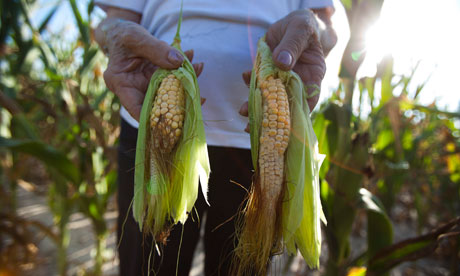
    A corn farmer holds drought-stricken ears of corn plucked from fields outside Eldorado, Illinois. Photograph: Jim Lo Scalzo/EPA

    America’s drought threatens a recurrence of the 2008 global food crisis, when soaring prices set off riots and unrest to parts of Africa, the Middle East, and Latin America, food experts warn.

    Corn prices reached an all-time high on Friday, as the drought expanded across America, trading at $8.24 a bushel on the Chicago exchange. Soybeans were also trading at record levels.

    The US department of agriculture meanwhile predicted there would be less corn coming onto global markets over the next year, because of a sharp drop in US exports.

    America is the world’s largest producer of corn, dominating the market. Corn is also connected to many food items – as feed for dairy cows or for hogs and beef cattle, as a component in processed food – expanding the impact of those price rises.

    That means the effects of the drought will travel far beyond the mid-western states baking under triple-digit temperatures, said Robert Thompson, a food security expert at the Chicago Council of Global Affairs.

    “What happens to the US supply has an immense impact around the world. If the price of corn rises high enough, it also pulls up the price of wheat,” he said.

    He went on: “I think we are in for a very serious situation worldwide.”

    Some analysts are predicting a repetition of the 2008 protests that swept across Africa and the Middle East, including countries like Egypt, because of food prices.

    In 2008, the food shock was due to rising prices for rice and wheat. This time, it’s because of corn and soybean, and there were no signs of shortfall in rice or wheat production.

    But the full effects of the American drought will likely take several months to emerge. Its severity will be determined by a number of additional risk factors.

    Global grain stocks have reached a new low, with the US and other countries running down their reserves. “There are no reserves of these foods in the US anymore,” said Sophia Murphy, a fellow at the Institute for Agriculture and Trade Policy.

    That means there is no room for manoeuvre for countries forced to import grains.

    Thompson also warned that countries could make matters worse by stockpiling – putting further pressure on prices. That was the pattern during the 2008 food crisis when Russia, Ukraine, India and Argentina all cut off grain exports.

    It was unclear as well whether America’s demand for ethanol would further limit the amount of corn on the world market. About 40% of America’s corn is used for ethanol – which helps drive up the price of corn, analysts say. But there were some reports that American ethanol plants were in shutdown across the mid-west, because high corn prices made production uneconomic.

    “What’s difficult is that we see a drought happen today but people really are going to be feeling that six months from now, possibly a year from now,” said Marie Brill, a policy analyst at ActionAid.

    But she said it was already clear the reduced supply and high prices of corn and soybean were set to cause serious hardship – especially among poor people in poor countries which depend on imported grain.

    Countries that are net importers of corn be hit the hardest including South Korea, Japan, Peru, Guatemala, El Salvador and Columbia. Much of East Africa will be badly affected, she said.

    Even those African countries that produce their own corn will suffer because they are locked into the higher global prices, she said. West Africa is already in food crisis. “If supply is as awful as the US government is predicting we’re going to see another round of high prices and another increase in hunger,” Murphy said.

  • Food price crisis feared as erratic weather wreaks havoc on crops

    Food price crisis feared as erratic weather wreaks havoc on crops

    ‘What the world economy really needs right now is a break’, one economist says, but instead it appears headed toward upheaval

    corn drought food

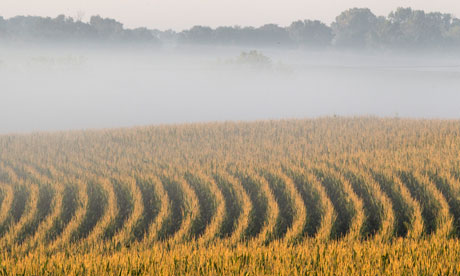
    Fog rolls over a corn field in Nebraska. The drought gripping the United States is the widest since 1956. Photograph: Nati Harnik/AP

    Freak weather in some of the world’s vital food producing regions is ravaging crops and threatening another global food crisis like the price shocks that unleashed social and political unrest in 2008 and 2010.

    As the US suffers the worst drought in more than 50 years, analysts are warning that rising food prices could hit the world’s poorest countries, leading to shortages and social upheaval.

    The situation has sparked comparisons to 2008 when high food prices sparked a wave of riots in 30 countries across the world, from Haiti to Bangladesh.

    Researchers say rising food prices also helped trigger the Arab Spring in 2011.

    Nick Higgins, commodity analyst at Rabobank, said: “Food riots are a real risk at this point. Wheat prices aren’t up at the level they got to in 2008 but they are still very high and that will have an effect on those who are least able to pay higher prices for food.”

    In America’s agricultural heartland, searing heat and sparse rainfall have left farmers helpless as their corn and soy bean crops wither in dry fields. Earlier this month, the US department of agriculture (USDA) slashed forecasts for the corn crop by 12%.

    US agricultural secretary Tom Vilsack said: “I get on my knees every day, and I’m saying an extra prayer right now. If I had a rain prayer or a rain dance I could do, I would do it.”

    As it is, current weather forecasts suggest the drought will continue and experts fear the USDA may have to cut its targets again in August.

    Dan Basse, president of AgResources in Chicago, said the government’s prediction would prove too optimistic if the drought continues. “We’ve been traipsing through the fields of southern Illinois, and it is worse than the government says.”

    The US is crucial to global food markets as the world’s largest exporter of corn, soy beans and wheat, so the impact of the drought will be felt across the globe.

    Corn prices have already shot up 40% since June to hit all-time highs, soy bean prices have jumped 30% to record levels, and wheat has surged 50%.
    It is not just the US. Unseasonal weather, thought to be caused by climate change, is affecting farmers across the world.

    South America has been hit by a drought, which could damage the soy bean harvest, while UK wheat has been damaged by the rain.

    Flash flooding in Russia could also affect the wheat harvest. Traders are particularly concerned about the latter as Russia might limit exports if it is worried about wheat supplies at home, causing further price spikes.
    Shortages have been compounded by huge orders for corn and soy beans to make biofuels, in order to meet quotas in the US and Europe.

    The US agriculture secretary said last week the situation was not bad enough to warrant a reduction in government mandates for biofuels, driving the price of corn even higher. Traders say China also buys and stores grain strategically, putting more pressure on limited supplies.

    Consumers will soon feel the effects of these spikes. A high price of wheat leads directly to higher prices in the shops, as it is the main ingredient for bread and other staples.

    The link is less direct with other crops. Corn and soy beans are used to feed livestock, so rising prices will ultimately cause the price of meat to rise. In the short-term, however, they will have the reverse effect. As the cost of feed rises, farmers kill cattle at lighter weights to avoid having to feed them. That will briefly flood the market with meat, causing prices to fall, but subsequent shortages will causes prices to rise sharply.

    Higgins at Rabobank said meat will then remain expensive for a long time. “It is very hard to rebuild cattle herds and these inflationary effects will be long and lingering.”

    Rising food prices have a disproportionate effect on the poorest people in the world.

    Ruth Kelly, Oxfam’s food policy adviser says people in the Western world spend around 15% of their income on food, but that rises to around 75% in developing countries, so any change in food prices has a dramatic impact on household budgets.

    Kelly says problems will be compounded by the previous two food price spikes in 2008 and 2011:

    “People are already in debt from previous spikes and suffering the consequences. When the first food crisis hit people were forced to sell off their assets, their cattle and jewellery, and take on debt to make ends meet. After multiple crises, people run out of savings and that can be quite disastrous.

    “People can find it much harder to cope when you have multiple shocks like this, without time to recover between them, rather than just a single shock.”

    Economists fear food price inflation will exacerbate the global economic crisis, as it limits the ability of emerging markets to provide any kind of stimulus to drive a recovery. Karen Ward, senior economist at HSBC, said: “What the world economy really needs right now is a break. Any inflationary pressure, particularly that stops the emerging world loosening policy and providing the boost to the global economy, would be a problem.”

  • Speech by Kelvin Thomson on Foreign Ownership and Food Security

    Speech by Kelvin Thomson on Foreign Ownership and Food Security

    Inbox
    x
    Hamilton, Tim (K. Thomson, MP)
    11:45 AM (2 minutes ago)

    to Tim
  • Stocks of in-house supermarket brands on the rise

    Stocks of in-house supermarket brands on the rise

    Updated July 18, 2012 18:26:02

    A business forecaster expects private label products to make up around a third of supermarket sales within five years.

    IBIS World’s figures indicate that private label, or no-name, groceries currently account for around a quarter of supermarket sales, generating revenue of $21.6 billion.

    That is around double IBIS World’s estimate for 2007-08 of $10 billion in revenue and a 13.5 per cent share of sales.

    While it expects growth in home brand spending to slowdown over the next five years, the major supermarkets’ own products are expected to hold a 33 per cent market share and account for almost $32 billion in sales by 2017-18.

    IBIS World general manager Karen Dobie says the global financial crisis has contributed to the rise in no-name sales.

    “The recessive economic climate has been a strong driver of private label growth. Households have been reining in spending, paying off debt and increasing savings,” she observed in the report.

    “This, coupled with an increase in the range of private-label products available, has led many consumers to make the shift to home brands.”

    The major supermarkets have been increasingly turning to in-house brands to boost margins by controlling more of the supply chain, and also to counter the arrival of foreign competition such as Aldi and Costco.

    Bread and butter

    Private labels have had varying degrees of success in different categories of grocery.

    Over the past decade, the share of private label sales in supermarkets has risen from 24 to 68 per cent of butter, 18 to 56 per cent of bread, 56 to 67 per cent of sugar and 51 to 55 per cent of fresh milk.

    Liquor has also moved strongly towards in-house brands, with their share rising from 2 to 8 per cent over the past 10 years.

    Ms Dobie says some types of products are more suited to being marketed as private label products.

    “Products with a high degree of homogeneity that are staples of grocery baskets have shown the strongest private-label growth,” she noted.

    “A particularly interesting product category is eggs. While private-label egg sales still account for over 50 per cent of market share, this has fallen from 61 per cent over the past ten years.

    “The decline is mainly due to a switch towards free-range, a segment not adequately represented by private-label players.”

    Areas that have a particularly low private label penetration are chocolate, soft drinks, cosmetics and sanitary products.

    Under pressure

    In those sectors where private label brands are already dominant, or expanding rapidly, Ms Dobie says the most common response has been for the manufacturers of branded goods to lower their prices.

    “Branded producers have responded to private-label growth by discounting their products to remain competitive,” she said.

    “However, the dominance of Coles and Woolworths means that they are likely to give preference to their own brands in terms of spacing and design allocations – placing continued pressure on the big brands.”

    She says, while consumers are getting lower prices in the short-term, in the longer-run primary producers, manufacturers and consumers are all likely to lose out to the benefit of Coles and Woolworths.

    However, consumers seem increasingly willing to risk the long-term pain of reduced choice and competition for the immediate gain of lower prices in the short-term.

    Those most likely to look for private label savings are unsurprisingly households on low-incomes (less than $44,000 per annum), for whom no-name products make up more than 40 per cent of their grocery spending.

    Those households earning more than $75,000 per year typically direct around 15 per cent of their grocery spending to no-name products.

    However, this income group is being increasingly targeted by supermarkets offering more expensive private label products that often imitate their branded competitors.

    “Major supermarkets are spending big bucks on activities aimed at blurring the lines between branded products and their own in-house fare,” added Ms Dobie.

    “These retailers are introducing premium, organic and fair trade products… to attract private-label buyers from all walks of life.”