Category: News

Add your news
You can add news from your networks or groups through the website by becoming an author. Simply register as a member of the Generator, and then email Giovanni asking to become an author. He will then work with you to integrate your content into the site as effectively as possible.
Listen to the Generator News online

 
The Generator news service publishes articles on sustainable development, agriculture and energy as well as observations on current affairs. The news service is used on the weekly radio show, The Generator, as well as by a number of monthly and quarterly magazines. A podcast of the Generator news is also available.
As well as Giovanni’s articles it picks up the most pertinent articles from a range of other news services. You can publish the news feed on your website using RSS, free of charge.
 

  • The new coal frontier

    The new coal frontier

    Mega mines, mega emissions

    Around 27bn tonnes of coal are thought to be locked under the ground of the Galilee Basin in the outback of Queensland. A huge proposed complex of coal mines is planned here, including the world’s largest thermal coal project.

    So are railway lines and a massive expansion of the Abbot Point port on the Great Barrier Reef.

    What will this mean for the Aboriginal community, the Great Barrier Reef and the world’s climate?

    My people, our land

    Adrian Burragubba is a strong man. His people, the Wangan and Jagalingou, have called this flat, arid outback in central Queensland home for tens of thousands of years, but now all that is under threat.

    When the white man first came here in his great-grandfather’s time, Adrian, 54, a tribal elder and ‘law man’, says they were thought of as ghosts – strange, but welcome enough. But later generations were to bear the brunt of the interlopers’ greed. His grandfather and his father were both removed from the land and put on church-run properties to make way for a gold rush.

    “Those places were like concentration camps,” he explains. “They wanted Aboriginal people out of the way, so you couldn’t leave them. The police would take you back if you did.”

    Now the rapacious outsiders are back. Massive mining operations are looking to plunder a gigantic new coal frontier in the Galilee Basin. There are 247,000 sq km (95,400 sq miles) of coal: a land mass the size of Britain.


    Will these companies succeed? “Over my dead body,” says Adrian.

    This is a story about the indigenous people – and the loss of Aboriginal lands. It is about Queensland’s fragile environment and the damage a massive new port and thousands of coal container journeys exporting coal would cause to the Great Barrier Reef, one of the most precious ecosystems on earth.

    And it is about the world’s climate – if the complex is fully developed, greenhouse gas emissions from the burned coal would top 700m tonnes a year, bringing irreversible climate change ever closer.

    Were the Galilee Basin a country, it would be the seventh largest contributor of carbon dioxide in the world, just behind Germany.

    Adrian, an accomplished didgeridoo player whose six children often perform traditional music alongside him, initially didn’t want to be drawn into the struggle. Now, he sees no choice but to lead the fight for his 400-strong tribe against what would be the world’s largest thermal coal project and second largest so-called carbon bomb.


    “This level of mining would devastate this land beyond recognition. It would destroy any sense of connection to the land. We are afraid of being wiped out completely.”

    ― Adrian Burragubba

    “All memory of our tribe will be erased forever due to mining. If we can’t maintain what our forefathers gave us, we will become non-existent. It will be a barren wasteland, cultural genocide.”

    We are next to Wolfgang’s Peak, a volcanic rock Burragubba describes as ‘our Uluru’ as he explains how it was created from a rainbow serpent falling from the sky and crashing to the ground. He hopes its name, derived from a white explorer, will be officially changed one day.


    “We talk about yumba, which is not just where you live. It’s where you began, the locus of your creation.”

    ― Adrian Burragubba

    “British law, Australian law – we can’t identify with that. We simply go along with it because we have to obey it, but our law is permanent.

    “Mining disrupts the practising of our law. This is our world, and if that ceases to exist, we will perish.”

    This is where the AS$16.5bn (£8.4bn) Carmichael project, set to be the first and largest of at least six huge mines planned for the Galilee Basin, is due to launch in 2017. Adani, an Indian firm advised by UK bank Standard Chartered, is behind the project, and is planning to build a 189km rail line to take the coal to an expanded port at Abbot Point near the blue collar town of Bowen on the Great Barrier Reef.

    Environmentalists have launched two separate court actions to halt Carmichael. They believe the other mines will be less viable if they can win at the first attempt because it would mean they would have to bear the costs of the infrastructure.


    All the mines planned for the Galilee Basin would, at capacity, ship around 330m tonnes of coal a year to India and China, more than doubling Australia’s current coal exports.

    Little wonder that Tony Abbott, the prime minister, has praised coal for being “good for humanity”, providing much-needed electricity abroad and thousands of jobs and billions of dollars in taxes at home.

    One key environmental impact will be on water, which, in parched Queensland, is precious. The Carmichael mine alone will require a peak of 12.5bn litres a year. In some places, the water table is expected to drop by 50 metres. The Belyando River would have water removed at the rate of 4,629 litres per second if Carmichael goes ahead.

    You can’t live long without water

    If you rely on a groundwater bore accessed by a pump near your house for your water supplies, like Bruce Currie, who has 1,400 cattle at Speculation Farm, the rampant thirst of the Galilee Basin projects is a very immediate threat.

    Bruce, and his wife Annette, are close to the southernmost proposed mines – the Kevin’s Corner and Alpha projects, to be operated by GVKHancock, a consortium of Indian mining power and the company headed by Gina Rinehart, the richest woman in Australia.

    The company says it has conducted extensive studies which show the mines will have no major impact upon groundwater. In any case, there are “make good” agreements with nearby landholders to remedy any problems.

    But Bruce, a father of five, says he is “suspicious” of the consortium’s insistence. He is going through a lengthy legal process with the company to guarantee his supply.

    “If we don’t have water supplies for us and our cattle, it will destroy our business, basically. The old saying out here is you can live a long time without love but you can’t live long without water.”

    Ground water supplies basically dictate whether the farm can operate and survive.


    “It not only means losing our business,” says Annette. “We’d lose our home, we’d lose our lifestyle, we’d lose our passion. It’s not only a case of the mines going ahead and we lose our water. It will destroy our life.”

    ― Annette Currie

    Bruce, who reads Confucius in his spare time, ran as an independent candidate at the last state election, railing against the influence mining firms have over the main political parties and what he feels is an increasingly throwaway society. “I was flogged,” he recalls.

    “Mining is unsustainable. They are going to get a few limited royalties to pay for this nation’s debt,” he says.

    “It would be responsible to move as quickly as we can now to renewable energy, rather than wait until our resources are depleted and we destroy other productive industries.”

    Tim Kirkwood, who runs a cattle station about 60km from the Carmichael mine, near Clermont, disagrees. The rail line that will transport the coal to port slices through his property, with a further area taken up by a new quarry. He believes the mine is vital to Australia’s way of life.


    “Mining and agriculture have always been the primary industries of Australia and always will be. Without them, we’ll be in big trouble.”

    ― Tim Kirkwood

    “You can be a greenie about these things, but those people generally think food comes from Woolworths,” he says. “They don’t realise that you need primary materials for things. They probably think their iPhones are created by Apple out of thin air. Mining and agriculture have always been the primary industries of Australia and always will be. Without them, we’ll be in big trouble.”

    Rob Williams, who works as an electrician, agrees. “How can it hurt? It’s got to be good. There’s lots of habitat out there for wildlife. Koalas and kangaroos – they learn to adapt. I work in the workshop and birds fly in there all the time. Wildlife adapts to mining, so people should do, too.”


    Head to the coast, though, and the mood is darker – for here the Great Barrier Reef is under threat.

    The battle for the Reef

    Tony Fontes arrived in Airlie Beach, near the Whitsunday Islands, in 1978. He’d done some diving back home in California. Nothing prepared him for what he saw on the world’s largest reef system.

    “It was mind blowing. I saw things you just dream of being next to such as manta rays, twice as big as me,” Tony says, stretching his arms wide.


    “After a while you notice the small things too, like sea slugs, which are like the butterflies of the sea. Finding them is like finding a nugget of gold.”

    ― Tony Fontes

    Tony began to worry about the reef in 1998, when there was a mass bleaching event. Another followed in 2002. Bleaching is a process where corals turn bright white and die due to heat stress.

    “It’s beautiful but very unhealthy,” Tony says. “Corals are generally autumn colours – browns, greens, greys. But when they are bleached they are the brightest snow while. Dazzling. Really pretty. But then after a few weeks it becomes yucky, very squishy, and then the corals are gone.”

    Scientists fret that unchecked global warming will irreversibly ravage the ecosystem. Corals are extremely sensitive to changes in water temperature and can die off if they warm too much. Ocean acidification, the change in the water’s chemistry when it absorbs CO2, is also a major threat, as it makes it harder for corals to form their skeletons.

    The reef has lost half of its coral over the past 30 years – cyclones, pollution, a plague of coral-eating starfish are to blame.


    Tourism operators and green groups laid siege to the plans to expand the Abbot Point port, involving the excavation of 5m tonnes of seabed.

    They would dump the sediment in the reef’s waters, potentially smothering corals and seagrasses considered vital for fish, turtles and dugongs.

    Prof Terry Hughes, head of coral reef research at James Cook University, Townsville, says: “It’s quite clear from the evidence that the stressors on the reef are too high. The reef is struggling to cope with the current level of pollution, fishing and global warming.”


    “I have no doubt the Galilee Basin will damage the Great Barrier Reef. The uncertainty is over the extent.”

    ― Terry Hughes

    “Turning around the trajectory of the reef is like turning around the Titanic. It’s no easy task, and opening up the Galilee Basin is loading the dice against a recovery.”

    The northern portion of the reef has fared much better than the southern, more developed part. It is still an exquisite ecological gem. But the disappearance of the corals has cascading effects, from the small fish that hide in the nooks and crannies to the sharks that feed upon those fish. Unesco’s world heritage committee will decide next month whether to officially list the reef as “in danger”.

    Tony wants people to get up in arms over climate change as they did over the sea dumping. He admits it will be harder this time around.


    “We need to mobilise, but climate change is too nebulous. Plus you’re taking on the coal industry”

    ― Tony Fontes

    “There aren’t many friends in that other than green groups and tourism is loathed to be associated with green groups. But the coal needs to stay in the ground and the Great Barrier Reef can be the spearhead. If we are going to lose it due to climate change, people will say ‘no, we’re not going to let that happen.’”

    All is not yet lost. While the green lobby is launching its legal challenges, simple economics will determine whether the excavation of the Galilee Basin goes ahead.

    Take the price of coal. It is half what it was five years ago and well below a level where analysts expect the Galilee Basin mines to make a decent profit.

    And then there is the reluctance of banks to get involved. A total of 11 – including HSBC, Citi and Barclays – have ruled out funding the projects, with other financial institutions fretting over the financial and reputational implications of backing the developments.

    Most of the large banks are signatories to the Equator Principles, an international set of standards that rule out the financing of projects that harm world heritage sites, and Unesco will decide next whether to list the Great Barrier Reef as in danger.

    Back at Wolfgang’s Peak, Adrian Burragubba certainly hopes the mines can be halted.

  • Great Barrier Reef WWW AUSTRALIA

    Click here to enable desktop notifications for Gmail.   Learn more  Hide
    More

    1 of 8

    Great Barrier Reef

    Inbox
    x

    Louise Matthiesson, WWF-Australia noreply@act.wwf.org.au via server8839.e-activist.com 

    3:05 PM (1 hour ago)

    to me
    Under water coral, Great Barrier Reef  © Troy Mayne

    Dear NEVILLE,

    Just 50 days.

    That’s all that’s left until the World Heritage Committee meets to decide whether the Reef is on track to return to good health, or whether our Governments must do more to do restore the world’s largest living organism.

    Moment’s like this can be really daunting – will all of our hard work pay off? Will the World Heritage Committee ensure that our Governments act to restore the Reef’s health? Make sure you ask them to protect the Reef here: wwf.org.au/reef

    Our expert policy team have done a full analysis and developed this checklist of what the Government needs to do before the meeting.  They must get this done if they want be able to say the Reef is on a path to better health.

    TODOLIST

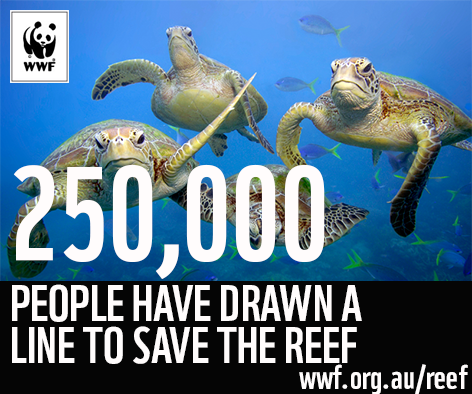
    But the good news is, we’re ready for it – we’ve just passed 250 000 signatures on our petition demanding an end to the industrial destruction of the Great Barrier Reef, and in the coming weeks, we’re going to present it to the World Heritage Committee with the message that the world wants to see the Reef return to health!

    250ksigs

    And check this out – the people are with us.  Here’s a vox-pop from the Courier Mail – from just this week!

    VoxPops

    We know what needs to be done.  We need to keep getting people to support our Reef, right up until the World Heritage Meeting.  If you know someone who hasn’t yet signed – please urge them to add their name at wwf.org.au/reef – every single name will be delivered to the committee.

    Thanks for helping us bring new people into the movement – it’s going to make all the difference.

    Louise Matthiesson
    Great Barrier Reef Campaigner
    WWF-Australia

  • A giant cheque, a big bird and a force for change ACF

    Click here to enable desktop notifications for Gmail.   Learn more  Hide
    1 of 9

    A giant cheque, a big bird and a force for change

    Inbox
    x

    Paul Sinclair, ACF Unsubscribe

    4:21 PM (35 minutes ago)

    to me

    Hi INGA

    Just a quick note to say hello and let you know how our campaigns are travelling.

    Thirteen billion dollars and no sense

    52,735 of you signed a petition asking Joe Hockey to stop mining the public purse to pay big polluting companies. Seems like he’s not listening. Watch our video for Matt and Kelly’s verdict on the Federal Budget. (Spoiler: they both give it one star.)

    The Renewable Energy Target is in limbo – but we’re not!

    There’s talk of further undermining clean energy in Australia. Here are ten reasons why burning native forests burnt for electricity should not be included in the RET.

    But local communities love a sun-powered country and you guys are spreading the word. So far, you’ve hung 27,468 posters in cafes, noticeboards and shops – like Ellen Boyd Green at Alice’s bookshop in North Carlton!

    (Sorry if you’re still waiting for posters, we had to print more – they’ll be with you soon!)

    Radioactive pollution in the Karlamilyi?

    We were very disappointed to hear that Minister Greg Hunt approved Cameco Corporation’s Kintyre mine in the river catchments of WA’s beautiful Karlamilyi – announced under the radar just before Anzac Day.

    But Minister Hunt knows we’re watching and the locals know they are not alone. 7,310 of you wrote letters expressing your concern, and the Traditional Owners appreciated this support and thank you for speaking out. It’s not over yet.

    Meanwhile, the WA government has delisted some of the world’s oldest rock art and the beautiful James Prices Point peninsula. The federal and state governments are failing – but our resolve is not. Stay tuned.

    Why did the cassowary cross the road?

    Because its habitat has been chopped in half by a freeway. So far this year, more cassowaries have died from speeding cars, dog attacks and habitat loss than in all of 2014.

    While local groups are doing great work to protect these gorgeous creatures, governments need to catch up! We need to transform our national nature protection framework so local, state and national laws work in together to protect life in Australia.

    Photo: Paul IJsendoorn

    Don’t let them silence you – speak out!

    Powerful lobby groups and a handful of politicians are trying to remove the charity status of environment groups, your ability to give tax deductible donations and your freedom to speak out. Submissions close on Thursday 21 May. Please – make a submission today.

    Photo: Morning Mist, Rock Island Bend, Franklin River, Southwest Tasmania.
    Photograph by Peter Dombrovskis, copyright Liz Dombrovskis

    Count Me in!

    It was wonderful to meet so many of you at our Count me in! tour, in towns and cities across Australia. Next up, Kelly, we’re heading to the Blue Mountains (20 May), Sydney (21 May) and Hobart (28 May). Will you join us?

    Together we’re making the case that change for the better is necessary, possible and achievable.

    Thank you,
    Paul

    Paul Sinclair
    Campaigns Director
    Australian Conservation Foundation

  • The Budget, The Verdict The Australia Institute

    1 of 8

    The Budget, The Verdict

    Inbox
    x

    The Australia Institute <mail@tai.org.au>

    4:21 PM (1 hour ago)

    to me
    The Australia Institute

    Dear Neville,

    Joe Hockey’s second budget was much better armoured than his first. The brazen nature of the first budget made the task of those critiquing it pretty easy. This one took more time and detailed analysis to break down.

    Our verdict: The 2015 Federal Budget doesn’t fit the 2015 Australian economy. It ignores obvious and major issues, and attempts to solve problems that don’t exist. Creating a political document is easy, and by doing so Abbott and Hockey have missed opportunities and this will harm the economy, environment and people of Australia for many years to come. In a word, the Budget is ‘lazy’.

    Last week, we described Joe Hockey’s pre-budget message as ‘more than mixed, it’s pureed’. And this Budget proved to be a mish-mash of measures, with no coherent economic strategy.

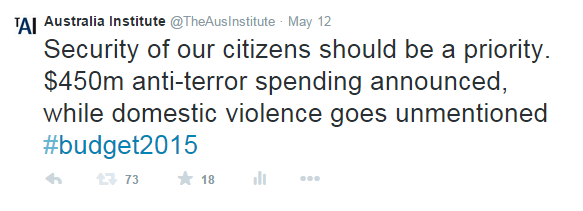
    Security_tweet.png

    Thank you for the many responses to our offer to join us in the lockup; they helped guide our work as we poured through the Budget Papers. We have addressed some of the most frequently raised issues below. Some items remained unchanged from last year to this, keeping the issues out of the news, but we note that in a lot of cases that means cementing the cuts of last year’s horror-budget.

    1. The Lazy Budget
    2. One Handout Washes the Other
    3. Joe Jilts Austerity and Stumbles on Stimulus
    4. Everything’s Bigger in Taxes
    5. Unpacking the Small Business Package
    6. TAI Budget Media

    The Lazy Budget

    Rubbery figures

    It seems every budget over the last few years has claimed that there will be decreasing budget deficits in the out years. This budget is no different. While there is no surplus claimed in any of the years the government does claim that by 2018-19 the budget deficit will fall to $7 billion.

    It is important to remember that this time last year the government was claiming this year’s budget deficit would be $17.1 billion. On Tuesday they said $35.1 billion. If the budget deficit can double in just one year imagine how much it can change in four years.

    The current guess for this year’s budget deficit is based on a bunch of savings that have been rejected by the senate. We found $2 billion worth that the senate have vowed to block. If they do then this year’s deficit will increase by $2 billion to $37.1 billion.

    It is important to remember that all these figures are rubbery. Nothing highlights this more than the government announcement that $90 billion in revenue has been written off the forward estimates. If Treasury can lose $90 billion dollars what chance does a $7 billion deficit in four years’ time have?

    Iron Ore Poor

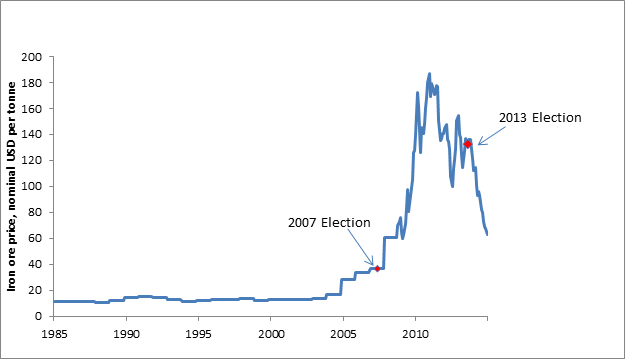
    In the 20 years from 1985 to 2005 iron ore averaged $13.17USD per tonne. The revenue streams in Joe Hockey’s budget into the future are based on a price of iron ore of $48USD per tonne. This might be true, and there’s an argument that given Australia’s dominance of the world market, we could even have some say in that. However, it does go to show the dangers of spending billions of taxpayer funds to assist mining companies, rather than investing in say health, innovation and education.

    Iron ore prices: What goes up…

    Iron_Ore_Price.png


    One handout washes the other

    When is a handout not a handout?

    The Treasurer has a unique spin on what a hand out actually is. When Leigh Sales on 7.30 described the budget as giving handouts, the Treasurer angrily responded that $20,000 in instant tax write offs was not a hand out because the government was simply giving people back their own money.

    This is ideological spin pure and simple. There is no difference between a government giving someone $100 in cash and giving them an extra $100 on their tax refund. The Treasurer is inventing the distinction so he can imply that people who get government largess by paying less tax are more virtuous than those that rely on government payments.

    If the Treasurer’s distinction is actually true then why was he claiming a crackdown on tax minimising multinationals? Surely they are just claiming back their own money.

    While this budget had less crass us-and-them analogies like the ‘lifters and leaners’ of the last budget, it is clear that the Treasurer has not learnt very much. He seems to think tax loopholes are good and virtuous and those that rely on government payments are not. What a coincidence that it is mainly high income earners who take advantage of tax loopholes and low income earners who rely on government payments.

    Joe Jilts Austerity and Stumbles on Stimulus

    The absence of action can be as powerful as any act, particularly in changing times. Economic debate since the GFC has often been put in terms of Austerity vs Stimulus. Joe Hockey, on the surface, appears to have done neither. However, analysis by TAI senior economist, Matt Grudnoff, has found that the dabbling done in these areas will leave nasty legacies.

    Austerity – The Budget’s bad houseguest lingers

    The budget has downgraded growth forecasts again. The economy is expected to grow by only 2.75% next year down from 3% which was estimated just 6 months ago. Unemployment is now expected to increase to 6.5% next year up an estimated 6% just 6 months ago. The Reserve Bank just lowered interest rates to record lows. All this points to a weaker economy and it requires a strong government response.

    What we got in the budget was an optimistic Treasurer who is not very keen to do anything and a nothing budget. In fact this budget has changed significantly from last year’s budget. But rather than heading in the right direction we have lurched from one bad budget to another.

    In opposition and then up until very recently the government had been running a very strong argument for austerity. We were constantly being told that we can’t live beyond our means. We had a budget emergency and the biggest crisis facing Australia today was the debt and deficit disaster.

    This has completely vanished in this year’s budget. Some of the old rhetoric is still being pulled out but this is not a budget from a government that is concerned about the size of the deficit.

    Stimulation, Joe’s new to it

    In the budget papers we even see small signs of what might be stimulus. But given its size it could just as easily be mistaken for electoral pork barrelling. The small business package that allows purchases of up to $20,000 to be written off against tax seems to be aimed to encourage spending to stimulate growth and employment.

    Of course stimulation only works if you’re adding extra money into the economy. If you put $2 billion in one program but then take out $2 billion in another program the net effect is likely to be zero. The Treasurer has been proudly telling everyone who will listen that all his new spending measures are being offset by savings measurers. Not a particularly smart move if you’re trying to stimulate the economy (as the Reserve Bank is doing).

    A close reading of the budget papers reveal that the Treasurer is not actually correct. New spending measures are expected to increase by $10 billion over the next four years. This is partly offset by $2 billion extra revenue in new revenue measures. This means that we have an addition of $8 billion over four years being injected into the economy or an average of $2 billion per year.

    $2 billion in an economy of $1,560 billion is hardly likely to have much effect.

    Everything’s bigger in Taxes

    Can you feel your bracket creeping?

    At the release of the Intergenerational Report earlier this year the Treasurer told us that one of his biggest concerns was bracket creep. He claimed that it was unacceptable that someone on average earnings would be in the second highest tax bracket.

    So what has the Treasurer done about it? Well…nothing.

    In fact bracket creep is what the Treasurer is hoping will bring his budget back to surplus. This is the laziest tax policy. Bracket creep disproportionality impacts on low income households.

    This is a massive missed opportunity. Instead of taxing smarter the government is being lazy. We could have wound back negative gearing and abolished the capital gains tax discount. This could raise $7.4 billion a year, help reduce speculation in the property market and make it more affordable to buy or rent a home.

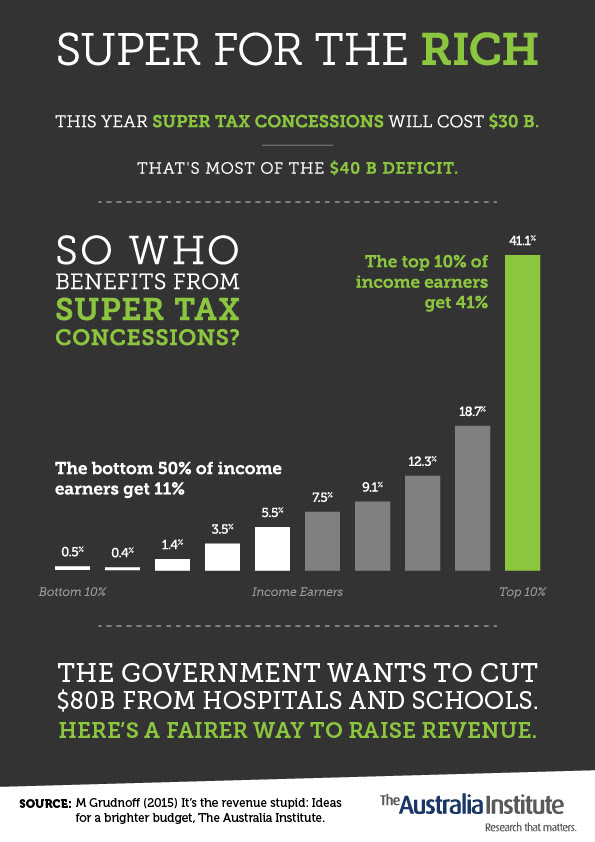
    The government could tackle rapidly growing super tax concessions. It could repurpose super tax concessions so that they do what they were designed to do, reduce pressure on the age pension. This could raise $10 billion or more.

    This money could then be used to offset bracket creep. This budget has completely ignored tax reform.

    $30 billion+ of savings, ignored:

    SuperannuationFinal-1V2.jpg

    They raised the GST and no one cared or noticed

    Over the years the GST has been the most divisive of tax debates. What a surprise then to find the coalition break a promise not to change the GST and have virtually no comment on it at all.

    In the budget, the government extended the GST to include imported digital products. It is expected to raise $350 million over two years.

    With such a muted reaction to small changes in the scope of the GST maybe the government should consider extending it to private schools and private health insurance. A TAI paper found that this could raise $2.3 billion, a third of which would come from the highest income households.

    That small business package

    The government has put together a package of goodies for small business but to distract from it looking like a political ‘handout’ they have attempted to sell it as a jobs package.

    The main items assisting small business are:

    • Tax cuts for businesses with turnovers up to two million dollars which involve:
      • cutting the company tax rate from 30 to 28.5 per cent and
      • a five per cent discount in tax paid by unincorporated small business up to a maximum of $1,000 pa.
    • Accelerated depreciation so that items worth up to $20,000 can be immediately deducted rather than written off over time.

    These two measures cost $3.3 billion and $1.8 billion over the next four years. In addition there are some very minor concessions for exemption from capital gains tax for changes to an entity’s structure, immediate deduction for professional expenses involved in setting up a business, and changes to small business fringe benefits tax arrangements for mobile phones and the like.

    Tax cuts for business are unlikely to have much impact on their employment and growth plans.[1] Giving small business more money does not increase demand for their product. They will only employ more people when they need to sell more stuff.

    The accelerated depreciation measures may encourage further spending on office furniture, machinery and office equipment.  This may well generate some new spending but it is more likely to just bring forward planned spending on the part of small business. It is also likely to appeal to all those tax avoiders who seek to disguise private spending as tax-assisted business expenses.  In any event it is not sufficient to prevent unemployment increasing from 6.25 to 6.5 per cent between the June 2015 and June 2016 quarters as shown early in Budget Paper no 1.

    So if the government’s handout to small business is not likely to have much of an impact on jobs, is the government serious about growing employment? There are some relatively minor employment measures mainly with the Youth Employment strategy. But despite this, in budget paper no 1, table 16, there is only small increase in spending on ‘Labour market assistance to job seekers and industry’ and a very flat level of funding for ‘vocational and industry training’. Hardly the results you would expect for a government trying to reduce unemployment.

    The government has been forced to abandon its policy of making people under 30 wait 6 months for unemployment benefits because the senate refused to pass it. This has not deterred them from punishing the victims of the sluggish economy. They have simply reduced it to those under 25 and reduced their wait time down to 4 weeks. While the government seems to think this is an employment strategy it is hard to see how forcing people into poverty will increase the number of jobs.

    One of the most remarkable measures in the growing jobs and small business package is ‘further strengthening the job seeker compliance arrangements’ which will spend $24.9 million in the departments of Human Services and Employment on measures that will save $6.9 million in payments to those on unemployment benefits! Put simply they are hoping to crack down on those who receive unemployment benefits. Again it’s hard to see how this will grow the economy and create more jobs.

    Putting some of these things together gives us a boost in after-tax incomes for people with business interests , nothing that improves the lot of the unemployed or their likelihood of finding work and a further attempt to use sticks to encourage them to look for the jobs that just are not there. This and other parts of the 2015 Budget will worsen the distribution of income in Australia.

    TAI Budget Media

    Crikey – Talk to the hand: Hockey is living in a budget fantasy land

    The Age – The real budget winners: Wealthy retirees

    The Wire – A lack of long term solutions in a ‘soft’ budget  

    ABC – Budget 2015: $20,000 small business tax break explained

    The Conversation – Path to budget surplus built on shifting foundations

    2SER – On the Money pre-budget special


    [1]
    Richardson D (2014) ‘The taxation of capital in Australia: Should it be lower?’ In Schroeder SK and Chester L (Eds) Challenging the orthodoxy: Reflections on Frank Stilwell’s contribution to political economy, Springer, pp 181-202.

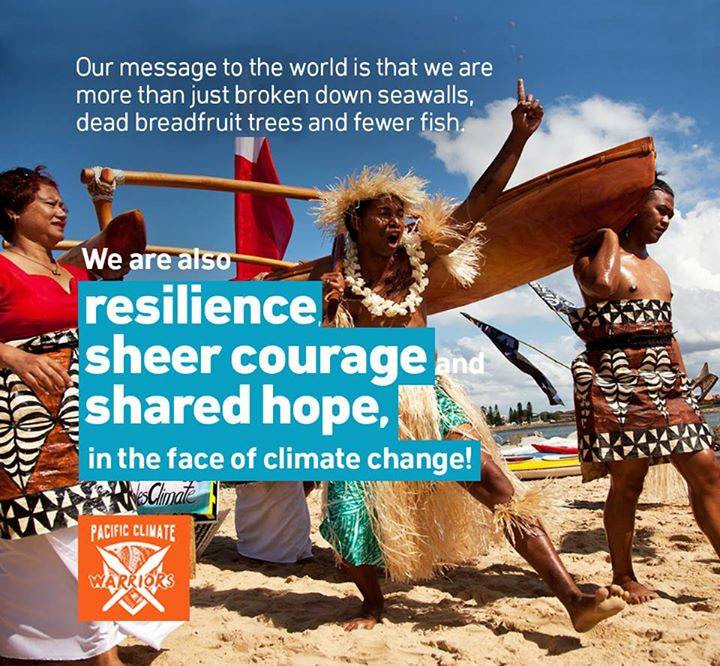
  • Sheer courage. A message from the Pacific Climate Warriors

    Click here to enable desktop notifications for Gmail.   Learn more  Hide
    Something’s not right.
    We’re having trouble connecting to Google. We’ll keep trying…
    Errors: 101
    More

    1 of 8

    Sheer courage. A message from the Pacific Climate Warriors

    Inbox
    x

    Aaron Packard – 350.org <aaron@350.org> Unsubscribe

    3:34 PM (11 minutes ago)

    to me

    Dear friends,

    It’s 6 months ago now that the Pacific Climate Warriors paddled out in traditional canoes, followed by hundreds of Australians to blockade the world’s largest coal port: Newcastle.

    That day will be forever etched in my mind – those gigantic coal-laden ships ground to a halt by those tiny canoes and kayaks. What the canoes and kayaks lacked in size, they made up for in the incredible strength of courage and determination of our people out on the water.

    Today we are excited to release a film that tells the story of the canoe blockade – through the voice of the Pacific Climate Warriors.

    Watch it here – or by clicking on the image.

    We believe this is a story that needs to be heard around the world. If you agree, please share this page as widely as you can – click here for the link to share.

    The flotilla put the spotlight on the brilliant, unique cultures of the Pacific Islands, and the loss and damage they face from the continued expansion of coal exports from Australia. It also showed the power of Australians standing together in solidarity with the Pacific Islands.

    350.org would like to acknowledge the local community of Newcastle and the Hunter Valley for building the foundation for success of the 2014 Pacific Climate Warrior’s Flotilla. Through unfunded grassroots organising local people held 7 vibrant and effective “People’s Blockade’s of the World’s Biggest Coal Port” events from 2006 – 2012. These events and broader associated coal campaigns built a rich and diverse history of involvement in peaceful climate action.

    This is the type of self-organised action that 350 endeavours to support, inspire and replicate.

    Thank you for all the support and solidarity – it means everything to the 350 Pacific movement.

    Onwards we go!

    Aaron for 350.org

    P.S. – The Pacific Climate Warriors are preparing for the next phase of the fight to keep the Pacific Islands above water. You can follow them on Facebook, Twitter and through the 350 Pacific website here.


    350.org is building a global climate movement.You can connect with us on Facebook, follow us on Twitter, and become a sustaining donor to keep this movement strong and growing.

  • An update on Bjorn Lomborg’s “Consensus Centre”

    1 of 22

    An update on Bjorn Lomborg’s “Consensus Centre”

    Inbox
    x

    Climate Council – Amanda McKenzie via sendgrid.info 

    2:15 PM (4 minutes ago)

    to me
    Hi Inga,
    Recently, we emailed you about the Australian Government’s planned funding of Danish climate contrarian Bjorn Lomborg’s “Consensus Centre” at the University of Western Australia. We were overwhelmed at the response we received – you’re clearly just as passionate as we are about Australians having access to climate change information that is based on the best science available.

    It’s thanks to you, and others nationwide, that the University of Western Australia announced last Friday that it would no longer house Bjorn Lomborg’s “Consensus Centre” – a fantastic outcome for science. So thank you!

    Unfortunately, Lomborg’s Centre is still trying to establish itself in Australia, and this is deeply troubling. We’re concerned that the Centre would be focused on spreading misinformation presented as fact. This article outlines those concerns and we invite you to share it with your networks.

    Misinformation is harmful. Just as false information about the ‘benefits’ of tobacco misled the public and damaged health, so false information about climate change and its impacts can mislead the public and decision-makers. Allowing it to go unchecked has already delayed much needed action to stabilise the climate system, so thank you again so much for your support.

    Yours sincerely,

    Amanda McKenzie
    CEO, Climate Council

    P.S In case you missed it, some of our youngest members starred in a particularly lovely Mother’s Day video over the weekend. We hope you enjoy it!