Category: News

Add your news
You can add news from your networks or groups through the website by becoming an author. Simply register as a member of the Generator, and then email Giovanni asking to become an author. He will then work with you to integrate your content into the site as effectively as possible.
Listen to the Generator News online

 
The Generator news service publishes articles on sustainable development, agriculture and energy as well as observations on current affairs. The news service is used on the weekly radio show, The Generator, as well as by a number of monthly and quarterly magazines. A podcast of the Generator news is also available.
As well as Giovanni’s articles it picks up the most pertinent articles from a range of other news services. You can publish the news feed on your website using RSS, free of charge.
 

  • 1 of 21

    10-year-old explains super tax reform in less than 2 mins

    Inbox
    x

    Bernie Fraser via GetUp!

    6:17 PM (35 minutes ago)

    to me
    Below is an important message to GetUp members from Bernie Fraser, former Governor of the Reserve Bank of Australia, Treasury Secretary, and independent director of several industry superannuation funds. Your details have not been shared with anyone.

    Dear NEVILLE,

    We need a fresh perspective in approaching tax reform.

    Nowhere in the near 200 pages of the Government’s ‘Re:think’ tax discussion paper, or in its 60 odd discussion questions, is the most fundamental of questions raised: what kind of society do we aspire to nurture in Australia, and how might tax reform best contribute to establishing such a society?

    The present tax breaks for superannuation ignore this question entirely. They are very expensive and poorly targeted. Treasury put the costs of these concessions at $32 billion in 2011-2012.1 And the Australian Council of Social Services has stated that half of these concessions go to the wealthiest 20 per cent of Australians.2

    Timing is critical for all reforms and momentum for tax reform is now building. Just yesterday, the Labor party announced a super tax reform policy that would go some way to addressing the inequity of the current system. Even so, sustained public pressure will be required to break through the vested interests defending these unfair concessions.

    A key part of building that pressure is providing Australians with a fresh perspective on tax reform, in a clear and convincing manner.
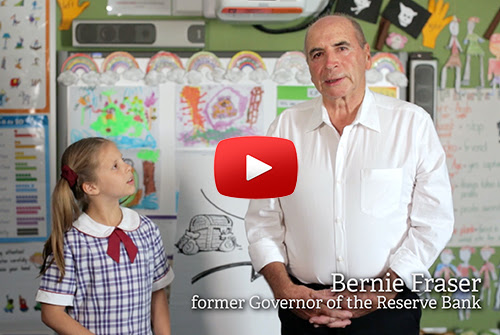
    So I invite you to watch and share this video, featuring a precocious young economist – just 10-years-old! – explaining the inequities of super tax breaks (with some assistance from myself).

    Then join us in the campaign to make the super of the future FAIR.

    Like most past reviews, the Government’s ‘Re:think’ tax discussion paper focuses on possible ‘reforms’ (often code for ‘reductions’ in personal and company taxes) to promote economic growth.

    The need for a strong, competitive economy is a given. The ultimate goal of policy making, however, is not to maximise the growth in GDP but to nurture a prosperous society which is also fair and compassionate. A society with opportunities for all Australians to access decent standards of education, health and other services, and with safety nets for those who – for whatever reasons – fall through the cracks.

    This is the kind of society promised profusely by all major parties in every election campaign, only to be rolled back by ideologies and lobby groups when they assume government. That is why it is important to build on the growing momentum for reform.

    In regards to super tax reform, this video is part of the fresh perspective we need when starting out to build a better tax system and a better country. I encourage you to watch it and share it with those you know, to make the case for fairer superannuation: https://www.getup.org.au/supertax

    Kind regards,
    Bernie Fraser

    PS – This graph shows just how skewed super tax breaks are towards the wealthy (those in the highest income deciles).
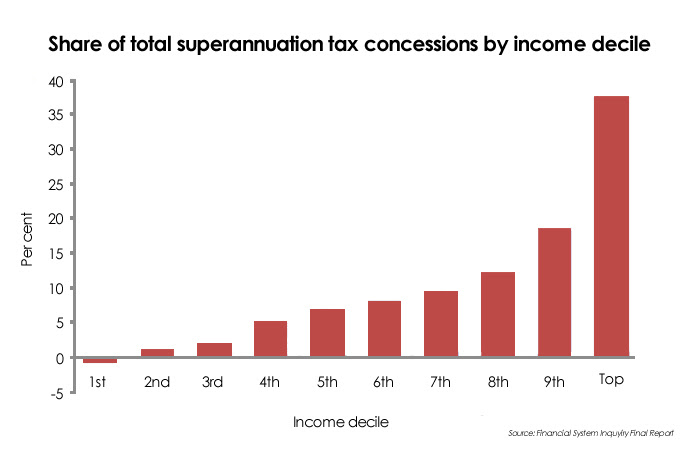
    Super Tax distribution by income decile

    REFERENCES:

    [1] ‘Distributional Analysis of Superannuation Taxation Concessions’, Treasury, 2011-2012

    [2] ‘ACOSS calls on Government to tackle sacred cow of super tax breaks’, ACOSS, 2014

    Graph: ABC Fact Check (Source: Financial System Inquiry Final Report)

  • The small country holding the key to divestment history 359 org

    Click here to enable desktop notifications for Gmail.   Learn more  Hide
    Something’s not right.
    We’re having trouble connecting to Google. We’ll keep trying…
    Errors: 101
    1 of 19

    The small country holding the key to divestment history

    Inbox
    x

    Charlie Wood – 350.org Australia <350@350.org> Unsubscribe

    4:04 PM (38 minutes ago)

    to me

    Dear friends,

    At US$867bn, Norway’s Global Pension Fund is the largest of its kind in the world. But with great (financial) power, come great (moral) responsibilities.

    We know that the Fund understands the need to divest as it’s already shed dozens of coal companies including Whitehaven, responsible for the disastrous Maules Creek mine, and Adani Power, whose parent company owns Abbot Point and the proposed Carmichael mega coal mine in the Galilee Basin. But the Fund is yet to give coal or fossil fuels the full flick.

    With a crucial Norwegian parliamentary hearing coming up on May 4th, we have a real opportunity to get the world’s largest fund to divest from coal altogether.

    Ask Norway’s political leaders to divest the country’s Global Pension Fund from fossil fuels, starting with coal.

    If the Fund fully divests from coal, the impact would be game-changing. With enough pressure from outside of Norway, we have a real chance of securing the largest act of fossil fuel divestment ever. If enough of us make our voices heard, it could send a strong signal that the writing is on the wall for the fossil fuel industry, and that it’s time to end coal once and for all.

    On May 4th, the Finance Committee of the Norwegian parliament will start debating the Fund’s investment policy. We already have some allies in parliament, and with your voice added to the voices of frontline communities who are fighting coal here in Australia to overseas in India, Poland, the Philippines and more, we can get a strong group of political parties to back our demands.

    Call on Norway to lead the way to a just transition towards a clean, 100% renewables future by divesting from fossil fuels.

    Norway has built its huge wealth off its oil and gas revenues for decades, but it’s also a leader in renewable energy, producing more than its entire energy needs last year. Now it’s time for Norway to get its investments in order too.

    Yours for a brighter future,
    Charlie

  • I love a sun-blessed country Kate- Solar Citizens

    1 of 30

    I love a sun-blessed country

    Inbox
    x

    Kate, Solar Citizens

    9:52 AM (5 minutes ago)

    to me
    Dear Neville —

    When I was ten we had to learn Dorathea Mackeller’s My Country by heart at school. The poem’s most famous line, ‘I love a sunburnt country’, always feels so quintessentially Australian to me. We are a sun-blessed country. We have this incredible resource that we can tap into to create the industries and jobs of the future.

    Kate Read

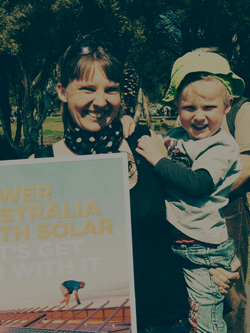
    Me and my son Harvey.                 

    But I’ve been reading in the papers that Australia is one of the only countries in the world that is going backwards on solar policy. Federal Government uncertainty around the Renewable Energy Target means that solar businesses are going under or struggling to keep staff on. This just seems absurd when the rest of the world is adding more renewable energy per year than coal, natural gas and oil combined. That’s the story I want my country to be part of.

    Governments should have innovative policies that switch us towards the energy sources of the future. But they’re only going to do this if we as citizens make it super clear that we’ll stand for nothing less. That’s why I’m 100% standing up for solar to make sure it happens. In the coming months my hope is that hundreds of thousands more solar owners and supporters across the country hear the call and join me.

    With more than 70,000 Solar Citizens Australia-wide, we can make it happen. This month we’re kicking things off with launch events in 5 cities, but we need your support to make them big, bright and high impact. Can you chip in $50, or whatever you can afford, so our Stand Up For Solar launch events go off with a bang? Click here to donate.

    The launch events are set to sweep the country beginning this Monday in Brisbane and finishing in Adelaide in late May. Inspiring expert speakers on solar and renewables, like Nigel Morris and Giles Parkinson, will be presenting in each city. This is our chance to reach out to thousands more solar supporters and show our politicians and the media we mean business.

    To make these events as big, vibrant and high impact as possible we need your support. Your donation will help print and mail flyers and posters across the country so volunteers like me can spread the word in our neighbourhoods. Donations will also help cover travel and accommodation for our expert speakers who are generously giving their time because they believe in the power of ordinary people like us to make change. Click here to to make your donation via our secure website today.

    I’m proud that we’re now one of over 1.3 million Australian households that have put solar on their rooftops. Seeing the meter ticking over and knowing that we’re contributing to a better energy future for my four year old son Harvey and my nephews and nieces makes me enormously happy.

    But at the moment, it’s hard to feel proud of our government’s solar policies. I’m making it my mission to change this, and I hope you’ll join me. Click here to chip in today and help Solar Citizens make a huge impact across the country this coming month.

    For a sun-blessed future,

    Kate Read, Solar Citizens Volunteer, Sydney

    P.S. If you live in Brisbane, the Sunshine Coast, Melbourne, Sydney or Adelaide and you haven’t RSVP’d for a launch event yet, click here to do it today – it’s going to be a great night. No event in your city or town? You won’t miss out. RSVP to the online launch Webinar here: http://www.standupforsolar.org.au/launch_webinar


    Solar Citizens
    http://www.solarcitizens.org.au/

  • climate code red

    Inbox
    x

    Climate Code Red <noreply+feedproxy@google.com>

    6:46 PM (48 minutes ago)

    to me

    climate code red


    It’s time to ‘Do the math’ again

    Posted: 22 Apr 2015 01:24 AM PDT

    DOWNLOAD

    Have we gone mad? A new report released today explains why contemporary climate change policy-making should be characterised as increasingly delusional.

    As the deadline approaches for submissions to the Australian government’s climate targets process, there is a flurry of submissions and reports from advocacy groups and the Climate Change Authority.

    Most of these reports are based on the twin propositions that two degrees Celsius (2°C) of global warming is an appropriate policy target, and that there is a significant carbon budget and an amount of “burnable carbon” for this target, and hence a scientifically-based escalating ladder of emission-reduction targets stretching to mid-century and beyond.

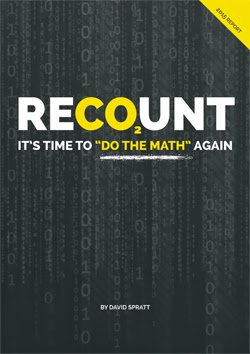
    A survey of the relevant scientific literature by David Spratt, “Recount: It’s time to ‘Do the math’ again”, published today by Breakthrough concludes that the evidence does not support either of these propositions.
    The catastrophic and irreversible consequences of 2°C of warming demand a strong risk-management approach, with a low rate of failure. We should not take risks with the climate that we would not take with civil infrastructure.

    There is no carbon budget available if 2°C is considered a cap or upper boundary as per the Copenhagen Accord, rather than a hit-or-miss target which can be significantly exceeded; or if a low risk of exceeding 2°C is required; or if positive feedbacks such as permafrost and other carbon store losses are taken into account.

    Effective policy making can only be based on recognising that climate change is already dangerous, and we have no carbon budget left to divide up. Big tipping-point events irreversible on human time scales such as in West Antarctica and large-scale positive feedbacks are already occurring at less than 1°C of warming. It is clear that 2°C of climate warming is not a safe cap.

    In reality, 2°C is the boundary between dangerous and very dangerous climate change and 1°C warmer than human civilisation has ever experienced.

    In the lead up to the forthcoming Paris talks, policy makers through their willful neglect of the evidence are in effect normalising a 2.5–3°C global warming target.

    This evidence in “Recount: It’s time to ‘Do the math’ again” demonstrates that action is necessary at a faster pace than most policy makers conceive is possible. Decades of procrastination mean there is no longer sufficient time for an incremental and non-disruptive reduction in emissions.

    Only a whole-of-society rescue plan, understood as action at emergency speed outside of the business-as-usual political mode, can provide hope of retaining a livable planet for ourselves and future generations.

    In a foreword to the report, Ian Dunlop, the former Chair, Australian Coal Association & CEO, Australian Institute of Company Directors, says that:

    For the last two decades global leaders have been guilty of willful denial regarding human-induced climate change, none more so than in Australia. Despite much rhetoric and endless negotiations, human carbon emissions continue in line with a worst-case scenario…

    Unfortunately the years of procrastination have cut off options to solve the climate challenge with a graduated response – emergency action is now inevitable if potentially catastrophic and irreversible impacts are to be avoided.

    Such views are dismissed as extremist by political and corporate incumbencies, and by most activist NGOs and investors. However, there has never been an honest official acknowledgment of the real climate challenge; as a result realistic solutions have not been forthcoming.

    Climate change is happening faster and more extensively than officially acknowledged and sensible risk management requires far more stringent action. This paper explains why.

    Download “Recount: It’s time to ‘Do the math’ again”

  • NSW 2015 – voters shift away from election day and postal voting

    NSW 2015 – voters shift away from election day and postal voting

    by Ben Raue

    The recent NSW state election saw a continuation of the long-term trend of less and less people casting ordinary election-day votes. In addition, in 2015 we saw the trend of increasing numbers of voters casting absentee votes or postal votes reversed, with those categories of voting becoming less popular, as pre-poll voting and iVote continue to increase in popularity.

    For this analysis, I’ve been able to collect the figures on how many people voted using each different type of voting at every election since 1999.

    In 1999, 84.6% of votes were cast as ordinary election-day votes. In 2015, this number dropped to 67.2%. In raw numbers, there has been a drop of 168,282 ordinary votes cast, despite the total number of votes cast increasing by 742,743.

    http://cf.datawrapper.de/oAmRU/1/

    As you can see, there was a slight decline in the proportion of ordinary votes from 84.6% in 1999 to 81.1% in 2007, although the raw numbers increased during this time. This trend has accelerated significantly since 2007, dropping to 74.2% in 2011 and 67.2% in 2015.

    Below the fold, I’ll show how those people who aren’t casting ordinary votes are now voting, and how that has shifted over time. We’ve seen the acceleration of a trend that has seen large numbers of people cast absentee, postal and pre-poll votes, and how big surges in absentee and postal votes in 2011 have ebbed away while pre-poll voting continues to increase in size.

    Read more of this post

    Ben Raue | April 22, 2015 at 1:46 pm | Tags: New South Wales 2015 | Categories: Uncategorized | URL: http://wp.me/ppI95-6QU
    Comment    See all comments
  • The policy I just announced Bill shorten

    Click here to enable desktop notifications for Gmail.   Learn more  Hide
    More

    3 of 28

    The policy I just announced

    Inbox
    x

    Bill Shorten via sendgrid.info 

    12:00 PM (37 minutes ago)

    to me
    .
    Inga –Today I announced Labor’s plan to restore fairness to our superannuation system.

    Huge sums of money are paid out to some of the wealthiest Australians through superannuation tax concessions, in fact 10% of Australians receive 38% of superannuation tax concessions.

    This government is going after the retirement income of pensioners but hasn’t had the courage to make hard decisions on these tax concessions.

    Labor is willing to make these decisions and we’ve announced them today:

    • If a retiree earns income from their superannuation account of more than $75,000 a year they’ll pay 15% tax on anything above $75,000 instead of no tax.
    • We’re lowering the threshold on the additional 15% High Income Superannuation Charge from those who earn $300,000 to people who earn more than $250,000 a year, affecting around 110,000 people.

    The changes announced today save $14.3 billion over 10 years. They are responsible, they are fair, and they are final.

    It’s important we get the facts out there on this one. Because this policy is about two things – fairness and doing the right thing by our economy. Two things the Liberals would have you believe don’t go together.

    Share-the-factsl.png

    Along with Labor’s crackdown to make multinational companies pay their fair share of tax, Labor has now put forward measures which improve the Budget bottom line over ten years by more than $20 billion – because we can only deliver the sorts of policies that Labor believes in if we have the revenue to pay for them.

    This demonstrates how Labor will responsibly manage the economy and the Budget without cutting billions of dollars from pensions, health and education like the Liberals want to.

    Thanks for standing with me on this,

    Bill.