Let’s save Bulga from Rio Tinto
|
Inbox
|
x |

|
12:17 PM (25 minutes ago)
 |
|
|||
|
Add your news
You can add news from your networks or groups through the website by becoming an author. Simply register as a member of the Generator, and then email Giovanni asking to become an author. He will then work with you to integrate your content into the site as effectively as possible.
Listen to the Generator News online
The Generator news service publishes articles on sustainable development, agriculture and energy as well as observations on current affairs. The news service is used on the weekly radio show, The Generator, as well as by a number of monthly and quarterly magazines. A podcast of the Generator news is also available.
As well as Giovanni’s articles it picks up the most pertinent articles from a range of other news services. You can publish the news feed on your website using RSS, free of charge.
|
Inbox
|
x |
|
12:17 PM (25 minutes ago)
|
|
|||
|
|
|
|
Inbox
|
x |

|
10:48 AM (1 hour ago)
|
|
|||

Dear NEVILLE,
At least 75 millionaires are paying less tax than you — in fact, they’re not paying any tax at all.
According to the Australian Tax Office, 75 Australians made more than $1 million in 2011-12 and paid zero tax — none.1 And they spent an average of $850,000 on aggressive tax avoidance, which they then got to claim as — you guessed it — a tax deduction!2
But thanks to the generous donations of GetUp members through our Brighter Budget campaign, our friends at The Australia Institute have developed a smart, sensible way to stop this rorting: “The Buffett Rule”.3
The Buffett Rule says: Right, enough of all of this loophole rubbish, the wealthiest 1% of income earners have to pay at least 35% in income tax — based around the rate paid by many Australian workers.4 This new tax Rule could raise nearly $2.5 billion per year – more than the Abbott Government’s cuts to Newstart benefits and the age pension combined.5
Both the Government and Labor Opposition are finally talking about revenue measures for the Budget, and are looking for what works and what’s popular. Together, we can deliver them the Buffett Rule on a silver platter by backing it and sharing it with our friends.
The Buffett Rule was inspired by multi-billionaire U.S. investor Warren Buffett. After Mr Buffett pointed out the gross unfairness of his secretary paying more tax than he did, President Obama proposed the Buffett Rule to ensure the wealthiest Americans paid at least the same tax rate as middle income earners.
The Buffett Rule became hugely popular, with the Wall Street Journal even reporting that 68% of millionaires supported a Buffett Rule in some form.6 So even those benefiting from these tax loopholes can’t help but support it!
GetUp’s member-funded Brighter Budget campaign aims to build a better future through smarter, fairer Budget policies. Through this first policy report, we’re bringing the Buffett Rule to Australia and applying it to high income tax dodging. This includes people who make millions and then reduce their taxable income down to an averge of $1.09 per year.7
GetUp members are funding research right now showing that this idea could be hugely popular in Australia too, especially in the key marginal electorates that will determine the outcome of the next election. But with the report launching today, now’s the time to get immediate public support behind it to grab the attention of our leaders. Click below to sign the petition:
https://www.getup.org.au/buffett-rule
Big corporations are rightly under the microscope for their tax avoidance measures right now – something GetUp members have been campaigning to achieve. But we can’t let millionaire tax dodgers get off scot-free either.
The principle is the same: everyone should pay their fair share to support the benefits we all get by living, working or running a business in Australia. Click here to join the fight.
Thanks for all you do,
Mark, Evan, Georgina and Nat for the GetUp team
PS – The graph below shows how the use of tax deductions skyrockets for the very highest income earners. One simple rule – The Buffett Rule – would change all that. Sign the petition today and share it with your friends.
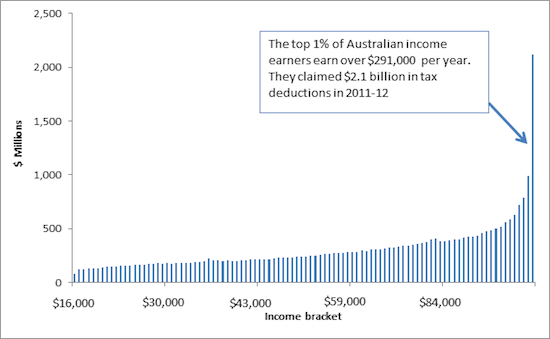
Source: “Closing the tax loopholes: A Buffett rule for Australia”, The Australia Institute, 7 April 2008
References:
1. “Closing the tax loopholes: A Buffett rule for Australia”, The Australia Institute, 7 April 2008
2. Same as above.
3. “‘Buffett Rule’ proposed to make sure high earners pay some tax”, The Sydney Morning Herald, 8 April 2008.
4. “Closing the tax loopholes: A Buffett rule for Australia”, The Australia Institute, 7 April 2008
5. “Changed indexation of pensions and tightened eligibility for all benefits”, Budget Review 2014-15, Parliament of Australia
“Federal budget 2014: Young to wait until 25 to get dole”, The Sydney Morning Herald, 14 May 2014
6. “Millionaires Support Warren Buffett’s Tax on the Rich”, The Wall Street Journal, 27 October 2011
7. “Closing the tax loopholes: A Buffett rule for Australia”, The Australia Institute, 7 April 2008
|
Inbox
|
x |
|
6:39 PM (8 minutes ago)
|
|
|||
 |
|
||||
 The Australian Government has delivered on its election commitment for a consistent and integrated Energy White Paper to give industry and consumers certainty and confidence in energy policy.
The White Paper has now been released, and sets out an energy policy framework for delivering competitively priced and reliable energy supply to households, business and international markets through:
An overview of the Australian Government’s vision for the energy sector, including the Government’s key priorities is available below.
Energy White Paper: at a glance (PDF) Energy White Paper: at a glance (DOC)

The Government released the Energy White Paper on 8 April 2015.
The White Paper’s focus is on increasing competition, energy productivity and investment to deliver reliable and cost competitive energy to households and business.
To support this vision, the Australian Government is leading, through the Council of Australian Governments Energy Council, market reforms for more competition and consumer choice.
A National Energy Productivity Plan is being developed for improving Australia’s energy use against a global and transitioning energy market.
The Australian Government is also putting in place the right market settings to maintain our investment attractiveness and ability to adopt new technologies.
The principles set out in the White Paper provide a rationale for these actions and future decision-making, giving industry and consumers certainty in energy policy.
You can obtain more information by phoning 1800 024 095 or by emailing ewp@industry.gov.au
|
Inbox
|
x |

|
8:24 PM (2 hours ago)
|
Hi NEVILLE, This is one of the bravest things we’ve seen. The Traditional Owners of Queensland’s Galilee Basin – the Wangan and Jagalingou people – have made the courageous decision to stop Adani building a giant coal mine on their ancestral lands. The Wangan and Jagalingou Family Council have launched their online campaign to stop Adani on GetUp’s grassroots campaigning platform CommunityRun. Already, over 75,000 Australians have signed their petition, making it one of the largest and fastest growing campaigns ever on CommunityRun. To watch Adrian’s incredible campaign video, learn more about the fight and join the campaign, click here: www.communityrun.org/p/stopadani You can read the original email from Wangan and Jagalingou spokesperson Adrian Burragubba below. —–
Dear NEVILLE, My name is Adrian Burragubba, and I’m a proud Traditional Owner of Wangan and Jagalingou country in central Queensland. You might know the area better as the Galilee Basin, where Adani wants to build one of the biggest coal mines in the world. My people have formally rejected an Indigenous Land Use Agreement with Adani to build the Carmichael coal mine on our land. I’m asking you and all people to join us in our fight. We are gravely concerned about Adani and the Queensland Government’s desperate attempts to open up the Carmichael mine on Wangan and Jagalingou country. Our traditional lands are an interconnected and living whole; a vital cultural landscape. It is central to us as a People, and to the maintenance of our identity, laws and consequent rights. If the Carmichael mine proceeds it will tear the heart out of our country. The scale of this mine means it would have devastating impacts on our native title, ancestral lands and waters, our totemic plants and animals, and our environmental and cultural heritage. It will pollute and drain billions of litres of groundwater, and obliterate important spring systems. It will potentially wipe out threatened and endangered species. It will literally leave a huge black hole of monumental proportions in our homelands. These effects are irreversible. Our land will be “disappeared”. I’m asking you to stand with my people as we fight Adani. Please sign our petition here: https://www.communityrun.org/p/stopadani The direct impacts won’t be limited to our lands – they would have cascading effects on the neighbouring lands and waters of other Traditional Owners and other landholders in the region. The mine would unleash a mass of carbon into the atmosphere and propel dangerous global warming. At no time have we, the Wangan and Jagalingou people given our free, prior and informed consent to the Queensland Government or Adani for the development of the Carmichael mine. But only days after we rejected Adani’s Indigenous Land Use Agreement, the company took aggressive legal action to override our decision. Adani wants to release themselves from the obligation to secure our agreement to mine our land. If they are successful in their legal ploy, they will also be able to seek the compulsory acquisition of our Native Title on our traditional lands. Adani is using its huge wealth and legal power against us while pretending to support our interests. We object in the strongest terms to their aggressive action to override us. We will not accept ‘shut up money’ so the mine can go ahead. We know our battle is a hard one. It is not just the multi-billion dollar might of Adani that my people are up against. Both the former LNP Queensland Government and Federal Environment Minister Greg Hunt approved Adani’s mine through the regulatory process. As first peoples, we will defend our rights as traditional custodians, protect our ancestral land and cultural health, and maintain our interests in and on our country. We will protect our land for the benefit of our people, the wider Australian community, and all of us who will be affected by the consequences of global warming. When we say No, we mean No. It’s time Adani learned. Thank you for listening to my story and hearing our call. Please join us: https://www.communityrun.org/p/stopadani Adrian Burragubba, on behalf of the Wangan and Jagalingou people. PS – CommunityRun is a site hosted by GetUp where anyone, like me, can start their own campaign. Your details haven’t been shared with anyone else.
GetUp is an independent, not-for-profit community campaigning group. We use new technology to empower Australians to have their say on important national issues. We receive no political party or government funding, and every campaign we run is entirely supported by voluntary donations. If you’d like to contribute to help fund GetUp’s work, please donate now! To unsubscribe from GetUp, please click here. Our team acknowledges that we meet and work on the land of the Gadigal people of the Eora Nation. We wish to pay respect to their Elders – past, present and future – and acknowledge the important role all Aboriginal and Torres Strait Islander people continue to play within Australia and the GetUp community. Authorised by Sam Mclean, Level 2, 104 Commonwealth Street, Surry Hills NSW 2010.
|
Related Google+ Page
|
||||||||||
Living on 12 volt solar power for zero EMF
Part 1 — Introduction
People who are sensitive to electricity and electromagnetic fields may benefit greatly from living in a house that does not have regular utility service. Some people have taken their homes off the utility grid while others have moved to an area beyond any utility service and bought or built an off-grid home.
Some people have a hybrid, where the house is off the grid, while a garage/outbuilding is on the grid with various appliances inside.
This multi-part article discusses the many things to consider when living off the grid, such as appliances and how to grow your own power.
| Keywords: | off-grid, 12 volt solar, DC electricity, why live off-grid, benefit, drawback, how to, low EMF, health, inverters, dirty electricity |
Table of Contents for Part 1
2.1 Dirty DC power
2.2 The problem with inverters
2.2 How about 24 volt?
5.1 Fuel cells
5.2 Grid power
5.3 Solar panels
5.4 Wind and microhydro systems
5.5 Generator
The other parts of this article covers the specific technologies needed, such as solar panels, batteries, 12 volt appliances, wiring, etc.
Building a 12 volt rural solar powered house has several possible advantages, including:
The health benefits may include:
There are several drawbacks to off-grid living, which must be carefully considered. It is a major change in lifestyle, one which some people may never be happy with, though others are quite satisfied with it (including this author).
The drawbacks to off-grid living may include:
The drawbacks to off-grid country living may include:
In some cases, it only makes sense to go off-grid in a rural area. In a city, town or suburbia, the electropollution and toxic drift from the neighbors will still be there. The electropollution will most likely include cell phones, wireless networks, stray currents in the soil and much more. Not much may be gained by removing the house from the electrical grid.
The exception may be for those who are very sensitive to the electrical field itself (as opposed to the magnetic fields, which are more commonly the problem). Another exception can be to avoid smart meters.
Living off-grid in a rural area is definitely not for everyone. People who require push-button convenience are not good candidates. There must be a true willingness to make changes to the lifestyle and to do without some common conveniences, such as those listed in the next section. However, once settled in, you may find the changes to be worth it. The better health and a calmer country lifestyle may be a pleasant result.
Off-grid living doesn’t need to be a hardy life of chopping wood and freezing in the dark, as some people seem to think. There are a few people living that way, but most off-gridders have all the important conveniences of a modern life, such as indoor plumbing, hot water, electric lights, a washing machine, refrigerator, radio, thermostat-controlled heating, etc.
If you find this document too technical, off-grid living is probably not for you. It does not require many mechanical skills to live off-grid, but you must be able to understand how the system works, and be able to start a generator.
You will also need to have the mindfulness to always conserve energy; to live within the limits of the system. Turning off what is not needed must become second nature. This includes keeping an eye on the weather to know how much power is available and perhaps use very little on dark winter days.
Some people are forgetful and may leave the lights on in the bathroom or on the porch. This can be a problem with a small solar system.
The system should have a voltmeter, which you’ll need to learn to read, and glance at throughout the day, just as drivers glance at the dashboard of a car.
It is essential to accept that in an off-grid house, electricity and water are not unlimited, like they are in a grid-connected house. They may not be rationed, but leaving the lights on everywhere in the house and taking 30-minute showers every day may not be possible. If the system is very small, such as in a camping trailer or a small cabin, it may be necessary to be very frugal with the resources.
People living in an off-grid house must have the presence of mind, and basic understanding of the system, to notice if the system needs maintenance. For instance, if the toilet leaks, so the pump goes on a lot, that must be taken care of so the batteries are not run down. During winter storms, electricity must be conserved more than usual, or the generator must be run to charge the batteries.
It does not take an engineering degree to live comfortably off the grid, nor does it take a lot of physical strength. There are several single women and retired people who live off the grid. A well-designed solar system may only need minor maintenance every few months, which does not require a strong person. Aside from changing the batteries (typically once every four years), the most physically demanding task might be to broom the snow off the solar panels. In some cases, it will be necessary to run a generator during dark winter days..
If you find that recycling, washing dishes by hand and using a clothesline is a real burden, this lifestyle is probably not for you. People with chronic fatigue and other mobility issues may simply not be able to do those chores. People who have never had to wash dishes and dry clothes on a clothesline may feel intimidated, and that it is a step back in time — those folks will have to decide whether minor effort is worth the possible benefits to them. Living off-grid requires that all members of the household cooperate. It only takes one person to sabotage the system.
A normal American house is served by 120 volt AC (alternating current) electricity, which comes from a local utility company. The electricity cycles back and forth (alternates) 60 times a second (in Europe and elsewhere, they use 230 volts and 50 cycles). This cycling of the power generates a pulsing magnetic field (EMF) around the wires in the walls and the cords plugged into the outlets. This field grows with increasing current.
A 600 watt space heater generates a field around the wires that is ten times as strong as a 60 watt light bulb. This field will be the same strength all the way along the cable inside the wall, back to the breaker box. The wall does not dampen this field at all (unless it’s a metal wall). If there are other electrical users on the same circuit, their magnetic fields add up. I.e., if there are two 60 watt light bulbs, the field around the cable is twice as large as if there were only one 60 watt light bulb.
Some researchers believe that a cycling magnetic field affects the cells in our bodies. The inner components of the cells simply vibrate in lockstep with the field, as it changes direction 50 or 60 times a second. If the electricity also contains additional frequencies, called “dirty electricity”, the pressure on the human cells increases.
With pure DC electricity (direct current), there is no cycling or pulsing field. Pure DC is simply healthier for humans.
The earliest electrical grids in New York City, set up by Thomas Edison around 1890, used DC electricity. But AC electricity soon took over, as it was much easier to transport over long distances, through the use of high voltage transformers.
Twelve volt DC electricity has a very weak electrical field, compared to the 120 volt/230 volt fields from the standard household system. The electrical fields from 120 volt/230 volt wiring can be largely eliminated by putting the wiring in steel conduit, as an alternative to go low voltage.
It is seldom that people are sensitive to the electrical field and not the magnetic field of household wiring. Many people appear to only be sensitive to the magnetic field.
2.1 Dirty DC electricity
It is a common misunderstanding that all DC electricity and all DC appliances are healthier than their AC counterparts. It is not that simple. DC appliances can radiate EMF as well. A cell phone is a DC appliance, for instance. So is a computer, inside the box.
Some electronics, such as radios and televisions, may be better tolerated when run from DC electricity. This is because the power supply that turns regular 120 volt (or 230 volt) AC into low voltage DC is omitted. It itself is usually a major source of radiation and dirty electricity. However, most electronics still create problems.
Appliances that use motors are usually more troublesome when run on DC electricity. Typical examples are fans, swamp coolers, pumps, dust busters and electric refrigerators. Their DC motors emit much more electromagnetic radiation than AC motors do, it is an inherent effect of how the two types of motors function. The result is that sensitive people need a greater safety distance from DC motors.
Appliances using DC motors and/or electronics will backfeed high frequency signals onto the wires in a house (just as AC appliances do). These signals can be strong (especially those from brushed DC motors), and a sensitive person may pick them up anywhere in the house (an AM radio may also).
It is possible to dampen the magnetic fields by using twisted cables throughout the house. Simple filters can also be used. A better option is to avoid problematic DC appliances, as described later in these articles.
2.2 The problem with inverters
Modern solar electric systems generate AC electricity so the household can use regular appliances and electronics. It may also sell AC power back to the electrical grid.
Solar panels always generate DC electricity. It is then converted into AC electricity using an inverter. An inverter works by chopping the DC electricity up thousands of times a second (the workings of an inverter are too complicated to describe in a short space). This chopping generates thousands of electrical spikes every second. This dirty electricity travels on the wires throughout the house and can usually be picked up as static on an AM radio, even when outside the house. These radio frequency emissions are a problem for very sensitive people.
A more objective way to measure it is with a Stetzer Microsurge Meter. It is likely to go off its scale.
Any inverter will emit radio frequency EMF; even the best quality sine wave or square wave inverter available. Newer models of the more expensive inverters are better, but may not be good enough.
3.3 How about 24 volt?
It is possible to use 24 volt instead of 12 volt. There are some advantages to a higher voltage when building a large system with a large battery bank. Large solar panels are also usually 24 volt. Some pumps, refrigerators and a few light bulbs are available in 24 volt versions. If you plan for a system with more than 1000 watts of solar panels, 24 volt is probably a good idea. However, with 24 volt there will be fewer choices and things may become more complicated. There are devices called DC–DC converters which can link 12 and 24 volt components in a system, but they radiate radio-frequency EMF.
We’ll discuss 24 and 12/24 volt systems throughout these articles.
If there is no compelling reason to use 24 volt, it is best avoided. A 12 volt system should be fully adequate for most low-EMF households.
The 12 volt system was a mainstay of solar homes for decades. The 12 volts came from the automotive industry, as they already used that in cars and RVs. It is also commonly used in boats. Today, 24 and 48 volt are also used, but generally only for systems with inverters.
There are many choices available in light bulbs, radios, fans, water pumps, refrigerators and even small hair dryers and evaporative coolers for 12 volt DC. These tend to be more expensive than the mainstream models, and some models are only designed for occasional camping use and are not durable enough to use daily.
Electrical motors for DC electricity send out more EMF than AC motors, so sensitive people should not use DC-powered refrigerators, fans or pumps in the house. These may be fine in an outbuilding.
Most laptop computers and portable electronics can be powered by 12 volt. Some other appliances, like printers and fax machines, may be converted to 12 volt if they have an external transformer that delivers 12 volt (check the label).
Energy-intensive appliances cannot realistically be used on a 12 volt solar system. Both because of the low voltage and because of the cost in batteries and solar panels. Examples of unrealistic uses are:
Occasionally used items, such as a clothes dryer, washing machine, vacuum cleaner and well pump can be run with a generator. Some people have even done it with electric water heaters and air conditioners.
Otherwise, one must do without or use alternative fuels, such as propane and natural gas. There are refrigerators, freezers, stoves and even an air conditioner available that run on gas (though it probably requires 120 volt AC for the controls). Gas is problematic for people with MCS, but can be used safely (see later).
People with MCS may use a washing machine more often than other people, especially to break in new clothes. Such a need must be carefully considered. Some people are able to break in new clothes by soaking them in a barrel for many days instead (change the water every 2-3 days).
If a member of the household is not sensitive, it may be a good idea to let him or her have a separate outbuilding (garage, shed, mobile home) with regular electricity. This can either be by having the grid connected just to the outbuilding, or have a separate solar system with an inverter there. It is important that there is absolutely no electrical connections to the main house. Not even a grounding wire.
If an inverter or other high-EMF device is used, this outbuilding should be at least 75 yards from the main house. If there is just regular non-wireless computer equipment, about 40 ft/13 m may be sufficient. More is always better. Such a setup could allow the non-sensitive person to use a computer, have satellite TV, fast internet, etc, alleviating a lot of stress.
There are multiple ways to generate 12 volt DC electricity, including solar panels, fuel cells, wind generators and micro hydropower. It is also possible to convert from 120 volt grid power. Each of these methods have their own set of issues.
5.1 Fuel cells
Fuel cells generate smooth clean DC electricity directly and may one day become a great solution for 12 volt DC power needs.
A few fuel cell systems are available, but they include an inverter for generating AC electricity. These systems are also very expensive.
It may be possible to modify a commercially available system, or build one from individual parts, to produce pure 12 volt DC, but this is still pioneer territory.
5.2 Using grid power
Twelve volt DC can be produced from normal grid power using a transformer and rectifier. The benefit of this method is that it is lower cost, low maintenance and power is basically unlimited. It does require that grid power is available, of course.
There are multiple issues, however. It is not just a matter of buying a car battery charger and a couple of batteries, or a standard power supply. These will not produce clean DC electricity.
Incoming dirty AC electricity will carry through and produce dirty DC electricity. The charger/transformer/rectifier system itself radiates EMF and may also produce dirty electricity, if a switch-mode system is used.
This author hasn’t seen a successful attempt at doing this, and only one failed attempt. A workable system would probably require:
Whether such a system can fully remove dirty electricity from powerline communication systems (PLC, BPL, PLT, TWACS, etc.) is uncertain. The author has not tested this setup due to cost.
Even though power is unlimited from the outside, there are still limits on the inside simply because 12 volt cannot handle large loads, such as cooking, space heating, etc.
5.3 Solar panels
Photovoltaic solar panels work by converting sunlight directly into pure DC electricity. They do not emit any dirty electricity or radiation of any kind, unless they are connected to inverters or other devices that are not needed in a 12 volt home.
Solar panels need sunlight to work, they work best in sunny climates. They can be used in cloudy climates, but then more panels are needed. Solar panels are only seasonally usable in areas with few daylight hours in the winter, such as Alaska and Scandinavia.
Living on solar requires the household to live in tune with the sun. When the batteries are fully charged on a sunny afternoon, the power from the sun is “use it or lose it”, but on cloudy winter days one must very strictly conserve the energy or crank up a generator.
5.4 Wind and micro hydro systems
This author does not have direct experience with such systems and does not know any people with EHS who do.
Both types of systems generate AC electricity, which must be rectified into DC electricity. But it will not be smooth DC, it will still fluctuate and may be a problem for the sensitive person. It may be possible to smooth the ripples in the power out by using very large capacitators.
Wind generators can be extremely noisy in windy weather, especially the small simple models. Many sensitive people are bothered by this type of noise. A wind generator should be placed well away from a house, preferably hundreds of yards. This will require a higher voltage and a step-down transformer near the battery bank.
In sunny areas, such as the deserts of the United States, there is little reason to use anything other than solar power. In other areas, wind and micro hydro may be necessary to make off-grid living practical.
5.5 Generator
A generator is essential for most off-grid houses. It can power a washing machine or a well-pump to fill a holding tank, or it can be used to charge a battery bank when there is not enough solar or wind energy.
It is best not to rely on a generator for daily use, as they are costly to run, both in fuel and maintenance. Some sensitive people are affected by the noise, fumes and dirty electricity from generators. Even the best quality generator has all of these problems.
It is probably even more difficult to produce clean 12 volt electricity from a generator than it is from grid power (see earlier), due to the low quality of the generator’s sine wave (this includes the models with a built-in inverter).
Living off the grid is a major change in lifestyle for most people. It can be a good idea to try it out first, before committing to it. That does not need to be a major ordeal, and it can be done even in an inner-city apartment.
Perhaps buy one solar panel that can fit in a window (preferably south-facing) or sit on a porch or balcony. Add a small charge controller and an RV/marine battery, and you have a small solar system. Play with the system to get a feel for what such a small system handles, and try out 12 volt lights, etc. Measure the voltage on the battery to see how it gets filled by the sun, and how using electricity affects the voltage momentarily and over time.
Experiment with various 12 volt lights to see how they work for you. There are several types to choose from.
If you use any portable electronics, such as a computer, try to charge it using solar power. Just beware that this small system may not be able to handle the load for more than a few minutes.
At the end of this article is a link to various articles, including one on how to build such a smaller starter system.
Think about how to do various chores without regular grid power, and try them out, if possible. Can you use a clothesline to dry clothes, for instance? Perhaps buy a propane camping stove and try to cook outside (even people with severe MCS can do it).
Perhaps designate one evening a week as “off-grid night”, where the breakers are turned off.
The rest of this article series covers the various alternative technologies available. They will not work for everyone, so it is best to carefully consider the changes needed before committing to them. Practicing can both make the transition easier and seem less overwhelming.
For more information
See www.eiwellspring.org/offgrid.html for the rest of this article, as well as other low-voltage off-grid articles.