The Generator news service publishes articles on sustainable development, agriculture and energy as well as observations on current affairs. The news service is used on the weekly radio show, The Generator, as well as by a number of monthly and quarterly magazines. A podcast of the Generator news is also available.
As well as Giovanni’s articles it picks up the most pertinent articles from a range of other news services. You can publish the news feed on your website using RSS, free of charge.
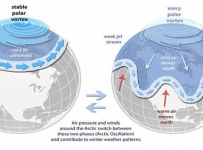
The “Beast from the East” that froze Europe last week is actually closer to the Game of Thrones Winter crossing The Wall. The Wall is a jet-stream driven by the temperature difference between the poles and continental Eurasia and North America. As the Arctic warms dramatically that differential disappears and the arctic airmass leaks south. The Vortex that froze northern USA in 2014 in a way that shocked the public at the time, has returned intermittently since and has now hit Northern Europe as well.
This is the atmospheric equivalent of the Gulf Stream that controls the weather in the North Atlantic, carrying warm tropical water up the East Coast of America to the West Coast of England. It is the Gulf Stream that keeps Eastern USA, England and Ireland comparitavely warm. The Ice Ages of pre-history occurred when the gulf stream was turned off.
Following a discussion about the impact of the gulf stream on ocean currents in live science discussions about whether global warming could cause an ice age fuelled hilarity among client skeptics. The notion was at the heart of the 2004 movie, The Day After Tomorrow. It took five years of more considered discussion for this simplistic notion that the planet will fix itself by simply flipping its major settings to engender a more nuanced discussion. Looking back over more than a decade of reporting on the politics of climate change what appears more important than our oversimplification of science in an attempt to get simple and clear explanations is the tendency to see these solutions as saving humanity. Rather than confronting the very real difficulties of the small changes in front of us, we immediately look to the more distant future in an attempt to find grand solutions.
How Climate Change Interacts With the Polar Vortex
The entire region of the Arctic above the 80 degree North Latitude line has been 8.64 degrees Celsius warmer than normal for all of 2018 thus far. This is an extraordinary departure for a region that plays a critical role in how the Earth’s climate system functions. When the Jet Stream winds slow, they tend to meander — forming large ridges and deep troughs. The elongated ridges and troughs eventually break like waves — pushing against the circulation of the Polar Vortex.
Record warmth in the Arctic is unprecedented. The north pole gets no sunlight until March, but an influx of warm air has pushed temperatures in Siberia up by as much as 35C above historical averages this month. Greenland has already experienced 61 hours above freezing in 2018 – more than three times as many hours as in any previous year. The question now is whether this signals a weakening or collapse of the polar vortex, the circle of strong winds that keep the Arctic cold by deflecting other air masses. The vortex depends on the temperature difference between the Arctic and mid-latitudes, but that gap is shrinking because the pole is warming faster than anywhere on Earth. While average temperatures have increased by about 1C, the warming at the pole – closer to 3C – is melting the ice mass.
Stronger storms mean new ‘category six’ scale may be needed
Traditional scale used goes only to five but strength and intensity of storms is increasing, stimulating creating a category six to reflect the increasing severity of tropical cyclones in the wake of warming sea temperatures and climate change.Scientifically, six would be a better description of the strength of 320km/h storms, and it would also better communicate the well-established finding now that climate change is making the strongest storms even stronger,
Climate change will push European cities towards breaking point
Uurgent need to adapt urban areas to cope with floods, droughts and heatwaves. The research highlights the urgent need to design and adapt our cities to cope with these future conditions.They found the British Isles have some of the worst overall flood projections, with the high scenario predicting half of UK cities could see at least a 50% increase on peak river flows.
There is a super-hot sport over the North Pole. It has forced the normal frozen Arctic air to the south, creating this crisis. We should call this the Dragon from the north, not the Beast from the East. The media has not discussed the connection. This is the only so-far-ultimate consequence of warming the planet and the oceans.
the Unusually Warm Arctic Might Scare Your Pants Off
Cities in Europe, meanwhile, are getting hit with unusually cold temperatures and snowfall. That’s days after the U.S. East Coast had record highs.
A Large Area of Open Water Forms North of Greenland During February
Warm winds blowing at up to gale force intensity from the south have assaulted the ice with high waves and above-freezing temperatures for about four days now. The ice edge north of Svalbard is being rapidly beaten back. Perhaps more disturbing, is the fact that the ice pack to the north of Greenland has also now withdrawn — opening up a huge polynya.
The global effect of Arctic melting will create almost as much global warming as already produced by the total rise in atmospheric CO2. Once a temperature threshold is breached, abrupt events follow due to amplifying feedbacks, even within a few years, examples being (1) freeze events which followed temperature peaks during past interglacial peaks due to influx of cold ice-melt water into the north Atlantic Ocean; (2) the Dansgaard–Oeschger warming events during the last glacial period; (3) the Younger dryas stadial freeze and the Laurentian stadial freeze. In some instances it only took a temperature rise of about 1-2 degrees Celsius to trigger extensive ice melt, with a flow of cold melt water into the oceans that triggered abrupt transitions that could occur over a few decades and even few years.
Increasing energy efficiency has long been promoted as a realistic means of reducing consumption and so lowering carbon emissions and resource consumption. Only problem is, gee whiz, that it does not work. Figures of the last two decades of energy use indicate that given an increase in efficiency, the resultant price drop encourages additional use and so increases consumption. In other words, the tendency is for humans to consume as much as we can afford rather than as much as we need.
The battle then is not to simply create better technologies but to better manage our lifestyle expectations and our behaviour.
From The TYEE …
The more ‘efficient’ our technology, the more resources we consume in a downward spiral of catastrophe. Thanks to efficiency an airline ticket is one of the most environmentally damaging goods money can buy.
The transition from incandescent to LED lights won’t result in any lasting savings as more efficient lighting resulted in more light consumption and therefore higher overall energy spending; efficiencies in cooling technologies encouraged more air conditioning and refrigeration everywhere; although it takes about three times less energy to make a ton of paper than it did in 1965, we photocopy one billion documents with a 22% growth rate; each unit generated by non-fossil-fuel sources displaced less than one-tenth of a unit of fossil-fuel-generated electricity.
Leigh Storr talks to The Generator at his office in Woolloongabba
As predicted by The Generator in August 2014 a combination of domestic solar power and local storage has fallen below the price of grid power. South Australia will ramp up its incentives to owners of household solar power. While this price advantage makes it attractive to customers in all states to leave the grid, sonme governments and power companies are colluding to make that difficult. Indeed it may also be socially responsible as well as more secure to remain connected to the grid despite the commercial disadvantages forced on the homeowner by pricing policies and regulation. The Generator August 2014 article outlines a guerilla disconnection process that allows users to sidestep regulations preventing disconnection flagged in Queensland at the time of writing.
Tesla battery + solar now significantly cheaper than greed power.
Analysis has shown that households are better off installing 5 kW solar and a battery rather than relying on grid only supply. South Australia’s consumers bought 20% less electricity from the grid in 2017 than they did in 2010. I imagine that by 2025 the amount will be at least 20% less again.
Battery storage leaves fossil fuels and regulators in state of intertia
Ever since the opening of the Tesla big battery next to the Hornsdale wind farm in South Australia last month, it is as though a new era has dawned for the management of Australia’s electricity supply. This is not just about flexibility, smoothing out renewables, or responding to peak demand and speed of response – it is also about grid security and grid stability. And it is causing a massive re-think. Here’s why:
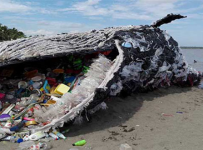
Greenpeace Philippines created this artwork to highlight the impact of plastics on the aceans
Life expectancy is falling in the US as the impact of pollutants on cancer in children, and untreatable diseases spread from industrially farrmed food into the population. As the impact of pollutants on childhood health is better understood experts warn that cancers, asthma and obesity have become normal characteristics of the population. Pollution is directly killing over 20 million people a year, wiping out the equivalent of a nation like Australia or a US state like Florida or New York, every year. The impact of industrial use of antibiotics in food production means that untreatable diseases are being transmitted into the population through the food chain.
A US-UK trade deal threatens to export the horrors of US corporate livestock production
Around 75% of the antibiotics used in the US are fed to farm animals. Our city is under siege, and we are knocking down our own defences. The EU and the UK are no paragons. The Guardian has revealed that both pork and chicken sold here are infected with resistant superbugs.
The Precautionary Principle Asks “How Much Harm Is Avoidable?” Rather Than “How Much Harm Is Acceptable?”
In 1980, breast milk in the US was so contaminated with DDT, PCBs and other industrial poisons. If it were cow’s milk, it would be banned. After two decades of failed “chemical regulation,” babies everywhere in the world are drinking industrial toxicants in breast milk. In 2005 umbilical cord blood from newborns showed that babies are now “pre-polluted” with 200 industrial compounds. In the US, children’s health is deteriorating. childhood cancers has risen 27% since 1974; childhood asthma, obesity, learning and behaviour problems doubled. Industrial poisons have spread worldwide because regulators have relied on a quantitative risk assessment to determine which chemical releases are “safe.” But “safe” amounts of 80,000 chemicals have contaminated the entire planet, so today noone is safe.
Junk Planet: Is Earth the Largest Garbage Dump in the Universe?
Approximately 19 million premature deaths occur annually as a result of the way societies use natural resources and impact the environment to support production and consumption. This will give you a reasonably comprehensive summary of the types of garbage being generated (focusing particularly on those that are less well known), the locations into which the garbage is being dumped and some indication of what is being done about it and what you can do too.
Desperate Need to Halt ‘World’s Largest Killer’ — Pollution
Analyses impacts on human health and ecosystems brought on by air, land, freshwater, marine, chemical and waste pollution. “None of us is now safe, so now all of us have to act. The health effects are stark, with air pollution alone killing some 6.5 million annually, affecting mostly poor and vulnerable people.”
Deposit schemes reduce drink containers in the ocean by 40%
Some eight million metric tonnes of plastic ends up in the ocean every year. There has been a push to get rid of plastic straws, and even Queen Elizabeth II has banned single use plastics from Royal Estates. How effective is a cash for containers program? While there is evidence that container deposits increase return rates and decrease litter, until now there has been no study asking whether they also reduce the sources of debris entering the oceans.
This article originally appeared on the ABC but was removed citing “editorial standards”. The fact was brought to the attention of the Generator News by News Daily The article itself was retrieved from the Web Archive
Tax-free billions: Australia’s largest companies haven’t paid corporate tax in three years
Exclusive by chief economics correspondent Emma Alberici
Qantas CEO Alan Joyce, one of the most prominent supporters of the Turnbull Government’s proposed big business tax cut, presides over a company that hasn’t paid corporate tax for close to 10 years.
The period roughly coincides with Mr Joyce’s tenure at the helm of Australia’s flag carrier.
Alan Joyce, the CEO of Qantas, is a major supporter of corporate tax cuts in Australia. (AAP: Joel Carrett)
Despite generating income of $106.4 billion, the flying kangaroo has avoided paying tax on that bounty since 2009, thanks to Australia’s generous tax concessions, depreciation provisions and the ability to offset company losses against past and future profits.
New analysis by the ABC reveals Qantas is not alone — its tax behaviour is consistent with about 380 of Australia’s largest companies. ATO corporate tax transparency data — confirmed in email exchanges with company representatives — reveals about one in five of the country’s biggest companies have paid no tax for at least the past three years.
Not one of Australia’s biggest airlines has paid corporate tax since at least 2013, including Virgin and its subsidiary Tigerair, Etihad, Emirates and Qatar.
Each one of those companies has sold billions of dollars worth of tickets in Australia.
When asked for an explanation, both Qantas and Virgin pointed the ABC to their historical losses and the entirely legitimate use of Australia’s tax laws that allow them to offset those losses against future profits indefinitely.
Both companies were at pains to point out that, notwithstanding their zero corporate tax liabilities, they had continued to collect and pay departure taxes, fuel and alcohol excises, payroll tax, GST and FBT.
Presumably that’s what the Etihad spokesman was alluding to in his statement to the ABC.
“Etihad is fully compliant with all Australian tax requirements, and has paid all the taxes it is obligated to do so under Australian law.”
EnergyAustralia’s tax-free decade
At a time when Australian households have seen their electricity prices soar, the country’s leading energy retailer, EnergyAustralia, hasn’t been paying corporate tax. EnergyAustralia paid no corporate tax for the decade to 2016.
For the three years to June 2016, EnergyAustralia’s 1.7 million electricity and gas customers across eastern Australia helped it record $24 billion worth of income on which no tax was paid.
An EnergyAustralia spokesperson said the company’s performance, “reflects how the power-generation sector is underpinned by assets that were built last century”.
“Since 2006, EnergyAustralia has written down the value of its assets by $1.9 billion.”
How much tax did the big banks pay?
Ten years after the global financial crisis — which they are largely responsible for creating — some of the world’s most prominent investment banks are collecting tidy sums of income in Australia and not paying corporate tax.
Among them is Malcolm Turnbull’s old employer, Goldman Sachs, which recently won a lucrative contract with the NSW Government.
Described by Rolling Stone Magazine as, “the great vampire squid wrapped around the face of humanity, relentlessly jamming its blood funnel into anything that smells like money”, Goldman will be paid $16.5 million as the state’s financial adviser on the sale of the $16.8 billion WestConnex motorway in NSW.
The investment bank generated revenue of $1.84 billion over three years but paid zero corporate tax.
Ditto for JPMorgan Chase which raked in $2.2 billion and hasn’t paid corporate tax since at least 2013.
In one of the most audacious explanations advanced to the ABC for the non-payment of corporate tax, a spokesman for America’s biggest bank said JPMorgan was still suffering the aftershocks of the financial crisis which meant its Australian operations continued to operate at a loss.
But late last year, it emerged JPMorgan Chase agreed to pay a record $13 billion fine to US federal and state authorities in 2013.
The purpose of this fine was to settle claims it had misled investors in the years leading up to 2008.
Could the bank be writing that fine off against its Australian income? The spokesman didn’t care to elaborate.
Shifting profits overseas
88 per cent of people, polled by Reuters, think corporate tax avoidance leads to a culture which poses the question: “Can we get away with it?” (Supplied: Thomson Reuters)
Curiously, French bank BNP Paribas also appeared to have made some bad investments taxpayers were having to compensate it for.
It hasn’t paid corporate tax for at least three years – like Goldman, JPMorgan Chase, American Express, Barclays Bank and the Royal Bank of Scotland.
The oldest foreign bank in Australia (resident here since 1881) told the ABC that despite attracting close to $10 billion in income since 2013, BNP failed to make any profits.
BNP said its losses, “included the write off of bad debts from lending to certain Australian domiciled companies”.
As far as the local financial services sector goes, Babcock and Brown International stands out among the 2,000 company names in the Australian Taxation Office’s public records.
Babcock and Brown remains the country’s biggest corporate failure, having collapsed in 2009 with debts of more than $10 billion.
According to the ATO, Babcock and Brown International (a wholly owned subsidiary of the liquidated group, Babcock and Brown Ltd) reported $1.7 billion worth of income for the three years to 2016.
It paid no corporate tax.
CEO Michael Larkin, who has been with the Babcock group for 14 years, told the ABC the money was taxed elsewhere in the world where Babcock and Brown International engages in business.
He wouldn’t be drawn on what the company does overseas, where or how much tax has been paid in other jurisdictions.
Australian tax law has allowed foreign companies to shift profits to affiliates or parent groups offshore in the guise of payments for services.
They’ve also been entitled to lend money to their Australian operations at inflated prices to create excessive tax deductions in Australia.
This can all work to render the Australian business loss-making, therefore not required to pay corporate tax.
For local companies, the dividend imputation system is a unique tool that allows businesses to pass tax credits on to their investors.
Australia and New Zealand are now the only two OECD countries to offer imputation which results in around a third of corporate tax revenue in Australia being handed back to investors.
Put simply, it means a 30 per cent corporate tax rate with franked dividends raises roughly as much as a headline 20 per cent rate without them.
Over the past 30 years, a number of countries have abandoned dividend imputation, including the UK, Germany, Finland, Norway, Singapore and Malaysia.
Thanks to legislation passed in 2013, the Australian Tax Office now publishes an annual record of total income received, taxable income and tax payable for the roughly 2,000 Australian companies with annual turnovers of more than $100 million.
It’s called The Corporate Tax Transparency Data which is somewhat of a misnomer given the numbers say nothing about how businesses use deductions and concessions to reduce their taxable incomes.
All the focus on the tax shenanigans of foreign technology and media companies has diverted our gaze from the taxpaying habits of some of their home grown rivals.
The media colossus reported total income of $8.5 billion and even boasted a $71 million profit in 2014/15 but no corporate tax was paid.
The company’s corporate affairs boss, Liz Deegan, wrote to the ABC to clarify that: “News Corp Australia has deductible operating costs and certain tax incentives and allowable credits, like R&D and franking credits, that offset the revenue disclosed.”
Its partly owned pay-TV company, Foxtel, received a $30 million gift from the Federal Government in the last budget, ostensibly to provide better coverage of female sports.
In the three years prior, Foxtel had also not paid corporate tax. Fairfax, News Corp’s newspaper rival in Australia, paid $53.1 million in corporate tax over the same period.
The tax-free club
Software giant Atlassian also pointed to R&D tax concessions when explaining why it too hasn’t paid corporate tax for the past two years on accumulated income just shy of $1 billion.
A tally of the three years’ available data reveals some of this country’s most recognised names haven’t paid corporate tax since at least 2013.
They include Broadspectrum (formerly Transfield Services) which collected $8.6 billion in income over three years. An estimated 30 per cent of that income ($2.5 billion) was paid directly by the Federal Government for running Australia’s offshore detention facilities. Broadspectrum was taken over by Spanish conglomerate Ferrovial in 2016.
Among the others who’ve escaped paying any corporate tax for three years are Bluescope Steel, Ansell, Amcor, Billabong International and TransurbanHoldings.
The big property and construction companies Lend Lease, Grocon, Stockland and GPT are also part of the corporate tax-free club.
Mackay Sugar and CSR who’ve been lobbying against a sugar tax haven’t paid corporate tax for three years either.
Not going down without a fight
The Turnbull Government knows well that forensic tax audits are an expensive and resource-sapping exercise, especially when they involve the complex interpretation of other countries’ tax codes and their intersection with ours.
Federal Treasurer Scott Morrison has committed $679 million over four years to a new Tax Avoidance Taskforce.
New laws to combat complicated corporate structures whose core purpose is to avoid tax have also been passed.
But if Australia wants the likes of Apple, Google and Facebook to pay more tax on the phones and advertising it sells in Australia, some of our biggest taxpayers, BHP and Rio Tinto should arguably be paying more tax in China where they sell most of their iron ore.
Among all the murky detail of corporate tax arrangements, one thing is clear: companies with the financial firepower of BHP and Rio Tinto aren’t going to accept a negative assessment from the ATO without a fight.
Both of Australia’s biggest miners are currently in dispute over their Singaporean marketing operations (corporate tax rate of 17 per cent).
Convoluted corporate arrangements see BHP and Rio sell commodities they’ve mined in Australia to their Singapore businesses, which on-sell the iron ore et al in to export markets (predominantly China) often with a hefty mark-up.
The ATO rejects the legitimacy of the tax structure and is seeking $1 billion in tax, interest and penalties from BHP and about half that ($500 million) from Rio.
A BHP spokesman told the ABC, “The primary tax in dispute represents less than 2 per cent of the $66 billion in taxes and royalties paid in Australia over that 11-year period … BHP does not agree with the ATO’s position.
“Consequently, we have objected to all the amended assessments and intend to continue to defend our position, including by initiating court action if necessary.”
Perhaps unsurprisingly, some of the country’s most trusted corporate advisers, including the Boston Consulting Group and MYOB, paid no tax for the three years to 2016.
Even the industry groups — Chartered Accountants (CAANZ) and the Certified Practising Accountants (CPA) have paid nothing, or next to nothing, in corporate tax over the that period on account of their “mutual” status which excludes membership fees from assessable income.
CPA Australia reeled in $493 million in income between 2013 and 2016.
Australia’s tax laws allowed them to pay just $1,967.00 in corporate tax.
Chartered Accountants Australia and New Zealand is a relatively new group.
In its two years as a registered entity for tax purposes it has paid zero corporate tax on $240 million in income.
Hawken says men should stand back and let women run the show
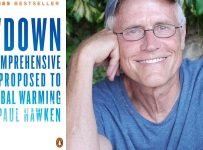
Touring Australia to promote his project and book Drawdown, Paul Hawken told audiences in Brisbane on Thursday and Byron Bay on Friday that overwhelmingly, women are the solution to climate change.
Hawken edited the 100 solutions presented in the book. Each solution selected for publication was modelled by the team of scientists that form the organisation Drawdown. Two of the top ten solutions specifically deal with the role of women. Solution #6 is the education of girls and solution #7 is family planning. Hawken described these solutions as pathways to the same outcome, which is empowerment of women, leading to a reduction in population growth which is one of two major factors driving environmental damage. Per capita consumption multiplied by the world population is the sum of total resource consumption on the planet. As well as impacting population levels, the empowerment of women leads directly to preferential investment in less aggressive and wasteful approaches to production and commerce, Hawken said.
A separate solution is to supporting women running small scale farms. That has a significant effect on the production of carbon. “Women running small farms produce more food than corporate agriculture,” Hawken told enthusiastic audiences, “that means that we do not have to accept the lie that we need big agriculture to feed the billions of people living in mega cities.”
He challenged the notion that corporate agriculture is feeding society. “Think about what they produce,” he said, “Corn, soy, sugar, highly refined grains and foodstuffs that cause obesity, diabetes, heart attacks. They are not feeding society, they are funding big pharma.”
He also pointed out that the military is one of the biggest contributors to environmental and societal harm, destroying landscapes, agriculture and societies on an enormous scale. He said that while he suspects world peace is probably the number one solution to reducing climate chaos, it has been left out of the book because there is no data available to model the impact of reversing it.
While the tour is largely complete, there are plenty of opportunities online to see Hawkens expounding the value of the book.