Category: News

Add your news
You can add news from your networks or groups through the website by becoming an author. Simply register as a member of the Generator, and then email Giovanni asking to become an author. He will then work with you to integrate your content into the site as effectively as possible.
Listen to the Generator News online

 
The Generator news service publishes articles on sustainable development, agriculture and energy as well as observations on current affairs. The news service is used on the weekly radio show, The Generator, as well as by a number of monthly and quarterly magazines. A podcast of the Generator news is also available.
As well as Giovanni’s articles it picks up the most pertinent articles from a range of other news services. You can publish the news feed on your website using RSS, free of charge.
 

  • Dire Warnings on Climate Change for Australia

    Dire Warnings on Climate Change for Australia

    118 Shares

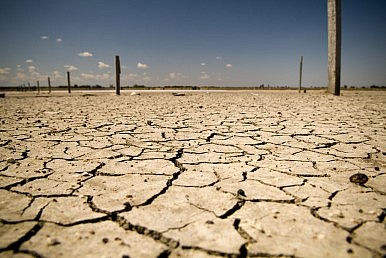
    The news passed relatively quietly last week but the CSIRO and Australian Bureau of Meteorology released their most comprehensive report to date on the possible effects of climate change on Australia. Predictably, those effects will be bad. In fact, Australia may be even worse off than elsewhere in the world.

    The headlined outcome was the worst-case scenario temperature rise: 5.1 degrees by 2090, as opposed to 4.8 degrees across the globe. The actual rise may be lower than that, but even 2 degrees will have terrible effects in Australia and its seas. The Great Barrier Reef might suffer most of all as the rising sea levels render the ocean too acidic to support coral reefs, which are largely calcifying.

    This is not the first dire report, of course, but it is extensive, “drawn from observations and from simulations based on up to 40 global climate models and four scenarios of greenhouse gas and aerosol emissions during the 21st century.” And its predictions for Australia are a worry. In précis, the effects will be: higher overall temperatures, more hot days and fewer cold, sea level rises and more acidic seas, fewer but stronger cyclones, less but heavier rain, and soil degradation. Infrastructure will be badly affected. Sea levels have already risen 20 centimeters since 1900 and Australia has seen seven of its ten hottest years ever recorded since 1988. 2013 was the hottest. This is, it seems, good evidence that despite the vagaries of the Australian climate, which are legion, some level of man-made climate change has already occurred.

    The solution offered is about as surprising as the outcomes that were predicted: Cut back on global greenhouse gas emissions. The report, in fact, was prepared with the natural resources sector in mind. And herein lies the problem. Australia is not interested in any of this. The Abbott government cut the carbon tax last year in July. Though certain noises are made about the environment, Australia does now, it is generally agreed, have a rather backwards climate policy and a prime minister who is a big fan of the use of coal. At press conference Monday, an embattled prime minister defending his leadership argued for the cuts his budget put forward, saying anything else would be “intergenerational theft,” leaving future generations to shoulder the burdens of the previous. Those who had been following the release of the report noted his words with especial bemusement.

    As we noted in November when writing about Foreign Minister Julie Bishop’s UN Security Council address, Australia now lags behind the U.S., U.K. and even China in its commitments to lowering emissions, even when the results of those emissions will hit this nation harder than any of the others. As yet, Tony Abbott has not publicly acknowledged the report but given it came out the same week he knighted Prince Philip, that is perhaps not surprising. He is not a man well known for talented public multitasking and had his hands full trying to explain his actions and deal with furious back benchers. The next global climate summit, to be held in Paris, is rapidly approaching and it might be nice if Australia’s government offered an idea of how it planned to approach the post-2020 period.

    Helen Clark was based in Hanoi for six years as a reporter and magazine editor. She has written for two dozen publications including The Diplomat (as Bridget O’Flaherty), TimeThe Economist, the Asia Times Online and the Australian Associated Press

  • climate code red David Spratt

    e to enable desktop notifications for Gmail.   Learn more  Hide
    1 of 6
    Web Clip

    climate code red

    Inbox
    x

    Climate Code Red <noreply+feedproxy@google.com>

    8:10 PM (1 minute ago)

    to me

    climate code red


    Two degrees of warming closer than you may think

    Posted: 05 Feb 2015 10:32 PM PST

    by David Spratt

    It’s taken a hundred years of human-caused greenhouse emissions to push the global temperature up almost one degree Celsius (1C°), so another degree is still some time away. Right?  And there seems to have been a “pause” in warming over the last two decades, so getting to 2C° is going to take a good while, and we may have more time that we thought.

    Wrong on both counts.

    The world could be 2C° warmer in as little as two decades according to the leading US climate scientist and “hockey stick” author, Dr Michael Manne. Writing in Scientific American in March 2014 (with the maths explained here), Manne says that new calculations “indicate that if the world continues to burn fossil fuels at the current rate, global warming will rise to 2C° by 2036” and to avoid that threshold “nations will have to keep carbon dioxide levels below 405 parts per million”, a level we have just about reached already.  Manne says the notion of a warming “pause” is false.
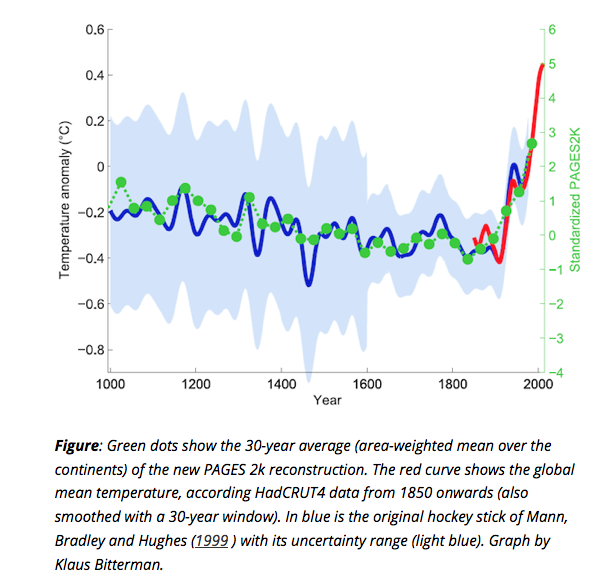
    Global temperature over the last 1000 years: the “hockey stick”

    Here’s why 2C° could be just 20 years away.

    Record heat

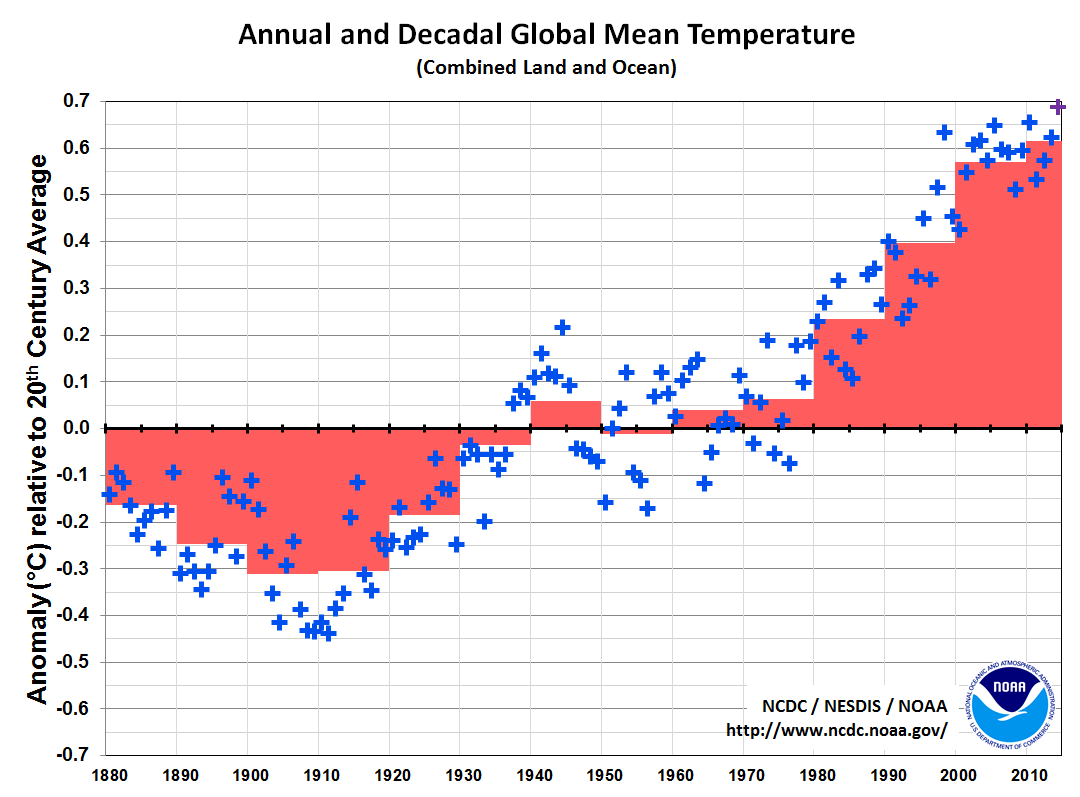
    2014 was the hottest year in the instrumental record. The US government agencies NASA and NOAA announced the 2014 record on 16 January, noting that “the 10 warmest years in the instrumental record, with the exception of 1998, have now occurred since 2000”.

    NASA’s Goddard Institute for Space Studies (GISS) says that since 1880, “Earth’s average surface temperature has warmed by about 1.4 degrees Fahrenheit (0.8C°), a trend that is largely driven by the increase in carbon dioxide and other human emissions into the planet’s atmosphere. The majority of that warming has occurred in the past three decades.”

    GISS Director Gavin Schmidt says that this is “the latest in a series of warm years, in a series of warm decades. While the ranking of individual years can be affected by chaotic weather patterns, the long-term trends are attributable to drivers of climate change that right now are dominated by human emissions of greenhouse gases.”

    2014 was also Australia’s third-hottest year on record, according to the Bureau of Meteorology: “Overall, 2014 was Australia’s third-warmest year on record: the annual national mean temperature was +0.91 °C above average…  All States, except the Northern Territory, ranked in the four warmest years on record.” 

    The 2014 record was achieved in neutral ENSO conditions

    Fluctuations in the ENSO cycle affect global temperature, with El Nino conditions (a mobile blister of Pacific Ocean heat that affects wind patterns and currents and reduces rainfall in eastern Australia) correlating with warmer global temperatures. Former NASA climate science chief Dr James Hansen and colleagues note that the record global temperature in 2014 “was achieved with little assistance from the tropical ENSO cycle, confirms continuing global warming…  and with the help of even a mild El Niño 2015 may be significantly warmer than 2014.”

    And El Nino conditions are likely to became more frequent with more warming. A year ago, Wenju Cai, a CSIRO climate researcher for Australia’s Commonwealth Scientific and Industrial Research Organisation (CSIRO), warned that the frequency of extreme El Niño events could double with climate change, in a paper that presented “evidence for a doubling in the occurrences in the future in response to greenhouse warming”.

    There is no “pause” in warming

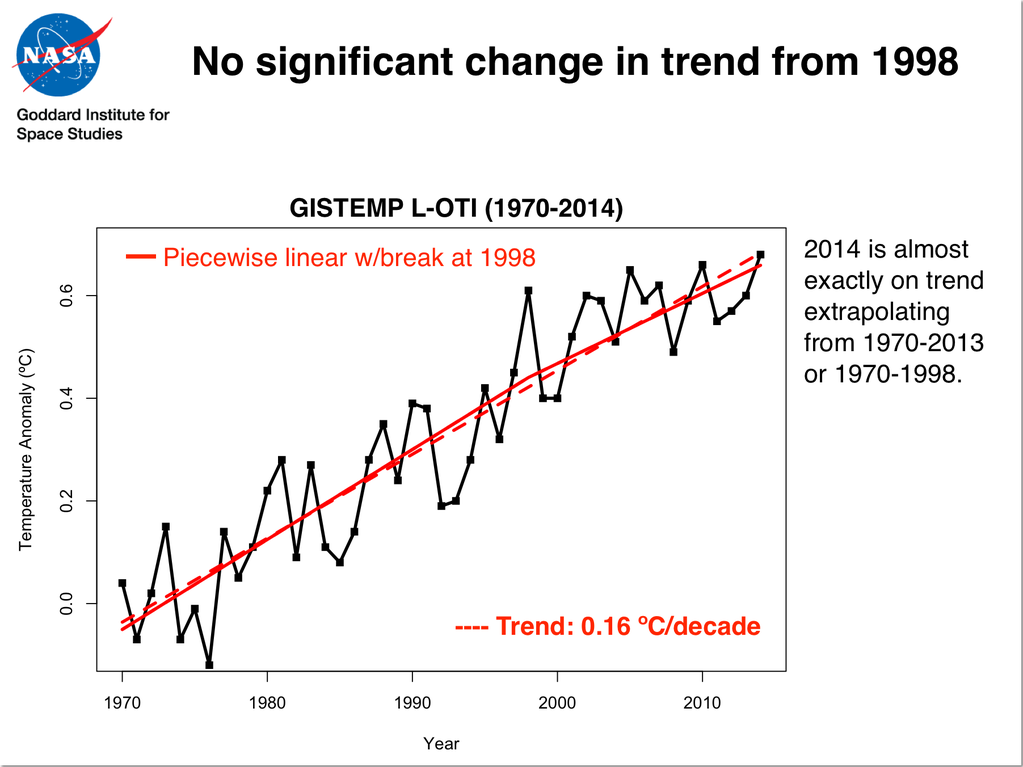
    In releasing the data on 2014’s record warmth, NASA charted warming since 1970 and demonstrated that there has been no “pause” or slowing in warming, contrary to the million-times-repeated claims of the climate warming denial industry.

    Joe Romm of Climate Progress says this chart (below) shows that: “The human-caused rise in surface air temperatures never paused, never even slowed significantly. And that means we are likely headed toward a period of rapid surface temperature warming. ”

    A year ago, Prof Matthew England of University of NSW suggested that temperatures were likely to rise quickly:

    Scientists have long suspected that extra ocean heat uptake has slowed the rise of global average temperatures, but the mechanism behind the hiatus remained unclear…. But the heat uptake is by no means permanent: when the trade wind strength returns to normal –- as it inevitably will –- our research suggests heat will quickly accumulate in the atmosphere. So global [surface] temperatures look set to rise rapidly….

    The oceans are warming very rapidly

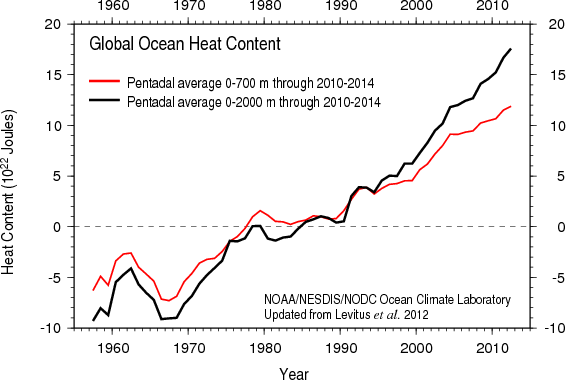
    Of all the additional heat trapped by higher levels of greenhouse gases, more than 90 per cent goes to warming the oceans, and thus ocean heat content (OHC) is by far the most significant and reliable indicator of global warming. By contrast only 2 per cent goes to warming the atmosphere, so small heat exchanges between oceans and the atmosphere (caused by changing sea surface, ocean circulation and wind conditions) can have a significant impact on atmospheric temperature, but not on ocean temperature.

    The NOAA’s State of the Climate for 2014 reports:

    During 2014, the globally-averaged sea surface temperature was 1.03°F (0.57°C) above the 20th century average. This was the highest among all years in the 1880-2014 record, surpassing the previous records of 1998 and 2003 by 0.09°F (0.05°C).

    The rate of OHC warming appears to be accelerating, with Romm noting that:

    … ocean warming has sped up, and sea level rise has accelerated more than we thought , and Arctic sea ice has melted much faster than the models expected, as have the great ice sheets in Greenland and Antarctica.

    And as Matthew England has told us, when the trade wind strength returns to normal, some ocean heat will quickly accumulate in the atmosphere.

    You can check all the NOAA ocean heat content charts here.

    Human greenhouse gas emissions are not slowing

    Data from the Global Carbon Project shows annual carbon dioxide emissions are continuing to increase, and that the rate of increase since 2000 is at least double that of the 1990-99 decade. Emissions are projected to continue on the current growth path till 2020.
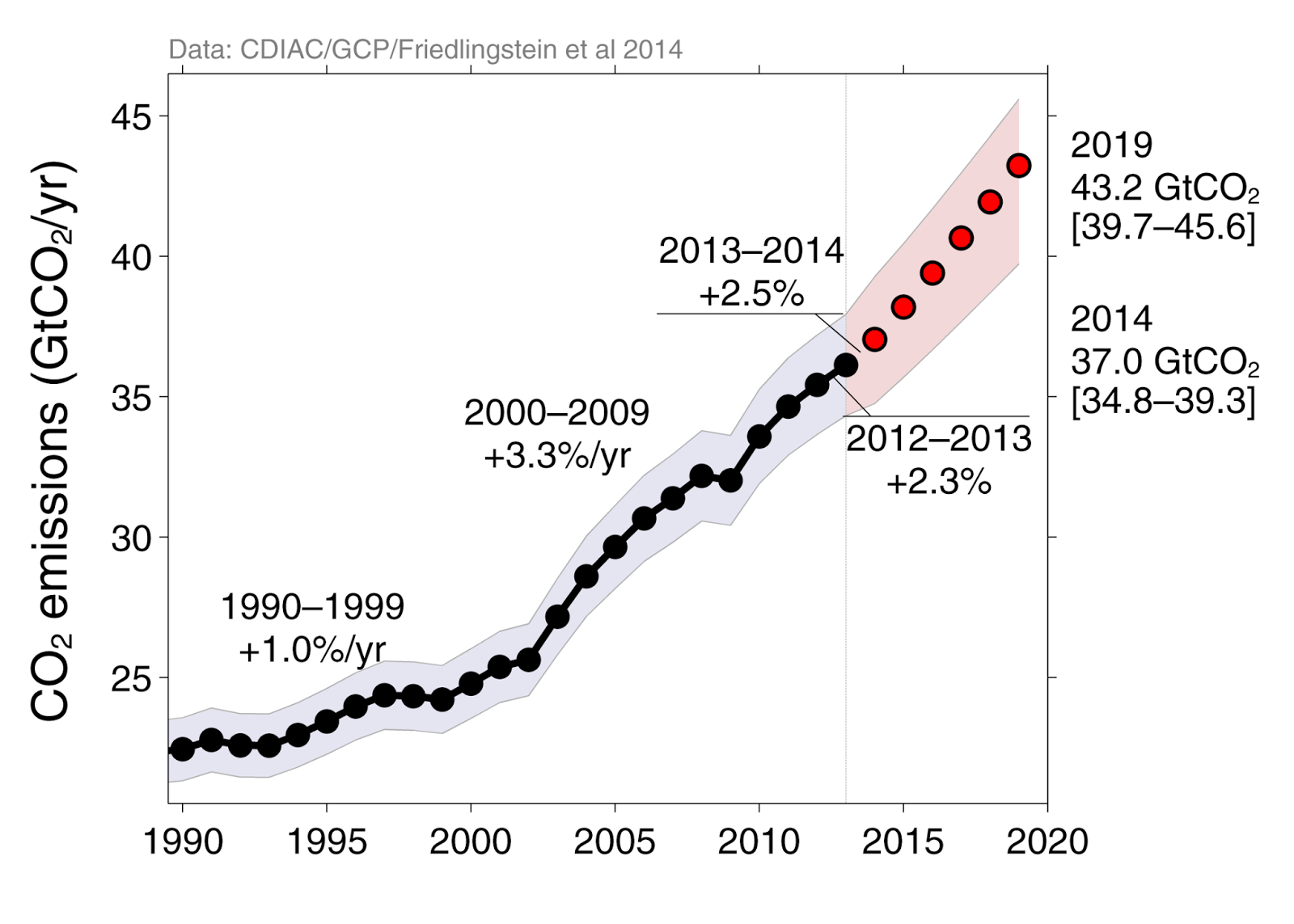
    Fossil fuel emissions 1990-2014 and projected to 2019

    To summarise the story so far: 2014 was a record hot year (without El Nino conditions); there has been no pause in warming; ocean heat content is rising at an increasing rate; global annual carbon dioxide emissions are continuing to grow; and more frequent El Nino conditions and a return to more normal trade wind strength will release some ocean heat to the atmosphere; so we are likely headed for a period of rapid surface temperature warming.

    But there is more to the story.

    A reservoir of heat already in the system

    Increased levels of atmospheric greenhouse gases create an energy imbalance between incoming and outgoing radiation, which is resolved by elements of the earth system (land and oceans) absorbing the additional heat until the system reaches a new balance (equilibrium) at a higher temperature. But that process takes time, due to thermal inertia (as with an electric oven: once energy is applied, it takes time to heat up and is not instantaneous).  As a rule of thumb, about one-third of the heating potential of an increase in atmospheric carbon dioxide will be felt straight away, another third take around 30 years, and the last third is not fully realised for a century.

    Thus there is more warming to come for the carbon dioxide already emitted, amounting to about another 0.6°C of warming.  And because the rate of emissions is increasing, that figure is also increasing.

    From this we can conclude that around 1.5°C of warming is locked into the system for current carbon dioxide levels, though very large-scale carbon drawdown could reduce levels slowly over decadal time frames.

    As well as long-lived carbon dioxide, there are other greenhouse gases with shorter lifetimes, particularly methane (lifetime approx. 10 years) and nitrous oxide (lifetime approx. 100 years). Because emissions of these gases are also continuing unabated, they also contribute to warming temperatures on decadal time frames.

    In fact, the current level of greenhouse gases if maintained is already more than enough to produce 2°C of warming over time: in 2008 two scientists, Ramanathan and Feng in On avoiding dangerous anthropogenic interference with the climate system: Formidable challenges ahead found that if greenhouse gases were maintained at their 2005 levels, the inferred warming is 2.4˚C (range 1.4˚C to 4.3˚C).

    The current level of greenhouse gases is around 400 parts per million carbon dioxide (ppm CO2), and 470 ppm carbon dioxide equivalent (CO2e) when other greenhouse gases are included. The last time CO2 levels were as high as they are today, humans didn’t exist, and over the last 20 million years such levels are associated with major climate transitions. Tripati, Roberts et al. found that, big changes in significant climate system elements such as ice sheets, sea levels and carbon stores are likely to occur for the current level of CO2:

    During mid-Miocene climatic optimum [16-14 million years ago] CO2 levels were similar to today, but temperatures were ~3–6°C warmer and sea levels 25 to 40 metres higher than at present… When CO2 levels were last similar to modern values (greater than 350 ppmv to 400 pmv), there was little glacial ice on land, or sea ice in the Arctic, and a marine-based ice mass on Antarctica was not viable…

    But the question remains as to how quickly this warming will occur, and for that we need to look at two further factors: climate sensitivity and the role of aerosols.

    Climate sensitivity

    The measure of how much warming occurs for an increase in greenhouse gases is known as climate sensitivity, and is expressed as the temperature rise resulting from a doubling of greenhouse gas levels.

    As Michael Manne explains:

    Although the earth has experienced exceptional warming over the past century, to estimate how much more will occur we need to know how temperature will respond to the ongoing human-caused rise in atmospheric greenhouse gases, primarily carbon dioxide. Scientists call this responsiveness “equilibrium climate sensitivity” (ECS). ECS is a common measure of the heating effect of greenhouse gases. It represents the warming at the earth’s surface that is expected after the concentration of CO2 in the atmosphere doubles and the climate subsequently stabilizes (reaches equilibrium)… The more sensitive the atmosphere is to a rise in CO2, the higher the ECS, and the faster the temperature will rise. ECS is shorthand for the amount of warming expected, given a particular fossil-fuel emissions scenario.

    As discussed previously here, some elements of the climate system respond quickly to temperature change, including the amount of water vapour in the air and hence level of cloud cover, sea-level changes due to ocean temperature change, and the extent of sea-ice that floats on the ocean in the polar regions. These changes amplify (increase) the temperature change and are known as short-term or “fast” feedbacks, and it is on this basis that (short-term) ECS is well established as being around 3°C for a doubling of greenhouse gas levels (see, for example, Climate sensitivity, sea level, and atmospheric carbon dioxide).

    But there are also longer-term or “slow” feedbacks, which generally take much longer (centuries to thousands of years) to occur. These include changes in large, polar, land-based ice sheets, changes in the carbon cycle (changed efficiency of carbon sinks such as permafrost and methane clathrate stores, as well as biosphere stores such as peat lands and forests), and changes in vegetation coverage and reflectivity (albedo). When these are taken into account, the sensitivity is significantly higher at 4.5°C or more. Importantly, the rate of change at present is so far that it appears that some of these long-term feedbacks are being triggered now on short-term timeframes (see Carbon budgets, climate sensitivity and the myth of “burnable carbon”).

    As Manne explains, uncertainty about ECS can arise from questions of the role of clouds and water vapour, with the most recent IPCC report simply giving a range of 1.5–4.5°C. Factors such as changing rates of heat flux between oceans and atmosphere (including the El Nino/La Nina cycle), and volcanic eruptions, can cloud the short-term picture, as has the focus on the non-existent “pause”.

    What would happen if ECS is a bit lower that the “best-fit” value of 3°C of warming for doubling of greenhouse gas levels?  Manne explains:

    I recently calculated hypothetical future temperatures by plugging different ECS values into a so-called energy balance model, which scientists use to investigate possible climate scenarios. The computer model determines how the average surface temperature responds to changing natural factors, such as volcanoes and the sun, and human factors—greenhouse gases, aerosol pollutants, and so on. (Although climate models have critics, they reflect our best ability to describe how the climate system works, based on physics, chemistry and biology. And they have a proved track record: for example, the actual warming in recent years was accurately predicted by the models decades ago.)
    I then instructed the model to project forward under the assumption of business-as-usual greenhouse gas emissions. I ran the model again and again, for ECS values ranging from the IPCC’s lower bound (1.5°C) to its upper bound (4.5°C). The curves for an ECS of 2.5 degrees and 3°C fit the instrument readings most closely. The curves for a substantially lower ECS did not fit the recent instrumental record at all, reinforcing the notion that they are not realistic.
    To my wonder, I found that for an ECS of 3°C, our planet would cross the dangerous warming threshold of 2°C in 2036, only 22 years from now. When I considered the lower ECS value of 2.5°C, the world would cross the threshold in 2046, just 10 years later.

    This is charted as:
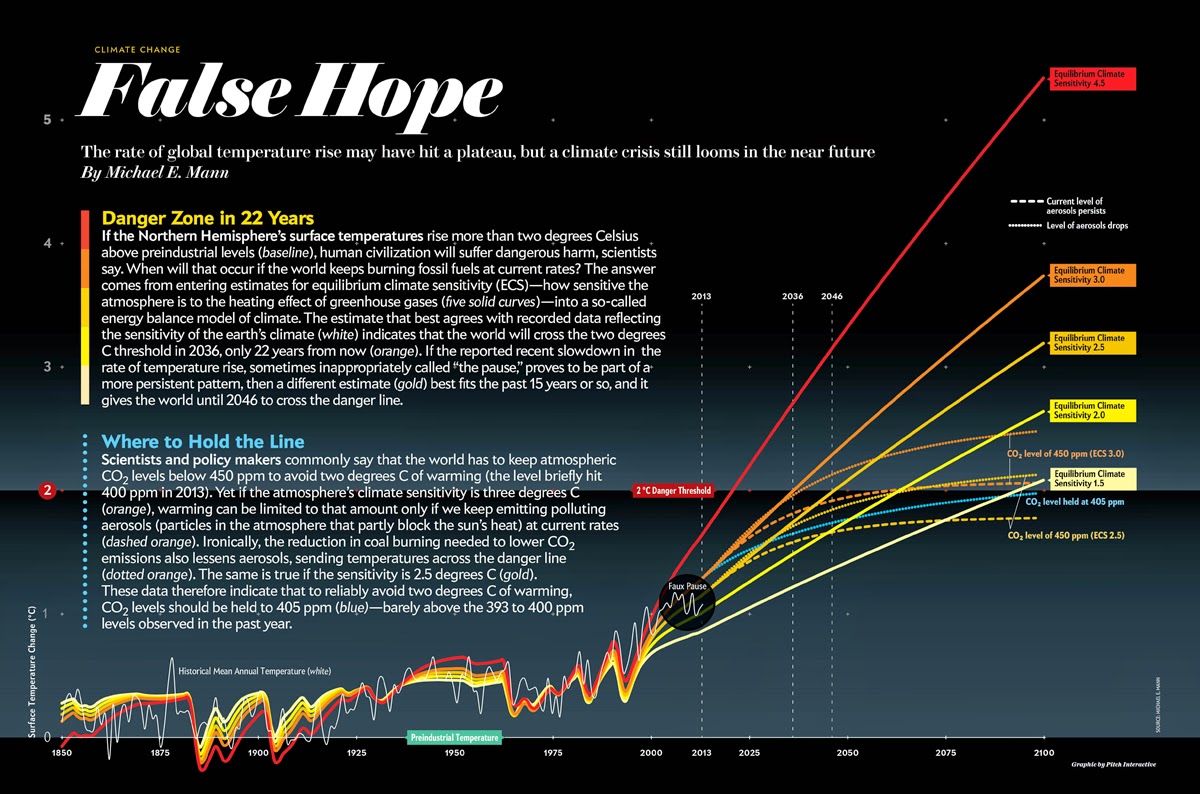
    MIchael Manne’s graph of future temperature for different climate sensitivities.  Click to enlarge.

    Manne concludes that “even if we accept a lower ECS value, it hardly signals the end of global warming or even a pause. Instead it simply buys us a little bit of time—potentially valuable time—to prevent our planet from crossing the threshold.”

    As I have explained repeatedly, including in Dangerous climate warming: Myth and reality, 2°C is far from a safe level of warming. In fact, a strong case is made that climate change is already dangerous at less than 1°C of warming and, in James Hansen’s analysis, “goals of limiting human made warming to 2°C and CO2 to 450 ppm are prescriptions for disaster” because significant tipping points – where significant elements of the climate system move from one discrete state to another – will be crossed.

    Aerosol’s Faustian bargain

    Manne also indicated what level of CO2 would be consistent with 2°C of warming:

    These findings have implications for what we all must do to prevent disaster. An ECS of 3°C means that if we are to limit global warming to below 2°C forever, we need to keep CO2 concentrations far below twice preindustrial levels, closer to 450 ppm. Ironically, if the world burns significantly less coal, that would lessen CO2 emissions but also reduce aerosols in the atmosphere that block the sun (such as sulfate particulates), so we would have to limit CO2 to below roughly 405 ppm.

    The aerosol question is central but often not discussed enough. Human activities also influence the greenhouse effect by releasing non-gaseous substances such as aerosols (small particles) into the atmosphere. Aerosols include black-carbon soot, organic carbon, sulphates, nitrates, as well as dust from smoke, manufacturing, windstorms, and other sources.

    Aerosols have a net cooling effect because they reduce the amount of sunlight that reaches the ground, and they increase cloud cover. This effect is popularly referred to as ‘global dimming’, because the overall aerosol impact is to reduce, or dim, the sun’s radiation, thus masking some of the effect of the greenhouse gases. This is of little comfort, however, because last only about ten days before being washed out of the atmosphere by rain; so we have to keep putting more into the air to maintain the temporary cooling effect.

    Unfortunately, the principal source of aerosols is the burning of fossil fuels, which causes a rise in carbon dioxide levels and global warming that lasts for many centuries. The dilemma is that if you cut the aerosols, the globe will experience a pulse of warming as their dimming effect is lost; but if you keep pouring aerosols together with carbon dioxide into the air, you cook the planet even more in the long run. A Faustian bargain.

    There has been an effort to reduce emissions from some aerosols because they cause acid rain and other forms of pollution. However, in the short term, this is warming the air as well as making it cleaner. As Manne notes above, likely reductions in coal burning in coming decades will reduce aerosol levels and boost warming

    Some recent research suggest aerosol cooling is in the range of 0.5–1.2°C over the long run:

    • Leon Rotstayn in The Conversation explains that “results from CSIRO climate modelling suggest that the extra warming effect from a decline in aerosols could be about 1°C by the end of the century. “
    • Present-day aerosol cooling effect will be strongly reduced by 2030 as more stringent air pollution controls are implemented in Europe and worldwide, and as advanced environmental technologies come on stream. These actions are projected to increase the global temperature by 1°C and temperatures over Europe by up to 2–4°C, depending on the severity of the action. This is one of the main research outcomes of the European Integrated project on Aerosol Cloud Climate and Air Quality Interaction project.
    • In 2011, NASA climate science chief James Hansen and co-authors warned that the cooling impact of aerosols appears to have been underestimated in many climate models and inferred that: “Aerosol climate forcing today is inferred to be −1.6±0.3Wm−2,”, which is equivalent to a cooling of about 1.2°C. In that case, they wrote, “humanity has made itself a Faustian bargain more dangerous than commonly supposed”.

    Conclusion

    Michael Manne’s analysis is sobering, especially when aerosols are accounted for.

    The world is already hitting 400 ppm CO2 (the daily average at the measuring station at Mauna Loa first exceeded 400 ppm on 10 May 2013 and currently rising at a rate of approximately 2 ppm/year and accelerating), so the message is very clear that today we have circumstances that can drive us to 2°C of warming, and that emissions from now on are adding to warming above 2°C and towards 3°C or more.  This reinforces my conclusion last year that there is no carbon budget left for 2°C of warming, and claims to the contrary are a dangerous illusion.

    Manne concludes in not dis-similar terms:

    The conclusion that limiting CO2 below 450 ppm will prevent warming beyond 2°C is based on a conservative definition of climate sensitivity that considers only the so-called fast feedbacks in the climate system, such as changes in clouds, water vapor and melting sea ice. Some climate scientists, including James E. Hansen… say we must also consider slower feedbacks such as changes in the continental ice sheets. When these are taken into account, Hansen and others maintain, we need to get back down to the lower level of CO2 that existed during the mid-20th century — about 350 ppm. That would require widespread deployment of expensive “air capture” technology that actively removes CO2 from the atmosphere.

    Furthermore, the notion that 2°C of warming is a “safe” limit is subjective. It is based on when most of the globe will be exposed to potentially irreversible climate changes. Yet destructive change has already arrived in some regions. In the Arctic, loss of sea ice and thawing permafrost are wreaking havoc on indigenous peoples and ecosystems. In low-lying island nations, land and freshwater are disappearing because of rising sea levels and erosion. For these regions, current warming, and the further warming (at least 0.5°C) guaranteed by CO2 already emitted, constitutes damaging climate change today.
  • They’re all the same BILL SHORTEN

    enable desktop notifications for Gmail.   Learn more  Hide
    More

    2 of 6

    They’re all the same

    Inbox
    x

    Bill Shorten via sendgrid.info 

    5:30 PM (1 hour ago)

    to me
    .
    Neville,

    Abbott, Bishop, Turnbull… whoever’s the leader, the Liberals’ policies remain the same: unfair for Australian families, pushing up cost of living pressures.

    They might want to dump Abbott, but these are the policies they all stand behind:

    • $5.5 billion in cuts to family payments
    • $1 billion in cuts to childcare
    • $100,000 university degrees
    • Getting rid of the Schoolkids Bonus
    • Making going to the doctor more expensive with a new GP Tax
    • Making filling your car more expensive

    All up, the Liberals’ unfair budget – ticked off by Abbott, Bishop, Turnbull and Hockey – will leave families a whopping $6000 a year worse off. That’s equivalent to around three months’ worth of child care.

    No matter the leader, Liberals don’t change. Their policies will always hurt Australian families.

    If you think that’s outrageous and unfair, share this with your friends:

    unfairsolutionscontact.png

    Thanks for standing with me on this,

    Bill

  • The UN heard your call, OceanLover! GREENPEACE

    Click here to enable desktop notifications for Gmail.   Learn more  Hide
    More

    1 of 14

    The UN heard your call, OceanLover!

    Inbox
    x

    Richard Page, Greenpeace <international@act.greenpeace.org>

    12:52 AM (8 hours ago)

    to me
    Dear NEVILLE,

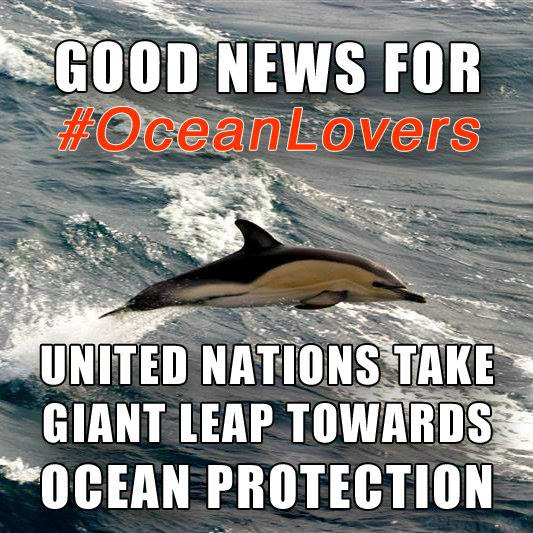
    You made it happen: after ten years of inconclusive talks, four days of deliberations at the United Nations and thousands of messages from #OceanLovers like you and me, on the 24th of January, governments from around the world agreed to develop a visionary treaty to protect marine life on the high seas. This historic decision is a major breakthrough towards urgently needed ocean protection, and a significant milestone in our decade-long campaign for the creation of a network of ocean sanctuaries covering 40% of the oceans.

    Such progress would not have been possible without the passionate call for oceans protection from #OceanLovers from all over the world, who asked governments to say YES! to a High Seas Biodiversity Agreement. When raised in unison, Ocean Lovers’ voices became an irresistible force, reminding the UN delegates that the world expected them to take urgent action for ocean protection, and giving our champions the strength to convince the handful of powerful countries that had been opposing the agreement for years.

    Good news for ocean lovers

    The journey is far from over though; while it is a massive achievement for the UN to have finally kickstarted this process, they failed to set a deadline for the adoption of the agreement. As with any international agreement, particularly one governing such a vast and precious part of the planet, there are several important steps between this first milestone and securing the protection we all want. Along the way, details will be negotiated, trade-offs agreed and outcomes delayed. Arguments are bound to be fierce, given what’s at stake. Without an ambitious, time-bound process, negotiations could go on forever… while our oceans continue to be in crisis.

    Having seen how hard most states fought to protect the high seas, we are confident that they will continue to champion greater and faster protection in the process ahead. Nonetheless, we #OceanLovers need to keep up the pressure and make the most of this momentous ‘Wave of Change’ we have started together. Lengthy and time-consuming as it will no doubt be, we must keep an eye on the political process to ensure the strongest and quickest outcome possible for the high seas.

    While we follow the political process, you can help strengthen the Ocean Lovers community: share the petition for ocean sanctuaries, make – and keep! – your #OceanLovers resolutions, and let the world know you’re proud to be part of the oceans movement that US Secretary of State John Kerry famously referred to as, “A hard-ass group of folks!”

    Much love,
    Richard Page
    #OceanLover and Greenpeace campaigner

  • Family violence services cut FAIR AGENDA COM

    Click here to enable desktop notifications for Gmail.   Learn more  Hide
    More

    1 of 7
    Web Clip
    ESPN.comPack DT arrested for gun, pot; had $190K3 hours ago

    Family violence services cut

    Inbox
    x

    Renee, Fair Agenda <info@fairagenda.org>

    12:12 PM (35 minutes ago)

    to me
    Fair Agenda
    *Trigger warning: discussion of domestic violence

    Neville,
    Another week, and another woman has been killed, allegedly at the hands of her former partner.1 At the same time, victims fleeing family violence look set to lose critical support services, with more than 50 organisations that provide critical family violence services set to cut staff, slash programs, or close entirely as a result of brutal federal government cuts.Unless enough of us speak out against it.

    A huge public outcry could turn this into a make or break issue for our “Prime Minister for Women”. Pressure on the government is already mounting, with shocking swings against the Liberal National Party in Queensland, and ongoing speculation about challenges for the Liberal Party leadership. We know public pressure has forced them to back down on funding cuts before — we’ve seen it with the proposed tertiary education changes and the medicare co-payment. And now with Australian of the Year Rosie Batty speaking out about the hypocrisy of these funding cuts, the heat is well and truly turning up on this issue.3

    Together, we could make this issue so politically toxic for the federal government that they’re forced to reinstate funding. Can you sign your support and show we won’t stand for funding cuts that hurt family violence victims?

    Last week, after naming Rosie Batty as Australian of the Year, Tony Abbott publicly declared his government’s commitment to addressing the scourge of family violence in our country – touting his decision to put the issue on the agenda for the Council of Australian Governments this year. 4 It’s a positive commitment – but stands in stark contrast to funding cuts that will hurt women and children trying to escape violence.

    From the 28th of this month, cuts are set to take effect across the departments of the Attorney-General, Social Services and Prime Minister and Cabinet.5 They’ll impact on services like:

    * The National Family Violence Prevention Legal Services, an organisation which specifically works with indigenous families – which will be forced to close unless new funding is found,

    * Community Legal Centres – that will lose front line family violence specialists and expect to have to turn away women and children at services across the country, and

    * The Women’s Legal Centre for the ACT and surrounding region – which expects to have to turn away 500 women a year as a result of the cuts.6

    Prime Minister Abbott has said his government is committed to eliminating violence against women.7 But these cuts will leave survivors of violence without critical services and support.

    It’s time all Australian Governments committed all the resourcing needed to address this devastating problem, and support survivors. Reinstating the cuts made in the last budget is just the first step.

    Can you sign and share this campaign, to build as much pressure as possible on Prime Minister Abbott and his government to reverse these cuts?

    Thanks for all you do,

    Renee for Fair Agenda

    *If you or someone you know is experiencing family violence, you can call 1800 RESPECT (1800 737 732) for 24/7 support.

    References

    1. Man remanded in custody over alleged axe murder of pregnant partner on Gold Coast, ABC news, 3 February 2014.

    2. Australian of the Year Rosie Batty calls on PM Tony Abbott to reinstate community services, Sydney Morning Herald, 1 February 2015.

    3. As above.

    4. COAG agenda to address ending violence against women, Prime Minister’s office, 28 January 2015.

    5. Australian of the Year Rosie Batty calls on PM Tony Abbott to reinstate community services, Sydney Morning Herald, 1 February 2015.

    6. As above.

    7. COAG agenda to address ending violence against women, Prime Minister’s office, 28 January 2015.

  • 10 months to save the world AVAAZ

    1 of 20
    Web Clip

    10 months to save the world

    Inbox
    x

    Ricken Patel – Avaaz

    10:35 AM (19 minutes ago)

    to me
    Dear Avaaz community,

    Click to pledge what you can now:

    $3    $6    $12    $24    $48

    Pledge other amount

    This may be the most important email I’ve ever written to you.

    Some time ago, a scientist went on his biannual tour of the Russian arctic ocean, checking for toxic plumes of methane gas bubbling up from the ocean. He’d previously seen hundreds of these plumes, about a meter wide each, emitting gas 50 times more damaging to our climate than carbon dioxide. This time, as he came across the first plume, he couldn’t believe it. It was a KILOMETER wide. A vast column of gas entering our atmosphere. He sailed on and found another a kilometer wide, and another, and another. Hundreds of them.

    This could be what the experts warned us about. As the earth warms, it creates many “tipping points” that accelerate the warming out of control. Warming thaws the Arctic sea ice, destroying the giant white ‘mirror’ that reflects heat back into space, which massively heats up the ocean, and melts more ice, and so on. We spin out of control. In 2014 everything was off the charts — it was the hottest year in recorded history.

    We CAN stop this, if we act very fast, and all together. And out of this extinction nightmare, we can pull one of the most inspiring futures for our children and grandchildren. A clean, green future in balance with the earth that gave birth to us.

    We have 10 months left until the Paris Summit, the meeting that world leaders have decided will determine the fate of our efforts to fight climate change. It might seem like a long time — it’s not. We have 10 months to get our leaders to that meeting, give them a plan, and hold them accountable. It’s us vs. the oil companies, and fatalism.

    We can win, we must, but we need to blast out of the gate in 2015 with pledges of just a few dollars/euros/pounds to support our work this year — we’ll only process the donations if we hit our goal. For the world we dream of, let’s make it happen.

    Click to pledge what you can, Avaaz will process our donations only if we reach our goal of 10,000 new supporters:

    Fatalism on climate change is not just futile, it’s also incompetent. The hour is late, but it is still absolutely within our power to stop this catastrophe, simply by shifting our economies from oil and coal to other sources of power. And doing so will bring the world together like never before, in a deep commitment and cooperation to protect our planetary home. It’s a beautiful possibility, and the kind of future Avaaz was born to create. Facing this challenge will take heart, and hope, and also all the smarts we have. Here’s the plan:

    1. Maintain Momentum — The People’s Climate March our community spearheaded was a massive game-changer in political momentum. It was magical, and we’ve seen concrete results in national policies. But the oil companies are gearing up, and we need to be ready.
    2. Make Hollande a Hero — French President Francois Hollande will chair the Paris summit — a powerful position. We need him to push for a high ambition agreement. Already, both he and much of his cabinet have met with Avaaz and he’s offered to name the Paris agreement after a young Avaaz member who delivered our petition to him! We need to make sure he doesn’t back down when things heat up.
    3. Take it to the Next Level — The scale of this crisis demands action that goes beyond regular campaigning. It’s time for powerful, direct, non-violent action, to capture imagination, convey moral urgency, and inspire people to act. Our climate march was step one. For step two, think Occupy.
    4. 
Out the Spoilers — Billionaires like the Koch brothers and their oil companies are the major spoilers in climate change – funding junk science to confuse us and spending millions on misleading PR, while buying politicians wholesale. With investigative journalism and more, we need to expose and counter their horrifically irresponsible actions.
    5. Define the Deal — Even in the face of planetary catastrophe, 195 governments in a room can be just incompetent. Amidst the thicket of complex policy talk, we need to define the red lines of the agreement and organize the press and politics around them. Our top focus – a clear commitment to a world without carbon, powered by 100% clean energy. That is what will put the fossil fuel industry on notice, and shift private investment massively into renewable energy.

    We need tens of thousands of us to pledge small donations to blast out of the starting gate on this plan. The amount doesn’t matter as much as the choice — to hope, and to act:

    YES, I’LL PLEDGE $3

    YES, I’LL PLEDGE $6

    YES, I’LL PLEDGE $12

    YES, I’LL PLEDGE $24

    YES, I’LL PLEDGE $48

    To give an amount other than the ones listed above, click here.

    At the last major climate summit in Copenhagen 2009, we played a pivotal role in German and Japanese ‘climate’ elections, in shifting Brazilian policy, and in helping win a major global deal on financing, with rich countries promising $100 billion per year to poor countries to help them address climate change. Back then, Avaaz was 3 million people. After Copenhagen, we reflected that we needed to be a lot bigger to meet the challenge posed by climate change. Now, we’re 40 million, and rising fast.

    Climate change is the ultimate global collective action problem, requiring cooperation from every government in the world. And Avaaz is the ultimate collective action solution, with millions of us united in common vision across every nation. This is our time, to build a world for our children whose beauty matches our dreams. Let’s get started.

    With hope and appreciation for this amazing community,

    Ricken and the entire Avaaz team

    MORE INFORMATION:

    2014 was the hottest year on record (Bloomberg)
    http://www.bloomberg.com/graphics/2014-hottest-year-on-record/

    “Vast methane plumes escaping from the seafloor” discovered in Siberian Arctic Sea (Daily Kos)
    http://www.dailykos.com/story/2014/07/28/1317252/–Vast-methane-plumes-escaping-from-the-seafloor-discovered-in-Siberian-Arctic-Sea#

    Five Reasons We Need a New Global Agreement on Climate Change by 2015 (Switchboard NRDC)
    http://switchboard.nrdc.org/blogs/jschmidt/five_reasons_we_need_a_new_glo.html

    10 Signs the stars are aligning for a climate deal in Paris (The Guardian)
    http://www.theguardian.com/environment/2015/jan/21/10-signs-stars-are-aligning-for-climate-deal-paris

    The Arctic Ice “Death Spiral” (Slate)
    http://www.slate.com/blogs/bad_astronomy/2013/05/28/arctic_sea_ice_global_warming_is_melting_more_ice_every_year.html


    Avaaz.org is a 40-million-person global campaign network
    that works to ensure that the views and values of the world’s people shape global decision-making. (“Avaaz” means “voice” or “song” in many languages.) Avaaz members live in every nation of the world; our team is spread across 18 countries on 6 continents and operates in 17 languages. Learn about some of Avaaz’s biggest campaigns here, or follow us on Facebook or Twitter.