Category: News

Add your news
You can add news from your networks or groups through the website by becoming an author. Simply register as a member of the Generator, and then email Giovanni asking to become an author. He will then work with you to integrate your content into the site as effectively as possible.
Listen to the Generator News online

 
The Generator news service publishes articles on sustainable development, agriculture and energy as well as observations on current affairs. The news service is used on the weekly radio show, The Generator, as well as by a number of monthly and quarterly magazines. A podcast of the Generator news is also available.
As well as Giovanni’s articles it picks up the most pertinent articles from a range of other news services. You can publish the news feed on your website using RSS, free of charge.
 

  • Shining a light SOLAR CITIZENS

    1 of 3

    Shining a light

    Inbox
    x

    Claire, Solar Citizens

    10:52 AM (11 minutes ago)

    to me

    Dear NEVILLE,

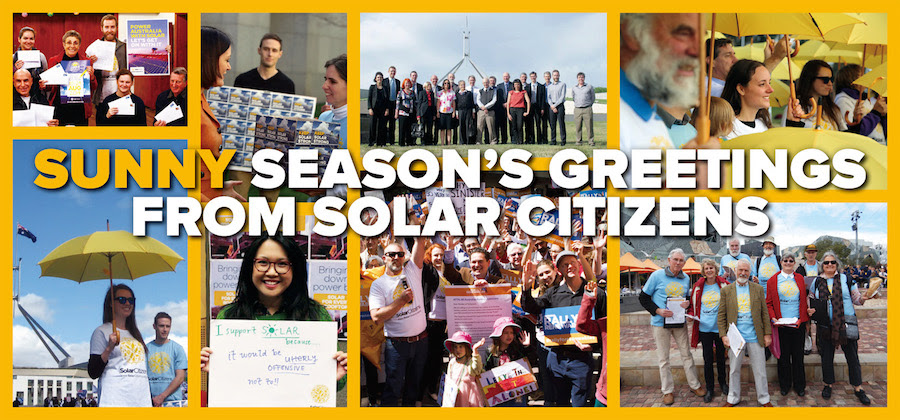
    I couldn’t let the year come to an end without saying a huge thank you for making 2014 the year when solar owners and supporters raised the rooftops.

    Together we’ve rallied in our thousands, written letter after handwritten letter, signed petitions and met with politicians. This year we’ve grown to more than 60,000 Solar Citizens supporters across our nation. Wow!

    Here are just a few of many highlights from 2014 and what we’ve achieved together:

    • Whether you came to a public meeting, held a Cuppa Sunshine or signed a petition postcard, you were there with us calling on our politicians to Keep Solar Strong and protect the Renewable Energy Target.
    • We held a snap national Rally for Renewables that saw thousands of people come together in an unprecedented show of support for renewable energy across the country.
    • Solar Citizens supporters formed teams around the nation to meet with dozens of MPs and senators to fight for the future of solar and the jobs, growth and investment it creates.
    • We held our first-ever volunteer leader training retreat to make sure our teams are prepared for whatever next year brings for solar.

    The Government is persisting in its attempt to gut or axe the Renewable Energy Target*, but together we’re making a huge difference to our solar future.

    One in five Australian households now use solar power and 85% of Australians want to see more solar power on our rooftops. Poll after poll shows that Australia wants more solar and renewables, not less – and the media is paying attention.

    So enjoy the season but you and I know there will be more to do come 2015. We won’t stop until the future of solar in Australia is secure and the rights of solar owners are protected. And the best thing is we know you’ll be standing with us – rain, hail or shine. That’s why we’ll win.

    From all the team and on behalf of committed Solar Citizens volunteers, thank you for your support and best wishes for the New Year.

    Sunny regards,

    Claire, National Director


    P.S. For us, summer so far has been full of sunshine and packed with giant beach towel signs on Parliament lawn, but it’s time for the national office team to re-charge our (solar-powered) batteries. We’ll be taking a short break and then be back, raring to go, in the New Year.

    http://www.businessspectator.com.au/article/2014/12/18/policy-politics/renewables-industry-concedes-ground-government-still-asking-20
    http://reneweconomy.com.au/2014/australian-fossil-fuel-subsidies-put-at-47bn-as-ret-wrestle-continues-58572

    Solar Citizens
    http://www.solarcitizens.org.au/

  • Australia faces a stormier future thanks to climate change

    19 December 2014, 6.46am AEDT

    Australia faces a stormier future thanks to climate change

    The supercell that hit Brisbane on November 27 this year caused more than A$500 million worth of damage, produced hail up to 7.5 cm in diameter, and lashed the city with winds of more than 140 km an hour…

    ‘Plates of the Outback’ – A supercell thunderstorm near Urana, NSW drifts over the landscape. John Allen, Author provided

    The supercell that hit Brisbane on November 27 this year caused more than A$500 million worth of damage, produced hail up to 7.5 cm in diameter, and lashed the city with winds of more than 140 km an hour.

    In the news, we hear about tornadoes or supercells, and wonder if climate change is beginning to have an impact on these events.

    In fact, the evidence suggests that while there has been no increase in severe storm activity in the past, we are likely to see stronger and more frequent storms in the future.

    The science of storms

    Growing up in Sydney’s western suburbs, I remember the summer thunderstorms appearing in the afternoon to the west, and wondering just why we see these castles in the sky.

    Thunderstorms form when moisture and warmth near the Earth’s surface is overlapped by cooler air, causing an “updraft” of rising air. The more warm and moist the air, the stronger the thunderstorm’s updraft.

    An example of a supercell thunderstorm updraft near Chingapook, Victoria. The red lines show where warm moist air moves towards the storm, and rises through the cooler dry air roughly outlined by the blue line. Wind shear pushes the precipitation away from the updraft, and allows the storm to rotate clockwise, producing a supercell. John Allen
    Click to enlarge

    Thunderstorm clouds are like the bubbles you see in a saucepan of water on the stove, where the heated water rises through cooler water above. Most of the time, a thunderstorm fills the sky for an hour, rises, rains and then disappears as if it was never there.

    Locations with reported severe thunderstorms for Australia for the period 2003-2010. 1550 events represent observations of tornadoes (red), hail (blue) and wind (green). John Allen
    Click to enlarge

    But in certain situations, these storms can become “severe”, producing hail in excess of 2 cm, wind gusts above 90 km per hour and sometimes tornadoes. To form, severe thunderstorms typically need some degree of changing wind speed and direction at different levels of the atmosphere — known as wind shear.

    If you’ve ever looked up at the sky and seen clouds moving in different directions, that is wind shear. Wind shear organises thunderstorms, moving rain away from the updraft, and allowing the storm to grow outside the normal lifetime of a thunderstorm, becoming stronger. The strongest of these organised storms are known as supercells and produce most hail larger than 5 cm, as well as tornadoes.

    Severe storms widespread in Australia

    Every year, Australia sees many severe thunderstorms, but we only hear about the few that hit populated areas, as someone needs to be present to observe the effects of a storm.

    In reality, severe thunderstorms are found over the entire continent, but the intersection between tropical moisture and stronger wind shear means that they are most commonly found over the east coast and interior, stretching from Rockhampton to Melbourne.

    To estimate their frequency, we can use a combination of potential updraft strength and wind shear to give an idea of how many days conditions are right for severe thunderstorm development. Using this approach, we can estimate Brisbane gets around 25 favourable days, Sydney 20 and Melbourne 10 days per year.

    ‘In Need of Rescue’ – A squall line moves along the Queensland coast toward Nowra. John Allen
    Click to enlarge

    Has 2014 been particularly stormy?

    Overall, the frequency of severe storms in 2014 was about average, or even slightly below. Perhaps we are just forgetting some of those days when the storms weren’t as extreme, or those which missed populated areas.

    The Brisbane supercell hailstorm of November 27 has a damage bill rising above A$500 million, but is far from unprecedented in either hail size or damage (in 1985 a similar event caused A$1.7 billion in equivalent damage).

    Similar hail events have often befallen Melbourne (2010, 2011), Perth (2010), and Sydney (2007).

    In terms of damaging winds, estimated gusts (around 140 km per hour) were not as strong as the 1985 storm (around 185 km per hour), but similar to the storm that affected the Brisbane suburb The Gap in 2008.

    If we just look at days favourable to severe thunderstorms, there is little indication that there is an increasing frequency of severe thunderstorms outside of natural variability since 1979.

    ‘The Shelf’ – A shelf cloud associated with a squall line stretches across the Victorian plains near Mitiamo. John Allen
    Click to enlarge

    Will severe storms become more common?

    In a warming climate, results for Australia, the United States and Europe have shown that the the surface air becomes warmer and moisture increases, making updrafts stronger, while the wind shear available to organise storms appear to decrease.

    This battle between the elements seems to end with the strength of updrafts winning, and results in more days with stronger severe thunderstorms. Over the east coast, projected increases by the end of the 21st century for Melbourne, Sydney and Brisbane range between 114% and 160% of present levels.

    ‘Crawler of the Dish’ – Lightning crawls through the anvil from a storm near Parkes, NSW while a semi-trailer drives down the road. John Allen
    Click to enlarge

    Are we certain though? Several factors remain unexplained in a warming climate.

    If the air above the surface warms as well, then it is possible that warming the surface won’t result in as many thunderstorms, but they will be stronger.

    If we don’t get as many patterns which pull the conditions favourable to thunderstorms together, then maybe the frequency won’t change or will simply shift the season.

    It is important to remember that even as the climate changes, our poor knowledge of past events is insufficient to say with any degree of certainty that a severe thunderstorm is beyond what was possible before.

    What this change does mean is an increasing likelihood that we will see severe thunderstorms more often, and the question remains as to whether Australia as a nation is prepared to respond.

  • Avaaz – in 2015, we Rise

    Click here to enable desktop notifications for Gmail.   Learn more  Hide
    More

    3 of 19
    Web Clip
    The Age National HeadlinesHazlewood upstages McGrath12 hours ago

    Avaaz – in 2015, we Rise

    Inbox
    x

    Ricken Patel – Avaaz

    4:38 AM (3 hours ago)

    to me
    Dear amazing Avaazers, this is from the heart —
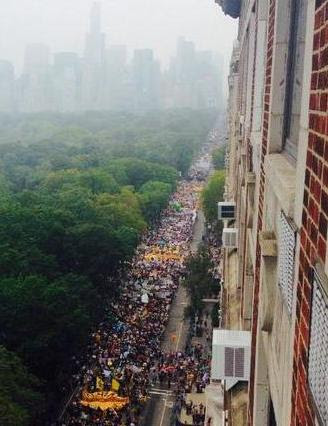

    Rising to the moment in the climate march. Let’s build this magic in 2015!

    In myself, and in the world, I feel things are fragile, poised on the edge between deepest dreams and oldest fears.

    The world hasn’t seen this many refugees since world war II. The politics of fear is rising. We’re decimating our planet — 95% of the mammals we’ve left alive are us, and the animals we breed to eat! And climate change threatens our very survival.

    And yet, never has the status and power of women been greater. Never before has more than half the human race lived in democracies. And we’ve cut global poverty in half in the last generation, and are on track to end it in this one. Never before has our human potential been so unleashed to decide our own fate.

    Maybe that’s how it goes. When you’re closest to your dreams, on the edge of grasping them, that’s when your worst demons come. And we face a choice and challenge — to rise with our best to this fateful moment, or let it fall.

    Will humanity rise? I believe it might depend partly on Avaaz. There’s 40 million of us now, the largest campaigning community ever. This fall, millions of us changed the game on climate change with a profound shift in political momentum on the issue. It was magical. As inspiring as the thousands of us who put our hands up to risk our lives on the front line of the Ebola fight. And the millions of us who took action to protect our oceans and defeat a Monsanto mega-project. From politicians, media and people, I’m hearing the same thing – we’re bringing hope.

    And hope is exactly what our world is desperate for. It’s the game changer. Hope, is how we rise.

    That hope and this precious community is made possible by a tiny fraction of us who chip in to cover all of Avaaz’s core costs. We only ask once per year — so if it feels right, pledge to support Avaaz in 2015 with a one-time donation, and help us all rise to this moment — we’ll process your pledge only if we reach our goal of 20,000 new supporters:

    Donating now enables Avaaz to plan responsibly around long term costs like our tiny but awesome staff team, our website and technology, and the security of our systems (this can get pricey when our campaigns are taking on shady characters!). It also means we have the ability to respond immediately to crises as they occur and jump on opportunities for action without delay.

    If 20,000 of us pledge, that would allow our community to expand all our work next year, helping to save lives in humanitarian emergencies, protect the environment and wildlife, support democracy and fight corruption, push for peace and reduce poverty.

    Donating to Avaaz has a double-impact — because our donations not only make change now by empowering particular campaigns, every contribution builds our community that will be making change for decades to come. It’s an investment with both immediate and long term results for our children’s and our planet’s future. Click here to contribute:

    YES, I’LL PLEDGE $5

    YES, I’LL PLEDGE $7

    YES, I’LL PLEDGE $11

    YES, I’LL PLEDGE $17

    YES, I’LL PLEDGE $28

    To pledge an amount other than the ones listed above, click here.

    Together, we’ve donated millions to humanitarian aid, played a key role in stalling Rupert Murdoch’s march to global media domination, won dozens of national and global victories on climate change, defeated Monsanto mega-projects, won protection for vast areas of our oceans and forests, upheld the global ban on whaling and helped protect Elephants and Rhinos, supported democracy movements from Burma to Zimbabwe to Palestine to Russia, killed ACTA and other efforts to censor the internet, opposed unjust war in Iraq and violations of human rights in Guantanamo, and stood up for whistleblowers like Snowden and Manning when it mattered. In literally hundreds of victories, our community has proven to be fearless, principled and effective in seeking the world we all dream of.

    But it’s not enough. To meet the challenges of our time, we need to reach another level to go to toe to toe with the governments and corporations that are behind the problems we face. To win on climate change, we need to beat the oil companies, and they spend billions. To win on human rights, we need to press abusive governments, and they have enormous power. The power of 40 million committed citizens is unstoppable, but accessing that power requires a journey of trust, and commitment. I’m so excited and hopeful to take the next step on that journey with you:

    YES, I’LL PLEDGE $5

    YES, I’LL PLEDGE $7

    YES, I’LL PLEDGE $11

    YES, I’LL PLEDGE $17

    YES, I’LL PLEDGE $28

    To pledge an amount other than the ones listed above, click here.

    Fundraising is often a problem for social change organisations. Government or corporate funding would profoundly threaten our mission. Funding from large donors also often comes with strings attached. And high-pressure tactics like telemarketing, postal mail, or direct on-the-street programmes often cost nearly as much as they raise! That’s why the Avaaz model – online, people-powered donations – is the best way in the world to power an engine of social change, and a huge part of our community’s promise.

    If we can multiply the number of supporters we have, it will take our community, and our impact, to a whole new level. I can’t wait.

    Regardless of whether you pledge today, please know how grateful I and the team are for your wisdom, your commitment, and your incredible spirit of humanity. It’s really a blissful thing to work for you! And together, we really, truly, can build the world we dream of.

    With love, hope and gratitude,

    Ricken and the whole Avaaz team

    PS – In case you’re mulling it over, here’s 11 more reasons to donate to Avaaz 🙂

    Reason 1 – What we do works

    With more than 40 million members in every nation of the world, able to mobilise at a moment’s notice to pressing needs and opportunities, Avaaz works –- together we’ve saved lives in Haiti and Burma, reversed government policies from Brazil to Japan, won victories on international treaties from banning cluster bombs to preserving oceans, and if Avaaz was a country, we’d be the 25th largest donor to Ebola emergency relief! Former UK Prime Minister Gordon Brown says of Avaaz “You have driven forward the idealism of the world … do not underestimate your impact on leaders,” while the Economist says Avaaz is “poised to deliver a deafening wake up call to world leaders,” and Al Gore says “Avaaz is inspiring, and has already made a difference.” We’re only 8 years old and growing fast, and the more our members get involved and donate, the more impact we have.

    Make a pledge here.

    Reason 2 – An Avaaz donation is an investment with permanent social change returns

    With Avaaz, our donations fund high impact campaigns that also recruit more people. More people means more donations, and more impact. So you’re not only achieving a particular change with your donation, you’re helping grow a community with new members that will multiply your donation many times over, and be a permanent and ever-increasing source of change. It’s a tremendous philanthropic value to have this kind of double and permanent impact.

    Reason 3 – We have no bureaucracy

    Avaaz is a massive network of citizens, but our organisation is absolutely tiny – just 69 full time campaigners with operational and technology support. Most large global NGOs have hundreds or even thousands of staff. Our small size means we have no time for red tape, layers of management, or being focused on anything but getting results.

    Reason 4 – We’re regularly audited, and fiscally responsible

    There’s a lot of fear out there about misuse of donated money. Most of the fear is misplaced – most organisations are filled with good people trying to do good things. With Avaaz you can be sure – partly because we’re required by law to be audited every 12 months. This audit thoroughly checks every aspect of our books and financial practices. We’ve been audited 8 times since we launched and every time been given a squeaky clean bill of health (for details, click here).

    Reason 5 – We have a world-class team that does outstanding work

    Campaigning, advocacy and social change are a serious and demanding business – the more competent the team, the more impact our donations have. Avaaz attracts some of the best campaigners and advocates in the world. Many of our Campaign Directors joined us after being CEOs of successful advocacy organisations, and most have degrees from the top universities in the world.

    Make a pledge here.

    Reason 6 – We’re 100% independent

    Avaaz takes absolutely no money from governments or corporations. This is hugely important to ensuring that our voice is exclusively determined by the values of our members, and not by any large funder or agenda. While we received initial seed grants from partner organisations and charitable organisations, 100% of the Avaaz budget now comes from small online donations. This means that the only agenda we have to follow is the people’s agenda.

    Reason 7 – We pass the money on when it makes sense, and give to the best efforts

    Avaaz has donated nearly $10 million to other organisations, because we saw them as better placed than us to have impact on a particular issue. For example, we’ve granted $2 million to Ebola frontline organisations, $1 million to a top rainforest conservation group, $1.6 million to Burmese monks and aid groups, $1.3 million to Haitian aid organisations (see this video from the groups that received our donations), and more than $1 million to relief organisations in Pakistan. The way we support organisations is important too. Most foundations have endless process and constraints that make them slow, bureaucratic and risk averse in supporting advocacy. Avaaz finds the best people and organisations and doesn’t micromanage them — we just empower them to do what they know best.

    Reason 8 – We’re political (this really matters)

    Most charities offer tax deductibility for donations. But this means that they are, in a way, partially taxpayer funded, and governments use that to place a very thick set of rules on what they can and can’t do. Chief among them is restricting what they can say to criticize, support, or oppose a politician. Avaaz is very rare in that our donations are not tax deductible, leaving us 100% free to say and do whatever we need to to get leaders to listen to people. Since so many important issues are won and lost in the political realm, this makes us much more effective than advocacy groups that shy away from speaking out politically.

    Reason 9 – We go where the greatest needs and opportunities are

    Most organisations focus on a single issue over a long period of time. This is very important to do, but that can mean that when desperate needs or amazing opportunities for social change arise, they get ignored because everyone is working on their own issue. Avaaz campaigns target the most urgent needs and opportunities, showing up just when a powerful burst of citizens’ attention is needed most. We work continuously with top quality partners in the areas we campaign on, and all describe Avaaz as an amazing added value to their work.

    Make a pledge here.

    Reason 10 – Democratic accountability is hard-wired into our model

    The Avaaz model of campaigning is people-powered. Our priorities are set at annual and weekly levels by polls of our membership and every campaign we run is first polled with members. No matter how much work we put into developing a campaign, if it fails to get the greenlight from members, we don’t run it. So on a day to day basis, how we spend the donations we receive is determined directly by members.

    Reason 11 – There’s no other organisation like us

    Avaaz is the world’s first and only massive, high-tech, people-powered, multi-issue, genuinely global advocacy organisation. In a world where the problems we face are consistently global, and the solutions to them increasingly require global, democratic action, Avaaz is uniquely placed to effect change. No other organisation can rapidly mobilise large-scale, coordinated democratic pressure in over 194 countries within 24 hours. A new model of internet-based, people-powered politics has changed politics in several countries, and Avaaz is taking that proven model global. The result is already the largest global online movement in history, and we’re just getting started.


    Avaaz.org is a 40-million-person global campaign network
    that works to ensure that the views and values of the world’s people shape global decision-making. (“Avaaz” means “voice” or “song” in many languages.) Avaaz members live in every nation of the world; our team is spread across 18 countries on 6 continents and operates in 17 languages. Learn about some of Avaaz’s biggest campaigns here, or follow us on Facebook or Twitter.

  • Lima Talks; Oil Prices; Happy Planet Index; Christmas Footprint Global Footprint Network

    Click here to enable desktop notifications for Gmail.   Learn more  Hide
    More

    1 of 2
    Web Clip

    Lima Talks; Oil Prices; Happy Planet Index; Christmas Footprint

    Inbox
    x

    Global Footprint Network Unsubscribe

    7:12 PM (1 hour ago)

    to me
    Ecological Footprint Image LightGreen Footprint Network News
    Issue 38, December 18, 2014

    Fueling Footprint Conversations

    The Lima Accord reached at the conclusion of COP 20, the UN Framework Convention on Climate Change’s 20th meeting last week, marks the first time all nations have agreed to cut carbon emissions. Although non-binding, it is an encouraging development that sets the stage for more action on climate change in 2015 ahead of the Paris summit next December.

    The more than 10,000 representatives from 196 nations went home with plenty of work to do to uphold their promises to spell out their voluntary commitments on emission reductions by March 2015. The sooner countries prepare for the inevitable march of time towards a low-carbon future, the better.

     “Economies that are not planning their transition to a low-carbon future are vulnerable to unpredictable events such as consumers and investors turning against carbon-intensive products, the price of renewable energy becoming more competitive than that of fossil fuel-based energy, and technology advances,” said Sebastian Winkler, VP of Programs and Outreach at Global Footprint Network, upon returning from Lima.

    Global Footprint Network’s Finance for Change initiative is developing tools to evaluate the risks of stranded assets posed to nations’ economies and their sovereign debt.

    “Our analysis shows that countries are unequally exposed in terms of the scale and impact of reforms required to move to low-carbon economies. The longer countries wait, the more their carbon-intensive assets will lose value in a low-carbon future,” Global Footprint Network President Mathis Wackernagel pointed out in his commentary on the landmark U.S.-China climate deal announced last month, which created momentum heading into the Lima meetings. Read Wackernagel’s full statement on the U.S.-China agreement.

    What’s really behind the dramatic drop in oil prices? When and why might they go back up? Who are the winners and losers? Chris Nelder, Global Footprint Network’s policy officer, suggests a jump in U.S. oil production as a result of fracking is one major factor, but traders are now fueling the price decline. He forecasts that if prices remain at their current depressed levels for another three months or more, we should expect a slowdown in growth of U.S. oil production. “Some slowing is already indicated, as new drilling permits fell by 40 percent from October to November,” he notes. Read more of Nelder’s oil price analysis

    Click the interactive map below to see the multitude of locations where our team has been working to expand knowledge about the Footprint these past couple of months.


    Footprint in Action
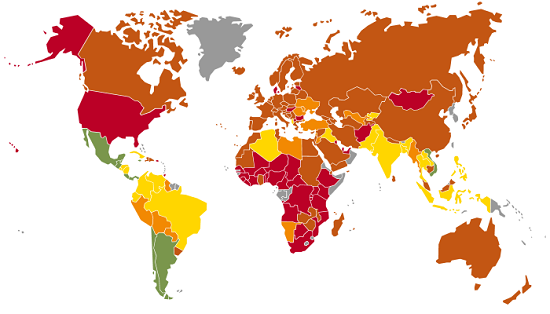
    Iraq – a “happier” country than … the United States?! The New Economics Foundation’s latest Happy Planet Index is out, demonstrating once again that the environmental cost of rich countries’ lifestyle fails to sustainably deliver long and happy lives. The overall index scores rank 151 countries based on life expectancy, experienced well-being and the Ecological Footprint. The resulting map is striking. Can you guess which is the happiest country of all?

    Montenegro appears to be the only country in the Mediterranean basin to have improved the proportion between biocapacity balance and production footprint between 1961 and 2007, according to the UN Development Programme’s latest National Human Development Report-Montenegro. Montenegro’s footprint comes close to its biocapacity, demonstrating that it is possible to achieve a high level of human development while maintaining a low level of environmental impact. At the same time, the local economy is about three times as energy-intensive as the EU economy. Across sectors, resource efficiency is indeed the main challenge facing the country going forward. Among five scenarios put forward in the report, “moderate reduction in the use of resources” emerges as optimal. It envisions an active and ambitious natural resource management policy that would increase resource productivity by 60 percent in 2020 compared to the 2005-2012 period average, and would achieve an absolute reduction of the use of resources of 20 percent compared to the same period average.

    News from the Network
    We were thrilled to learn that Professor Herman Daly, widely viewed as the father of ecological economics, was named a Laureate of the 2014 Blue Planet Prize (received by Global Footprint President Mathis Wackernagel in 2012). A formal acknowledgement of his contribution to economic theory was long overdue: He was one of the first to demonstrate that an economy has an optimal physical scale in the context of the natural ecosystems that support it.

    If too big, an economy starts yielding diminishing returns on investments, since the costs of operating become larger than the benefits that the system is able to generate. Consider the overuse of natural capital, for instance, where degradation of that capital is mistakenly considered “income” while, in fact, the long-term ability of that capital to keep yielding steady income is being compromised.

    By calling for an economic theory that is consistent with biophysical limits, Daly essentially laid the foundation for Global Footprint Network’s work. When asked whether his ideas about living within the regenerative capacity of the planet are unrealistic, he typically answers that he’d rather be unrealistic about socio-economic rules and behaviors than about physical conditions, since the economic rules can change but physical reality cannot. We could not agree more.

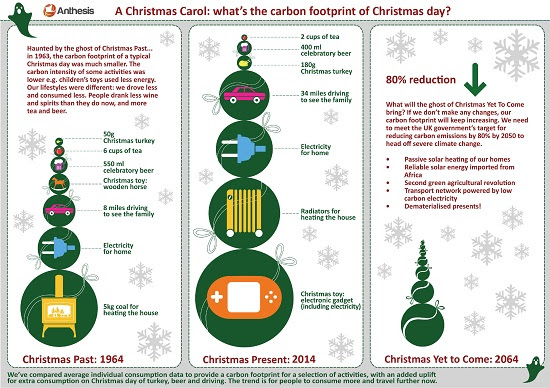
    The Carbon Footprint … of Christmas: Santa Claus has long been known for traveling sustainably on a reindeer-powered sleigh, snacking on milk and cookies, and delivering books, puzzles and board games with low-emissions life cycles to children around the world. Our 2014 Christmas, on the other hand, requires a lot more carbon than it did 50 years ago, according to an infographic from our partner organization Best Foot Forward (Anthesis Group). We drive around 34 km on fossil-fuel powered cars, eat meat galore and shower our loved ones with gifts of electronic gadgets. These devices have high carbon Footprints due to the large amount of energy required to produce the components and batteries, and to the power they consume when in use.

    Instead of a white Christmas, how about creating a green Holiday where the gift of experiences trumps the giving of things? Check out these suggestions from treehugger.com.

    From Our Blog
    Lead scientist David Lin traveled to the Indian state of Odisha to provide support to Pragyan Bharati, our India director, on our new pilot project there, Sustainable Development Return on Investment. In partnership with local organizations Gram Vikas and International Development Enterprises-India, we aim to empower local villagers to have a more informed voice in shaping development in their communities. Read Lin’s account of his eye-opening trip, in which he saw first-hand how seemingly small innovations can make an impact.

    Last month co-founders Susan Burns and Mathis Wackernagel were inducted into the Sustainability Hall of Fame. Susan made the trip to the International Society of Sustainability Professionals Conference in Denver, Colorado, to receive the award. She took that opportunity to pause and reflect on her journey as a sustainability pioneer. Read her candid interview.

  • 2014: best, worst and funniest ACF

    3 of 4
    Web Clip
    Forbes.com: Most popular storiesTechnical Glitch Hasn’t Stopped Best Buy’s Holiday Boom2 days ago

    2014: best, worst and funniest

    Inbox
    x

    Kelly O’Shanassy, ACF Unsubscribe

    7:01 PM (20 minutes ago)

    to me

    Dear NEVILLE

    I deeply appreciate you being part of ACF in 2014. Thank you.
    As a big believer in celebrating the wins, standing strong after the losses and keeping a sense of humour at all times, we’ve pulled together the highs, the lows and the hilarities of 2014. Enjoy!

    The Best

    Tasmanian World Heritage forests safe – When the federal government asked the UNESCO World Heritage Committee to tear up the listing for 74,000 ha of Tasmanian wilderness – you signed, called, faxed, delivered trees, rallied and donated. It took just seven minutes for the committee to throw out the government’s proposal. It made me dance among the trees!

    Radioactive waste dump dumped For seven years, the Muckaty mob fought a radioactive waste dump on their land. In June, the federal government formally withdrew its plan. They were the sixth remote community targeted and pressured by federal governments to be a dumping ground. They’re the sixth to say no.
    Environment laws protected – Pushing the big business agenda – to mine, dredge, and frack with no one watching – the government tried to water down the laws that protect the places we love. Against the odds, you and community leaders from all over Australia held them at bay, persuading crossbench Senators we need strong protections. There’s a long road ahead. Your support can help the push for a new generation of environment laws.
    Stolen country returned – “There’s a time to cry, there’s a time to laugh – now is the time to dance.” Olkola elder, Mike Ross, did exactly that last week when, after a century locked out, his people’s country on Cape York was returned to them. It’s an incredible story.
    The road ahead – I’m so excited to forge ACF’s new path with you and our President Geoff Cousins. If you missed our AGM, you can watch Geoff reveal how far he is prepared to go to make change. In my speech I talk about two of my favourite things: trees and people power.
    Sparking community change – ACF and the YMCA have doubled Spark’s reach. Kinder teachers, fitness instructors and chefs at YMCA centres saving energy and going solar. As part of the Climate Reality Project, we trained 415 new leaders. And we know many of you are taking action at home and in your communities. Your efforts matter.

    The Worst

    Where do I start?
    Polluters no longer pay – The government scrapped the law that made polluters pay for their carbon pollution. It was working. Pollution was going down. Now it’s going back up. This is what happened after you signed the petition. We lost that one……for now!
    Clean energy assaulted – In another inexplicable move, the government attacked the Renewable Energy Target with a hand-picked panel of climate denialists and former oil and gas executives, but you fought back with letters, phone calls, rallies, posters and by pressuring the ‘dirty three’ power companies. The RET is still alive.
    Nature not nurtured –  The Tasmanian government scrapped the Tasmanian Forest Agreement, the historic ‘peace deal’ between conservationists and the timber industry.
    The federal government approved the biggest coal mine in the world, dredging the reef, and opening a giant coal port.
    All this when we know nature is in trouble. A landmark survey of Australia’s environment by the Places You Love Alliance shows that we need to restore our rivers, climate, forests, soils, oceans and reefs, not make them worse — or we could lose them forever.
    Money madness – The federal government is handing out $47 billion in fossil fuel subsidies that promote pollution and only $1 billion to the Direct Action Plan to reduce pollution.

    The Funniest

    Good for humanity? – The Prime Minister, taking his cues from big coal, declared that “coal is good for humanity”. (Well it would be be funny if it weren’t so sad).
    It reminded me of the hilarious failed attempt the coal industry made to run a social media campaign called #Australiansforcoal. Hmmm, turns out Aussies prefer clean energy.
    G20 surprise – Our climate change campaign manager Victoria McKenzie-McHarg went above the call of duty with her crazy call to put climate change on the agenda of the G20. We can’t believe she did it in one take. And despite Mr Abbott’s best efforts, the G20 turned into a show of force for action to tackle climate change.
    The Emperor’s new clothes – Saffron, from our Canberra office, fielded some tricky questions from her six year old this year about her work in Parliament House. My favourites:
    • If people who don’t want to destroy the world become leaders one day, will you have to get a different job?
    • Is government just for boys?
    • Why don’t you have shoes that are pretty AND comfy?
    Meme me please – If you need more of a laugh, join ACF’s Facebook. You’ll find plenty of chuckles there. After all, how much can a koala bear?*
    Thank you so much for your continued financial support, interest and environmental action. With you on our team, 2015 could be the biggest year in ACFs history (and it’s our 50th!).
    Enjoy the great outdoors and the holiday season,
    Kelly
    Kelly O’Shanassy
    Chief Executive Officer
    Australian Conservation Foundation
    PS. You keep ACF fearless and independent – We are 94% funded by you, our members and supporters, and I’m so grateful for your support and to those who have remembered ACF in their wills. Our campaign for stronger, not weaker, environmental laws is at a crucial stage. Your contribution can make a difference
  • Season’s Greetings GEODYNAMICS

    1 of 2
    Web Clip
    CNN.com Recently Published/UpdatedOxfam digests lessons from 2004 Indian Ocean tsunami4 hours ago

    Season’s Greetings

    Inbox
    x

    Geodynamics info@geodynamics.com.au via mail28.wdc01.mcdlv.net 

    3:32 PM (5 minutes ago)

    to me

    #
    This is an auto-generated email alert. Please do not reply to this email. If you have any queries please contact us via info@geodynamics.com.au or click here to visit our website.

    We thank you for your interest in Geodynamics Limited.

      COPYRIGHT 2014
    GEODYNAMICS LIMITED

    Geodynamics Limited – Level 1 / 9 Gardner Close – Milton Queensland 4064

    www.geodynamics.com.au | Unsubscribe | Update Subscription Preferences | Privacy Policy


    Click here to Reply or Forward
    0 GB (0%) of 15 GB used
    ©2014 GoogleTermsPrivacy
    Last account activity: 1 hour ago

    Details