AdDon’t buy CBA, BHP, WOW – www.moneymorning.com.au – Forget blue-chip stocks. Here’s where the big gains are in 2014
|
Coal is good for humanity?

|
|||||||||||||
Add your news
You can add news from your networks or groups through the website by becoming an author. Simply register as a member of the Generator, and then email Giovanni asking to become an author. He will then work with you to integrate your content into the site as effectively as possible.
Listen to the Generator News online
The Generator news service publishes articles on sustainable development, agriculture and energy as well as observations on current affairs. The news service is used on the weekly radio show, The Generator, as well as by a number of monthly and quarterly magazines. A podcast of the Generator news is also available.
As well as Giovanni’s articles it picks up the most pertinent articles from a range of other news services. You can publish the news feed on your website using RSS, free of charge.
|
AdDon’t buy CBA, BHP, WOW – www.moneymorning.com.au – Forget blue-chip stocks. Here’s where the big gains are in 2014
|
Coal is good for humanity?
|
|||||||||||||
|
AdCommercial Solar Power – www.naturalsolar.com.au – 12 Year Installation Warranty Commercial Solar Experts Free Quote
|
Daily update: RET about to get Abbott-style haircut
|
||||||||||||||||||||||||||||||||||||
|
Adphoto booth hire sydney – www.wackysnaps.com.au – Unlimited Instant Photo, Free Props Weddings, Functions, Parties
|
Their fight is our fight too
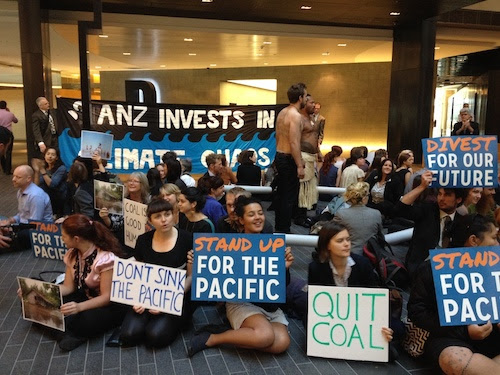
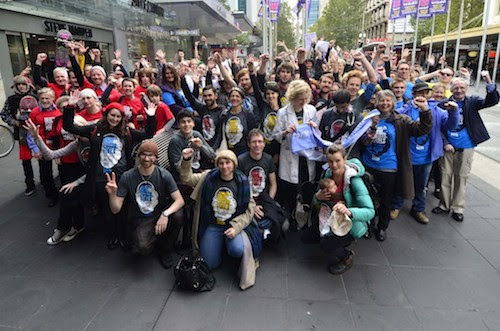
Dear friend, Last week, thirty Pacific Islanders did something truly brilliant. Together, brothers and sisters from across the Islands joined over 500 Australians to block ten coal ships at the world’s largest coal port in Newcastle. Click here to re-live this incredible day. And this week, Australia responded. In cities around the country, we stood together to show that the fight for the Pacific Islands is our fight too. Australians will not let our island neighbours drown – we will stand up to the fossil fuel industry whose activities are destroying their and our homes, their and our communities. Click here to pitch-in and help us sustain the fight! Over the past four days, Australians everywhere have taken the frontline of the fight against climate change to the heart of the fossil fuel industry and their backers. From Melbournians peacefully sitting-in at ANZ – the largest lender to coal and gas projects in Australia…
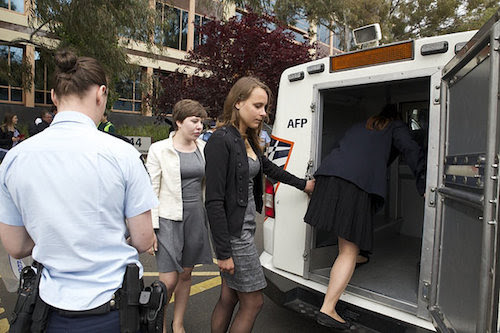
…to Canberrans getting arrested for peacefully occupying the Minerals Council of Australia, whose lobbying locks us into an unsafe future…
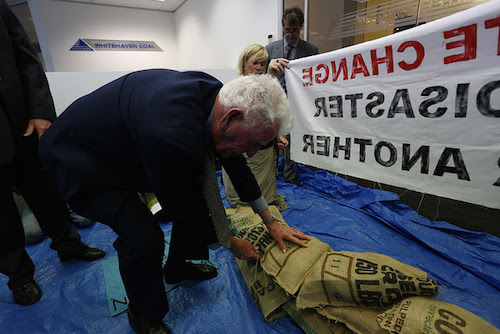
…and 92-year olds sitting in at the offices of Whitehaven Coal who, right now, is developing Australia’s largest greenfields coal mine at the Leard State Forest.
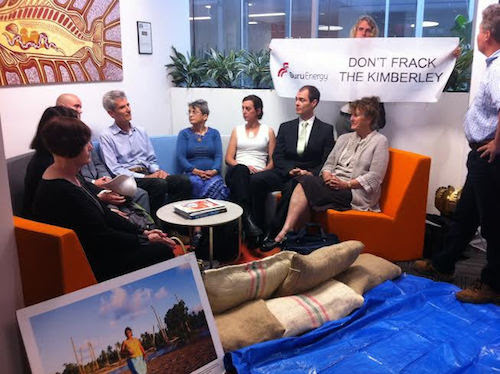
From Perth residents occupying the offices of oil and gas company Buru Energy, who plans to frack the land of traditional owners in the stunning Kimberly…
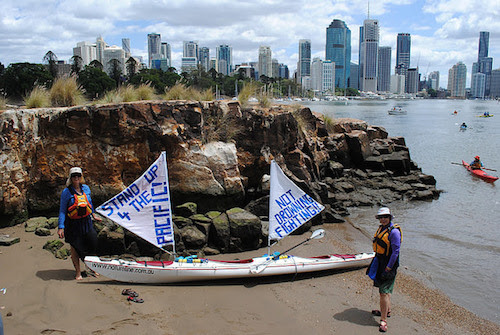
…and flotillas on the Brisbane river… …to thousands of Australians moving hundreds of millions of their savings out of Australian Banks financing fossil fuel expansion. And this is just the start. To truly win this fight, the action that we’ve taken this past week has to grow in scale and pace. The coming months and years will test us in ways that we can’t imagine. Because we are the first generation to feel the impact of climate change and the last to be able to do anything about it. So let’s do something about it – together, peacefully, hand-in-hand. Yours in solidarity, Blair, Charlie, Josh, Simon and Aaron for the whole 350 team — PS See all the images from the Warriors’ actions here:
350.org is building a global climate movement. Become a sustaining donor to keep this movement strong and gr |
|||||||||||
1 of 7
| AdStudy Region Development – une.edu.au/Economic-Development – Study Econ & Reg Development online anywhere, anytime with UNE. Oct 27! |
[Watermatters] Water Matters Issue 34 October 2014 [SEC=UNCLASSIFIED]
Dear subscribers
Please find the link to the Water Matters e-newsletter below. This issue contains stories about renewed funding for the GABSI program, the Commonwealth Environmental Water Holder’s selection of six local engagement officers, a new web tool allowing users to map Australia’s groundwater resources and the 100th anniversary of the River Murray waters agreement.
http://www.environment.gov.au/water/publications/water-matters
Water Matters provides subscribers with information about the Australian Government’s water reform initiatives.
If you wish to unsubscribe from Water Matters, please follow this link: http://www.environment.gov.au/apps/web-forms/subscribe/watermatters.html |
|||||||||
|
AdDon’t buy CBA, BHP, WOW – www.moneymorning.com.au – Forget blue-chip stocks. Here’s where the big gains are in 2014
|
Hoodwinked?

Dear NEVILLE, They’re not being straight with us and they are still out to destroy solar and renewables. Two weeks ago Cabinet rejected the dodgy Warburton review of the Renewable Energy Target. But yesterday the Federal government walked into negotiations with almost exactly the same position as the Warburton review, and that is the destruction of the Target. The government is bent on pursuing the so-called “real 20%”, which would mean Australia’s renewable energy production would be cut almost in half by 2020. The vested interests are lining up for exemptions and the big power companies reckon they will clinch their glittering prize – a weakened Target that will mean bigger profits for them and higher power prices for all of us. So far Labor says it will not accept such an attack on the policy, saying it is “completely unacceptable”. But without a bipartisan agreement on the Target, there is no certainty for solar in Australia and the jobs, growth and investment it creates. The future of solar and renewable energy in this country hangs on a precipice, but you can help. Make a quick phone call today to the MPs who are in Parliament this week, negotiating the future of the Target. Tell your politician that you won’t be taken for a ride when they are talking about Australia’s solar and renewables future. Tell them that we want the Target kept in full, with no cuts.
Yesterday Industry Minister and government negotiator Ian Macfarlane said there would be “no change to the household photovoltaic scheme”. It’s encouraging talk that shows we’re making progress and being heard in the halls of Parliament – our campaign is working. All of your letters, emails, Facebook messages, MP meetings and rallies have left the government with no doubt that we love our solar. But the government seems to think it can talk up protecting household solar so it can clinch wholesale cuts to the Target, which would mean less jobs, growth and investment in Australia and higher power prices for everyone by 2020. Even modelling commissioned by the Warburton Review found that the Target will lower power prices in the long term. A promise from the government on this is hollow unless they can come to a bipartisan agreement; and remember we had bipartisanship until the government started waging its year-long campaign to try and decimate renewables. Right now we need to keep up the pressure on the government and the opposition to make sure there are no cuts to the Target so that solar’s future is protected. Call these key MPs today at their Parliament House offices and tell them that you and millions of Australians want solar and the Renewable Energy Target protected in full.
Australians want the Renewable Energy Target and solar protected – make sure our representatives know that, in no uncertain terms. Make a quick call today to the key negotiating MPs and tell them that the Target must be kept, in full. Yours for a strong solar future, Claire, National Director
P.S. When Tasmanian Solar Citizens met with cross bench Palmer United Party senator Jacqui Lambie last month she told us that she loves and supports solar. It’s a position she repeated yesterday when she was interviewed on Sky News. Every conversation you can have with a politician calling on them to protect the Renewable Energy Target gets through and has an impact. Make your call today to tell MPs at the negotiating table to protect solar and the Target in full – the future of Australian renewables is in our hands. Solar Citizens -=-=- Solar Citizens is an independent community-based organisation bringing together millions of solar owners and supporters to protect and grow solar in Australia. You can also keep up with Solar Citizens on Twitter or like us on Facebook. |
|||||||||||
 Thames Barrier | Shutterstock
Sea levels could rise by a maximum of 190 centimetres by the end of the century, according to a new study, which examines a worst case scenario for sea level rise.
In reality, the amount of sea level rise we get is likely to be less than that. But scientists and policymakers examine such ‘worst case’ scenarios to safeguard against climate risks.
Upper limit
With 10 per cent of the world’s population living less than 10 metres above sea level, the threat of coastal flooding is significant. The Intergovernmental Panel on Climate Change (IPCC) expects sea level rise to cause a ‘ significant increase‘ in sea levels extremes and the risk of coastal flooding.
The new study, published in Environmental Research Letters, considers the assessment of 13 ice sheet experts. They conclude that the contribution from ice sheets is likely to be greater than projected by the IPCC. The paper suggests that sea levels could rise by as much as 190 cm this century.
Projections of sea level rise are typically constructed by working out the contribution to sea level rise from different factors. The biggest contribution is from water expanding as it warms, followed by melting glaciers, then melting ice sheets on Greenland and Antarctica.
The crucial question for sea level rise this century is how much ice will be lost from the ice sheets, the authors argue. But it remains one of the largest uncertainties. In its Fifth Assessment Report (AR5), the IPCC says there isn’t sufficient evidence for them to give probabilities of large-scale losses of ice sheets.
The new study uses expert judgement to consider areas of ice sheet loss that are often not included in the sea level models that the IPCC bases its assessment on. They then combine these judgements with the methods used in AR5 to produce their upper-limit figure of 190 cm.
‘Likely’ range
It’s likely that sea level rise will be lower than that. In AR5, the IPCC projects sea level rise of between 26 and 82 cm by 2100. These projections are presented as a ‘likely’ range, meaning there is a 66 per cent likelihood that sea level rise will fall within this range.
The graph below shows the projections of sea-level rise from all five IPCC Assessment Reports since the IPCC was founded in 1988, based on a ‘business as usual’ scenario where carbon emissions continue to rise.
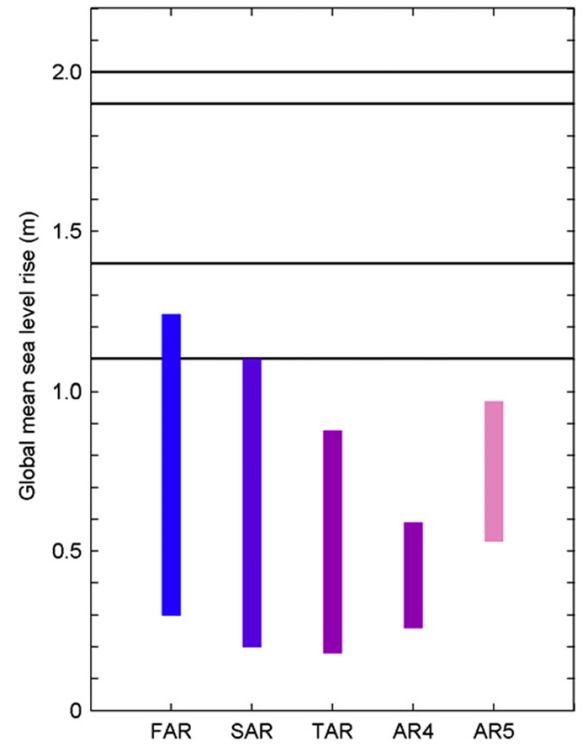
The range of global mean sea level projections for 2100 under business-as-usual scenarios from five IPCC Assessment Reports. From the First Assessment Report (FAR) on the left to the Fifth Assessment Report (AR5) on the right. The black horizontal lines represent ‘low probability-high impact’ scenarios used in national planning assessments: 110 cm from the Delta Commission in the Netherlands, 140 cm from the Scientific Committee on Antarctic Research, 190 cm from UK Climate Projections 2009, and 200 cm from the US National Oceanic and Atmospheric Administration. Jevrejeva et al. (2014)
The projections have changed over the years as understanding of sea level changes has improved. The projection range from AR5 is higher than the Fourth Assessment Report (AR4), for example, because AR4 didn’t consider the contribution of Greenland and Antarctic ice sheets.
Flood protection
The graph also shows sea level projections used in national planning as a series of horizontal black lines. You can see how much higher these are than the IPCC ranges.
So why the difference? Worst case scenarios are necessary in planning for future climate, particularly when the potential cost of any damage is high.
The upper end of the IPCC projections is not a worst case scenario, but rather the largest rise that they consider ‘likely’.
Designers of flood protection need to be sure that they will be able to cope with more than just the ‘likely’ increase in sea levels; therefore, other scenarios have been developed to consider larger, albeit less likely changes.
In the most recent set of climate projections for the UK, for example, the Met Office produced a ‘High++’ scenario of up to 190 cm of sea level rise for just these situations. It takes into account large changes in ice sheets that could cause much larger sea level rises than the IPCC range includes.
The upper end of the High++ scenario “provides a plausible but highly uncertain and very unlikely scenario”. It’s being used in the Thames Estuary 2011 Project to assess the flood risk to London through the 21st century.
While large changes in the ice sheets are unlikely, the thinking goes that there is too much at risk to plan for only an average amount of sea level change. These scenarios are not there to worry people, but to ensure our flood protection can cope with whatever the sea might throw at us.
Jevrejeva et al. (2014) Upper limit for sea level projections by 2100, Environmental Research Letters, doi:10.1088/1748-9326/9/10/104008 [This article is open-access and therefore available to download for free]