Category: News

Add your news
You can add news from your networks or groups through the website by becoming an author. Simply register as a member of the Generator, and then email Giovanni asking to become an author. He will then work with you to integrate your content into the site as effectively as possible.
Listen to the Generator News online

 
The Generator news service publishes articles on sustainable development, agriculture and energy as well as observations on current affairs. The news service is used on the weekly radio show, The Generator, as well as by a number of monthly and quarterly magazines. A podcast of the Generator news is also available.
As well as Giovanni’s articles it picks up the most pertinent articles from a range of other news services. You can publish the news feed on your website using RSS, free of charge.
 

  • Live: Pacific Warriors to face off with coal ship

    1 of 5
    Ad850% + Investment Returnsthe-best-investments-today.com – Invest In Alternative Investments. Huge Profits. Free Top-Pick Guide!

    Live: Pacific Warriors to face off with coal ship

    Inbox
    x

    Aaron Packard – 350.org <aaron@350.org> Unsubscribe

    11:16 AM (4 hours ago)

    to me

    After months of preparation and planning, 30 Pacific Climate Warriors just launched their traditional canoes into the water in Newcastle. They are paddling into the oncoming path of coal ships in an attempt to shut down the world’s largest coal port for a day.

    You can follow the action on our live blog right now!

    As the Pacific Warriors arrived in Australia, news came from back home that king tides fueled by rising sea levels had wreaked havoc on a number of Pacific Islands. Homes flooded, crops lost and critical infrastructure damaged. This was a timely reminder of what living with climate change is like for the Pacific Islands and why they have come to Australia to fight back against the fossil fuel industry.

    But as the warriors stand up to the industry we need your support. They know they cannot win this fight alone.

    Show the Pacific Warriors that they are not out there alone. Share your support and spread their story by taking a photo with your message to the Climate Warriors and posting it to social media using the hashtag #StandUpForThePacific. Need some inspiration? Click here for more information.

    We want to flood social media with messages of support for the Warriors so their message is impossible to ignore. Click here to learn more about how you can show your support for the Pacific Warriors.

    This is a big day. It is a day where the Pacific stands up against the destruction of the fossil fuel industry.

    Please stand with us.

    Regards,
    Aaron Packard on behalf of the 350.org team

    PS: Hear first hand from the Warriors next week in your local city. Click here to register today: www.350.org.au/warriorstory

    1 of 5
    Ad850% + Investment Returnsthe-best-investments-today.com – Invest In Alternative Investments. Huge Profits. Free Top-Pick Guide!

    Live: Pacific Warriors to face off with coal ship

    Inbox
    x

    Aaron Packard – 350.org <aaron@350.org> Unsubscribe

    11:16 AM (4 hours ago)

    to me

    After months of preparation and planning, 30 Pacific Climate Warriors just launched their traditional canoes into the water in Newcastle. They are paddling into the oncoming path of coal ships in an attempt to shut down the world’s largest coal port for a day.

    You can follow the action on our live blog right now!

    As the Pacific Warriors arrived in Australia, news came from back home that king tides fueled by rising sea levels had wreaked havoc on a number of Pacific Islands. Homes flooded, crops lost and critical infrastructure damaged. This was a timely reminder of what living with climate change is like for the Pacific Islands and why they have come to Australia to fight back against the fossil fuel industry.

    But as the warriors stand up to the industry we need your support. They know they cannot win this fight alone.

    Show the Pacific Warriors that they are not out there alone. Share your support and spread their story by taking a photo with your message to the Climate Warriors and posting it to social media using the hashtag #StandUpForThePacific. Need some inspiration? Click here for more information.

    We want to flood social media with messages of support for the Warriors so their message is impossible to ignore. Click here to learn more about how you can show your support for the Pacific Warriors.

    This is a big day. It is a day where the Pacific stands up against the destruction of the fossil fuel industry.

    Please stand with us.

    Regards,
    Aaron Packard on behalf of the 350.org team

    PS: Hear first hand from the Warriors next week in your local city. Click here to register today: www.350.org.au/warriorstory

  • A Tax Cheat is a THIEF (HOCKEY)

    1 of 9
    AdI want to retire abroadwww.escapologist.com.au – Now you can live in luxury for less These 3 countries are safe & cheap

    ‘A tax cheat is a thief’ – Joe Hockey

    Inbox
    x

    Lily – GetUp!

    12:39 PM (2 hours ago)

    to me
    Dear NEVILLE,

    Corporate tax dodging is costing Australian taxpayers billions of dollars — money that could be funding our hospitals, universities and social safety net.

    In a matter of days, more than 40,000 of us signed a petition asking Joe Hockey to ensure corporate tax dodgers pay their fair share of tax — and the pressure is working.

    The Treasurer is now talking tough on corporate tax dodging, saying ‘a tax cheat is a thief’ and making commitments to crack down on global tax evasion.1 But meanwhile, he’s slashed the ATO budget, hamstringing their ability to go after the worst corporate tax cheats.

    So to turn tough talk into action, Government MPs and senators need to know that reports of corporate tax dodging have really touched a nerve with their voters. Together, let’s deliver the message: talk is cheap — we want action.

    Click here to email your Government MP or Senator and ask for real action to ensure that big business pays their fair share of tax

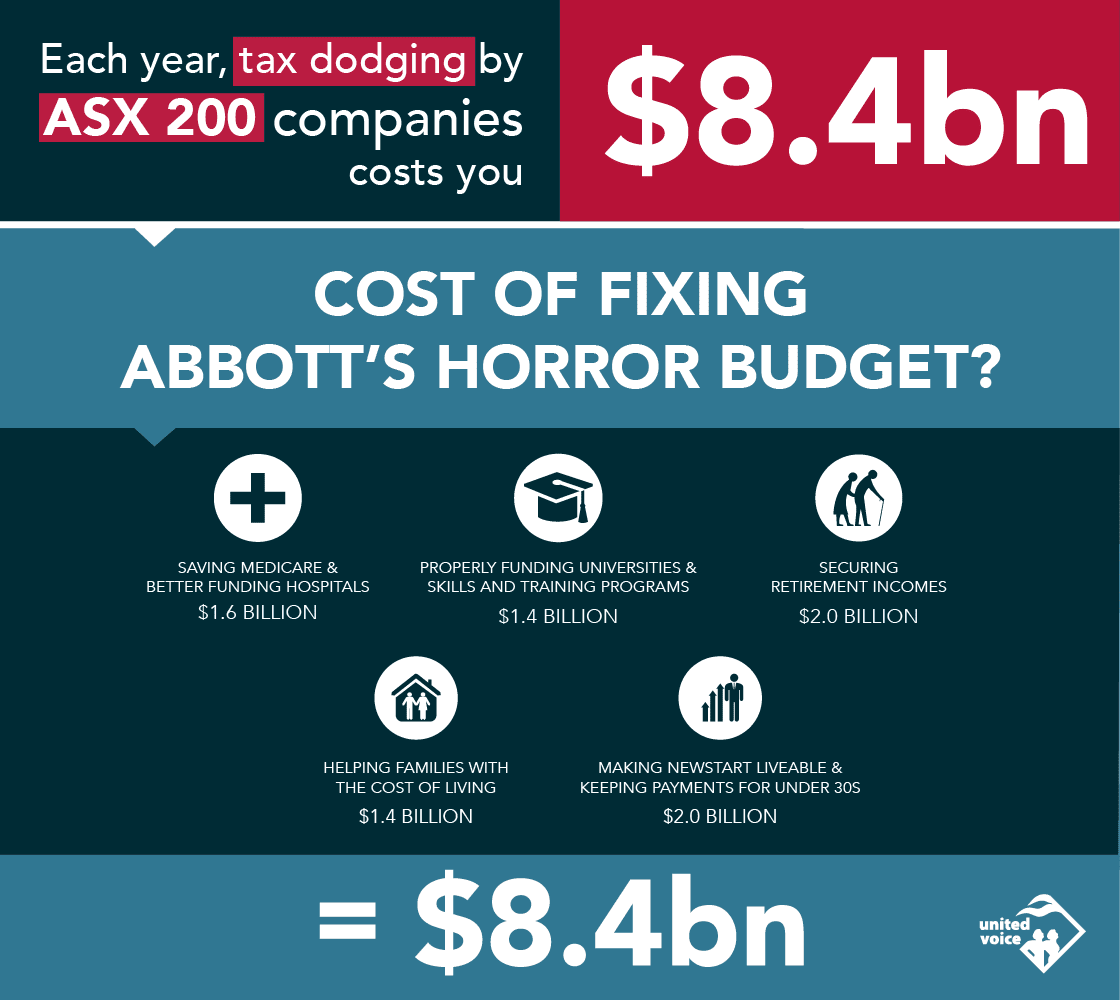
    An estimated 2.5 milllion Australians are now living below the poverty line at the very time the Abbott Government is asking the poorest Aussie households to contribute $1.1 billion more than the wealthy.2 And according to a report by the Tax Justice Network and United Voice, the top 200 ASX companies are paying billions less than they should be, parking some of their profits in offshore tax havens.3

    It’s disgraceful. That’s why Australians are up in arms over the failure of big business to pay their fare share, while we’re asked to bear the budget pain. So this is exactly the right time to put pressure on our politicians to take a tougher stance on tax dodging by big business.

    While Mr Hockey’s crack down rhetoric is a great start, his actions leave a lot to be desired. The Government just cut $189 million from the Australian Taxation Office — the very body that polices tax compliance. They’ve also left open loopholes that could have delivered $1.1 billion more to the national coffers.4

    Actions speak louder than words, and picking up the phone to call an MP’s office is an incredibly effective way of putting pressure on our decision makers. Click here to call your Liberal MP or Senator and ask them what actions — not words — they’re going to take to crack down on corporate tax dodgers: www.getup.org.au/corporate-tax-call

    It’s only fair that big businesses making massive profits pay their fair share, just like the rest of us. If they don’t, we’re the ones who end up footing the bill.

    Thank you for all that you do,
    Lily, Mark, Nat and Georgina, for the GetUp team

    PS — This image from our friends at United Voice shows who picks up the bill when our government fails to crack down on big business tax dodgers: our schools, communities and hospitals. Take the time now to tell your MP to spend more time cracking down on big business tax dodgers, instead of squeezing out budget savings from the poor, the sick and our seniors.

    image

    [1]’The Path to Brisbane — Setting up the G20 to make a difference’, The Hon Joe Hockey MP, 8 October 2014.
    [2]’Poverty in Australia Report’, Australian Council of Social Services, October 2014. ‘Poorest families pay most in budget’, Sydney Morning Herald, 22 May 2014.
    [3]’Who Pays for Our Commonwealth? Tax Practices of the ASX 200′, United Voice and the Tax Justice Network, October 2014.
    [4]’Corporate tax avoidance costs Australian business’, Sydney Morning Herald, 30 September 2014.

  • AdSolar Hot Water Systemwww.gosolarnewcastle.com.au – Quality Product Backed By 15 Yrs Warranty.250/315/400L Tank Sizes.

    Daily update: Why rooftop solar makes networks such a hard sell

    Inbox
    x

    RenewEconomy editor@reneweconomy.com.au via mail69.atl51.rsgsv.net 

    1:21 PM (1 hour ago)

    to me
    NSW report delivers sobering news for Australian networks. Plus:will EVs save utilities, or destroy them?; how the electricity industry is trying to stop solar – part II; VEET scheme off the chopping block; the truth about Queensland coal and the economy; why dissing coal divestment won’t do any good; EU renewables headed for grid parity by 2018; renewables win top share of German energy mix; and solar project costs at 6.5c/kWh in US state of Georgia.
    Is this email not displaying correctly?
    View it in your browser.
    RenewEconomy Daily News
    The Parkinson Report
    New report says asset value of NSW networks needs to be written down by nearly half so they can compete with rooftop solar. If they don’t, consumers will be forced to pay more, many will leave the grid, and the assets will end up being stranded.
    For utilities, electric vehicle uptake could boost electricity demand and balance a changing grid. On the flip-side, it could help drive households off grid.
    Part Two – and another 10 examples – of how electricity industry is trying to slow deployment of rooftop solar.
    Victorian Energy Efficiency Target scheme given stay of execution, as Napthine govt backs away from plans to cut it short and scrap it.
    Despite fossil fuel spin about coal’s economic importance, report finds more Queenslanders work in Arts and Recreation than in the coal industry.
    Companies critical of fossil fuel divestment should take responsibility for better valuing and reporting their environmental and social impacts.
    New European analysis finds solar and wind could achieve grid parity in Turkey by 2018; solar in Spain by 2021, Portugal by 2022 and Italy by 2025.
    Non-hydro renewables increased electricity output by 8.6 TWh over first 9 months of 2014, making them Germany’s number one power source for the first time.
    The average utility-scale solar bid for power-purchase agreements for a solr project in the US state of Georgia averaged at 6.5 cents per kilowatt-hour.
  • RENEW ECONOMY DAILY UPDATE

    ADVERTISEMENT

    Subscription Center

    Energy & Sustainability »

    Climate Central

    Renewables Are as Green as You’d Expect

    Despite all the metals and raw materials that go into making solar cells and wind turbines, these sources of low-carbon renewable electrify will have a low climate and environmental impact through 2050

    October 8, 2014 |By Bobby Magill and Climate Central

    Wind farms are a major part of global renewable energy buildout by 2050.
    Credit: Lollie-Pop/flickr

    lot of metals go into making solar cells and wind turbines, raw materials such as copper, iron, rare earth metals such as indium and others and that involve a lot of greenhouse gases and other pollution when they’re mined and processed to make parts for renewable power generators.

    So just how green are these sources of low-carbon renewable electricity? Pretty green, it turns out.

    Rolling out wind and solar power projects across the globe through 2050 will probably have a very low climate and environmental impact and even reduce air pollution despite the need for extracting pollution-intensive raw materials for those wind, solar and hydropower projects, according to new research published Monday.

    As part of the new Norwegian University of Science and Technology study, researchers conducted the first-ever lifecycle analysis of a wide-scale global rollout of new wind, hydro and solar power plants, asking whether shifting from coal and natural gas power generation to renewables would increase or decrease certain types of pollution.

    Generally, there isn’t much known about the environmental and climate costs of a global shift from fossil fuels to renewables and how that shift affects pollution from producing raw materials used in solar panels and wind turbine blades such as copper, concrete, aluminum, indium and other materials, according to the study.

    Wind turbines require up to 14 times the iron needed for fossil fuel power generation, and solar photovoltaics require up to 40 times the copper than traditional coal, oil or natural gas-fired power plants, according to the study.

    But over time, the environmental impact of extracting those raw materials declines, pollution decreases and the total quantity of those materials likely needed for renewables is a fraction of the volume of those materials being mined today, the study says.

    The researchers assumed that solar, wind and hydropower will make up 39 percent of total global power production in 2050, up from 16.5 percent in 2010, requiring 1.5 gigatons of bulk raw materials for construction.

    “I was surprised that all the pollution went down for renewables,” the study’s lead author, Edgar Hertwich, an energy and process engineering professor at the Norwegian University of Science and Technology, told Climate Central. “I expected some of the toxics might be rising because of the materials used. Metal ores contain a lot of heavy metals. I expected that to be significant. I was really surprised it didn’t show up.”

    When compared to coal-fired power plants, renewables come out on top because wind and solar power generation requires no additional raw material over the lifespan of the turbine or solar panel. Coal-fired plants, on the other hand, require continued mining of coal, he said.

    The study, published Monday in the journal Proceedings of the National Academy of Sciences, concludes that new renewable power installations would increase the demand for iron and steel by 10 percent by 2050, and the copper that would be needed for photovoltaic systems are equivalent to two years of current global copper production.

    “The amount of material having to move for coal is more than metal moved for renewables,” he said.

    Even when solar and wind power generators need to be rebuilt, raw materials can be recycled from older power generators, he said.

    Displacing fossil fuels with renewables could reduce global greenhouse gas emissions by 62 percent below a scenario that assumes global energy consumption would continue on its current trajectory, with coal power generation possibly increasing 149 percent over 2007 levels, according to the study. The research also shows that freshwater pollution could be reduced by half and particulate matter in the air reduced by 40 percent.

    “This study helps further verify the benefits and necessity of renewable technologies for meeting long-term greenhouse gas mitigation goals,” said Christine Shearer, postdoctoral scholar of earth system science at the University of California-Irvine, whose recent research suggests that reliance on natural gas for power generation impedes the development of renewables.

    “We know that no energy source is benign,” she said. “Each one will have an impact on the environment and resources, especially when scaled up. Hertwich and his colleagues have done a real service by quantifying these life cycle effects and showing the benefits of renewable energies not only for the climate, but also air and water, with a manageable amount of resources.”

    You May Also Like:
    Three Decades Until Carbon Budget Is Eaten Through
    Drought Dries Up California Hydropower
    Oceans Getting Hotter Than Anybody Realized
    Climate Fueled Some of 2013’s Most Extreme Events

    This article is reproduced with permission from Climate Central. The article was first published on October 7, 2014.

  • HANSEN On Climate Change

    Climate scientist James Hansen met with the Des Moines Register editorial board on Oct. 15, 2014. Kelsey Kremer/The Register

    6 4 LINKEDINCOMMENTMORE

    James Hansen’s pitch for reducing the greenhouse gases that cause climate change is boiled down to some basic numbers:

    A fee of $10 per ton of carbon dioxide, increasing $10 each year, would reduce carbon dioxide emissions by 33 percent in a decade.

    While such a carbon tax remains a third-rail issue politically, Hansen, an Iowa native and former director of NASA’s Goddard Institute for Space Studies, says it’s the best way to slow rising sea levels, superstorms and other catastrophes caused by climate change.

    “In reality, we’re headed down a path that is certain disaster if we stay on that path,” he told Register editors and writers Wednesday.

    Hansen said a carbon tax could be an economic development tool. Under the plan he advocates, every dollar raised would be distributed equally to legal U.S. residents. Hansen said it would raise the price of a gallon of gas by about $1, but would return about $2,000 annually to every resident.

    He said the U.S. should lead on the issue. The first country to adopt a carbon tax will reap the benefits of owning new green technologies born out of incentives for reducing emissions, he said.

    “It’s a tragedy if we don’t do it, because the solution is not that painful,” he said.

    Hansen is speaking on climate change this afternoon at the Heartland Global Health Consortium at Drake University and at 7 p.m. in the main lounge of the Iowa Memorial Union in Iowa City.

    An early messenger, Hansen has been sounding alarm bells about the dangers of climate change since the 1980s, when he first testified before Congress. Today, he directs the climate science program at Columbia University’s Earth Institute, where he is working on a paper called “Ice melt, sea level rise and superstorms.”

    Hansen said increasing temperatures will speed the melting of the planet’s ice caps, raising sea levels and making coastal cities uninhabitable. But it’s not just the coasts. Studies show a rise in global temperature of 3 degrees Celsius, which he said would happen by 2050 on the current trajectory, would reduce harvests in the U.S. corn belt by 46 percent, he said.

    “We’re already pushing beyond the safe level,” he said. “We need to reduce carbon emissions as rapidly as is practical, and that’s what putting an honest price on carbon will do.”

    What is practical, though, is a matter of debate. Opponents of a carbon tax say it would hamstring the economy, increasing the price of goods via higher fuel costs. Others say it would be fruitless for the United States to impose a carbon tax if the developing world continues to burn fossil fuels at an increasing rate.

  • Daily update: Regulator warns consumers could flee the grid

    Click here to enable desktop notifications for Gmail.   Learn more  Hide
    1 of 1
    AdCommercial Solar Powerwww.naturalsolar.com.au – 12 Year Installation Warranty Commercial Solar Experts Free Quote

    Daily update: Regulator warns consumers could flee the grid

    Inbox
    x

    RenewEconomy editor@reneweconomy.com.au via mail13.atl111.rsgsv.net 

    2:20 PM (37 minutes ago)

    to me


    AER says Australia facing ‘prosumer’ energy revolution; step changes to a distributed energy future; SunEdison enters Oz market through EnergyMatters purchase; NSW flags wind farm planning changes; super fast-charge battery breakthrough; Joe Hockey joins coal spin conga line; US residential solar demand headed for 1GW a year; and the true cost of energy – and subsidies – in Europe.
    Is this email not displaying correctly?
    View it in your browser.
    RenewEconomy Daily News
    The Parkinson Report
    Australian Energy Regulator says network models need to be changed to allow great access for customers to participate in the market. It warns that if barriers remain, then prosumers – those generating and storing their own energy – will “walk away” from the grid.
    Inventor of floor tiles that generate energy says distributed energy with storage and smart grids are the future.
    US solar giant SunEdison has confirmed its purchase of Energy Matters, continuing the growing incursion of US solar companies into Australian market.
    NSW Planning Minister says new rules coming as she laments wind farms turning countryside into “industrial” zones.
    Scientists from a Singapore university have developed a new battery that can be recharged up to 70% in only 2 minutes, and with a 20-year lifespan.
    Treasurer barely misses a beat when challenged to justify Australia’s fossil fuel industry and bottom-dwelling record for greenhouse gas emissions.
    Residential demand in US is increasing as PV systems become increasingly attractive across more states and falling prices drive demand growth.
    A new EU attempt to assess the costs of fossil fuels, renewables and nuclear power on a level playing field raises as many questions as answers.
    Carbon capture and storage has been on the radar since 1995. 20 years later, is it any more likely to become a commercial emissions reduction reality?