1 of 1
 Ad3 Best Solar Power Quotes – solarquotes.com.au/_Get_Free_Quotes – 1 Form – 2 Minutes – 3 Free Quotes. We Use 8,000 Reviews To Hand-Pick 3
|
Daily update: How battery storage costs could plunge to below $100/kWh

|
||||||||||||||||||||||||||||||||||||||||||||
Add your news
You can add news from your networks or groups through the website by becoming an author. Simply register as a member of the Generator, and then email Giovanni asking to become an author. He will then work with you to integrate your content into the site as effectively as possible.
Listen to the Generator News online
The Generator news service publishes articles on sustainable development, agriculture and energy as well as observations on current affairs. The news service is used on the weekly radio show, The Generator, as well as by a number of monthly and quarterly magazines. A podcast of the Generator news is also available.
As well as Giovanni’s articles it picks up the most pertinent articles from a range of other news services. You can publish the news feed on your website using RSS, free of charge.
|
Ad3 Best Solar Power Quotes – solarquotes.com.au/_Get_Free_Quotes – 1 Form – 2 Minutes – 3 Free Quotes. We Use 8,000 Reviews To Hand-Pick 3
|
Daily update: How battery storage costs could plunge to below $100/kWh
|
||||||||||||||||||||||||||||||||||||||||||||



The RV Kaharoa motored out of Wellington, New Zealand on Saturday, loaded with more than 100 scientific instruments, each eventually destined for a watery grave. Crewmembers will spend the next two months dropping the 50-pound devices, called Argo floats, into the seas between New Zealand and Mauritius, off the coast of Madagascar. There, the instruments will sink and drift, then measure temperature, salinity and pressure as they resurface to beam the data to a satellite. The battery-powered floats will repeat that process every 10 days — until they conk out, after four years or more, and become ocean junk.
Under an international program begun in 2000, and that started producing useful global data in 2005, the world’swarming and acidifying seas have been invisibly filled with thousands of these bobbing instruments. They are gathering and transmitting data that’s providing scientists with the clearest-ever pictures of the hitherto-unfathomed extent of ocean warming. About 90 percent of global warming is ending up not on land, but in the oceans.
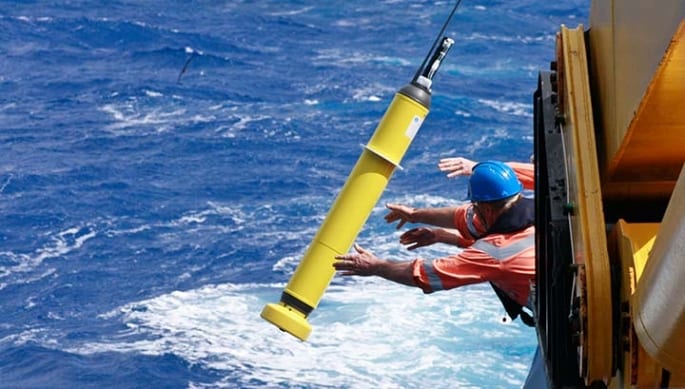 Research published Sunday concluded that the upper 2,300 feet of the Southern Hemisphere’s oceans may have warmed twice as quickly after 1970 than had previously been thought. Gathering reliable ocean data in the Southern Hemisphere has historically been a challenge, given its remoteness and its relative paucity of commercial shipping, which helps gather ocean data. Argo floats and satellites are now helping to plug Austral ocean data gaps, and improving the accuracy of Northern Hemisphere measurements and estimates.
“The Argo data is really critical,” said Paul Durack, a Lawrence Livermore National Laboratory researcher who led the new study, which was published in Climate Nature Change. “The estimates that we had up until now have been pretty systematically underestimating the likely changes.”
Durack and Lawrence Livermore colleagues worked with a Jet Propulsion Laboratory scientist to compare ocean observations with ocean models. They concluded that the upper levels of the planet’s oceans — those of the northern and southern hemispheres combined — had been warming during several decades prior to 2005 at rates that were 24 to 58 percent faster than had previously been realized.
“We continue to be stunned at how rapidly the ocean is warming,” said Sarah Gille, a Scripps Institution of Oceanography professor. Gille was not involved with this paper, nor was she involved with a similar one published Sunday that examined the role of ocean warming in rising sea levels. She described both of them as “tremendously interesting” studies.That rapid ocean warming has consequences for the Earth’s climate and its shorelines.
“Even if we stopped all greenhouse gas emissions today, we’d still have an ocean that is warmer than the ocean of 1950, and that heat commits us to a warmer climate,” Gille said. “Extra heat means extra sea level rise, since warmer water is less dense, so a warmer ocean expands.”
Ocean warming is exacerbating flooding caused by the melting of glaciers and other ice. Seas have risen 8 inches since the industrial revolution, and they continue to rise at a hastening pace, worsening floods and boosting storm surges near shorelines around the world. Another 2 to 7 feet of sea level rise is forecast this century, jeoparizing the homes and neighborhoods of the 5 million Americans who live less than 4 feet above high tide, as well as those of thehundreds of millions living along coastlines in other countries.
The other ocean temperature study, also published Sunday in Climate Nature Change, used Argo and other data to tentatively conclude that all of the ocean warming from 2005 to 2013 had occurred above depths of 6,500 feet. During the same period, the Jet Propulsion Laboratory scientists who wrote the paper concluded, the expansion of those warming waters caused a third of the planet’s 2.8 millimeters of annual sea-level rise.
Sunday’s papers joined more than 1,000 others published so far that have used Argo float data to improve science’s understanding of waterways that are climatically influential but difficult to measure manually. “This research covers a very broad range of topics including ocean circulation, water mass formation and spreading, mesoscale eddies, interannual variability such as El Niño, decadal variability, and multi-decadal climate change,” said Scripps Institution of Oceanography professor Dean Roemmich, who was in New Zealand last week preparing Argo floats for deployment by the RV Kaharoa’s crew. “The program has revolutionized large-scale physical oceanography.”
Steve Rintoul, a researcher at Australia’s Commonwealth Scientific and Industrial Research Organisation, or CSIRO, said findings of ocean warming above 6,500 feet in the Jet Propulsion Lab’s study explain the recent slowdown in warming at the Earth’s surface, which is sometimes called global warming hiatus, or warming pause.
“An important result of this paper is the demonstration that the oceans have continued to warm over the past decade, at a rate consistent with estimates of Earth’s net energy imbalance,” Rintoul said. “While the rate of increase in surface air temperatures slowed in the last 10 to 15 years, the heat stored by the planet, which is heavily dominated by the oceans, has steadily increased as greenhouse gases have continued to rise.”
That extra heat isn’t expected to swim with the fishes forever. Some of it will eventually rise from the deep, raising temperatures in places that more directly affect us landlubbers.
Just how rapidly the oceanic heat will resurface to warm the land is “something that we struggle with,” said Scripps’s Gille. But she said heat is constantly shifting between oceans and the atmosphere. “A warmer ocean will mean a warmer atmosphere.”
First published at Climate Central. Reproduced with permission.

A new study by the University of Florida (UF) has found that the state’s hot, humid climate has a beneficial effect on soil’s ability to hold down greenhouse gas carbon emissions
Carbon trapped in moist soil helps slow the build up of carbon-based gasses in the atmosphere, so it’s important to preserve it, according to Sabine Grunwald, a water science professor at UF’s Institute of Food and Agricultural Sciences (IFAS) who led the research.
“The conservation of the ‘black gold’ below our feet – which is not only a natural part of Florida’s soils but also helps to improve our climate and agricultural production – is a hidden treasure,” Grunwald said. “Soils serve as a natural container to hold carbon that would otherwise be emitted into the atmosphere as greenhouse gases.”
Related: Climate Change Deniers Are Having A Very Bad Year
Florida is florid because it’s wet, and over the years more carbon has been absorbed by its soil than in any other U.S. state — unless you include Alaska, whose carbon-retention capacity isn’t known because its soil hasn’t been studied as extensively.
Meanwhile, in the past 45 years, Florida’s population has more than tripled from 5 million to about 18 million today. Grunwald says this has caused a major change in land use, with growth in urban areas and declines in forests, rangeland and farmland.
While that may sound bad for the environment, it’s good for the atmosphere because wetlands, which hold a lot of carbon, have increased by 140 percent, while farmland, which is low in carbon, has decreased by about 20 percent, according to Grunwald’s study, which is the first of its kind and was published in the journal Science of the Total Environment.
Related: Despite Rising Voice of Climate Movement, Global Leaders Dither
The research team studied information from 1,251 soil samples from throughout the state from 1965 to 1996, and collected new samples statewide in 2010. That way they were able to study how Florida’s soil holds on to carbon – called “soil carbon sequestration” – over 45 years.
Their study found that, together, land use, land cover and recent warming from climate change make up for 46 percent of soil carbon sequestration, including 27 percent from land cover and land use and 19 percent from climate change.
The team relied on rainfall and temperature to measure how climate change affects sequestration. They learned that the recent higher average temperatures correspond with higher sequestration, though greater rainfall tended to show less sequestration. They found that crops grown in agricultural wetlands stored the most carbon, while crops requiring drier soils sequestered the least.
By Andy Tully of Oilprice.com
|
Ad50% Off Enrich Miles – malaysiaairlines.com/EnrichPromo – Redeem Your Miles on Your Next Flight. Offer Ends Soon. Book Now!
|
Demand a precautionary approach to synbio
|
||||||||||||||
|
AdSolar Panel Sale 3 Quotes – solar-panels.solarquotes.com.au – w/ 12,000+ Real Installer Reviews. How Do You Choose? Learn How Here »
|
Government’s Duty
|
||||||||||||||||
|
AdRedeem Flights for Less – malaysiaairlines.com/EnrichPromo – The Enrich Redemption Offer’s Back. Up to 50% off Enrich Miles!
|
Daily update: Is this the death of Australia’s renewables industry
|
||||||||||||||||||||||||||||||||||