The Generator news service publishes articles on sustainable development, agriculture and energy as well as observations on current affairs. The news service is used on the weekly radio show, The Generator, as well as by a number of monthly and quarterly magazines. A podcast of the Generator news is also available.
As well as Giovanni’s articles it picks up the most pertinent articles from a range of other news services. You can publish the news feed on your website using RSS, free of charge.
In major headlines yesterday, the Abbott Government is capitulating on billions in cruel cuts to Newstart and social services.1 That’s after GetUp members stepped up with donations to unmissable billboards, holding key senators to their budget promises.
Now with the Government’s budget strategy in disarray, we’ve got the chance to stop their plans to deregulate university fees too — preventing sickening fee hikes that would deny opportunities to many and shackle others to a lifetime of debt.
So, we’re partnering with teachers and students on a new TV ad campaign, grounded in the messaging that tested best with swing voters. Then we’re running the ad in areas guaranteed to grab the attention of the key crossbench senators with the power to stop the Government’s plans — because that’s what’s working.
According to recent research, many Australians still don’t know about the proposed university fee deregulation — but when they do hear about it, they’re not happy. That’s where we come in.
The research shows that for key swing voters the prospect of degree costs skyrocketing to $100,000+ sets off absolute alarm bells. Especially offensive is the idea that money, not hard work, will get you a place at university, and that student debts will take a lifetime to pay off.
To drive these cut-through messages home, we’re launching an ad with our friends at the National Tertiary Education Union and the National Union of Students that shows what getting into university would become under deregulation: an all-out bidding war. Can you help get it on the air, so we can raise alarm bells with key swing voters, as their senators decide the fate of these bills?
Cutting back on higher education in a knowledge-based global economy is a recipe for disaster, especially when a study released this week revealed that Australia is getting huge public returns on its education spending — amongst the highest of any OECD country.2
University deregulation won’t just hurt students, it will create a drag on our whole economy, by undermining our clever country and creating a generation awash in debt. Let’s be clever ourselves, by getting this new uni fee auction TV ad on the air to the right people at the right time.
Thanks for all you make possible,
Mark and Nat, for the GetUp team
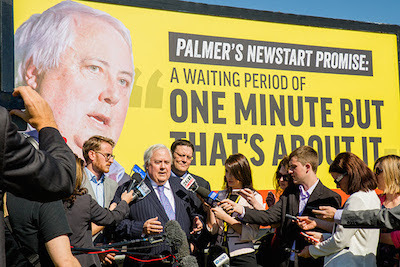
PS – Just weeks ago, more than 1,400 GetUp members chipped in to get billboards in front of Clive Palmer and PUP senators, to hold them to their budget promises at the critical moment. And it bloody well worked! Below is a picture of Mr Palmer and Senator Glenn Lazarus literally standing in front of their Newstart promise — writ large by GetUp members — as they announced they would not do a deal with the Government. Now to get this uni fees ad on the air at this decision moment for crossbench senators, we need to raise the bar even higher. Click here to chip in!
PPS – Coming up on the 16 October is the Student’s National Day of Action. Students, teachers, alumni, and parents will be mobilising on campuses across the country, the last hoorah before semester ends. Find out about events happening near you on the National Union of Students website.
References:
[1] “Federal Government to introduce new split welfare bill to House of Representative with Labor’s backing”, ABC News, 2 October 2014
[2] “Australian universities climb Times world rankings, while US and UK lose ground”, Sydney Morning Herald, 2 October 2014
GetUp is an independent, not-for-profit community campaigning gr
The 10 stuff-ups we all make when interpreting research
UNDERSTANDING RESEARCH: What do we actually mean by research and how does it help inform our understanding of things? Understanding what’s being said in any new research can be challenging and there are…
UNDERSTANDING RESEARCH: What do we actually mean by research and how does it help inform our understanding of things? Understanding what’s being said in any new research can be challenging and there are some common mistakes that people make.
Have you ever tried to interpret some new research to work out what the study means in the grand scheme of things?
Well maybe you’re smart and didn’t make any mistakes – but more likely you’re like most humans and accidentally made one of these 10 stuff ups.
1. Wait! That’s just one study!
You wouldn’t judge all old men based on just Rolf Harris or Nelson Mandela. And so neither should you judge any topic based on just one study.
If you do it deliberately, it’s cherry-picking. If you do it by accident, it’s an example of the exception fallacy.
The well-worn and thoroughly discredited case of the measles, mumps and rubella (MMR) vaccine causing autism serves as a great example of both of these.
People who blindly accepted Andrew Wakefield’s (now retracted) study – when all the other evidence was to the contrary – fell afoul of the exception fallacy. People who selectively used it to oppose vaccination were cherry-picking.
2. Significant doesn’t mean important
Some effects might well be statistically significant, but so tiny as to be useless in practice.
Associations (like correlations) are great for falling foul of this, especially when studies have huge number of participants. Basically, if you have large numbers of participants in a study, significant associations tend to be plentiful, but not necessarily meaningful.
One example can be seen in a study of 22,000 people that found a significant (p<0.00001) association between people taking aspirin and a reduction in heart attacks, but the size of the result was miniscule.
The difference in the likelihood of heart attacks between those taking aspirin every day and those who weren’t was less than 1%. At this effect size – and considering the possible costs associated with taking aspirin – it is dubious whether it is worth taking at all.
3. And effect size doesn’t mean useful
We might have a treatment that lowers our risk of a condition by 50%. But if the risk of having that condition was already vanishingly low (say a lifetime risk of 0.002%), then reducing that might be a little pointless.
We can flip this around and use what is called Number Needed to Treat (NNT).
In normal conditions if two random people out of 100,000 would get that condition during their lifetime, you’d need all 100,000 to take the treatment to reduce that number to one.
4. Are you judging the extremes by the majority?
Biology and medical research are great for reminding us that not all trends are linear.
We all know that people with very high salt intakes have a greater risk of cardio-vascular disease than people with a moderate salt intake.
The graph is U shaped, not just a line going straight up. The people at each end of the graph are probably doing different things.
5. Did you maybe even want to find that effect?
Even without trying, we notice and give more credence to information that agrees with views we already hold. We are attuned to seeing and accepting things that confirm what we already know, think and believe.
There are numerous example of this confirmation bias but studies such as this reveal how disturbing the effect can be.
In this case, the more educated people believed a person to be, the lighter they (incorrectly) remembered that person’s skin was.
6. Were you tricked by sciencey snake oil?
A classic – The Turbo Encabulator.
You won’t be surprised to hear that sciencey-sounding stuff is seductive. Hey, even the advertisers like to use our words!
But this is a real effect that clouds our ability to interpret research.
In one study, non-experts found even bad psychological explanations of behaviour more convincing when they were associated with irrelevant neuroscience information. And if you add in a nice-and-shiny fMRI scan, look out!
7. Qualities aren’t quantities and quantities aren’t qualitites
For some reason, numbers feel more objective than adjectivally-laden descriptions of things. Numbers seem rational, words seem irrational. But sometimes numbers can confuse an issue.
For example, we know people don’t enjoy waiting in long queues at the bank. If we want to find out how to improve this, we could be tempted to measure waiting periods and then strive to try and reduce that time.
But in reality you can only reduce the wait time so far. And a purely quantitative approach may miss other possibilities.
If you asked people to describe how waiting made them feel, you might discover it’s less about how long it takes, and more about how uncomfortable they are.
8. Models by definition are not perfect representations of reality
A common battle-line between climate change deniers and people who actually understand evidence is the effectiveness and representativeness of climate models.
But we can use much simpler models to look at this. Just take the classic model of an atom. It’s frequently represented as a nice stable nucleus in the middle of a number of neatly orbiting electrons.
While this doesn’t reflect how an atom actually looks, it serves to explain fundamental aspects of the way atoms and their sub-elements work.
This doesn’t mean people haven’t had misconceptions about atoms based on this simplified model. But these can be modified with further teaching, study and experience.
9. Context matters
The US president Harry Truman once whinged about all his economists giving advice, but then immediately contradicting that with an “on the other hand” qualification.
Individual scientists – and scientific disciplines – might be great at providing advice from just one frame. But for any complex social, political or personal issue there are often multiple disciplines and multiple points of view to take into account.
To ponder this we can look at bikehelmet laws. It’s hard to deny that if someone has a bike accident and hits their head, they’ll be better off if they’re wearing a helmet.
Do bike helmet laws stop some people from taking up cycling?Flickr/Petar, CC BY-NC
Click to enlarge
But if we are interested in whole-of-society health benefits, there is research suggesting that a subset of the population will choose not to cycle at all if they are legally required to wear a helmet.
Balance this against the number of accidents where a helmet actually makes a difference to the health outcome, and now helmet use may in fact be negatively impacting overall public health.
Valid, reliable research can find that helmet laws are both good and bad for health.
10. And just because it’s peer reviewed that doesn’t make it right
Peer review is held up as a gold standard in science (and other) research at the highest levels.
But even if we assume that the reviewers made no mistakes or that there were no biases in the publication policies (or that there wasn’t any straight out deceit), an article appearing in a peer reviewed publication just means that the research is ready to be put out to the community of relevant experts for challenging, testing, and refining.
It does not mean it’s perfect, complete or correct. Peer review is the beginning of a study’s active public life, not the culmination.
And finally …
Research is a human endeavour and as such is subject to all the wonders and horrors of any human endeavour.
Just like in any other aspect of our lives, in the end, we have to make our own decisions. And sorry, appropriate use even of the world’s best study does not relieve us of this wonderful and terrible responsibility.
There will always be ambiguities that we have to wade through, so like any other human domain, do the best you can on your own, but if you get stuck, get some guidance directly from, or at least originally via, useful experts.
Make no mistake: this will not be the last time Tony Abbott tries this on. Tony Abbott wants to cut pensions. He wants to cut billions from schools and hospitals. He has not given up on his GP tax.
As long as Tony Abbott and the Liberal Party occupy the benches of Government, Australians will always have to fear these people attacking their cost of living.
Today, we draw the battle lines for the next election. Between a party that protects the pension, and a party that cuts it. Between a party that stands up for families, and a party that forgets them. Between a movement who will always fight for the most vulnerable amongst us, and a Prime Minister who lied to us.
That’s the choice. That’s the contest. Labor’s up for this fight — and together I know we can win it. We beat the Liberals today, and we’ll beat them at the next election.
Climate change places everything at stake for our Pacific Island neighbours.
That’s why, in just over a week’s time, we will welcome thirty incredible Pacific Climate Warriors to Australia. Together we’ll stand with them, as they stand up to the fossil fuel industry, whose activities are driving the demise of their cultures and their homelands.
Here are three ways that you can support the Warriors from Sydney…
1. Welcome the Warriors to Australia
Join us to welcome the Warriors as they arrive into Australia:
When: 10am – 12pm, Saturday 11th October
Where: Campbelltown Arts Centre, 1 Art Gallery Rd, Campbelltown
2. Hear first hand from the Warriors about why they have travelled to our shores.
From youth workers and President’s children to parish secretaries and teachers’ aides, the warriors will leave you humbled and even more resolute to demand the safe and just climate future that is within our reach. Each talk will be part storytelling, part performance and part a call to action.
If you want to go further, join us for a Peaceful Direct Action training on Saturday 11 October. Renowned campaigner Nicola Paris will provide a training on the theory of peaceful direct action and then support all of us to prepare a solidarity action to stand with the Warrirors during their tour.
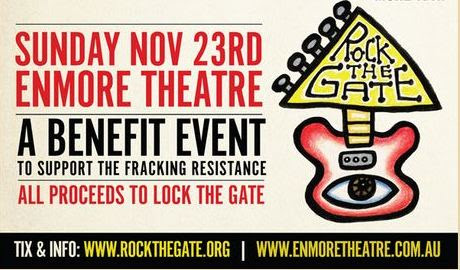
We’re excited to invite you to the biggest anti-fracking rock concert ever held in Australia – Rock the Gate – at the Enmore Theatre in Newtown, Sydney, 23rd November. All proceeds go to support Lock the Gate Alliance. Get your tickets now!
It’s spring and there is so much happening right across the country. This newsletter brings you lots of great events and all the latest updates – from the looming Senate Inquiry into the Qld Government, to the first Mining Free Community in South Australia, and the NSW Chief Scientists report on CSG. It’s all happening, and there are so many ways to get involved!
Events
Join other communities at the Protecting our Heritage, Embracing the Future conference near Ipswich, from 24th to 27th October 2014. There will be inspiring speakers, top-notch trainers and a chance to learn from other mining-affected communities from all around Australia. Registrations close this Friday – Register Now!
Join in Fair Food Week from the 10th to 19th October where you can organise or participate in a local event to celebrate and learn about cultivating a better food future. The week is organised by the Australian Food Sovereignty Alliance. See all the details and get involved here.
At a loose end on the long weekend? Get along to the Longview Farm Party, near Taree. A family friendly weekend event with live music, movies under the stars, fireworks and a giant waterslide. And it’s also a fundraiser for Lock the Gate. Enjoy a wonderful weekend by the Nowendoc River.
Come along to what is sure to be the biggest rally ever seen in the Northern Rivers as the community declares the region Gasfield Free and demands that all gas licences across the Northern Rivers are cancelled! 1st November 2014, Riverside Park Lismore.
Queensland
In Queensland, the Federal Senate has launched an Inquiry into the Newman Government which will investigate coal and gas mining approvals and whether they have complied with Australia’s international obligations. The Inquiry was achieved thanks to the combined efforts of the Palmer United Party, the Australian Greens and the ALP.
This follows hard on the heels of an appalling midnight amendment to mining laws which was rammed through Qld Parliament in September to remove the rights of landholders to object to mining approvals in court.
This makes it even more important to step up our campaign for our bold new agenda – the People’s Common Rights and Provisions Bill 2014 – which sets out a plan to restore community rights to clean air and water and the right to say no to mining. Already more than 2,500 Queenslanders have backed the bill. The next step is to debate the Bill in Parliament on the 28th October
. Will you be there?Western Australia
Community concerns about unconventional gas drilling are growing rapidly in Western Australia, as exploratory shale gas drilling draws close to the Mt Lesueur National Park in the Mid West of the state. Last month, Central Greenough became the first community in WA to declare itself gasfield free and the Shire of Cooroow voted for a moratorium on fracking until a full Environmental Impact Statement is prepared.
Victoria
Having successfully turned away Lakes Oil with their preparedness for a community blockade, Gippslanders and other Victorians are hoping that the forthcoming state election will see some firm policy from all sides of politics to create clear protected areas where unconventional gas is prohibited, and tough regulatory measures across the state. The message is being taken to audiences in the city with the launch of an exciting new film ‘Farmland, not Gaslands‘.
New South Wales
The final report by the NSW Chief Scientist on CSG mining has vindicated community concerns about the risks of CSG drilling and identified massive failures in regulation. We are calling for a halt to any further CSG drilling until all the additional research, law reform and environmental monitoring she recommends has been conducted and strict no-go zones are in place to protect water supplies, residential dwellings and food-producing areas.
Daily protest action is now underway in Gloucester, where exploratory fracking is planned within 300m of family homes. The local community have called for help from around the state. Will you come to their aid?
The level of bias in the NSW planning system towards coal miners has been challenged recently by mining affected communities who have lodged a formal complaint to the NSW Ombudsman against the Department of Planning and Environment. You can read the shocking log of claims against the Department here.
Northern Territory
In NT there is an ongoing inquiry into fracking that has attracted huge interest. The Commissioner conducting the inquiry recently attended a public meeting in Darwin where 90 people came to hear and express deep concern about the risks of shale gas in the Territory.
South Australia
The community of Robe will be the first in South Australia to declare their community ‘Gasfield Free’ when they gather together on Saturday, 11th October. The District Council of Robe has already taken strong action against gas drilling, joining with seven other Councils to ask the South Australian government to place a moratorium on unconventional gas drilling in the Limestone Coast region.
Time for Qld to ditch gold-plated grid?; Plans launched for community-owned energy retailer; India to become renewables superpower; Ergon says solar is game changer for energy business models; SunEdison claims world’s cheapest solar; Newman refuses briefing with top scientists; Network gold plating to be investigated; NY’s bold new plan to expand solar; Redefining future of the grid; and Why you might actually enjoy life in a degrowth economy.
New report underlines massive subsidy paid to deliver coal-fired electricity through poles and wires to regional Queensland. Everyone might be better off if they embraced renewable-based mini grids.
A new consortium hopes to become Australia’s first community owned retailer, with plans to build, generate and sell renewable energy in northern rivers region of NSW.
Federal Senate votes for independent inquiry into allegations electricity networks have misled the energy regulator and deliberately pushed up power prices.
NY-Sun awards announced for large solar electric projects that will increase the solar capacity in New York State by 68 percent, or more than 214 megawatts.