Category: News

Add your news
You can add news from your networks or groups through the website by becoming an author. Simply register as a member of the Generator, and then email Giovanni asking to become an author. He will then work with you to integrate your content into the site as effectively as possible.
Listen to the Generator News online

 
The Generator news service publishes articles on sustainable development, agriculture and energy as well as observations on current affairs. The news service is used on the weekly radio show, The Generator, as well as by a number of monthly and quarterly magazines. A podcast of the Generator news is also available.
As well as Giovanni’s articles it picks up the most pertinent articles from a range of other news services. You can publish the news feed on your website using RSS, free of charge.
 

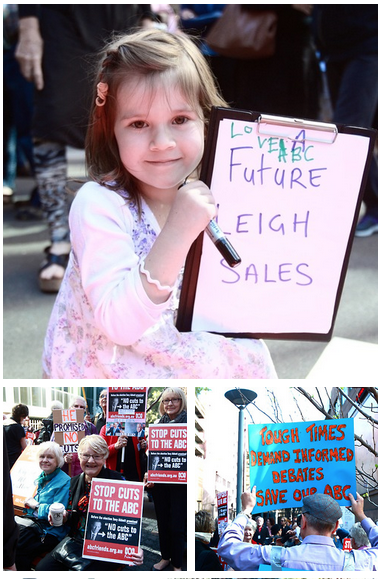
  • Outside ABC headquarters today

    AdRetiring overseas is easywww.escapologist.com.au – Three English speaking countries where you can live well for less

    Outside ABC headquarters today

    Inbox
    x

    Erin – GetUp!

    11:10 PM (33 minutes ago)

    to me
    NEVILLE,

    Wow. Today was a visually stunning show of what our movement is capable of – this time, in less than 40 hours.

    When we heard the ABC Board was just days away from making a call on whether to axe programs like Lateline, state-based 7.30 programs and other critical investigative reporting, GetUp members wrote in with concern and outrage that was palpable. So, we did what we do best – leapt into action.

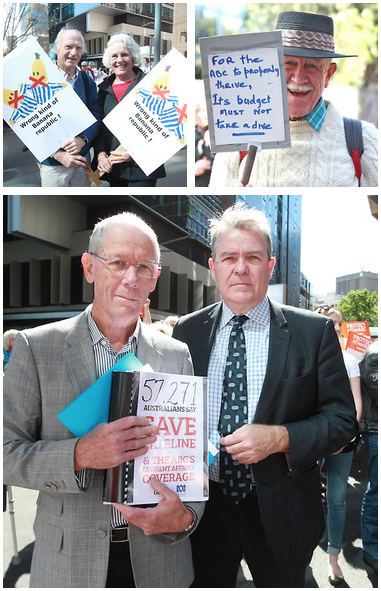
    In just 36 hours, more than 57,000 GetUp members signed former Media Watch presenter Jonathan Holmes’ CommunityRun petition calling for the protection of these programs. It was one of the fastest-growing self-started petitions on the platform.

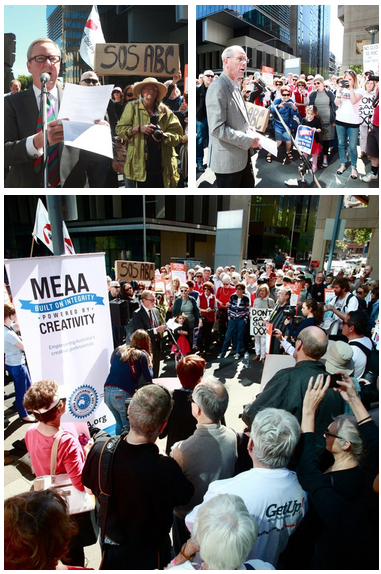
    Then, with just 24 hours notice, more than 400 of us gathered together outside the ABC’s head offices, led by ABC veterans Jonathan Holmes and Quentin Dempster, to speak out against the cuts.

    Check out some of the great coverage in Crikey, the Australian and Mumbrella – and this gallery of the incredible crowd:

    photos1

    photos2

    photos3

    photos4

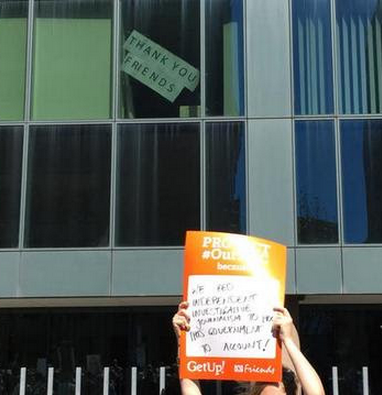
    ABC thank you

    While the ABC board made the baffling decision to not take 3 minutes out of their meeting to accept the petition signed by more than 57,000 Australians and delivered by Jonathan Holmes – we know they heard our message loud and clear. Not just outside their offices, but also through the 7,000 emails you wrote to the Board in advance of the event. ABC staff inside the building even reported they could hear us chanting in the streets. And tonight, unconfirmed reports say that ABC’s Director Mark Scott has said Lateline will remain on the air into next year, albeit possibly in a different format1. This is promising news, but with other critical current affairs coverage still facing the axe and sweeping changes to Lateline still very possible, the threat to the ABC remains urgent, and real.

    Our efforts may be far from over, but there’s no doubt that the actions of this movement are being seen and heard – and making a difference to the decision-makers who matter. GetUp members have rallied to protect the ABC’s critical current affairs coverage and investigative reporting for years – and we’ll continue to fight. Stay tuned for news and the next steps soon.

    For now, to everyone who signed Jonathan Holmes’ petition, shared it with friends and family or came along today – thank you, and congratulations..

    If you haven’t already, there’s still time to share Jonathan Holmes’ petition with friends and family on Facebook, or to write to the Board and urge them not to make cuts to the ABC’s current affairs coverage. In the meantime, stay tuned for more news on the future of ABC programs as we hear more.

    Thanks for all that you do,

    Erin, Kelsey, Alycia, Sally and the GetUp team

    PS – Today’s event in Sydney was organised by our friends at the CPSU, MEAA and ABC Friends – and it couldn’t have happened without the incredible show of public support from people like you. Thanks for being there, and being a part of this critical fight to protect our public broadcaster’s most valuable reporting. We’ll post a video of some of the footage from the event on our Facebook page tomorrowclick here to follow GetUp on Facebook.

    References:
    [1] ABC retains Lateline, but axe looms on TV, radio, Sydney Morning Herald, October 1, 2014.

  • You proved Pyne wrong

    1 of 2
    Ad850% + Investment Returnsprivate-client-investments.com – Invest In Alternative Investments. Huge Profits. Free Top-Pick Guide!

    You proved Pyne wrong

    Inbox
    x

    Bill Shorten via sendgrid.info 

    6:17 PM (22 minutes ago)

    to me
    .

    Neville,
    We asked you to prove Christopher Pyne dead wrong — and you did.

    Last week he said that Labor’s comments don’t get on TV and his do. Together we’ve raised enough to make an ad and prove him wrong.

    In just 24 hours over 1500 people donated, and gave us enough to engage a production team to start filming. We’ll be in touch soon with a preview of the ad you’ve funded, and we’ll let you know how we’re reaching out to people who don’t realise what Christopher Pyne and Tony Abbott are up to.

    Thank you. You made this possible.

    Thousands of Australians are worried about the harsh effects of $100,000 degrees.

    We don’t want the opportunity of a university education to depend on parents’ bank balances instead of ability and hard work.

    Together you and I are showing Christopher Pyne we can get our message out to Australians everywhere.

    Thank you for standing with me on this,

    Bill

  • Daily update: Energy storage – generators to be the biggest losers

    1 of 1
    AdHome Solar Power Systemswww.bradfordsolar.com.au – Solar Power Systems for Your Home. Free Quote. Start Saving Today!

    Daily update: Energy storage – generators to be the biggest losers

    Inbox
    x

    RenewEconomy editor@reneweconomy.com.au via mail76.atl71.mcdlv.net 

    3:33 PM (8 minutes ago)

    to me
    HSBC report says generators to be biggest losers of energy storage boom. Plus: Wind energy could supply 30% of Australia’s energy needs by 2025; UNSW solar PhD to lead PV powered simulated Mars mission; Munich’s race to 100% renewables; Maurice Newman’s latest climate target; 20 years of off-grid, solar living; Vic ALP flags state RET; Spanish island nears 100% renewables with hydro and wind; why oil-free mobility is an energy game changer; China mogul’s 50GW clean energy initiative; and Japan’s latest renewables tally.
    Is this email not displaying correctly?
    View it in your browser.
    RenewEconomy Daily News
    The Parkinson Report
    New report from HSBC says conventional generators will be the biggest losers from the upcoming energy storage boom, as both consumers and grid operators look to battery and other storage technologies. Germany will lead the way as they may be first to “storage” parity.
    Windlab says RET could be met easily with wind energy alone. Wind farms could even supply 30% of Australia’s electricity by 2025.
    UNSW solar PhD to spend 8 months in a solar + storage + HFC powered pod, set on a Hawaii volcano, as commander of NASA-funded simulated Mars mission.
    Five years after setting its 100% renewables by 2025 target, Munich has hit the 37% mark. So what is the German city, and its utility company, doing right?
    Tony Abbott’s main business advisor wants investigation into Bureau of Meteorology, accusing it of being caught up in global warming politics.
    If you really want to understand how solar can change lives, you need to go to a remote area and Barkala Farm out past Coonabarabran is a long way from home.
    Victoria Labor indicates for first time it will consider a state-based renewables target if the national target is dumped by Tony Abbott.
    Most remote of Spain’s Canary Islands months away from becoming world’s first 100% renewable energy self-sufficient, off-grid island.
    Revitalizing China’s innovation engine presents unique opportunities to accelerate the world’s next industrial revolution—especially in energy.
    Billionaire who helped buy out Suntech announces plans to deploy geothermal energy, EVs, LEDs and energy storage on an unprecedented scale.
    Japan has approved 71,780 MW of renewable energy projects, with solar representing 96% of the approved capacity, according to METI data.
    Two main backers of campaign against development of 200-turbine wind farm on King Island found to be BRW Rich Listers and absentee land-owners.
  • Population growth is as potentially catastrophic as climate change. So why aren’t we talking about it?

    6
    Michael McCarthy

    Monday 29 September 2014
    Population growth is as potentially catastrophic as climate change. So why aren’t we talking about it?

    One of these threats draws thousands of protesters on to the streets. The other doesn’t…
    Share
    953

    96

    7

    1K

    Ads by Googl

    Two colossal challenges face the Earth in the 21st century, and threaten its very habitability by human beings, yet widespread concern focuses only on one of them. This anomalous, not to say crazy situation has in the past fortnight been made clearer than ever before.

    The first challenge is that of climate change, the dire nature of which was formally recognised at the climate summit at the UN in New York last week by 120 world leaders, including Barack Obama and David Cameron (joined by the Hollywood star Leonardo DiCaprio). They were spurred on to do so by the climate protest marches which took place in more than 160 countries a few days beforehand, with more than half a million marchers taking part, including 300,000 in New York and 40,000 in London. And more scientific backing was given to the case for action by a new report from leading scientists, published on the day of the marches, warning that the point of no return for combating global warming would be reached within thirty years.

    This report, from the Global Carbon Project, an academic coalition which monitors the soaring carbon dioxide emissions causing the atmosphere to warm, led by Professor Corinne Le Quéré from the University of East Anglia, was published on 21 September, in Nature, one of the world’s two leading scientific journals. Its concerns were widely noticed by all those making their voices heard on the grim dangers of an overheating world.

    Three days earlier, on 18 September, an equally significant report on the dangers facing the Earth in the coming century was published in the other leading scientific journal, Science; yet its conclusions were on the lips of few if any of the world leaders in New York, or of the climate marchers in cities around the world. That is because its subject matter was what has become the Great Unsayable, the Truth Which Dare Not Speak Its Name: the threat to the planet from the uncontrollable increase in human numbers.
    Read more:
    It’s time for God to step in on climate change
    If you really care about climate change you’ll stop eating burgers

    The Science report, from a team led by Patrick Gerland of the UN Population Division in New York and Professor Adrian Raftery of the University of Washington in Seattle, was groundbreaking, in that it overturned the principal assumption of world population policy of the past 20 years: that human numbers, now up to 7.2bn, from 3bn in 1960, would rise to a peak of about 9bn by mid-century, then level off or even decline, as fertility levels fell in the developing world.

    This decline is not, after all, going to happen, the report says. Its headline is stark: “World population stabilisation unlikely this century.” Instead, it says, there is an 80 per cent probability that the world population will increase to between 9.6 and 12.3bn by 2100. Most of the increase will be in sub-Saharan Africa, the reason being that fertility rates there are remaining very high, partly because of the lack of women’s education, and partly because of lack of access to contraception services.

    In pictures: Climate Change Protests Around the World
    1 of 6

    Sydney

    Next

    Sydney
    London
    New York
    New York
    London
    Berlin

    The Gerland/Raftery report is studiously restrained, as a scientific paper has to be, in its comment: “Because rapid population increase in high-fertility countries can create challenges ranging from depletion of natural resources to unemployment to social unrest, the results of this study have important policy implications.” But it is prefiguring a catastrophe, not least because of the other great threat, climate change itself; climate destabilisation and soaring human numbers will not be separate phenomena. They will combine, and act upon, and reinforce each other. One of the biggest threats of global warming is thought to be to agricultural production in sub-Saharan Africa; think how that threat will be intensified when the mouths to feed there are five times more numerous than they are today, as the new report predicts for 2100.

    Jonathon Porritt, one of Britain’s leading environmentalists, recognises the threat. “The simple truth is that continuing population growth is a multiplier of every one of today’s converging sustainability pressures,” he says. Other leading green figures, including David Attenborough and Professor Jim Lovelock, have begun to agree with him openly; but from the green movement as a whole, the silence on the subject is deafening. No marches about population growth; the very idea seems unthinkable.

    The projected vast increase in human numbers is a threat to the Earth’s life-support systems, to its “carrying capacity”, every bit as much as climate change is, and although it is a difficult issue, it is ludicrous simply to ignore it and pretend it is not there. There are two great dangers facing the planet, not one. And not to recognise that is crazy indeed

  • Occupying Hong Kong

    Occupying Hong Kong

    by · September 29, 2014

    umbrellaGUEST POST BY KEVIN LIN 

    The past week has seen a dramatic escalation of Hong Kong’s pro-democracy movement, against the Chinese government’s obstruction in Hong Kong’s electoral process. In scenes reminiscent of the Arab Spring uprisings, 30,000 college students and supporters occupied streets in Hong Kong’s central financial district, encircled by riot police armed with batons, pepper spray and tear gas. For many protesters, there is also a striking parallel to the Tiananmen movement more than two decades ago — particularly because Hong Kong is the only place in China where hundreds of thousands of people gather each year on the anniversary of Tiananmen movement.

    The latest civil disobedience has been organised by college students who began their occupation outside the government headquarters last week. On Sunday they were joined by the Occupy Central movement, which previously had planned a similar occupation for 1 October to coincide with China’s National Day. Hong Kong is no stranger to protests in recent times, but none has had such a spectacular impact. Thanks to Hong Kong and international media coverage (Chinese media has maintained a virtual blackout except for condemnations and reports of a counter-protest) we have been able to monitor the protest’s development closely.

    The atmosphere was extremely tense on Sunday night. Protesters came equipped with goggles and umbrellas — the image of an umbrella is fast becoming the most visible symbol of the protest — to protect themselves against pepper spray. To disperse the protesters, riot police shot tear gas directly into the crowd. Dozens were injured, and scores more arrested. Demonstrators also feared the possible use of rubber bullets, and organisers have urged them to leave in such a situation. The harsh police response has been roundly criticised in Hong Kong. While some activists left overnight, the mobilsation continued well into the early hours of Monday as thousands remained on the streets.

    China’s political interference

    The protests have arisen out of anger toward China’s encroachment into Hong Kong politics after the latter’s return to China in 1997. While notionally permitting a high degree of autonomy, China has impeded moves towards direct election of its Legislative Council and Chief Executive, as encoded in its Basic Law. In particular, pro-democracy activists have been frustrated by obstruction of the election of the Chief Executive, which has been appointed by Beijing since 1997. While Beijing has said it will allow an election for the first time since Hong Kong was integrated in to China, set to take place in 2017, all candidates are to be selected by a nominating committee. There are fears this could screen out candidates unacceptable to Beijing.

    The protest last week was sparked by an announcement in late August, by the Standing Committee of China’s National Congress, which ruled out open nominations. Keenly aware of the possibility of losing control over Hong Kong and that impact in the mainland, the Chinese government has refused to back down in the face of mounting opposition. The opposition movement included an unofficial referendum in June and a mass demonstration of 500,000 on 1 July, which is the anniversary of Hong Kong’s handover to China. Hong Kong’s business elite has warned the democracy movement against jeopardising Hong Kong’s economy.

    Protesters have made their objectives clear. The Hong Kong Federation of Students threatened class boycotts and strikes over its demand that China’s National Congress withdraw its announcement and implement open nominations of candidates. They have called for the resignation of the Chief Executive, Leung Chun-ying. The political clarity and wide acceptance of these goals has galvanised the movement. Other Hong Kong activist groups and trade unions are trying to include social issues, urging the government to legislate on work hours and pensions, restrict real estate speculation, protect housing rights, and implement social policy for workers, women and ethnic minorities.

    bottles

    The demonstrations have been fuelled by resentment of Beijing’s meddling in Hong Kong. Beijing is widely seen as exercising subtle and not-so-subtle influences that threaten Hong Kong’s cherished civil liberties, such as freedom of the press. In 2012, a planned introduction of “moral and national education”, seen as political indoctrination, was resisted by mass mobilisation. The tightening of social and media control on the mainland in the last couple of years has only reinforced fears of what may happen to Hong Kong. In this respect, the protests in Hong Kong share many similarities with the Sunflower movement in Taiwan early this year. Also a student-led protest movement alarmed by China’s encroachment, the Sunflower protest challenged the Taiwanese government in its handling of a trade agreement with China. For Taiwan, the Hong Kong protests only underscore scepticism of the “One China, Two Systems” model.

    In recent years, hostility toward the mainland has grown in Hong Kong as a result of mainland emigration to Hong Kong. It is seen as straining resources and destroying Hong Kong’s identity and quality of life. This has pitched people in Hong Kong and the mainland against one another, seriously militating against forging solidarity at a critical time like this. The anti-China/Chinese sentiments, coupled with a reassertion of local identity, have the effect of alienating people on the mainland. However, the recent protests have not seen such sentiments become prominent, and individuals in China have posted messages and photos of solidarity with Hong Kong protesters. Yet more organised solidarity remains elusive.

    Trade union mobilisation

    The protesters have been able to keep up momentum, but what is the possibility of wider mobilisation?

    The pro-democratic Hong Kong Confederation of Trade Unions has been active in supporting the protesters. On Sunday, it issued a call for general strike: “workers have been demanding a fair election system to rectify the longstanding problem of the business-leaning government”. On Monday morning, about 80-100 delivery workers at Coca-Cola Hong Kong staged a strike after emerging from their union meeting. On Monday afternoon, organised by the Hong Kong Confederation of Trade Unions, about 1000 social workers and social work students gathered at Hong Kong Polytechnic University in solidarity with the protesters. The Confederation was also active in supporting the dockers’ strike in 2013, in opposition to the pro-China Hong Kong Federation of Trade Unions.

    More protests

    While the Hong Kong government softened its approach on Monday, pulling back riot police and sending a team to negotiate with protesters, activists have returned in large numbers for another night’s demonstration. It is unlikely that either Hong Kong or Beijing will accept the protesters’ demand on direct election, although Hong Kong’s Chief Executive (whose election in 2012 was marked by controversy due to his relationship with China) may resign under pressure. If so, it will be a humiliating defeat for Beijing, and complicate the mainland’s relationship with both Hong Kong and Taiwan.

    At this point, it is impossible to tell how the Chinese government will respond. It cannot quell the protest in the same way as it deals with domestic protests. Yet, if the protest continues, China will undoubtedly put more pressure on the Hong Kong government to do so. The use of lethal force would, however, be fatal to the Hong Kong government. Always sensitive to international interference, China’s Foreign Ministry has warned the United States and other nations to stay out of Hong Kong’s affairs. However, the more important question on the minds of protesters is whether the Chinese government can stay out of Hong Kong’s affairs.

    – See more at: http://left-flank.org/2014/09/29/occupying-hong-kong/#sthash.KeoHDtDN.dpuf

  • Daily update: Solar costs heading to 4c/kWh, rooftop solar seen “unbeatable”

    1 of 1
    AdSolar Panel Installationwww.bradfordsolar.com.au – Solar Panel Installation Company Backed By CSR. Get Your Free Quote.

    Daily update: Solar costs heading to 4c/kWh, rooftop solar seen “unbeatable”

    Inbox
    x

    Renew Economy editor@reneweconomy.com.au via mail198.atl61.mcsv.net Unsubscribe

    3:27 PM (16 minutes ago)

    to me
    Solar costs heading to 4c/kWh, rooftop solar seen “unbeatable”; Stored electricity heads to $0.05/kWh; Australia’s unsustainable size 13 footprint; New-build houses in WA suburb must install solar, wind; How solar “socket” parity took the world by surprise; Solar best option for energy poor says IEA; Human hands all over Australia’s hottest year; New housing in Cali to be EV capable; Why local energy ownership matters; NSW fertiliser firm installs 100kW solar to cut bills; and Inside Cali’s $8bn wind energy project.
    Is this email not displaying correctly?
    View it in your browser.
    RenewEconomy Daily News
    The Parkinson Report
    IEA says rooftop solar is “unbeatable” and will underpin its forecasts for solar – both PV and thermal with storage – to become the dominant energy technology, with costs falling to 4c/kWh. Finance is a key, however, and that will require some stable and sensible policy.
    Winfried Hoffmann has created a learning curve for battery storage that predicts costs will fall much faster than many experts believe.
    WWF says Australia one of worst offenders in a world living well beyond its means – a pattern driving dramatic declines in biodiversity since 1970.
    Nedlands Council orders new-build and renovated houses in affluent Perth suburb to install minimum of 1.5kW solar, wind or other on-site generation.
    Socket parity has arrived so quickly it has turned the electricity industry on its head. Now solar could do the same for liquid fuels.
    Coal industry pushes coal-fired generators as best means to address energy poverty, but IEA says solar is the best solution.
    Amid predictions China could have a 35% share of global PV capacity by 2050, Beijing calls for regional govts to have up to 10% renewables by 2015.Content
    New analyses show people didn’t just leave fingerprints on the record-breaking heat: we left a clear handprint.
    Latest EV friendly bill in Cali set to require that all recently constructed parking lots or housing must be ready for electric charging infrastructure.
    Solar and wind projects can mean big bucks for communities – but only if they keep them local!
    A 100kW rooftop solar system installed by one of Australia’s leading fertilizer and garden products manufacturer should save the company $45,000 a year.
    The key to the $8 billion California wind energy project would be a massive compressed air energy storage system using salt caverns in Utah.