Category: News

Add your news
You can add news from your networks or groups through the website by becoming an author. Simply register as a member of the Generator, and then email Giovanni asking to become an author. He will then work with you to integrate your content into the site as effectively as possible.
Listen to the Generator News online

 
The Generator news service publishes articles on sustainable development, agriculture and energy as well as observations on current affairs. The news service is used on the weekly radio show, The Generator, as well as by a number of monthly and quarterly magazines. A podcast of the Generator news is also available.
As well as Giovanni’s articles it picks up the most pertinent articles from a range of other news services. You can publish the news feed on your website using RSS, free of charge.
 

  • Cowards in our democracies Hansen


    ul.shr-socials li.shareaholic { background-image: url(“http://planetextinction.com/blog/wp-content/uploads/shareaholic/spritegen/sprite.png”) ! important; }

    Cowards in our democracies – Hansen

    Public doubt about climate science is not an accident!

    The threat of human-made climate change and the urgency of reducing fossil fuel emissions have become increasingly clear to the scientific community during the past few years. Yet, at the same time, the public seems to have become less certain about the situation. Indeed, many people have begun to wonder whether the climate threat has been concocted or exaggerated.

    Public doubt about the science is not an accident. People profiting from business-as-usual fossil fuel use are waging a campaign to discredit the science. Their campaign is effective because the profiteers have learned how to manipulate democracies for their advantage.

    The scientific method requires objective analysis of all data, stating evidence pro and con, before reaching conclusions. Sscience is now pitted in public debate against the talk-show method, which consists of selective citation of anecdotal bits that support a predetermined position.

    Why is the public presented results of the scientific method and the talk-show method as if they deserved equal respect? A few decades ago that did not happen.

    for the whole report

  • Australasian Ocean Currents

    The Antarctic Circumpolar Current

    The 20 000 kilometre Antarctic Circumpolar Current is considered the powerhouse for global climate. It connects the Atlantic, Pacific and Indian Oceans in an eastward flow equivalent to 150 times the combined flow of all the world’s rivers.

    The Antarctic Circumpolar Current comprises a series of merging and separating jets acting as a buffer between different masses of water either side of two naturally occuring features, the sub-tropical front and the sub-Antarctic front. This region features high ocean nutrient production south of Australia.

    The Leeuwin Current

    Influenced from the Pacific Ocean by El Niño, the Leeuwin Current exerts a major influence on the distribution of marine life and Western Australia’s weather. It forms near the North West Shelf on Australia’s west coast.

    Ocean currents shape the marine environment and our climate.

    As it travels south the current breaks into a series of southward and eastward flowing eddies and eventually dissipates in the Tasman Sea and Southern Ocean. It is the longest coastal current in the world, extending some 5 000 kilometres.

    The Indonesian Throughflow

    The Indonesian Throughflow is a system of currents that carries water westward from the Pacific to the Indian Ocean through the deep passages and straits of the Indonesian Archipelago. This is the only place in the world where warm, equatorial waters flow from one ocean to another.

    This warm tropical water influences the character of the Leeuwin Current. Without these deep ocean passages between Australia and Asia, the ocean and climate conditions off Western Australia would be very different – more like the colder conditions and deserts found along the western coast of South America and south-west Africa.

    Beyond Australia, the Indonesian Throughflow is a critical element in the global climate system because the heat it carries from the tropical Pacific to the Indian Ocean increases the energy available to the Asian and Australian monsoons.

    Knowing how much heat and freshwater is transferred between oceans is relevant to understanding the extent to which ocean currents influence regional sea surface temperatures and rainfall. Understanding the way the upper ocean and atmosphere interact is the key to predicting variations in rainfall and other aspects of the climate.

    CSIRO is involved in a five-nation research project which is now underway in Indonesian waters that is providing a series of snapshots against which future changes can be compared.

    The East Australian Current

    The East Australian Current flows south along the east coast of Australia from near Queensland’s Fraser Island to Tasmania. It is an important feature of the Tasman Sea between Australia and New Zealand, which has been warming faster than other parts of the ocean.

    This is caused by activity in the upper part of the atmosphere over Antarctica, where each spring the onset of daylight brings a set of chemical reactions that deplete ozone in the stratosphere.

    This changes the circulation of the atmosphere which in turn alters the wind patterns that drive the ocean currents in the Pacific Ocean, known as the South Pacific Gyre. This strengthening of the South Pacific Gyre also causes a strengthening of the East Australian Current, so that the warm tropical waters from the Coral Sea region are forced further south, warming the Tasman Sea.

    Learn more about CSIRO’s work in Oceans observation.


    NB  Ocean currents will not be constant with Icemelt. Sea- level rises may not be uniform.

  • Flooding rated as worst climate change threat facing UK

    Flooding worst threat facing UK

    Flooding rated as worst climate change threat facing UK

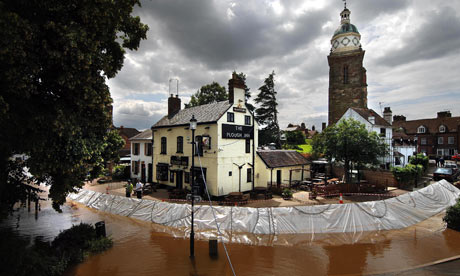
    Flood defences in summer 2007 at Upton on Severn, Worcestershire

    Flooding is the greatest threat to the UK posed by climate change, with up to 3.6 million people at risk by the middle of the century, according to a report published on Thursday by the environment department.

    The first comprehensive climate change risk assessment for the UK identifies hundreds of ways rising global temperatures will have an impact if no action is taken. They include the financial damage caused by flooding, which would increase to £2bn-£10bn a year by 2080, more deaths in heatwaves, and large-scale water shortages by mid-century.

    Unusually for such documents, it also highlighted ways in which the country could benefit from milder winters and drier summers, such as fewer cold-related deaths, better wheat crops and a more attractive climate for tourists.

    Lord John Krebs, chairman of the adaptation committee of the independent advisory group Committee on Climate Change, said that without planning and investment to deal with the threats the UK would “sleepwalk into disaster”. The benefits of climate change should also not be taken as reason to stop worrying about it, even with policies to reduce the threats, said Krebs: “Whether it will result in a net benefit we simply can’t tell.”

    Scientists and other experts, led by Defra, identified 700 impacts of climate change in the UK, including the possibility of refugees arriving from wars over dwindling water and food.

    High-impact events expected by mid-century included decreased forestation caused by red band needle blight, shortages in public water supply (especially in the north, Midlands and south of England), and worse water quality.

    The assessors selected the 100 most pressing threats and opportunities and rated these according to their impact, the confidence of the modellers, and how soon the threats might occur. All the report’s forecasts assume no governmental action to reduce or remove the threats.

    The four most immediate “high consequence” risks all concerned flooding, with the expectation that in 10 years or so there will be increased flood damage to homes, with knock-on effects on insurance premiums and mental health.

    Between 1.7 million and 3.6 million people are expected to be at risk of flooding by 2050, without investment to lessen the threat.

    Other issues highlighted by the report include changes in wildlife migration, alterations in species communities as plants and animals fail to move fast enough to thrive, sewer overflows polluting the coast, changes in the soil, erosion from heavier rains, loss of staff working-time from heat stress, changes in fish stocks, and wildfires in drier summers.

    Julian Hunt, emeritus professor of climate modelling, at University College London, said the report’s finding that there would be longer periods of “static weather” and cloud cover, could threaten solar and wind energyfrom solar and wind sourcesenergy.

    “This leads to dangerous urban heat island temperatures and droughts. But it also indicates the danger of lengthy, very low, wind conditions, or cloudy conditions – so low-carbon energy alternatives to wind and solar are essential,” said Hunt.

    Peter Mallaburn, reader in climate policy at De Montfort University, said the need to save energy was in conflict with government policies not pushing for higher energy efficiency standards for commercial buildings.

    “This report says, for the first time, that not only are our homes and offices leaky, but that they will start to overheat in a warmer world,” said Mallaburn. “We need a coherent strategy to sort out this mess. Let’s hope that this report acts as a wake-up call.”
    ul.shr-socials li.shareaholic { background-image: url(“http://planetextinction.com/blog/wp-content/uploads/shareaholic/spritegen/sprite.png”) ! important; }

  • Teetering on a tipping point: dangerous climate change in the Arctic

    Teetering on a tipping point: dangerous climate change in the Arctic

    We are seeing the first signs of dangerous climate change in the Arctic. This is our warning that humanity is facing a dire future. [From Carlos Duarte, http://theconversation.edu.au]

    The Arctic region is fast approaching a series of “tipping points” that could trigger an abrupt domino effect of large-scale climate change across the entire planet. The region contains arguably the greatest concentration of potential tipping elements.

    If set in motion, these can generate profound alterations which will place the Arctic not at the periphery, but at the core of the Earth system. There is evidence that these chain reactions have begun. This has major consequences not just for “nature”, but for the future of humankind as the changes progress.

    Research shows that the Arctic is now warming at three times the global average.

    For the whole report click here

  • Link between earthquakes and cyclones


    ScienceDaily (Dec. 8, 2011) — A groundbreaking study led by University of Miami (UM) scientist Shimon Wdowinski shows that earthquakes, including the recent 2010 temblors in Haiti and Taiwan, may be triggered by tropical cyclones (hurricanes and typhoons), according to a presentation of the findings at the 2011 AGU Fall Meeting in San Francisco.


    See Also:
    Earth & Climate

    • Earthquakes
    • Natural Disasters
    • Hurricanes and Cyclones
    • Severe Weather
    • Rainforests
    • Earth Science
      • North Anatolian Fault
      • Alpine Fault
      • Typhoon Tip
      • 1997 Pacific typhoon season
        “Very wet rain events are the trigger,” said Wdowinski, associate research professor of marine geology and geophysics at the UM Rosenstiel School of Marine and Atmospheric Science. “The heavy rain induces thousands of landslides and severe erosion, which removes ground material from the Earth’s surface, releasing the stress load and encouraging movement along faults.”
        Wdowinski and a colleague from Florida International University analyzed data from quakes magnitude-6 and above in Taiwan and Haiti and found a strong temporal relationship between the two natural hazards, where large earthquakes occurred within four years after a very wet tropical cyclone season.
        During the last 50 years three very wet tropical cyclone events — Typhoons Morakot, Herb and Flossie — were followed within four years by major earthquakes in Taiwan’s mountainous regions. The 2009 Morakot typhoon was followed by a M-6.2 in 2009 and M-6.4 in 2010. The 1996 Typhoon Herb was followed by M-6.2 in 1998 and M-7.6 in 1999 and the 1969 Typhoon Flossie was followed by a M-6.2 in 1972.
        The 2010 M-7 earthquake in Haiti occurred in the mountainous region one-and-a-half years after two hurricanes and two tropical storms drenched the island nation within 25 days.
        The researchers suggest that rain-induced landslides and excess rain carries eroded material downstream. As a result the surface load above the fault is lessened.
        “The reduced load unclamp the faults, which can promote an earthquake,” said Wdowinski.
        Fractures in Earth’s bedrock from the movement of tectonic plates, known as faults, build up stress as they attempt to slide past each other, periodically releasing the stress in the form of an earthquake.
        According to the scientists, this earthquake-triggering mechanism is only viable on inclined faults, where the rupture by these faults has a significant vertical movement.
        Wdowinski also shows a trend in the tropical cyclone-earthquake pattern exists in M-5 and above earthquakes. The researchers plan to analyze patterns in other seismically active mountainous regions — such as the Philippines and Japan — that are subjected to tropical cyclones activity.
        Recommend this story on Facebook, Twitter,
        and Google +1:

    • Reference

  • On our Radar: The Danube ices over

    Beijing plans to reduce air pollution levels by 30 percent by 2020 by phasing out old cars, relocating factories and planting new forests, state news reports say. [Reuters]

    A federal magistrate in New Orleans rules that lawyers for plaintiffs suing BP and others for damages related to the 2010 gulf oil spill won’t be able to introduce some of the corporate defendants’ internal e-mails as evidence at trial. [Bloomberg]

    Scientists at Cambridge University have developed a new type of solar cell that could harvest 25 percent more energy from the sun than traditional ones. The cell, a hybrid, absorbs red light and harnesses the extra energy of blue light to boost the electrical current. [Click Green]