

State mulls uniform ban on outdoor smoking
State mulls uniform ban on outdoor smoking
Louise Hall
September 10, 2010
THE state government is considering a statewide ban on smoking in outdoor areas such as alfresco dining areas and children’s playgrounds following lobbying by local councils and health groups.
The new five-year NSW Tobacco Strategy, which is yet to be approved by cabinet, is believed to recommend the introduction of uniform anti-smoking laws in crowded outdoor areas such as concerts, markets and shopping malls.
California bags the plastic bag ban but makes solar leap
couldn’t punch their way out of a plastic bag
California bags the plastic bag ban but makes solar leap 6
But don’t go crying in your organic beer yet. On Thursday, the California Public Utilities Commission signed off on 650 megawatts of new solar energy contracts and programs.
Which all goes to show that in the Golden State, environmental politics are not green and brown. And despite the unknown fate of Proposition 23, the oil company-bankrolled ballot initiative to suspend California’s global warming law, the state’s panoply of green laws allows progress to be made on various fronts.
The utilities commission, for instance, approved contracts for two giant photovoltaic solar farms to be built in the Mojave Desert by First Solar. Together they will supply 550 megawatts of electricity to the utility Southern California Edison.
Meat eating can be an environmentally friendly choice, argues George Monbiot
Meat eating can be an environmentally friendly choice, argues Geoge Monbiot 44
As a meat-eater, I’ve long found it convenient to categorise veganism as a response to animal suffering or a health fad. But, faced with these figures, it now seems plain that it’s the only ethical response to what is arguably the world’s most urgent social justice issue.
-George Monbiot, “Why vegans were right all along,” Dec. 2002
Guardian columnist and well-known environmentalist George Monbiot ate the above words yesterday — with a dash of salted crow, one imagines. In a column titled “I was wrong about veganism. Let them eat meat — but farm it properly,” he tells how a book released in England this week has persuaded him that meat eating per se isn’t environmentally irresponsible, it’s the current industrial farming model that is.
Monbiot himself is not vegan. In 2008 he wrote that he gave up all animal products “for about 18 months, lost two stone, went as white as bone and felt that I was losing my mind. I know a few healthy-looking vegans, and I admire them immensely.”
Green economy growing in West Midlands
Green economy growing in West Midlands

Firms in the West Midlands are increasingly looking at green industry to grow their businesses, a survey has revealed.
Some 70% of professional services firms see the low carbon and environmental technologies sector as a key growth area, according to the survey commissioned by business support hub West Midlands (WM) Knowledge.
Jo Miners, of WM Knowledge, said of the findings: “As a region with a strong focus on low carbon industries, the West Midlands has a leading reputation in advanced manufacturing, electric vehicle engineering, low carbon building and environmental technologies.
AGL accused of dumping tainted water in Hunter
AGL accused of dumping tainted water in Hunter
Ben Cubby ENVIRONMENT EDITOR
September 9, 2010
VINEYARD owners accuse the energy company AGL of dumping contaminated water in the Hunter Valley, where it is planning to extract coal seam gas.
The state government said it was concerned and had asked AGL to remediate a site near the town of Broke, after 120,000 litres from a groundwater monitoring program was expelled into a paddock the company owns.
Deadly flood threat hangs over French Alpine village
Deadly flood threat hangs over French Alpine village
Scientists are racing to prevent a build-up of water under a glacier on Mont Blanc from flooding the village of Saint-Gervais
- Guardian Weekly, Tuesday 7 September 2010 16.53 BST
- Article history
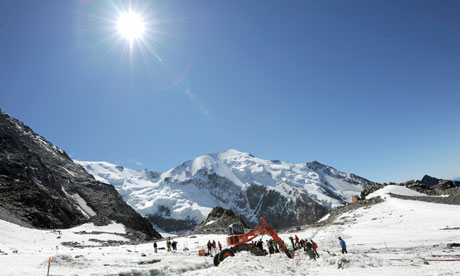 Technicians start work on draining the vast underground lake beneath the glacier. Photograph: Jean-Pierre Clatot/AFP/Getty Images
Viewed from up here, the world of man appears very small and vulnerable. The Tête-Rousse glacier, hovering between sky and earth at an altitude of 3,200 metres, dominates the scene splendidly. It is a magnificent panorama of infinite horizons, the perfect silence interrupted only by sound of the climbers’ crampons as they start the ascent to Aiguille du Goûter, the normal route up Mont Blanc. Facing us, the Aravis range and the Chablais Alps break up the horizon, while in the valley below, tiny chalets appear to be clinging to the mountainside.
But the serenity is deceptive. In the core of the glacier lies a silent threat that could, without warning, destroy the village of Saint-Gervais below. Trapped under the glacier lies an enormous 65,000 cubic metre pocket of water – the equivalent of 20 Olympic swimming pools – that could burst and surge down on to the village below. “It’s impossible to predict when that might happen,” said Christian Vincent from the Grenoble Laboratory of Glaciology and Geophysical Environment. He is here to carry out a regular temperature check at Tête-Rousse.
The 75 metre-deep glacier covers 8 hectares of a rocky basin. Early this summer, several boreholes were pierced with a high-pressure hot water drill and special sensors introduced on to the bedrock. Using a snow shovel, the scientist clear the markers that show where these were placed and note down the temperatures. “Precise knowledge of a glacier’s temperatures is vital to understanding how these water pockets are formed,” Vincent explains.