Category: News

Add your news
You can add news from your networks or groups through the website by becoming an author. Simply register as a member of the Generator, and then email Giovanni asking to become an author. He will then work with you to integrate your content into the site as effectively as possible.
Listen to the Generator News online

 
The Generator news service publishes articles on sustainable development, agriculture and energy as well as observations on current affairs. The news service is used on the weekly radio show, The Generator, as well as by a number of monthly and quarterly magazines. A podcast of the Generator news is also available.
As well as Giovanni’s articles it picks up the most pertinent articles from a range of other news services. You can publish the news feed on your website using RSS, free of charge.
 

  • AFRICA’S EXPLOSIVE POPULATION GROWTH kelvin thompson MP

    6 of 63


    AFRICA’S EXPLOSIVE POPULATION GROWTH

    Inbox x

    Ryan, Julie (K. Thompson, MP) <Julie.Ryan@aph.gov.au>

    4:14 PM (2 hours ago)

    Dear Population Supporter
    There is a great deal of dismay and hand-wringing over the tens of thousands of people leaving Africa for Europe and the UK by any and all means they can.

    Given this, the latest work of the United Nations is very disturbing. It shows that Africa will double – repeat double – in size between now and 2050. It says Africa’s growth will account for much of the explosive growth in the world’s population this century.

    It finds that the world is growing by around 83 million people a year, and estimates that the global population will reach 8.3 billion in 2030, 9.7 billion in 2050, and 11.2 billion by 2100. It says that there is less than a one in four chance of an end to global population growth by 2100.

    Africa has the highest fertility level, with around 4.7 children per woman. Of the additional 2.4 billion people who will be added to the globe between now and 2050, some 1.3 billion will be born in Africa. In countries such as Nigeria, Africa’s most populous nation, there are signs that fertility rates are again increasing. There is a 90 per cent chance of its current population of 182 million rising to 439 million by 2100, two and a half times its current size.

    This is a recipe for humanitarian disaster and misery on an unprecedented scale. It is tragic and disgraceful that no serious attempt is being made to reduce fertility rates in Africa. If this projected population growth happens, it is utterly foreseeable that the flood of people out of Africa will make today’s numbers seem totally insignificant.

    All of those with a capacity to make a difference – Europe, the United Nations, refugee advocacy groups, aid organisations – have an obligation to speak up about the unfolding disaster that is Africa’s population growth, and do everything they can to rescue both Africa and the rest of the world from this disaster.

    The Hon. Kelvin Thomson
    Federal Member for Wills

    to Julie
  • Update: Nothing is happening LABOR

    More

    1 of 54

    Update: Nothing is happening

    Inbox
    x

    George Wright Unsubscribe

    11:18 AM (18 minutes ago)

    to me
    The latest politics update from the Australian Labor Party | Unsubscribe
    .
    Neville —

    We would love to give you an update on the Abbott Government’s agenda in the parliament this week, but the reality is nothing is happening.

    They have very few bills before the house, in fact they’re only spending 10% of the time allocated to Government Business in Parliament on legislation. Given legislating is core business for government that’s pretty astonishing. What’s more is that there’s no sign things will improve, the Coalition Government have so little going on, it’s reported they cancelled their upcoming Cabinet meeting because there’s nothing on the agenda!

    What’s on earth is going on?

    Tony Abbott and the Liberals are a mess and that’s having its effect on the parliament.

    Meanwhile the rest of us are left with the reality of their narrow, cruel lack-of-an-agenda: blocking their own MPs from a free vote on marriage equality, attacks on our proud renewable energy industry; commitment to some of the weakest emissions reduction targets in the developed world; former speaker Bronwyn Bishop booted for her taxpayer funded helicopter trips; making it harder for environmental activists to take big coal mining companies to court; and vigorous defence of an expensive and politically motivated Royal Commission whose ‘independent’ head Dyson Heydon was billed to speak at a Liberal party Fundraiser?!!

    Still on the table are their $80 billion in cuts to schools and hospitals, $100,000 degrees, and cuts to the pension, just to mention a few.

    Oh, and in his spare time Tony Abbott hates windfarms.

    It goes on…and on…. The Abbott Government really doesn’t have anything even remotely constructive on its agenda.

    The good news is we don’t have to sit down and cop it. Our community, thanks to you, has been hugely successful in shutting down elements of the Abbott Government’s unfair agenda. The community has mobilised against $100,000 degrees, stopped the $7 GP copayment and generated amazing momentum towards making marriage equality a reality. So thank you for your support and for helping to stop the worst Tony Abbott and the Liberals want for Australia.

    In the coming weeks and months we’ll continue to push our agenda for Australia’s future: 50% renewable energy generation by 2030, making marriage equality a reality within the first 100 days of a winning an election and transferring to a knowledge economy through investment in STEM education.

    We still have a lot more to do. We have an election to win and we still have to be ready to fight Tony Abbott’s next disturbing thought bubble.

    Thanks for standing together to stop Tony Abbott from doing his worst.

    George Wright
    Labor National Secretary

  • Our dirty secret LABOR HERALD

    4 of 56

    Our dirty secret

    Inbox
    x

    Labor Herald updates@laborherald.com.au via sendgrid.info 

    12:55 PM (6 hours ago)

    to me
  • “Vigilantes and saboteurs”? ACF

    More

    3 of 56

    “Vigilantes and saboteurs”?

    Inbox
    x

    Geoff Cousins, ACF Unsubscribe

    2:25 PM (5 hours ago)

    to me

    Hi

    This is extraordinary. Rattled by the Federal Court overturning approval of the Carmichael Coal Mine, the government plans to rush a bill through Parliament tomorrow to rip out the laws that allow Australians to challenge dangerous projects – like new coal mines – in court.

    Our national nature protection laws were introduced by the Howard government to provide sensible checks and balances.

    Yet our current Prime Minister calls the Mackay Conservation Group’s legitimate legal challenge to the Carmichael Coal Mine sabotage. And Attorney-General George Brandis calls environment groups vigilantes.

    The Australian Government wants to make it easier for big polluters to pollute and damage life, and harder for Australia to become powered by clean renewable energy. We want a society powered by clean energy that protects life and empowers communities.

    Thankfully, many people and communities are willing to speak up for the places and wildlife they love and depend on.

    The Places You Love alliance – who I stood with at an emergency press conference this morning – represents 1.5 million Australians.

    We’re working together to mobilise supporters and you have a critical role to play as a part of this huge alliance. It’s time to up the ante.

    Will you email your local Member of Parliament and tell them you care about protecting our land, water and wildlife? Say you want them to protect the community’s legal right to challenge government decisions to approve massive coal projects that fuel global warming and damage life.

    Tens of thousands of ACF supporters took action last week, and together, we can get the emails rolling in to Members of Parliament all across the country.

    It’s just a small handful of politicians – fuelled by greedy coal lobby groups – who are trying to take away the voice of our communities.

    Today’s action by the Abbott Government is part of the big polluters campaign to revoke environment groups’ charity status and remove your ability to give tax deductible donations and raise funds to challenge big polluters. The Abbott Government is using the language of terrorism to describe reasonable people working within the laws of our country.

    The Guardian said the Abbott Government war on green ‘saboteurs’ is Laurel and Hardy slapstick – but the consequences are severe.

    National environmental law exists for a reason – to protect the life, land, water and wildlife.

    The truth is our national environment law, the EPBC Act, has prompted very little court action. While more than 5000 projects have been referred under this law, only 27 have been brought before the court for judicial review.

    Governments should welcome public transparency and scrutiny of polluting and damaging industrial developments.

    The Australian Government’s extreme reaction to the Federal Court’s decision against the development of the Carmichael Coal Mine make it clear – it’s time for a new generation of environmental laws. We need a healthy and robust nature protection framework that can’t be exploited by big polluters.

    To find out more about the campaign, you can listen to my interview with ABC radio this morning.

    Local people have the courage to protect the places, water and wildlife Australians love and depend on from the big polluters. And it’s up to us to keep this right alive.

    Will you send an urgent email today to your representative in Parliament? Tell them you’re from their electorate and you want them to protect Australia’s environmental law.

    Thanks for all you do,

    Geoff

    Geoff Cousins
    President
    Australian Conservation Foundation

  • Arctic Ocean Seafloor Features Map

    geology McAfee SECURE sites help keep you safe from identity theft, credit card fraud, spyware, spam, viruses and online scams

    Home » Articles » Oil & Gas » Arctic Ocean Seafloor Features Map

    Arctic Ocean Seafloor Features Map

    Major Basins, Ridges, Shelves and Bathymetry

    Arctic Ocean Seafloor Features Map

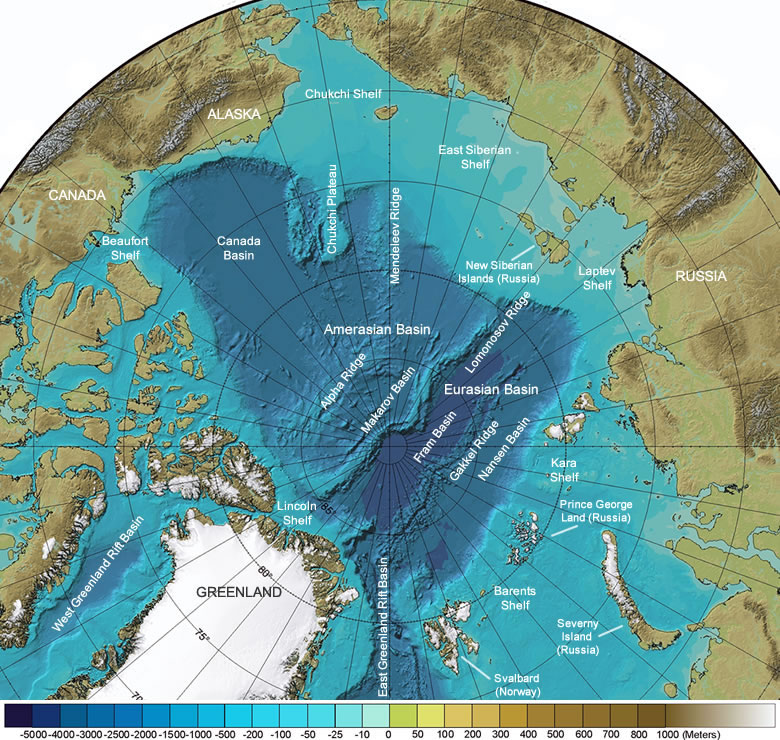
    Arctic Ocean Seafloor Features Map: International Bathymetric Chart of the Arctic Ocean annotated with the names of seafloor features

    Arctic Ocean: History and Now

    The Arctic Ocean has played a minor role in world history. Ice cover severely hinders navigation; the area is remote; there is almost no infrastructure; winters are dark and very cold; summer days are short and foggy. These challenges make the Arctic Ocean a hostile and difficult area.

    Today, we are at a time when interest in the Arctic Ocean is growing steadily. A warming climate is thinning and shrinking the polar ice pack to allow increased navigation. New oil and gas assessments have revealed an enormous energy resource. And, the Law of the Sea Treaty has motivated nations to clearly define their exclusive economic zone in the Arctic Ocean.

    The new interest in the Arctic Ocean is not confined to its surface; it extends to the bottom where information about its structure is needed by geologists, oceanographers, biologists and other people who work there. The primary physical features of the Arctic Ocean seafloor are labeled on the bathymetry map above and described in the paragraphs below. Maps in the right column illustrate navigational, physical and mineral resource features.

    Arctic Ocean Geography

    The Arctic Ocean has a surface area of about 14.056 million square kilometers (5.427 million square miles), making it the smallest of Earth’s five oceans. Baffin Bay, Barents Sea, Beaufort Sea, Chukchi Sea, East Siberian Sea, Greenland Sea, Hudson Bay, Hudson Straight, Kara Sea, and Laptev Sea are generally considered to be part of the Arctic Ocean. It is connected to the Pacific Ocean through the Bering Strait and connected to the Atlantic Ocean through the Labrador Sea and the Greenland Sea.

    Lomonosov Ridge

    The dominant topographic feature of the Arctic Ocean seafloor is the Lomonosov Ridge. This feature is thought to be part of the Eurasian continental crust that rifted from the Barents-Kara Sea margin and subsided in early Tertiary time (about 64 to 56 million years ago). The side of the Ridge facing Eurasia is bounded by half-graben faults and the side facing North America is gently sloping.

    Blood Diamonds
    What Causes a Tsunami?
    Marcellus Shale
    Rare Earth Elements

    The Lomonosov Ridge traverses the Arctic Ocean from the Lincoln Shelf (off Ellesmere Island and Greenland) to the New Siberian Islands off the coast of northern Russia. It divides the Arctic Ocean into two major basins: the Eurasian Basin on the Eurasian side of the ridge and the Amerasian Basin on the North American Side. It rises over 3000 meters above the floors of these basins and at its highest point is about 954 meters below sea level. It was discovered by Russian scientists in 1948.

    In 1982 a United Nations treaty known as “The Law of the Sea” was presented. It addressed navigational rights, territorial waters limits, exclusive economic zones, fishing, pollution, drilling, mining, conservation and many other aspects of maritime activity. It was the first attempt by the international community to establish a formal agreement on a logical allocation of ocean resources. Under the Law of the Sea, each country receives exclusive economic rights to any natural resource that is present on or beneath the sea floor out to a distance of 200 nautical miles beyond their natural shorelines. In addition to the 200 nautical mile economic zone, each country can extend its claim up to 350 nautical miles for those areas that can be proven to be an extension of that country’s continental shelf.

    Nations could use the “Law of the Sea” treaty to determine who owns the Arctic Ocean seafloor. Russia has presented a claim to the United Nations that the Lomonosov Ridge is an extension of Eurasia and that entitles Russia to an extended exclusive economic zone. Canada and Denmark make similar claims to extend their control from the opposite side of the Arctic Ocean.

    Amerasian and Eurasian Basins

    The Lomonosov Ridge divides the floor of the Arctic Ocean into two major basins. The Eurasian Basin is on the Eurasian side of the Lomonosov Ridge and the Amerasian Basin is on the North American side of the Lomonosov Ridge.

    The Amerasian and Eurasian Basins have been subdivided by ridges. The Gakkel Ridge, a spreading center responsible for the rifting of the Lomonosov block from the Eurasian continent, divides the Eurasian Basin into the Fram Basin on the Lomonosov side of the ridge and the Nansen Basin on the Eurasian continent side. The Alpha Ridge divides the Amerasian Basin into the Canada Basin on the North American side of the ridge and the Makarov Basin on the Lomonosov side of the ridge.

    Continental Shelves

    The Amerasian Basin and the Eurasian Basin are surrounded by extensive continental shelves. These include the Chukchi Shelf and the Beaufort Shelf along North America; the Lincoln Shelf along northern Greenland; the Barents Shelf, Kara Shelf, Laptev Shelf and East Siberian Shelf along Eurasia.

    Enormous amounts of natural gas are believed to be beneath the Barents Shelf and the Kara Shelf as parts of the East Barents Petroleum Province and the West Siberian Petroleum Province. Oil and natural gas are believed to be beneath significant parts of the Chukchi Shelf, Beaufort Shelf and Canada Basin as part of the Arctic Alaska Petroleum Province and the Amerasia Petroleum Province (see map in right column).

    Rift Basins

    Greenland is flanked by two rift basins: the East Greenland Rift Basin and the West Greenland Rift Basin. These basins connect the Arctic Ocean with the Atlantic Ocean. Each of these basins is thought to be underlain by a significant oil and natural gas resource.

    Navigation Through the Arctic Ocean

    Two potentially important navigation channels pass through the Arctic Ocean (see map in the right column). The Northwest Passage is a sea route that connects the Pacific Ocean to the Atlantic Ocean across the northern coast of North America and through the Canadian Arctic Archipelago. The Northern Sea Route is a similar route that connects the Atlantic Ocean to the Pacific Ocean across the northern coast of the Eurasian Continent.

    Both of these routes have been virtually impassable in the past because they are covered by thick, year-round sea ice. However, they have been relatively ice-free for a few weeks in recent years (see map in right column) and have attracted a small amount of commercial shipping. Each of these routes cuts thousands of miles off of a trip from the Atlantic to the Pacific. Both routes face jurisdictional problems and questions over who has a right to use them and under what conditions.

  • The trillion-dollar hole in Abbott’s climate policy logic

    The trillion-dollar hole in Abbott’s climate policy logic

    Print Friendly

    A new report from global investment giant Citigroup has blown a great big hole in the Abbott government’s logic for aiming low on emissions reduction and renewable energy growth.

    The Coalition’s justification for its low-ball climate targets has been, consistently, relentlessly, that it was the economically responsible policy path for the government to take. On the other hand, it argues, the costs of Labor’s “ideological obsession” – a proposed 50 per cent renewable energy target by 2030, and more ambition on emissions reduction – would be “simply catastrophic.”

    Unfortunately for Tony Abbott and his environment minister Greg Hunt, the report published by Citi on Tuesday suggests this line of logic is deeply flawed.

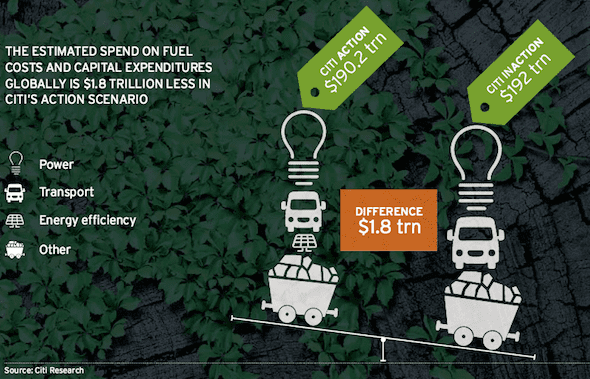
    The report, which seeks to objectively analyse the economics of acting – or not – on climate change, finds that its ‘Action’ scenario – in which governments invest heavily in overhauling their energy markets, transport sectors and industries to a low-carbon mix – results in an undiscounted saving of $1.8 trillion out to 2040.

    Screen Shot 2015-08-18 at 10.37.24 am

    This is because, while governments spend more on renewables and energy efficiency in the early years (and yes, Citi does factor in the cost to existing industries of a massive shift to low-carbon energy sources), the savings in fuel costs in later years offset earlier investment, says the report.

    Moreover, it adds, “if the scientists are correct,” – and strangely enough Citi believes they are – “the potential liabilities of not acting [listed further on in the report as global food shortages, widespread drought, mass population displacement, increased flooding, etc] are equally vast.”

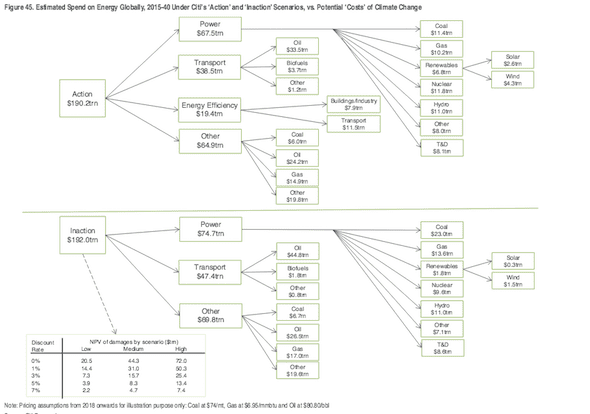
    “The cumulative ‘lost’ GDP from the impacts of climate change could be significant, with a central case of 0.7%-2.5% of GDP to 2060, equating to $44 trillion on an undiscounted basis,” the Citi report says.

    Screen Shot 2015-08-18 at 10.37.39 am

    The report finds that the cumulative losses to global GDP from climate change impacts (‘Inaction’) from 2015 to 2060 are estimated at $2 trillion to $72 trillion depending on the discount rate and scenario used. Lower discount rates encourage early action.

    If emissions continue to rise and therefore temperature continues to increase after 2060, the negative effect on GDP losses could become more than 3% of GDP with estimates ranging from 1.5% to almost 5%.

    More worryingly, the report notes that under an ‘Inaction’ scenario, the world would be locked to a high-emissions infrastructure and the damages could continue for more than a century, with the highest impacts of GDP foreseen in south and south-east Asia, Africa and the Middle East.

    “The estimated damages could be larger as these economic studies only measure those impacts that are quantifiable and largely concentrate on market or near market sectors. Other impacts such as tipping points, weather related events or catastrophic risks are not included in the studies.”

    Screen Shot 2015-08-18 at 12.05.52 pm

    One the other hand, says Citi, “if we derive a risk-adjusted return on the extra capital investment in following a low carbon path, and compare it to the avoided costs of climate change, we see returns at the low point of between 1% and 4%, rising to between 3% and 10% in later years.”

    So, on a risk adjusted basis this implies a return of 1-4 per cent at the low point in 2021, rising to between 3-10 per cent by 2035, the report finds.

    “Not spectacular returns,” Citi concedes, “but against current low yields… it represents a relatively attractive option.” And, of course, there is the added benefit of avoiding catastrophic global warming.

    Summing up, the Citi report has this to say: “With a limited differential in the total bill of Action vs Inaction (in fact a saving on an undiscounted basis), potentially enormous liabilities avoided and the simple fact that cleaner air must be preferable to pollution, a very strong ‘Why would you not?’ argument regarding action on climate change begins to form.”

    Can someone let Abbott know?