

Millions at risk of flooding as river deltas sink
Millions at risk of flooding as river deltas sink
Deltas vulnerable to flooding will increase dramatically as sea levels rise, researchers find. From SciDev.net, part of the Guardian Environment Network
- guardian.co.uk, Friday 25 September 2009 11.35 BST
- Article history

A satellite image of the Ganges delta, the world’s largest delta, which is vulnerable to flooding. Photograph: Envisat/ESA
Most of the world’s river deltas are sinking relative to sea level, putting millions at risk of severe flooding, say researchers.
And human activity, such as dam-building, is the biggest reason, according to the study published last week in Nature Geoscience (20 September).
Loss of soil threatens food production, UK government warns.
Loss of soil threatens food production, UK government warns
Defra’s chief scientist says safeguarding soil is ‘critical’ if food production is to increase in the UK in the next 20-30 years
- guardian.co.uk, Thursday 24 September 2009 18.00 BST
- Article history
More than 2m tonnes of topsoil from farms and forests is being eroded by wind and rain each year, jeopardising efforts to increase food production, the UK government said today.
The soil erosion is reducing the amount of food grown, increasing the risk of flooding and undermining efforts to reduce carbon emissions.
UK land has been steadily degraded by 200 years of intensive farming and industrial pollution, warned the Department for the Environment, Food and Rural Affairs (Defra) in a major study of soils. But it said the situation is not nearly as bad as in many Asian and African countries, where soil erosion due to overgrazing and poor farming practices is now seriously threatening food production.
World consumption plunges planet into’ecological debt’, says leading thinktank
World consumption plunges planet into ‘ecological debt’, says leading thinktank
Consumption exceeds Earth’s annual ‘biocapacity’ today amid warnings of dependence on overseas food and energy
- The Guardian, Friday 25 September 2009
- Article history

Rich nations are still gobbling up the world’s resources despite the recession. Photograph: Corbis
Rich consumers are still voraciously gobbling up the world’s resources, despite the worst recession in a generation, with their appetite pushing the planet into “ecological debt” from today , according to a report by think-tank the new economics foundation.
This “ecological debt day” marks the point in the year when consumption around the world exceeds the Earth’s annual “biocapacity” — so for the remainder of the year, we will be eating into environmental resources that will not be replaced, according to nef’s calculations.
UK launches 22m(UK) wave energy fund
UK launches £22m wave energy fund
Government invites wave and tidal energy developers to bid for £22m in new grants designed to accelerate the commercial development of marine energy technologies. From BusinessGreen.com, part of the Guardian Environment Network
- guardian.co.uk, Wednesday 23 September 2009 11.43 BST
- Article history
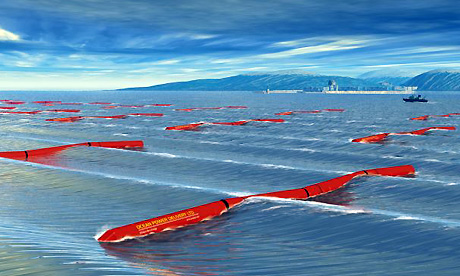
An artist’s impression of the wavefarm in full production
The government has today formally launched its Marine Renewables Proving Fund, inviting wave and tidal energy developers to bid for £22 million in new grants designed to accelerate the commercial development of marine energy technologies.
The fund, which was announced in July as part of the government’s renewable energy strategy and will be managed by the Carbon Trust, aims to help marine energy developers get their technologies to a stage where they can be installed, at which point they can apply for further financial assistance from the Marine Renewables Deployment Fund.
China and India are leading the way.Yes, I’m optimistic
China and India are leading the way. Yes, I’m optimistic
This week’s summit on climate change offered cause for confidence. But all nations now need to redouble their efforts
-
- guardian.co.uk, Wednesday 23 September 2009 21.30 BST
- Article history
This week’s summit on climate change at the United Nations in New York has given a strong boost to the negotiations over a major international treaty, but there remain a number of major obstacles that must be overcome before the crucial meeting in Copenhagen in December.
China, India and Japan, along with the private sector, all made positive and significant contributions at the summit.
Spending crisis could put brake on clean coal project
Spending crisis could put brake on clean coal project
- The Guardian, Wednesday 23 September 2009
- Article history
The government’s claim to be a world leader in developing clean coal technology has been dented after officials warned privately that public spending constraints could force them to cut the £10bn programme.
The Guardian has learned that Ed Miliband‘s energy and climate change department is under pressure from the Treasury to scale back its ambitions for new carbon capture and storage (CCS) coal plants.
Officials have admitted that securing the necessary investment is “challenging in the current climate”.