Category: Uncategorised

  • Interminable conversations

    Birds do it. Bees do it
    Even educated fleas do it
    Let’s do it, Let’s fall in love
    Cole Porter 1928

    There is no doubting the power of conversation as a communication tool. The best preachers and the biggest stadium rock bands mimic traditional call and response to engage the audience and drive home the memory if not the message.

    Climate for change is the latest grass roots movement to adopt the pattern to drive for specific outcomes.

    1. “What do we do as individuals [to prevent climate change]?’
    2. “How effective is that?”
    3. “Would it be more effective to lobby government to change the regulations than to change our light globes?”
    4. Let’s agree that we should use our collective energy to lobby government.

    Get Up eplored a conversational approach in the 2016 election campaign, refined and rolled it out as a significant component of its 2019 platform.

    The ALP says that it is using it, but it stops short of allowing a second voice in the conversation, so can not be genuinely included as a data point in this analysis.

    The Greens have been using it in one form or another since 2013. Adam Bandt employed what his campaigners called the Barack Obama strategy in his first successful election campaign. Obama had taken his inspiration from Chicago community activist Saul Alinsky and his book Rules for Activists via

    Keep this manual safe and confidential.
    DO NOT SHARE

    Bandt’s campaign manual was taboo in the Australian Greens, for a variety of reasons, some practical, some factional, some relating to inertia. It had the words, “Keep this manual safe and confidential. Do Not Share” emblazoned across the inside cover. As a result, the South Brisbane Greens fought the 2013 campaign against Kevin Rudd in Griffith directly following Saul Alinsky’s principles and simply told everyone we were using the “Bandt model”. When Rudd resigned in 2014 we campaigned against Terri Butler in the by-election using the official playbook and paid Get Up’s Simon Sheikh to send some staff to come and train us in the fine print of the technique.

    Following that, the model has become de-rigueur in The Greens and has spread through other environmental and activist groups as outlined above.

    The most recent incarnation of the two-decade old training by Al Gore’s Climate Action has now added conversational techniques to its armoury.

    The failure of all this conversing to make a “Climate Election” out of the 2019 contest for control of the Australian Federal Parliament simply brings The Greens, Climate Action, Climate for Change and Get Up to the same point.

    The populace is not sufficiently moved by the evidence of the damage they inflict on future generations or the world’s poor to give up their four-wheel drives, steak dinners, international holidays and other benefits of continuous economic growth.

    We need not argue about why this is the case, that is fairly straight forward, we do need, however, to discuss what we can do to engage the natural morals and humanity of the silent majority.

    The reasons that people do not want to engage are spelled out in the uncompromising and terrifyingly honest video snip, “Deep Adapatation” by Jem Bendell. https://www.youtube.com/watch?v=DAZJtFZZYmM&t=2s

    The contract is broken – We are not in control any more,”he points out.

    To paraphrase: the very real and well understood danger that we may become extinct in the lifetime of people living today, leads directly to the breakdown of the fundamental promise that has underpinned liberal democracy. That promise has been that life will continue to get better, as long as we stick to the rules. As a consequence, people are no longer sticking to the rules.”

    The impact is that veteran campaigners are giving up, declaring the end of social democracy and the failure of the climate movement. In April this year John James wrote his final weekly newsletter, opening with the words:

    “For more than three decades I have been spreading news of the climate crisis during the years when we could have made a difference, and at no moment in all that time has the good news outshone the bad.

    “I am 88. I gave my first public talk on ecology and the warming planet in 1982. I am weary of reiterating increasingly miserable news. We all know where we are heading. We won’t be bored in the years that remain to us.”

    These campaigners express disappointment that we did not make the change that had to be made to avoid the position we are in now but in a very real way they have simply switched gear accepting the inevitable. They have not given up campaigning, they have simply given up trying to bring the mainstream with them.

    I interviewed Richard Heinberg in 2008 about his scenario analysis PowerDown. I pointed out to him that based on the political landscape at the time his Lifeboat scenario seemed more likely than any of the others. He was shocked. “I had to include that for completeness in the spirit of scenario analysis, but it is the worst case scenario. That is what we need to do if none of the other scenarios eventuate.” https://thegenerator.news/thegenerator/soundfiles/Heinberg_Lifeboats.mp3

    On the other hand, the youth is newly energised to pick up where their elders have left off.

    The Extinction Rebellion, the Climate Emergency are declarations that reflect the urgency so cogently declared by Greta Thornburg. That does not resolve some of these inherent tensions, though. When Greta declared that Sustainability is dead, Climate Change is everything, the fractious nature of the discussion that emerged must have made fossil fuel magnates extremely warm and comfortable.

    Recently, a number of young women who have expressed serious concern about their decision to bear children in the face of a possible extinction event. I grew up in the shadow of the Atomic era, I was born at the height of the Cold War. I missed being conscripted to Vietnam by five years. As youngsters we expressed intellectual concern about the morals of bringing children into this world, but all the women my age who discussed with me their reasons not to breed were driven by rather more selfish reasons. Children are an expensive luxury in a neo-liberal society.

    These deep, life changing decisions by thoughtful people whom I respect are symptoms of the alarm generated by the possibility of extinction and the certainty that we are at the end of growth.

    The reality is that we have to go far beyond conversations that bring the mainstream voter into the conversation, we absolutely have to take action to begin to build a post-growth, post-carbon world. That requires more than conversations or lobbying politicians, that requires radical action, leading to radical change.

    Simon Sheikh of Future Super in January 2014
    Simon Sheikh of Future Super ex-Get Up acted on establishing an income stream before setting up a business training people in the conversational approach.

    It may well be that the organisations that have engaged directly in the financial system, Future Super, Planet Ark two name just two, despite their flaws, offer a significant clue.

  • The best and worst of recycling

    Agricultural use of single-use-plastics dwarves domestic use, Jenny Brown of Envorinex told a crowd of forty at The Precinct in Brisbane last night. The good news is that the company which she founded and heads as managing director, is doing something about it.

    A manufacturer of plastic goods for industrial and infrastructure applications since 2003, Ms Brown has been waging war on waste by recycling as much plastic as possible and delivering goods made from 100% reclaimed waste in the bulk of her products.

    Jenny Brown of Envorinex at the Circular Economy Meetup - June 2019
    Anshu Sisodia and Jenny Brown of Envorinex with friend at Brisbane’s Circular Economy meetup for World Environment Day in June

    “Plastic can be re-used dozens of times and last for centuries if it is properly processed,” she said, “the important thing is to get it right the first time.”

    Some of Envorinex greatest successes include the processing of tonnes of bags and tubes used to deliver saline solution in hospital and converting that into mats and other products.

    “All of the goods that leave our factory can be recycled again, and again and again,” she said.

    Envorinex is based in northern Tasmania and employs around twelve full time staff on two different production lines, reclaiming and processing waste and producing a range of products from guide posts for roads, antifatigue mats for oil rigs, through to simple clips and accessories for a range of applications.

    Ms Brown is in Queensland to explore the establishment of a processing plant to recycle a significant portion of the agricultural waste from the southern half of the state.

    Her presentation included images of tonnes of single use plastic discarded by strawberry and livestock farmers. Envorinex also processes hard plastics recovered from mines and Tasmania’s very active salmon and oyster farming industry. The stanchions and frames used to contain the fish or on which the oysters grow, are replaced every three to five years and include many tonnes of plastic.

    She said that the enemy of recycling is contamination. This is not so much the organic material that attaches to the plastic as the ropes, nylon clips and other attachments that have to be removed manually, vastly increasing the cost of handling and recycling.

    She also noted that most manufacturers reduce costs by mixing substances such as sawdust with virgin plastics to reduce costs and by skimping on other additives that ensure longevity and recyclability.

    Answering a question from the audience about domestic use of single-use-plastics she said that Envorinex deals exclusively with industrial and agricultural waste because domestic waste is so contaminated that it is extremely difficult to recycle.

    “This is why the waste from Australia and other rich countries has been rejected by China, India and Malaysia. They simply cannot process it,” she said. The problem is partly that packaging is often made from a mixture of products that cannot be effectively separated as well as the poor handling and sorting on the part of domestic users.

    She also noted that there are some applications, such as hospital equipment, where single use plastics are necessary but, that generally speaking, single use packaging items are the major problem.

    More information is available from the Envorinex website

  • Growth, or not, and a little Wisdom

    A public discussion on the Post-Growth Future for Business held at University of Queensland generated far-reaching discussion last Friday, 7th June.

    Dr Cle-Anne Gabriel
    Dr Cle-Anne Gabriel at UQ Business School

    Hosted by Dr Cle-Ann Gabriel, who is researching business models for sustainability, the event outlined the reasons for considering an end to growth, the challenges that poses for business and some approaches that can help business flourish in a post-growth environment.

    Key among the ideas was that individual businesses can grow in a zero growth economy, the challenge is where the degrowth comes from to balance that out.

    Dr Gabriel provided an overview of the philosophical underpinnings of zero-growth, the difference between degrowth (it is a process that can be applied to specific areas, such as developed countries, to move toward a post-Growth economy) and post-Growth, and a list of the challenges facing economists.

    Dr Michelle Maloney

    Dr Michelle Maloney, codirector of the New Economy Network, walked through the recent history of growth and the increasing influence of finance as a result of neo-liberalism and some of the tools being used to replace economic growth in specific communities.

    Associate-Professor Bernard McKenna

    Associate Professor Bernard McKenna focused on the nature and application of wisdom. He pointed out that the application of theory and dogma to economic management and in governance generally can lead to harsh and unintentional harm, if is applied without the ameliorating impact of wisdom.

    The complimentary and thorough talks generated vigorous and wide ranging discussion in the workshops raising a number of interesting questions and observations.

    One very challenging observation was that the exponential curves of the “Great Acceleration” all follow similar trajectories to that of population. If deforestation, plastic pollution, ocean acidification, falling water tables, disappearing ice etc are all functions of overpopulation, then this leads to the challenging idea that reducing population would solve all the other problems on its own. That in turn leads to the uncomfortably cynical observation that the inaction of the world’s richest nations on climate change and their increasing hostility to immigration could well engineer such an outcome by simply letting three quarters of the world disappear in an ecological catastrophe.

    Professor McKenna’s work on Wisdom would obviously not accommodate such a conclusion.

  • Geoff Jnr on deGrowth

    A much younger Geoff Ebbs discusses a Zero Growth economy in 2010
  • Dick Smith and Geoff Ebbs discuss degrowth

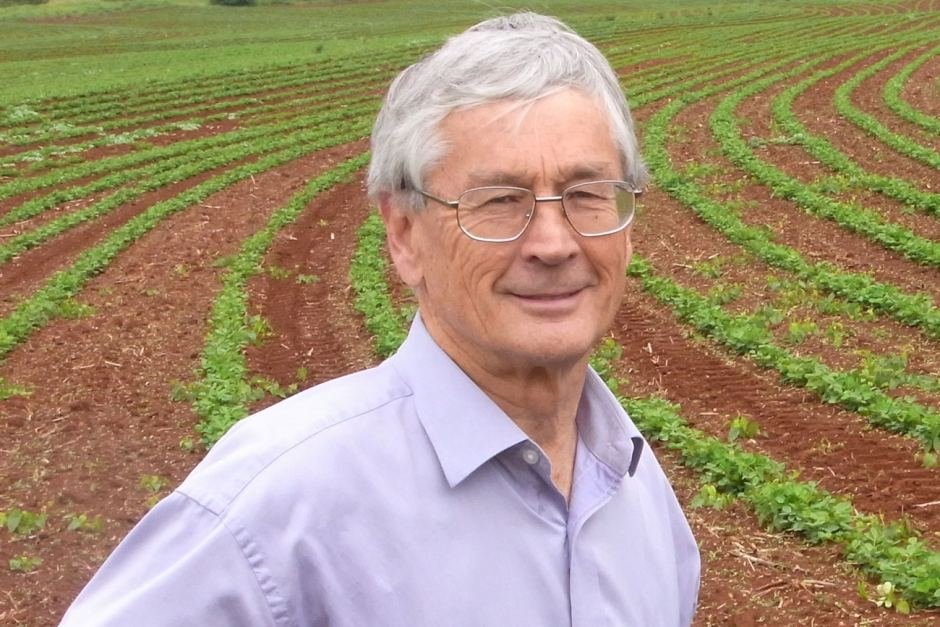
    Entrepreneur and adventurer Dick Smith is no stranger to controversy.

    Dick Smith appeared on the ABC discussing Australian food production

    Over the years he has threatened to run against Tony Abbott, as well as starting a range of ventures that can only be described as profit for a purpose. Dick Smith foods for example was set up with the sole purpose of keeping Australian food processors in Australian hands.

    In this interview with Geoff Ebbs, Dick Smith discusses the end of growth and the challenges inherent for capitalism in that concept.

    Dick and Geoff discuss growth and capitalism in this section of a 15 minute interview.

    The interview was first aired on The Generator, a weekly radio show on Byron Bay’s Bay FM that ran from 2005 until 2009.

  • Discussion thrives at Griffith Circular Economy event

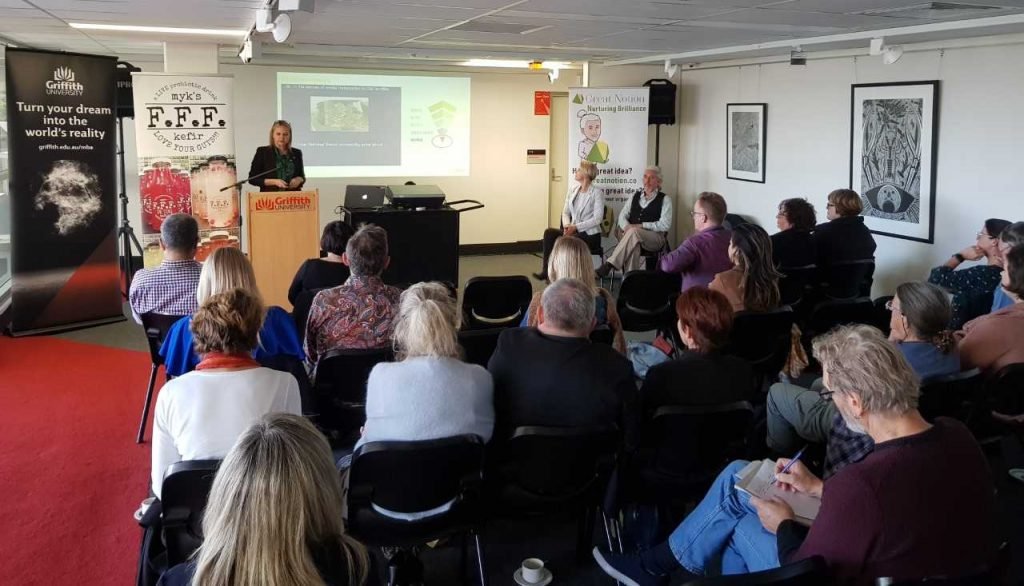
    Over fifty delegates kicked off a lively discussion about the role of the Circular Economy for small business at Griffith University, Southbank, yesterday, Thursday, 30th May.

    The Queensland Small Business Week Event #QSBW had businesses grilling government, academics and practitioners about tools to implement the strategies discussed, government support for innovation and long term impacts on the economy.

    Liesl Hull from Suez presented examples of practitioner success
    Liesl Hull from Suez presented examples of practitioner success

    Geoff Ebbs of Great Notion hosted a panel with Dr Robert Hales, Director of Griffith’s Centre for Sustainable Enterprise and Marjon Wind, of CE Labs and BMI. Speakers inlcuded Syliva Garner from Queensland Department of Environment and Science, Petra Perolini of the Queensland College of Art and Liesl Hull from waste conglomerate Suez.

    Griffith University will launch a course for business leaders in July, in the same timeline CE Labs will announce the outcome of the 3 month process they launched in February and Great Notion will begin a roadshow through business networks and chambers of commerce.