Category: Uncategorized

  • Global Warming Pause Due To Pacific Says Trenberth

    Site » News stories

    News

    Global Warming Pause Due To Pacific Says Trenberth

    06.12.2013

    06.12.2013 19:00 Age: 23 hrs

    Leading climate scientist Kevin Trenberth tells reportingclimatescience.com that the pause in global warming may be caused by the Pacific Ocean. And in a new paper he argues that the pause does not mean climate change has stopped but that it is simply “manifested in different ways”.

    Trenberth: “The centre of action is the Pacific Ocean but the main places where heat goes deep into the ocean are the Atlantic and Southern Oceans rather than the Pacific,” he told reportingclimatescience.com. Courtesy: NCAR

    Click to enlarge. Figure from the paper shows how winds interact with the sea and contribute to piling up water in the western Pacific.

    Click to enlarge. Figure from the paper shows the relationship between the long term global warming trend and the Pacific Ocean oscillations.


    by Leon Clifford


    Leading climate scientist Kevin Trenberth has told reportingclimatescience.com that he believes the pause in global warming may be caused by long term changes in the Pacific Ocean.


    Trenberth and colleague John Fasullo argue in a new scientific paper that the massive El Nino Pacific Ocean warming event that occurred in 1997 and 1998 triggered the pause. They say that the El Nino caused a large loss of heat from the deep ocean to the sea surface that resulted in a cooling of the oceans. Since then the deep ocean has been absorbing heat back from the upper ocean and so cooling the atmosphere.


    The implication is that the heat being absorbed from the atmosphere by the oceans has offset the underlying and ongoing warming of the atmosphere due to green house gases. As the deep ocean waters have slowly warmed they have taken heat from the upper ocean which has then cooled the atmosphere. This is the cause of the apparent hiatus in global warming that has manifested itself as a halt in the rise in global mean atmospheric temperatures seen in the second half of the 20th century.


    Implication

    Trenberth and Fasullo, from the US National Center for Atmospheric Research in Boulder Colorado, suggest that long term oscillations in the Pacific Ocean, known as Pacific Decadal Oscillations (or PDOs) drive alternate 20-plus year cycles of upper ocean warming and cooling which also involve heat being exchanged with the atmosphere. The implication of this is that when the Pacific is in a negative phase the upper ocean loses heat and so cools the atmosphere, and that when it is in a positive phase the upper ocean warms and so heats the atmosphere.


    “It is not so much that the atmosphere warms up rather that the upper levels of sea get warmer and these interact more directly with the atmosphere,” Trenberth said. So a warmer sea surface leads to a warmer atmosphere. “More heat penetrates to the deep ocean in the negative phase and that is not the case in the positive phase,” he explained.


    “We can speculate that the huge 1997–1998 El Niño event was a trigger for the change in the PDO; certainly, it led to a large loss of heat in the Pacific… that has taken years to recover from, if the recovery is even complete. Past behavior of the PDO… suggests that regimes can last for 25 years,” Trenberth and Fasullo write in their paper.


    “The picture emerging is one where the positive phase of the PDO from 1976 to 1998 enhanced the surface warming somewhat by reducing the amount of heat sequestered by the deep ocean, while the negative phase of the PDO is one where more heat gets deposited at greater depths, contributing to the overall warming of the oceans but cooling the surface somewhat. The Pacific Ocean appears to account for the majority of the decadal variability… Nevertheless, the events in the Pacific undoubtedly also affect the Atlantic, Indian, and Southern Oceans as the system acts collectively to equilibrate to these changes in the flow of energy,” they write.


    The paper, entitled “An apparent hiatus in global warming?”, appears the new scientific journal Earth Futures.

    Teleconnections

    “There are really deep teleconnections between the Pacific and the Atlantic and Southern Oceans,” Trenberth explained. “The centre of action is the Pacific Ocean but the main places where heat goes deep into the ocean are the Atlantic and Southern Oceans rather than the Pacific.”


    There is also a very strong relationship with winds and sea level, according to Trenberth. Water is piling up in the western Pacific Ocean at a rate of around 10mm per year which is three times the global average. This has led to a difference in sea level, measured by satellite radars, between the western and eastern Pacific. “The sea level is 20cm higher in the western Pacific and the only way to keep it there is for strong winds to pile up the water. It is these changes in the winds that change the ocean currents and affect where the heat is going,” he explained. “But this can’t keep going for ever. The ocean wants to slop back to the east.”


    Trenberth points to three lines of evidence that support this idea: measurable and recorded changes in the wind strength, satellite altimeter radar measurements of sea level and an analysis of ocean heat data.


    Transition

    Trenberth said that the negative phase of the PDO is associated with wetter, cooler weather in the tropics and with colder winters in Europe. The implication is that when the phase turns positive we will see more droughts and extreme heat events and wild fires in the tropics and countries such as Australia, he said. “The biggest changes in surface temperature are on land,” he explained.


    Each phase of these PDO cycles last between 20 and 30 years, according to the historical record. Positive phases of the PDO took place from 1923 to 1942 and from 1976 to 1998, and negative phases from 1943 to 1976 and after 1999, according to data. Trenberth believes that it is possible that another significant El Nino event will mark the transition from the current negative PDO to a positive PDO. This may then result in a return to rising atmospheric surface temperatures.


    “Deniers of climate change often cherry-pick points on time series and seize on the El Nino warm year of 1998 as the start of the hiatus in global mean temperature rise,” Trenberth and Fasullo comment in their paper. “This turns out, arguably, to have been the transition time from a positive to a negative phase of the PDO.”


    “Global warming has not stopped; it is merely manifested in different way,” the authors state.


    Abstract

    Global warming first became evident beyond the bounds of natural variability in the 1970s, but increases in global mean surface temperatures have stalled in the 2000s. Increases in atmospheric greenhouse gases, notably carbon dioxide, create an energy imbalance at the top-of-atmosphere (TOA) even as the planet warms to adjust to this imbalance, which is estimated to be 0.5–1 W m−2over the 2000s. Annual global fluctuations in TOA energy of up to 0.2 W m−2 occur from natural variations in clouds, aerosols, and changes in the Sun. At times of major volcanic eruptions the effects can be much larger. Yet global mean surface temperatures fluctuate much more than these can account for. An energy imbalance is manifested not just as surface atmospheric or ground warming but also as melting sea and land ice, and heating of the oceans. More than 90% of the heat goes into the oceans and, with melting land ice, causes sea level to rise. For the past decade, more than 30% of the heat has apparently penetrated below 700 m depth that is traceable to changes in surface winds mainly over the Pacific in association with a switch to a negative phase of the Pacific Decadal Oscillation (PDO) in 1999. Surface warming was much more in evidence during the 1976–1998 positive phase of the PDO, suggesting that natural decadal variability modulates the rate of change of global surface temperatures while sea-level rise is more relentless. Global warming has not stopped; it is merely manifested in different ways.


    Citation

    “An apparent hiatus in global warming?” by Kevin E. Trenberth, John T. Fasullo. Article first published by Earth Futures online: 5 DEC 2013. DOI:10.1002/2013EF000165

    Read the abstract and read the open access paper here.
  • A TALE OF TWO CYCLONE SEASONS

    A Tale of Two Cyclone Seasons

    acquired January 1 – December 4, 2013 download large image (2 MB, PDF)
    A Tale of Two Cyclone Seasons

    Color bar for A Tale of Two Cyclone Seasons
    acquired May 1 – December 4, 2013 download large image (1 MB, PDF)

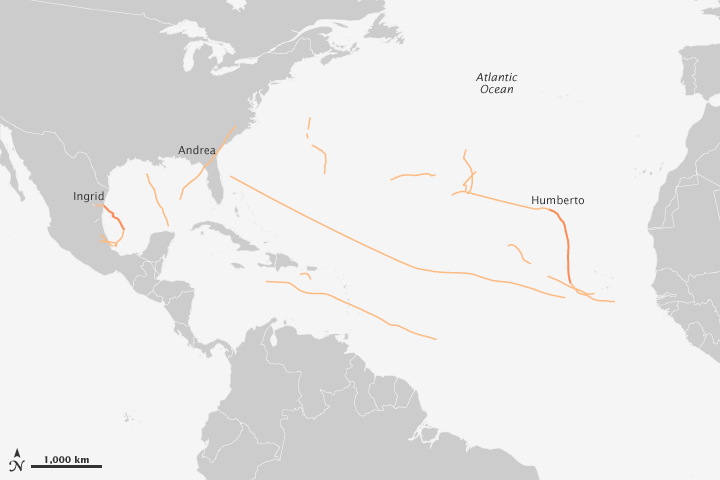
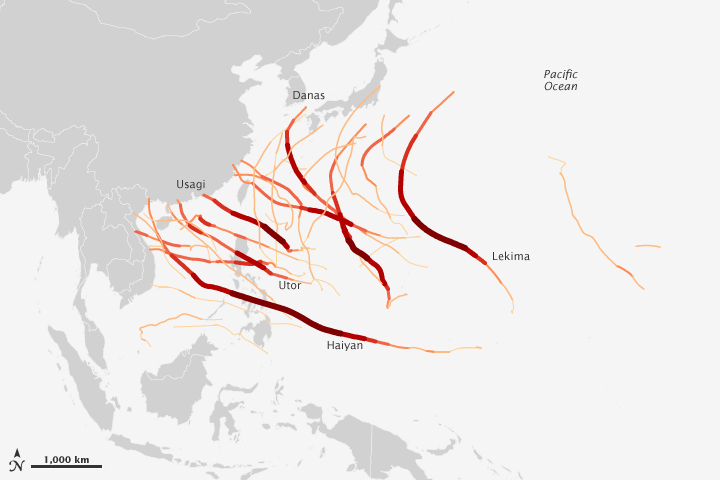
    The basins are roughly 180 degrees apart, and in 2013, so were the tropical cyclone seasons. While the Atlantic hurricane season was remarkably quiet and mostly uneventful, the typhoon season was active and intense in the Western Pacific Ocean, though not necessarily out of character for the region.

    The maps above show the tracks and intensity of the tropical storms in both basins this year. The color and width of each line reflects the intensity of the storm on each day of its activity.

    In the Atlantic, 13 tropical storms were observed (plus one tropical depression), with just two developing into hurricanes—the fewest since 1982. None of the storms became major hurricanes, the first time that has happened since 1994. The U.S. National Weather Service ranked 2013 as “the sixth-least-active Atlantic hurricane season since 1950.”

    “This unexpectedly low activity is linked to an unpredictable atmospheric pattern that prevented the growth of storms by producing exceptionally dry, sinking air and strong vertical wind shear in much of the main hurricane formation region,” said Gerry Bell, lead seasonal hurricane forecaster at NOAA’s Climate Prediction Center. “Also detrimental were several strong outbreaks of dry and stable air that originated over Africa.”

    In the Western Pacific in 2013, there were between 28 and 31 tropical storms, and 13 to 16 typhoons—six of which reached super typhoon strength. (Note: different institutions, including the Joint Typhoon Warning Center, Unisys Weather, and the Japanese Meteorological Agency, have arrived at slightly different counts for the region.) According to the Tropical Storm Risk Consortium, the average is 26 tropical storms and 16 typhoons. The most active Western Pacific typhoon season was 1964 with 39 tropical storms.

    Nearly one third of the world’s tropical storms form in the Western Pacific in any given year. “The Western Pacific is the world’s largest breeding ground of tropical cyclones, and storms tend to be larger and more intense there,” said research meteorologist affected each year by roughly ten typhoons, five to six tropical storms, and four tropical depressions. Trade and monsoon winds tend to steer storms toward the archipelago. In 2013, several storms passed through the Philippines, bringing repeated and devastating rainfall that is depicted in this new animation from scientists at NASA’s Goddard Space Flight Center.

    “The heaviest typhoon traffic in the Western Pacific is just to the northeast of the Philippines,” said Bill Patzert, a climatologist at NASA’s Jet Propulsion Laboratory. “For land-impacting typhoons, the Philippines is the bullseye.”

    1. References

    2. NOAA (2013, November 25) Slow Atlantic hurricane season coming to a close. Accessed December 6, 2013.
    3. Philippine Atmospheric, Geophysical and Astronomical Services Adminstration Climate Information and Statistics. Accessed December 6, 2013.
    4. Unisys Weather (2013) 2013 Hurricane/Tropical Data for Western Pacific. Accessed December 6, 2013.
    5. Weather Underground (2013, November 29) The Unusually Quiet Atlantic Hurricane Season of 2013 Ends. Accessed December 6, 2013.
    6. WikiPedia 2013 Pacific typhoon season. Accessed December 6, 2013.

    NASA Earth Observatory images by Jesse Allen and Robert Simmon. Caption by Mike Carlowicz, with reporting help from Bill

  • Flooding Half-million homes at risk are not covered by flood scheme

    Half-million homes at risk are not covered by flood scheme

    Government insurance plan ignores serious future effects of climate change, Friends of the Earth warns
    Storms across Britain, Scarborough

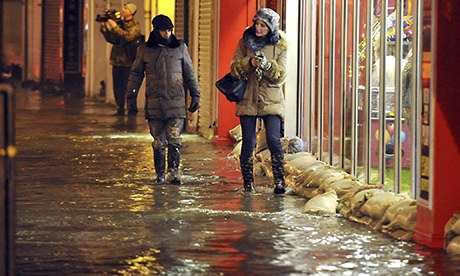
    Shoppers on Scarborough sea front after the worst tidal surge in 60 years. Photograph: Dobson Agency/REX

    Almost half the homes deemed at serious risk from flooding will not be covered under the government’s new flood insurance scheme because officials have decided to omit the future impact of climate change.

    As the cleanup continues on coastlines inundated by the worst tidal surge for 60 years, it has emerged that the government’s flood insurance deal, Flood Re, is likely to cover just 500,000 homes.

    Yet the government’s owncomprehensive Climate Change Impact Assessment reveals that, when factoring in climate change and population growth, the true figure of homes considered to be at significant risk during the 2020s will be 970,000.

    Despite its own dire predictions on the potential impact of climate change, the government’s impact assessment for Flood Re does not take account of “changing flood risk due to deterioration of existing flood defences [or] climate change”.

    Details of Flood Re are being debated by a bill committee of MPs with specific clauses to be considered this week.

    Initial assessments of the damage caused by Thursday’s surge indicates that 1,400 properties were flooded and up to 15,000 people had to leave their homes.

    On Saturday Owen Paterson, the environment secretary, visited some of the worst-affected communities in eastern England, including Hull and Boston, where many were still waiting to return to their homes.

    Meanwhile, insurers are braced for new claims over damage to homes and businesses, two months after storms in southern England led to payouts of £130m.

    Yet the fact that the damage was less extensive than feared has led to praise for improved flood defences, with experts estimating they may have protected up to 800,000 properties.

    Their success has underscored the frustration of campaigners who maintain that not including climate change as a factor in the impact of flooding is both short-sighted and irresponsible.

    Guy Shrubsole, Friends of the Earth climate campaigner, said: “Following th=e devastating damage caused by the biggest storm surge across the east coast in the past 60 years, it’s unforgivable that the government’s future flood insurance plan excludes consideration of climate change.

    “Its own figures show that global warming will put tens of thousands more British homes at risk of flooding in future.

    “The environment secretary must stop playing Russian roulette with people’s homes and livelihoods through his cavalier approach to flood risk.”

    The Flood Re scheme allows for the environment secretary to set a target number of homes to be covered by the insurance scheme, with the likely figure set to be 500,000 properties.

    Projections clearly show that climate change is set to dramatically increase flood risk. The government’s own figures show that over the next 15 years alone a million more people could be put at significant risk because of climate change.

    Friends of the Earth is campaigning for Flood Re to ensure the evidence of increased risks generated by climate change are explicitly factored into the scheme and is concerned that the government has excluded consideration of existing and future climate change impacts from the design of the scheme.

    Green light

    close

    Sign up for the Green light email

    The most important environment stories each week including data, opinion pieces and guides.

    Sign up for the Green light email

    Today’s best video

    • The NSA files trailblock image  
      Live: Follow NSA-related developments as controversy over leaks continues to make headlines
    • Guadian Review's books of 2013  
      Expires Friday 13 December: get at least 25% off books at the Guardian’s Bookshop, including fiction, cookery books, memoirs and much more.
      Shop now

    Half-million homes at risk are not covered by flood scheme

    Government insurance plan ignores serious future effects of climate change, Friends of the Earth warns
    Storms across Britain, Scarborough

    Shoppers on Scarborough sea front after the worst tidal surge in 60 years. Photograph: Dobson Agency/REX

    Almost half the homes deemed at serious risk from flooding will not be covered under the government’s new flood insurance scheme because officials have decided to omit the future impact of climate change.

    As the cleanup continues on coastlines inundated by the worst tidal surge for 60 years, it has emerged that the government’s flood insurance deal, Flood Re, is likely to cover just 500,000 homes.

    Yet the government’s owncomprehensive Climate Change Impact Assessment reveals that, when factoring in climate change and population growth, the true figure of homes considered to be at significant risk during the 2020s will be 970,000.

    Despite its own dire predictions on the potential impact of climate change, the government’s impact assessment for Flood Re does not take account of “changing flood risk due to deterioration of existing flood defences [or] climate change”.

    Details of Flood Re are being debated by a bill committee of MPs with specific clauses to be considered this week.

    Initial assessments of the damage caused by Thursday’s surge indicates that 1,400 properties were flooded and up to 15,000 people had to leave their homes.

    On Saturday Owen Paterson, the environment secretary, visited some of the worst-affected communities in eastern England, including Hull and Boston, where many were still waiting to return to their homes.

    Meanwhile, insurers are braced for new claims over damage to homes and businesses, two months after storms in southern England led to payouts of £130m.

    Yet the fact that the damage was less extensive than feared has led to praise for improved flood defences, with experts estimating they may have protected up to 800,000 properties.

    Their success has underscored the frustration of campaigners who maintain that not including climate change as a factor in the impact of flooding is both short-sighted and irresponsible.

    Guy Shrubsole, Friends of the Earth climate campaigner, said: “Following th=e devastating damage caused by the biggest storm surge across the east coast in the past 60 years, it’s unforgivable that the government’s future flood insurance plan excludes consideration of climate change.

    “Its own figures show that global warming will put tens of thousands more British homes at risk of flooding in future.

    “The environment secretary must stop playing Russian roulette with people’s homes and livelihoods through his cavalier approach to flood risk.”

    The Flood Re scheme allows for the environment secretary to set a target number of homes to be covered by the insurance scheme, with the likely figure set to be 500,000 properties.

    Projections clearly show that climate change is set to dramatically increase flood risk. The government’s own figures show that over the next 15 years alone a million more people could be put at significant risk because of climate change.

    Friends of the Earth is campaigning for Flood Re to ensure the evidence of increased risks generated by climate change are explicitly factored into the scheme and is concerned that the government has excluded consideration of existing and future climate change impacts from the design of the scheme.

    Green light

    close

    Sign up for the Green light email

    The most important environment stories each week including data, opinion pieces and guides.

    Sign up for the Green light email

  • Paradise lost?

    Paradise lost?

    Sunday 8 December 2013 8:05AM


    Two of Australia’s world heritage wonders—the Great Barrier Reef and the Wet Tropics – are at risk of being declared ‘in danger’. Both are threatened by climate and development pressures and as Sarah Dingle discovers, the Wet Tropics is suffering from years of government neglect.


    This week, Queensland’s extraordinary Wet Tropics rainforest celebrates 25 years on the World Heritage List.

    Recently, the World Heritage Committee has named the Wet Tropics one of the top three most irreplaceable areas on earth for biodiversity.

    But current and former managers of the Wet Tropics Management Authority have told Background Briefing that they’ve suffered from years of government disinterest.

    For the past five months, they’ve received no Commonwealth funding.

    Long-vacant directorships remain unfilled, meaning the Authority is hamstrung. In the iconic Daintree rainforest, boardwalks are rotting due to a lack of upkeep.

    Now the last chairman of the Authority says two new foreign pests alone could put the Wet Tropics on the World Heritage In Danger list.

    Extraordinary evolution

    The Wet Tropics rainforest is home to dozens of plant, bird and mammal species which are found nowhere else on the planet.

    On the shore of Lake Barrine in the Atherton Tablelands, Professor Steve Turton from James Cook University’s showed Background Briefing some of the native ‘green dinosaurs’ – massive long-lived bull kauri trees.

    ‘They’re probably approaching about 1000 years old, something like that,’ he says. Only a small number remain as a result of past logging practices in the area.

    The enormous conservation value of the Wet Tropics was confirmed with a recent global analysis of natural heritage sites by the International Union for the Conservation of Nature, a key advisory body to the World Heritage Committee.

    The IUCN ranked the world’s most important irreplaceable areas for biodiversity. ‘The Wet Tropics of Qld is the third, it’s in the top three’, says the Director of the IUCN’s World Heritage Program, Tim Badman.  ‘I can’t overstate how significant it is … Out of more than 100,000 protected areas globally, it’s a huge finding.  

    But the Wet Tropics is under severe pressure from local, and global pressures.

    The latest IPCC report confirms that the planet has already warmed an average of 0.85 degrees since the 1880s, and Wet Tropics scientists say that’s starting to bite.

    Habitats are shrinking, and the animals are following.

    Some species of possum which usually live at an altitude of 600 metres are now being observed at 800.

    ‘The fact that we’re observing animals moving up mountains would suggest that there is a climate signal happening out there,’ says Steve Turton.

    ‘Only about 10% of the wet tropics is above 1000m. We’re almost at 1000m here. There’s nowhere [else] for them to go.’

    Local pressures

    Climate change isn’t the only challenge for the Wet Tropics.

    The Wet Tropics Management Authority is currently hamstrung – of the seven directorships on its board, only three are filled.

    ‘It’s a particularly appalling state of affairs,’ says the last Chairman of the WTMA, international World Heritage expert Professor Peter Valentine. ‘Certainly in the last decade I think it’s been rare when a full quorum of the board has been available.’

    Peter Valentine’s term as Chairman ended in February, and the position has been vacant ever since.

    Both the Commonwealth and the Queensland government are responsible for board appointments, but there’s no penalty if they fail to make any for months.

    WTMA is usually funded by Commonwealth and state governments, to the tune of about $5 million in total per year.

    That’s been declining in real terms for more than a decade, and there have been no Federal funds at all since the start of this financial year, according to senior manager Dr Paul Chantrill.

    ‘We understood there were negotiations in place before the election, but they of course could only go a certain way down in terms of the approval process because of the caretaker conventions,’ he says.

    This article represents part of a larger Background Briefing investigation. Listen to Sarah Dingle’s full report on Sunday at 8.05 am or use the podcast links above after broadcast.

    Recently, the Authority has even been struggling to maintain basic infrastructure, like the boardwalks in the iconic Daintree rainforest.

    ‘If people want to go to the Daintree and they’re falling through a boardwalk because it’s rotten and I’ve seen the ones you’re talking about, that’s going to send a pretty bad message to the tourist industry,’ says Steve Turton.

    The Federal Environment Minister, Greg Hunt says the Coalition government is addressing the situation.

    ‘I have met in the last three weeks with the WTMA in an attempt to and I am confident that we will provide that base funding.’

    It’s the worst possible time for the Wet Tropics Management Authority to be hamstrung.

    Two new foreign pests are already at the gates: myrtle rust fungus, which destroys new growth, and the yellow crazy ant, which forms super colonies and eats everything from worms to small mammals.

    Biosecurity Queensland says now that it’s arrived, it’s not possible to eradicate myrtle rust.

    Professor Peter Valentine says when he was Chair of the Wet Tropics Management Authority, he warned that he’d have to take his concerns to the World Heritage Committee if there was no action on myrtle rust or the Yellow Crazy Ant.

    ‘I think both of these developments and other biosecurity failures are things that are more likely to lead to the Wet Tropics World Heritage Area as being listed as in danger,’ he says.

    According to Dr Paul Chantrill, this is the most precarious moment the Wet Tropics in 25 years of World Heritage listing.

    ‘I would definitely think it is, yes, yes. That’s certainly a moment of truth approaching for Wet Tropics as an agency.’


  • Reservoir emissions: a quiet threat to expanding hydropower

    You're No Dummy

    E&E Publishing&nbsp

    CLEAN ENERGY:

    Reservoir emissions: a quiet threat to expanding hydropower

    Henry Gass, E&E reporter

    ClimateWire: Friday, December 6, 2013

    Hydropower is a frequent target for criticism. Regardless of your views on global warming, turning a serene stretch of river into an artificial lake humming with electrical equipment can make you unpopular, and the announcement of any new hydropower project is often swiftly followed by outcries over habitat disruption and community displacement, among other concerns.

    But hydropower’s clean energy bona fides are rarely questioned.

    In fact, hydropower reservoirs do generate carbon emissions, and some scientists think these emissions could be substantial — maybe enough to cancel out the system’s green benefits.

    Steven Bouillon, a carbon cycles researcher at the University of Leuven in Belgium, said the magnitude of emissions depends on the design of the reservoir. Bouillon is leading research in Africa to quantify emissions from inland water systems, including reservoirs.

    “We’re quite convinced that for certain reservoirs, the effects on greenhouse gas emissions locally will offset the benefits of clean energy production,” he said.

    When reservoirs are built — for hydropower or other purposes — the grass, vegetation and trees submerged underwater begin to slowly decompose, releasing the carbon dioxide they had been storing through photosynthesis for centuries.

    How much of this carbon dioxide actually gets “outgassed” into the atmosphere is a product of several factors. The gas can bubble to the surface of the reservoir and escape; it can be released as the water passes through a dam’s hydroelectric turbines; and it can be released farther downstream. Some gas could also never make it out at all, buried in sediment in the reservoir or farther downstream, or carried all the way out to the ocean.

    The size of the reservoir can make a difference. Shallow reservoirs with a wide surface area can emit more, because they’ve flooded more carbon-rich land, which can easily escape as gas out of the shallow water. Conversely, deep dams with a small surface area have much lower emissions.

    The methane problem

    Methane — a much more potent greenhouse gas than CO2 — may be a bigger concern, however.

    Submerged vegetation emits some methane naturally, but stagnant reservoir water can also create an oxygen-deprived layer of water at the bottom of the lake, and this anoxic environment can turn some of the decomposing carbon into methane instead of CO2.

    And to make matters worse, many hydropower stations draw water from the bottom layers of reservoirs to generate electricity, all but ensuring a portion of the methane gas is emitted downstream or as it passes through hydroelectric turbines.

    A June 2012 commentary article in the journal Nature Climate Change claimed that the carbon emissions from all of Brazil’s hydroelectric reservoirs were equal to or greater than the annual emissions of São Paulo, the country’s largest city.

    Richard Taylor, executive director of the International Hydropower Association, said these reports exaggerate reservoirs’ role in the natural carbon cycle. Indeed, the world over, carbon stored in forests and vegetation routinely seeps through groundwater into rivers and then outgases into the atmosphere (ClimateWire, Nov. 21).

    “You have a natural system going on, unrelated anthropogenic activities going on,” Taylor said. “We know we can measure emissions on the surface of a reservoir, but the story is much, much more than that.”

    With carbon constantly cycling through water and forest systems, and constantly flowing in and out of the atmosphere, do reservoirs really change anything? Or do they just emit carbon gas that would’ve found some other way into the atmosphere?

    1 long-term study, mixed results

    There has been only one study chronicling pre- and post-flood emissions from the same hydroelectric reservoir, a seven-year study of the Eastmain-1 dam in northern Quebec. Cristian Teodoru, a postdoctoral researcher at the University of Leuven, led the team that spent three years monitoring emissions from the landscape before it was flooded at the end of 2005. They then spent four more years measuring emissions from the flooded landscape.

    Teodoru and his colleagues found that in its first post-flood year, the reservoir was a large net source of CO2 but a much smaller source of methane compared with pre-flood levels. In subsequent years, however, net carbon dioxide emissions declined steeply, while net methane emissions remained constant or increased slightly.

    Another concern raised by scientists is that, while these emissions may decline over time, the big spike in outgassing early on is much higher than emissions from fossil fuel generation and could take decades to recover from.

    Taylor, who’s read the study, described the methane emissions as so small they’re “negligible.” But in its paper, Teodoru’s team ultimately concluded that “the reservoir will continue to emit carbon gas over the long term at rates exceeding the carbon footprint of the pre-flood landscape.”

    Teodoru said net emissions from reservoirs could be even greater in tropical and subtropical climates, since the bacteria in the water breaking down the carbon-rich vegetation work faster in higher temperatures. Northern reservoirs, including Eastmain-1, are also frozen for much of the year, he said, stifling potential emissions.

    “If you compare the same surface in Canada to one in Brazil, you’d have totally different emissions,” Teodoru said.

    The tropics and subtropics could also soon see a hydropower boom. Scientists believe up to two-thirds of the planet’s hydropower capacity is still undeveloped — the majority of it in the Southern Hemisphere — and forecast hydropower capacity to double by 2050.

    With so many factors contributing to the natural carbon cycle, Taylor said research has yet to fully conclude what impact reservoirs have on this cycle.

    He also argued that some research up to now has been flawed. Many studies investigating carbon emissions from reservoirs use the Balbina Dam in Brazil as a case study. The dam is wide and shallow, and it’s been shown to emit more methane than most coal plants.

    Ways to build lower-emitting dams

    Taylor called the dam an outlier, with a uniquely poor design and location contributing to exceptionally high emissions. Balbina has a 250-megawatt generating capacity yet has the same surface area as the deeper Itaipu Dam, whose 14,000 MW capacity is second in the world to China’s Three Gorges Dam.

    Balbina, Taylor said, is “atypical, yet the most intensively studied project on greenhouse gas emissions.”

    That said, there are steps hydropower developers can take to minimize reservoir emissions.

    Developers should try to avoid building dams near major carbon sinks, for example, and should install an off-take system that draws water from the upper levels of the reservoir, not the methane-rich lower levels, Taylor said.

    The International Hydropower Association has developed a sustainability assessment protocol that looks at more than 20 topics from the project planning stage to construction and production where emissions could be prevented.

    “As we learn, we will evolve that practice,” he said. “Certainly, we would look at water quality. If that’s well-managed, I think the greenhouse gas issue’s well-managed.”

    Ultimately, Taylor said he hopes the industry can move past this issue and focus on other things, saying he thinks the industry is “very tired of being the butt of this.”

    “All renewables work together, and the storage of energy in hydro reservoirs is key to the increased utilization of renewables,” he said.

    “We’re managing [emissions] the best we can,” he added. “I can’t say there’s going to be a perfect solution, but I

  • This petition went bananas GET UP and save ABC

    3 of 39
    Why this ad?
    Cert IV Traininginspireeducation.net.au/Training – Australia’s Leader in Cert IV Training and Assessment training!

    This petition went bananas

    Inbox
    x
    GetUp!
    10:33 AM (2 hours ago)

    to me
    In just 48 hours the petition to save the ABC has gone bananas, with more than 155,000 Australians signing on. Will you join them in protecting our national broadcaster from funding cuts, ads and commercialisation? Help GetUp members reach 200,000 signatures, sign the petition to save our ABC: https://www.getup.org.au/ourABC

    Dear NEVILLE,

    The attack is on again.

    This week, members of the Government – including Cory Bernardi, Bronwyn Bishop and Ian Macdonald – agitated to defund Australia’s favourite public broadcaster.

    Liberal Senator Cory Bernardi called our ABC a “taxpayer-funded behemoth”, and suggested that “we could perhaps cut the ABC budget and allow the commercial media operators to compete.”

    Let’s sign and share this petition, and create a huge, instant response to stand up for our ABC: https://www.getup.org.au/ourABC

    Here’s why we need to oppose this now: they’ve pulled this move before. This is the Coalition throwing out a test balloon, so they can see how the public responds to their long-held desire to slash the ABC.

    Pulled straight from the Christmas wishlist of Rupert Murdoch and right-wing think-tank the IPA, defunding or commercialising the ABC would ruin a rare, educational and uniquely Australian public resource.

    We like our ABC free of ads, free for all, free to remain fair and balanced.

    Will you make sure Tony Abbott knows to keep it that way?

    https://www.getup.org.au/ourABC

    the GetUp team.

    PS – This is just the beginning. This is far from the first time politicians have tried to sell off our independent public resources. In 2006, when Howard tried to further slash funding to the ABC, GetUp members came out in force, holding grassroots demonstrations around the country, and forced a back down. Earlier this year, members chipped in to run a national ad ensuring that the Victorian state Liberals backed down from threats to privatise the ABC. Join the fight again? https://www.getup.org.au/ourABC


    GetUp is an independent, not-for-profit community campaigning group. We use new technology to empower Australians to have their say on important national issues. We receive no political party or government funding, and every campaign we run is entirely supported by voluntary donations. If you’d like to contribute to help fund GetUp’s work, please donate now! If you have trouble with any links in this email, please go directly to www.getup.org.au. GetUp has recently updated our Privacy Policy, to read the policy go to: www.getup.org.au/about/privacy-policy. To unsubscribe from GetUp, please click here. Authorised by Sam Mclean, Level 2, 104 Commonwealth Street,