Category: Uncategorized

  • Tony Abbott says climate link to bush-fires is “complete hogwash”

    Tony Abbott says climate link to bush-fires is “complete hogwash”

    By on 25 October 2013
    Print Friendly

    Prime Minister Tony Abbott has further entrenched his position on climate change and the bush-fires that have afflicted NSW, describing the link between the two as “complete hogwash.”

    The comment, made in an interview with prominent News Ltd commentator and climate change denialist Andrew Bolt (a telling choice for what Bolt claims to be the new PM’s first print media interview), Abbott said that at some point over time “all (weather) records” will be  broken.

    Asked by Bolt about the “insanity” of links between climate change and bush-fires, and Abbott’s decision to scrap the carbon price, the prime minister responded: “I suppose you might say they are desperate to find anything that they think might pass as ammunition for their cause.”

    But while the conservative right struggles to see the link between climate change and bush-fires, Alan Jones and Andrew Bolt have managed to find a direct link between compulsory voting and bushfires. In a radio chat this morning on 2GB, Jones declared that if there was no preferential voting in this country, “we would be fine. There would be no fuel load on the floor”

    He later said: “Why should voting be compulsory. Why should preferential voting be compulsory? That is relevant to what we’ve seen this week (with the bush fires).” Why, might you ask. Because without preferential voting, Jones assumes there would be no Greens, and no impediment to hazard reduction. Perhaps voting reform can become the new climate policy.

    Abbott’s comments come two days after he told of the UN climate change body that she was “talking out of her hat” by linking climate change and the increased risk of bush-fires, and a day after Environment Minister Greg Hunt – who insists he accepts the science – admitted to the BBC that he had referred to Wikipedia to support his contention that there was no link between climate change and bush-fires. It also comes as the Climate Council issues a new report that states that climate change is increasing the probability of extreme bushfire conditions.

    SMH.com.au reports that the Climate Council, a body that emerged with the assistance of crowd-funding after the Abbott government abolished the Climate Commission in September – warns of increasing days of extreme fire danger in future across south-eastern Australia.

    “While Australia has always experienced bushfires, climate change is increasing the probability of extreme fire weather days,” the report found. ”Climate change is making hot days hotter, and heatwaves more frequent and severe. Last summer, Australia experienced the hottest summer on record, and now has just had the hottest September on record.”

    In the meantime, David Spratt, co-author of “Climate Code Red: The case for emergency action” and a founding director of Safe Climate Australia, has written this piece about the debate around climate change and bush-fires.


    It’s hard to imagine that one tweet from Australian Greens deputy leader Adam Bandt could change the terms of the climate change policy debate in Australia. But it has.

    On 17 October, as fierce, out-of-season bush fires erupted around Sydney and destroyed 200 houses after the hottest year on record in Australia, Bandt tweeted that Australia would experience more terrible climate impacts if newly-elected conservative prime minister Tony Abbott got his way and abandoned the carbon pricing and renewable energy legislation enacted by the Labor government in 2010.

    The previous day, Bandt had written in The Guardian that: “Faced with the biggest ever threat to Australia’s way of life (bush fires), Tony Abbott is failing in the first duty of a prime minister which is to protect the Australian people.” This struck a chord with many people and launched a long overdue, but until now suppressed, public discussion about the relationship between a hotter and more extreme climate and worsening disasters.

    A taboo had been broken, and amidst intense debate the dam wall broke.

    Support for this necessary conversation came from everywhere: climate action advocacy groups, Labor backbenchers Kelvin Thompson and Doug Cameron, senior political commentators, scientists and editorial writers. Lenore Taylor observed that “policymakers can no longer credibly look away.” UN climate chief Christiana Figueres told CNN that the Abbott government would pay a heavy political and economic price for going backwards on climate action.

    For three years, Abbott has dominated the public climate debate with a relentless negative campaign on Labor’s carbon tax, a fig leaf for his long-term climate denialism that “the science isn’t settled”, is “highly contentious” and “not yet proven”, that “it’s cooling” and “it hasn’t warmed since 1998″ and there’s “no correlation between carbon dioxide and temperature”.

    Now accused of “failing to protect his people”, Abbott refused to respond for days, and instead headed off for duty with his local volunteer fire brigade. But shouldn’t the Prime Minister be leading the country, not his local fire brigade, at a time of emergency? For the first time in years, the prime minister was no longer on the front foot in the climate policy discussion.

    That climate change would load the dice in favour of more intense disasters is well established. Fire researchers in 2007 estimated that climate change would result in a two-to-fourfold increase in extreme fire days. Between 1973-2010, Melbourne and Adelaide recorded a 49% increases in their cumulative annual Forest Fire Danger Index. And in February 2009 Victoria’s Black Saturday bushfires killed 173 people, injured 414, destroyed 2,029 homes, and cost $4.4 billion in damage. The fire index was an unprecedented 190 on a zero-to-100 scale. Yet the possible impact of climate change on the days’ events and planning for the future was excluded from the subsequent royal commission’s terms of reference.

    This week the NSW fire commissioner spoke of “unparalleled conditions” and “a whole new ball game”. Conservative NSW premier Barry O’Farrell, when asked asked if climate change made disastrous events such as the NSW fires more likely, replied: ”Well, clearly, I think that’s the science.”

    Now the taboo has been broken, what does in mean for the debate in Australia as prime minister Abbott prepares to trash Labor’s legislation?

    Labor and the climate advocacy movement made a strategic mistake in 2010 by trying to sell the climate legislation as about “clean energy futures” and “saying yes” without talking about how climate change would affect people’s lives. It was all about selling good news and not mentioning bad news, selling an answer without elaborating the question. Public support went down.

    Climate change is a choice between increasing harm, or acting to restore safety. All the studies on health and safety promotion — smoking, obesity, drink driving, HIV, workplace safety — show same thing. Be honest about the problem and tell it like it is; show a better alternative, the benefits of changing behaviour; and finally demonstrate an efficacious path, the “you can do it” actions that the person or society is empowered to take to move from fear to success.

    The debate which has erupted over extreme climate events has important lessons for all those urging more, not less, action on climate change. The story should be about people in Australia and not distant places, about now and not just the distant future, about connecting the dots between extreme events and global warming. It is a story about record heat and bush fires, about how family and friends will live in a hotter and more extreme world, about how a retreating coastline will affect where we live and work, a story about health and well-being, about increasing food and water insecurity, and the more difficult life that children and grandchildren will face. This makes climate action a values issue, the choice between increasing climate harm and climate safety.

    Australian per capita income is the highest in the world, yet we are less happy than citizens in austerity-riven Spain. Society’s pace of change is creating new fears and insecurities as people struggle to keep up. They fear for the future in which their children will live. Hyper-consumption is being driven by anxiety — fear of being left behind, of being “unfashionable” in the broad meaning of the term — and an increasing sense of self-entitlement.

    Sociologist Zygmunt Bauman says that “human vulnerability and uncertainty is the foundation of all political power”. Abbott understood the politics of fear in his tearing down of the Labor government.

    Can he now be stopped by constructing a narrative that recognises reasonable fear and provides a clear path to climate safety, rather than increasing personal and planetary insecurity? Can John Howard’s and Tony Abbott’s “battlers” become

  • Monday: Bushfire Q&A ( CLIMATE COUNCIL)

    Monday: Bushfire Q&A

    Inbox
    x
    Climate Council via cmail1.com
    12:58 PM (1 hour ago)

    to me
    Images are not displayed. Display images below – Always display images from info@climatecouncil.org.au
    Dear INGA,We’ve been busy this week explaining the relationship between climate change and bushfires in the media. Today, analysis from Climate Councillors Lesley Hughes and Will Steffen was reported on the front page of The Age.

    Many of you emailed us with questions about the bushfires, and the impacts of climate change on extreme weather events. So, we’re holding a live video briefing and Q&A on bushfires with Climate Councillor Prof. Lesley Hughes this Monday at 6.30pm.

    You can submit your questions by simply replying to this email – info@climatecouncil.org.au. Please don’t hesitate to invite friends or family to join too.

    Over the last three decades, extreme bushfire weather has increased in southern parts of Australia, especially in the southeast. As the conditions of our climate system change, we are experiencing more hot, dry days that increase the risk of bushfires.

    Climate Councillors Prof Hughes and Prof Will Steffen are currently developing a report on the link between bushfires and extreme weathers. It will be released early November and you will be the first to get a copy.

    Until then, read and share the bushfire information section on our website: http://www.climatecouncil.org.au/bushfire-information/

    Our thoughts are with families and communities affected by the fires.

    Yours,

    Tim Flannery – for the Climate Council team

    PS – We know many of you will have friends, colleagues and family who also have questions about the fires. Please, share this email with them and invite them to go to www.climatecouncil.org.au to tune in to our live Q&A this Monday Oct 28th, 6.30pm.

    PPS – We’ve been having a few problems with some of our emails being identified as “spam”. Please reply to this email to ensure you keep receiving updates from the Climate Council team.

    This email was sent to nevilleg729@gmail.com. If you are no longer interested you can unsubscribe instantly.

    Click here to Reply or Forward
  • The movement we’re building 350 org

    Why this ad?
    Master of Public Healthtua.edu.au/Master_of_Public_Health – Study Online at Torrens University. Request Information Right Now!

    The movement we’re building

    Inbox
    x
    Charlie Wood – 350.org Australia <charlie@350.org>
    11:58 AM (22 minutes ago)

    to me
    Images are not displayed. Display images below – Always display images from charlie@350.org

    Dear Friend,

    With each week, our movement shows its colours ever brighter. Last week was no exception.

    Last Tuesday, hundreds of students at 19 campuses around the country called on their universities to stop investing in the fossil fuel industries of the past. A picture tells a thousand words, so click on the image below to check out the photos that rolled in, and to see the momentum the campus groups are building.

    And whilst our tertiary institutions’ engines for change are firing up, so too are the wider public’s.

    Over the past 6 weeks, more than 750 of you have turned out to learn about the solutions that fossil fuel divestment offer our climate and communities as part of our public forums in Brisbane, Melbourne, Hobart, Canberra, Sydney (with Perth to come later this month).

    200 of you have given up your evenings and weekends to attend our divestment trainings in Hobart, Adelaide, Melbourne, Canberra, Perth, Sydney and Brisbane – equipping yourselves to start shifting money out of the high carbon economy.

    1000 of you have contacted your super funds and banks, asking them to stop funding climate change

    To top it off, we now have over 100 volunteers nationally giving their time to divestment campaigns in Australia.

    We’ve put together this infographic to celebrate how far we’ve all come…

    It’s early days, but with the support and dedication you’ve shown so far, it’s clear that the challenging course we face is becoming easier by the day thanks to the movement you are building with us.

    Whether you’re a student, retiree, professional, parent or grandparent, the divestment movement is about you, for you – your money, your future – this is your movement.

    And as we grow, we can outgrow the problem, together.

    For what you’ve given so far, and for what you will give, thank you.

    Have a great weekend,

    Charlie, Aaron and Blair on behalf of 350.org Australia

    P.S. Help us grow our movement even more – invite your friends to like and follow us on facebook and twitter, and sign up to get these

  • Climate change in Australia – The Facts

    Bushfires and Climate Change in Australia – The Facts

    1. In Australia, climate change is influencing both the frequency and intensity of extreme hot days, as well as prolonged periods of low rainfall. This increases the risk of bushfires.

    While Australia has always experienced bushfires, climate change is increasing the probability of extreme fire weather days.

    Climate change is making hot days hotter, and heatwaves more frequent and severe. Last summer, Australia experienced the hottest summer on record, and now has just had the hottest September on record. Southeast Australia is experiencing a long-term drying trend. More intense and frequent hot weather, as well as dry conditions, increases the likelihood of extreme fire weather days.

    Extreme fire weather has increased over the last 30 years in NSW, Victoria, Tasmania and parts of South Australia

    2. The NSW fires are being influenced by record hot, dry conditions.

    While bushfires in NSW at this time of year are not unusual, the severity and scale of the fires may be unprecedented. Australia has just experienced its hottest 12 months on record. NSW has experienced the hottest September on record; days well above average in October and exceptionally dry conditions. These conditions mean that the fire risk is currently extremely high.

    3. It is crucial that communities, emergency services, health services and other authorities prepare for the increasing severity and frequency of extreme fire conditions.

    To deny the influence of climate change on extreme fire weather, and not take appropriate action to prepare for these changed conditions, places people and property at unnecessarily high risk.

    4. In the future, southeast Australia is very likely to experience an increased number of days with extreme fire danger.

    The projected increases in hot days across the country, and in consecutive dry days and droughts inthe southeast, will very likely lead to increased frequencies of days with extreme fire danger in that region.

    As the fire seasons in southeast Australia become longer, the opportunity for fuel reduction burning is also decreased.

    ————————————————————————————————————————————————————–

    Learn more about the link between climate change and extreme weather from the previous Climate Commission’s Extreme Weather Report.

    The Climate Council will be releasing a report on the link between bushfires and extreme weather in November 2013.

    Bushfire Summary Graphic

  • Climate change and fire risk: what scientists say Climate Code Red

    • Today at 8:13 PM
    To
    • ngarthurslea@yahoo.com.au

    climate code red


    Climate change and fire risk: what scientists say

    Posted: 23 Oct 2013 04:19 PM PDT

    Prime minister Tony Abbott says that “fire is a part of the Australian experience” and not linked to climate change. Here’s what the peer-reviewed scientific research says.

    Bushfire weather in SE Australia: Recent trends and projected climate change impacts

    Lucas, C., K. Hennessy, G Mills and J. Bathols (2007), “Bushfire weather in SE Australia: Recent trends and projected climate change impacts”, Bushfire CRC, Australian Bureau of Meteorology and CSIRO, Melbourne.

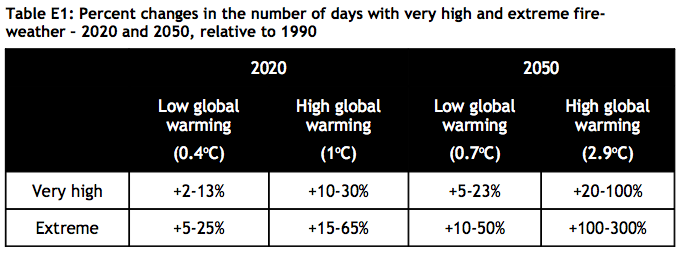
    The number of ‘very high’ fire danger days generally increases 2-13% by 2020 for the low scenarios and 10-30% for the high scenarios (Table E1). By 2050, the range is much broader, generally 5-23% for the low scenarios and 20-100% for the high scenarios. The number of ‘extreme’ fire danger days generally increases 5-25% by 2020 for the low scenarios and 15-65% for the high scenarios (Table E1). By 2050, the increases are generally 10-50% for the low scenarios and 100-300% for the high scenarios.
    ‘Very extreme’ days tend to occur only once every 2 to 11 years at most sites. By 2020, the low scenarios show little change in frequency, although notable increases occur at A mberley, Charleville, Bendigo, Cobar, Dubbo and Williamtown. The 2020 high scenarios indicate that very extreme’ days may occur about twice as often at many sites. By 2050, the low scenarios are similar to those for the 2020 high scenarios, while the 2050 high scenarios indicate a four to five-fold increase in frequency at many sites.

    Only 12 of the 26 sites have recorded ‘catastrophic’ fire danger days since 1973. The 2020 low scenarios indicate little or no change, except for a halving of the return period (doubling frequency) at Bourke.  The 2020 high scenarios show ‘catastrophic’ days occurring at 20 sites, 10 of which have return periods of around 16 years or less. By 2050, the low scenarios are similar to those for the 2020 high scenarios. The 2050 high scenarios show ‘catastrophic’ days occurring at 22 sites, 19 of which have return periods or around 8 years or less, while 7 sites have return periods of 3 years or less.

    Fire and climate change: don’t expect a smooth ride

    Roger Jones, The Conversation, 22 October 2013

    In research I did with colleagues earlier this year we looked at the Fire Danger Index calculated by the Bureau of Meteorology, and compared how it changed compared to temperature over time in Victoria.

    South-east Australia saw a temperature change of about 0.8C when we compared temperatures before 1996 and after 1997. We know that it got drier after 1997 too.

    We then compared this data to the Forest Fire Danger Index, to see if it showed the same pattern. We analysed fire data from nine stations in Victoria and did a non-linear analysis. We found that fire danger in Victoria increased by over a third after 1996, compared to 1972-1996. The current level of fire danger is equivalent to the worst case projected for 2050, from an earlier analysis for the Climate Institute.

    While it’s impossible to say categorically that the situation is the same in NSW, we know that these changes are generally applicable across south-east Australia. So it’s likely to be a similar case: fire and climate change are linked.


    IPCC: Managing the Risks of Extreme Events and Disasters to Advance Climate Change Adaptation

    (Field, C.B., V. Barros, T.F. Stocker, D. Qin, D.J. Dokken, K.L. Ebi, M.D. Mastrandrea, K.J. Mach, G.-K. Plattner, S.K. Allen, M. Tignor, and P.M. Midgley (editors)

    Box 4-1: Evolution of Climate, Exposure, and Vulnerability – The Melbourne Fires, 7 February 2009

    The fires in the Australian state of Victoria, on 7 February 2009, demonstrate the evolution of risk through the relationships between the weather- and climate-related phenomena of a decade-long drought, record extreme heat, and record low humidity of 5% (Karoly, 2010; Trewin and Vermont, 2010) interacting with rapidly increasing exposure. Together the climate phenomena created the conditions for major uncontrollable wildfires (Victorian Bushfires Royal Commission, 2010).

    The long antecedent drought, record heat, and a 35-day period with no rain immediately before the fires turned areas normally seen as low to medium wildfire risk into very dry high-risk locations. A rapidly expanding urban-bush interface and valuable infrastructure (Berry, 2003; Burnley and Murphy, 2004; Costello, 2007, 2009) provided the values exposed and the potential for extreme impacts that was realized with the loss of 173 lives and considerable tangible and intangible damage. There was a mixture of natural and human sources of ignition, showing that human agency can trigger such fires and extreme impacts.
    Many people were not well-prepared physically or psychologically for the fires, and this influenced the level of loss and damage they incurred. Levels of physical and mental health also affected people’s vulnerability. Many individuals with ongoing medical conditions, special needs because of their age, or other impairments struggled to cope with the extreme heat and were reliant on others to respond safely (Handmer et al., 2010). However, capacity to recover in a general sense was high for humans and human activities through insurance, government support, private donations, and nongovernmental organizations (NGOs) and was variable for the affected bush with some species and ecosystems benefitting (Lindenmayer et al., 2010; Banks et al., 2011; see also Case Study 9.2.2).

    Chapter 3 details projected changes in climate extremes for this region that could increase fire risk, in particular warm temperature extremes, heat waves, and dryness (see Table 3-3 for summary).

    4.4.7.4. Wildfire

    Wildfires around Canberra in January 2003 caused AUS$ 400 million damage (Lavorel and Steffen, 2004), with about 500 houses destroyed, four people killed, and hundreds injured. Three of the city’s four water storage reservoirs were contaminated for several months by sediment- laden runoff (Hennessy et al., 2007). The 2009 fire in the state of Victoria caused immense damage (see Box 4-1 and Case Study 9.2.2).

    An increase in fire danger in Australia is associated with a reduced interval between fire events, increased fire intensity, a decrease in fire extinguishments, and faster fire spread (Hennessy et al., 2007). In southeast Australia, the frequency of very high and extreme fire danger days is expected to rise 15 to 70% by 2050 (Hennessy et al., 2006). By the 2080s, the number of days with very high and extreme fire danger are projected to increase by 10 to 50% in eastern areas of New Zealand, the Bay of Plenty, Wellington, and Nelson regions (Pearce et al., 2005), with even higher increases (up to 60%) in some western areas. In both Australia and New Zealand, the fire season length is expected to be extended, with the window of opportunity for fuel reduction burning shifting toward winter (Hennessy et al., 2007).

    Changes in Australian fire weather between 1973 and 2010

    Clarke, H., C. Lucas and P. Smith (2012) “Changes in Australian fire weather between 1973 and 2010”. Int. J. Climatol., DOI: 10.1002/joc.3480

    A data set of observed fire weather in Australia from 1973–2010 is analysed for trends using the McArthur Forest Fire Danger Index (FFDI). Annual cumulative FFDI, which integrates daily fire weather across the year, increased significantly at 16 of 38 stations. Annual 90th percentile FFDI increased significantly at 24 stations over the same period. None of the stations examined recorded a significant decrease in FFDI. There is an overall bias in the number of significant increases towards the southeast of the continent, while the largest trends occur in the interior of the continent and the smallest occur near the coast. The largest increases in seasonal FFDI occurred during spring and autumn, although with different spatial patterns, while summer recorded the fewest significant trends. These trends suggest increased fire weather conditions at many locations across Australia, due to both increased magnitude of FFDI and a lengthened fire season. Although these trends are consistent with projected impacts of climate change on FFDI, this study cannot separate the influence of climate change, if any, with that of natural variability.

    The recent bushfires and extreme heat wave in southeast Australia

    Karoly, D.J. (2009) “The recent bushfires and extreme heat wave in southeast Australia”. Bulletin of the Australian Meteorological and Oceanographic Society 22: 10-13

    See also: Bushfires and extreme heat in south-east Australia

    Although formal attribution studies quantifying the influence of climate change on the increased likelihood of extreme fire danger in southeast Australia have not been undertaken yet, it is very likely that there has been such an influence. Increases in maximum temperature have been attributed to anthropogenic climate change. In addition, reduced rainfall and low relative humidity are expected in southern Australia due to anthropogenic climate change. The FFDI for a number of sites in Victoria on 7 February reached unprecedented levels, ranging from 120 to 190, much higher than the fire weather conditions on Black Friday or Ash Wednesday, and well above the “catastrophic” fire danger rating (Lucas et al., 2007).

    Of course, the impacts of anthropogenic climate change on bushfires in southeast Australia or elsewhere in the world are not new or unexpected. In 2007, the IPCC Fourth Assessment Report WGII chapter “Australia and New Zealand” (Hennessy et al., 2007) concluded ‘An increase in fire danger in Australia is likely to be associated with a reduced interval between fires, increased fire intensity, a decrease in fire extinguishments and faster fire spread. In south-east Australia, the frequency of very high and extreme fire danger days is likely to rise 4-25% by 2020 and 15-70% by 2050.’ Similarly, observed and expected increases in forest fire activity have been linked to climate change in the western US (Westerling et al., 2006), in Canada (Gillett et al., 2004) and in Spain (Pausas, 2004).

    While it is difficult to separate the influences of climate variability, climate change, and changes in fire management strategies on the observed increases in fire activity, it is clear that climate change is increasing the likelihood of environmental conditions associated with extreme fire danger in southeast Australia and a number of other parts of the world.

    Regional signatures of future fire weather over eastern Australia from global climate models

    Clarke, H.G., P.L. Smith and A.J. Pitman (2011), “Regional signatures of future fire weather over eastern Australia from global climate models”. Int. J. Wildland Fire, 20, 550-562.

    Skill-selected global climate models were used to explore the effect of future climate change on regional bushfire weather in eastern Australia. Daily Forest Fire Danger Index (FFDI) was calculated in four regions of differing rainfall seasonality for the 20th century, 2050 and 2100 using the A2 scenario from the Special Report on Emissions Scenarios. Projected changes in FFDI vary along a latitudinal gradient. In summer rainfall-dominated tropical north-east Australia, mean and extreme FFDI are projected to decrease or remain close to 20th century levels. In the uniform and winter rainfall regions, which occupy south-east continental Australia, FFDI is projected to increase strongly by 2100. Projections fall between these two extremes for the summer rainfall region, which lies between the uniform and summer tropical rainfall zones. Based on these changes in fire weather, the fire season is projected to start earlier in the uniform and winter rainfall regions, potentially leading to a longer overall fire season.

    The sensitivity of Australian Fire danger to climate change

    Willliams, A.A., D.J. Karoly and N. Tapper (2001), “The sensitivity of Australian Fire danger to climate change”. Climatic Change 49:171-191

    Global climate change, such as that due to the proposed enhanced greenhouse effect, is likely to have a significant effect on biosphere-atmosphere interactions, including bushfire regimes. This study quantifies the possible impact of climate change on fire regimes by estimating changes in fire weather and the McArthur Forest Fire Danger Index (FDI), an index that is used throughout Australia to estimate fire danger. The CSIRO 9-level general circulation model (CSIRO9 GCM) is used to simulate daily and seasonal fire danger for the present Australian climate and for a doubled- CO2 climate. The impact assessment includes validation of the GCMs daily control simulation and the derivation of ‘correction factors’ which improve the accuracy of the fire danger simulation. In summary, the general impact of doubled-CO2 is to increase fire danger at all sites by increasing the number of days of very high and extreme fire danger. Seasonal

  • “The world needs more political leaders like President Nasheed”: 350.org

    Page added on October 23, 2013

    Email This Post Email This Post                      Print This Post Print This Post

    “The world needs more political leaders like President Nasheed”: 350.org

    By Leah Malone | October 23rd, 2013 | Category: Environment, Politics, Society | 11 comments “The world needs more political leaders like President Nasheed”: 350.org thumbnail

    Global climate justice NGO 350.org has reaffirmed that “urgent action is needed to address the climate crisis” in the Maldives, and that its continued active international leadership is “immensely important”.

    In light of the IPCC’s findings and the danger sea level rise poses for the Maldives, 350.org has highlighted the essential international leadership role former President Mohamed Nasheed and the country have played for achieving climate justice.

    “The IPCC’s 5th assessment report largely reaffirms what we already knew, and makes it abundantly clear that urgent action is needed the world-over. It is immensely important the Maldives to continue it’s active, leadership stance to go carbon neutral within a decade and advocate for more international action,” Will Bates, Global Campaigns Director and Co-Founder of 350.org told Minivan News.

    The Intergovernmental Panel on Climate Changes’s fifth assessment report emphasised the importance of human influence on the climate change system.

    “Warming of the climate system is unequivocal, and since the 1950s, many of the observed changes are unprecedented over decades to millennia. The atmosphere and ocean have warmed, the amounts of snow and ice have diminished, sea level has risen, and the concentrations of greenhouse gases have increased,” read the report released last month.

    “As the ocean warms, and glaciers and ice sheets reduce, global mean sea level will continue to rise [during the 21st century], but at a faster rate than we have experienced over the past 40 years,” said IPCC Working Group 1 Co-Chair, Qin Dahe.

    The IPCC’s report “sounds the alarm for immediate action on climate change,” declared 350.org.

    “The report, which is the most authoritative, comprehensive assessment of scientific knowledge on climate change, finds with near certainty that greenhouse gas emissions are warming the planet and that climate impacts are accelerating… Scientists have upped the certainty that humans are responsible for warming, increasing their confidence to 95%,” highlighted 350.org.

    350.org has been building a global grassroots movement to solve the climate crisis. It has coordinated over 20,000 climate demonstrations in more than 182 countries since the organisation’s founding in 2008.

    350 parts per million is what many scientists, climate experts, and progressive national governments are now saying is the safe upper limit for carbon dioxide in the Earth’s atmosphere.

    “The world needs more political leaders like President Nasheed”: 350.org

    Bates noted that former President Nasheed has been an integral figure for the global climate justice movement.

    “President Nasheed’s courageous and creative actions to confront the true scale of the climate crisis in 2009 and 2010 were a powerful wake-up call for the world. Hearing from an entire nation about the imminent threat to their future through their democratically elected president, and seeing their actions to address the crisis was an inspiration for the rest of the world to step up our efforts to address the climate crisis,” Bates stated.

    “The world needs more political leaders like President Nasheed who understand the severity of the threat, and who speak and act truthfully in response,” he added.

    The NGO also believes President Nasheed’s leadership within the Maldives has benefited the nation’s domestic climate justice movement.

    “I believe it was in part thanks to the openness and freedom given to civil society in general during his administration that allows young people and NGOs to organize on climate change above and beyond what President Nasheed was working on at the national policy and international levels,” said Bates.

    “No doubt his efforts to have the Maldives go carbon neutral in a decade was a powerful act of leadership that more governments around the world should be following as well,” he added.

    “We support human rights and a free and fair democratic process in the Maldives,” Bates noted in regard to Nasheed’s ongoing domestic efforts to ensure these values are upheld.

    Although he emphasised that 350.org is not directly involved in Nasheed’s political struggles at home, Bates explained how the non-violent direct action strategy 350.org employs can benefit the Maldives in its fight for climate justice as well as democratisation.

    “Social movements around the world have proven the power of non-violent direct action as a means of creating change, political and otherwise,” he said.

    “President Nasheed’s underwater cabinet meeting in 2009 was a particularly creative form of action, and there are countless ways that different non-violent tactics – from marches and rallies to culture-jamming and online memes – can enhance struggles against climate change as well as for promoting democracy and fair elections,” he continued.

    “We’ve seen incredibly creative actions in the Maldives by grassroots activists fighting climate change too and with such international concern for the political situation there, similar tactics could be employed at the current time with great effect,” he added.

    Nasheed has often spoken of the close interrelationship between climate change, human rights, and democracy, particularly since his February 7, 2012 controversial transfer of power, and 350.org has echoed this belief.

    “Human rights and climate justice are very clearly inextricably linked as the climate crisis infringes on people’s access to food, water, health, and general security. Furthermore, the causes of the climate crisis, such as the extraction and burning of fossil fuels and cutting down forests have immense human rights implications. Meanwhile many the solutions, such as more decentralized renewable energy infrastructure, are in many ways a step towards democratizing more of how our world works,” said Bates.

    “Although that is not to say that countries that exist with undemocratic systems of government can’t also enact solutions to achieve greater human rights and climate justice,” he added.

    Extreme sea level rise threats

    “The rate of sea level rise will very likely exceed that observed during 1971–2010 due to increased ocean warming and increased loss of mass from glaciers and ice sheets,” all prospective scenarios in the IPCC’s report projected.

    Sea level is expected to rise between 0.26 metres (0.85 feet) and 0.98 metres (3.22 feet) by 2100, depending on the amount of greenhouse gas emissions produced this century, it added.

    While these projections represent the possible low and high extreme scenarios of sea level rise, small island states – such as the Maldives – are especially vulnerable, the IPCC previously stressed in it’s fourth assessment report.

    With over 80 percent of the land area in the Maldives being less than a meter (3.28 feet) above mean sea level, “the slightest rise in sea level will prove extremely threatening,” UNDP Maldives previously declared. “A rise in sea levels by 0.50 meters could see significant portions of the islands being washed away by erosion or being inundated [by the ocean].”

    “Even now some islands are seriously affected by loss not only of shoreline but also of houses, schools and other infrastructure,” it continued.

    Not only is the Maldives extremely vulnerable to sea level rise, other climate change impacts – including extreme weather events, coral bleaching and acidification – which exacerbate these negative effects, it added.

    Earlier this year the World Bank also expressed the urgent need for concerted efforts to support the Maldives in adapting to climate change due to sea level rise projections.

    Additionally, the UN’s 2013 global human development report highlighted inequality and climate change vulnerabilities as major concerns for the Maldives, despite the country’s “significant economic growth” in recent years.