Category: Uncategorized

  • Hundreds of millions of global poor will be affected by warming oceans

    Hundreds of millions of global poor will be affected by warming oceans

    By on 24 October 2013
    Print Friendly

    Climate Progress

    The damage climate change will do to the oceans could be disastrous for the world’s poorest, according to a new study.

    Humanity’s greenhouse gas emissions will alter the oceans in several ways, including shifts in ocean temperature, reduced oxygen concentrations, and higher acidity as they absorb more carbon dioxide from the atmosphere. To track how, a group of researchers lead by Camilo Mora, a geography professor at the University of Hawaii, ran 32 marine habitats around the world through a series of modeled simulations. They looked at what would happen to these areas until 2100, under both a “business as usual” scenario — in which carbon dioxide concentration in the atmosphere rises to 900 parts per million — and an alternative scenario in which humanity takes drastic action to cut those emissions.

    “Our results suggest that the entire world’s ocean surface will be simultaneously impacted by varying intensities of ocean warming, acidification, oxygen depletion, or shortfalls in productivity,” the researchers reported. “Only a very small fraction of the oceans, mostly in polar regions, will face the opposing effects of increases in oxygen or productivity, and almost nowhere will there be cooling or [decrease in acidity].”

    These changes could very well reduce the oceans’ biological productivity. In particular, the models suggested a four to ten percent cut in the production of phytoplankton, which form the lowest foundation of most of the oceanic food chains. That in turn would mean “massive and challenging” ramifications for the 470 to 870 million poor people around the world who rely on the seas for their food and livelihoods. Many of them live in the countries that will be the hardest hit by the changes the researchers tracked.

    This work follows up on a growing body of evidence detailing the unique threat climate change poses to the global poor. The problems extend well beyond ocean changes, to extreme weather and crop disruptions. Southern and southeastern Asia are home to a large portion of the global poor, and face destabilizing climate shifts, altered monsoon patterns, and floods. The World Bank has warned that within two decades, drought and rising heat could leave 40 percent of sub-Saharan Africa’s farmland unsuitable for growing maize or for grazing livestock.

    Other studies predict 325 million extremely poor people will live in 49 of the globe’s most climate disaster-prone areas by 2030.

    The ocean study was published this month in the journal Public Library of Science Biology.


  • Abbott: fanning the flames

    Abbott: fanning the flames

    Inbox
    x
    Iain Keith – Avaaz.org
    2:06 PM (2 hours ago)

    to me

    Dear friends across Australia,

    As NSW burns, PM Abbott is working to kill the carbon price, our best tool to fix climate change and prevent more deadly fires in the future. The new ALP team can help stop Abbott’s plans, but they’re not convinced climate change is an issue that’s worth fighting for — let’s show the ALP that public opinion is desperate for climate leadership! Sign now:

    Australian homes are burning again, but with Tony Abbott and his coal cronies working to kill the carbon price, our best tool to fix climate change and prevent more deadly fires in the future is on the rocks. It’s up to us to extinguish their plans.

    While the PM volunteers to help the emergency services, his relentless assault on the carbon price locks our brave firefighters into a future where fires are more ferocious and frequent. The new ALP team can help stop Abbott’s plans, but they’re not convinced climate change is an issue worth fighting for now they’re in opposition. A massive outcry across Australia right now can show the ALP that public opinion is desperate for climate leadership and saving the carbon price is a fire fight worth having.

    New leader Bill Shorten is deciding their opposition playbook right now — let’s show him the roar of public opinion wants the ALP to do everything they can to save the carbon price and protect a cooler future for Australia! Sign now then forward this email to everyone — when we reach 100,000 signers a group of firefighters will deliver our petition to ALP headquarters:

    http://www.avaaz.org/en/abbott_fanning_the_flames/?bhPqncb&v=30617

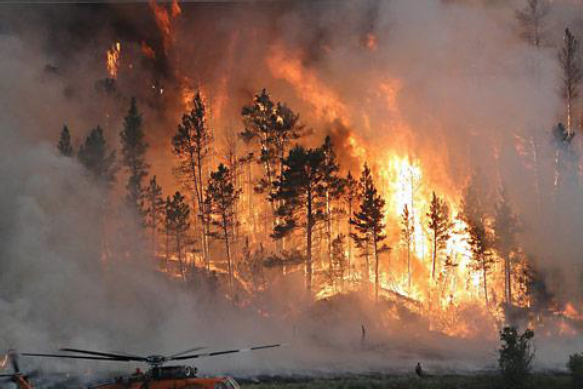
    New South Wales is in a state of emergency and yesterday was the most dangerous day for bushfires in years. While some fires have now been downgraded, experienced fire fighters are urging everyone not to be complacent, because they know when we have fires this early in October, the situation all summer will be extremely dangerous.

    Weeks ago the world’s leading scientists confirmed that humans are causing climate change and it’s going to get much worse without urgent action. It’s bad news for Australia which is only going to get hotter, drier, and more prone to bushfires. Tony Abbott is one of the few people in the world that disagrees with the overwhelming scientific consensus. But right now, the decision on whether or not to repeal the carbon price rests with the new ALP team, who are questioning whether or not to support the policy they introduced. If they give in, the carbon price will be dropped without protest in the senate.

    Let’s raise our voices now before Australia’s best climate chance is extinguished. Sign now so the Labor Party knows that they do have the public backing to support the carbon price in the senate:

    http://www.avaaz.org/en/abbott_fanning_the_flames/?bhPqncb&v=30617

    Australia is at high risk of climate catastrophe: our coasts, farms, cities, could all change drastically and in only decades! Climate change is the biggest single threat humans face and solving it requires global coordinated action. Avaaz members joined with many others to help win Australia’s carbon price which is widely heralded as a world leading policy and has triggered other countries to follow suit. Now let’s defend it and keep alive the hope that we can extinguish the climate crisis.

    With hope,

    Iain, Emily, David, Alice, Ben, Richard and the whole Avaaz team

    Sources

    Live NSW bushfires: RFS braces for horror weather conditions (ABC)
    http://www.abc.net.au/news/2013-10-23/live-blog-nsw-bushfires-wednesday/5039260

    Greg Hunt’s plan bypasses Senate (The Age)
    http://www.theage.com.au/federal-politics/political-news/greg-hunts-plan-bypasses-senate-20131021-2v…

    Australia could be left with no policy on climate change (The Guardian)
    http://www.theguardian.com/world/2013/sep/25/australia-climate-change-policy-vacuum

    CSIRO recently published this paper on the links between climate change and possible increased bushfire risk (CSIRO)
    http://www.csiro.au/Outcomes/Climate/Adapting/Climate-Change-Fire-Weather.aspx

    UN climate chief Christiana Figueres calls for global action amid NSW bushfires (ABC)
    http://www.abc.net.au/news/2013-10-22/un-climate-chief-warns-of-nsw-27doom-and-gloom27/5036814

    Support the Avaaz Community!
    We’re entirely funded by donations and receive no money from governments or corporations. Our dedicated team ensures even the smallest contributions go a long way. Donate to Avaaz
  • Al Gore attacks Tony Abbott’s refusal to link bushfires with climate change

    Al Gore attacks Tony Abbott’s refusal to link bushfires with climate change

    Nobel laureate likens Australian prime minister to ‘pliant politicians’ who said tobacco didn’t cause lung cancer

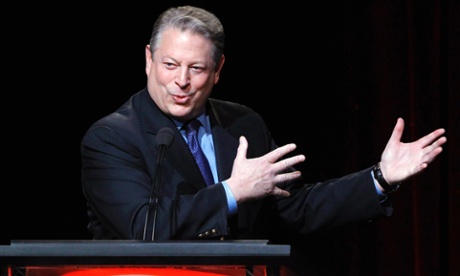
    Al Gore
    ‘The meaningful way to resolve this crisis is to put a price on carbon and in Australia’s case, to keep a price on carbon,’ Al Gore said. Photograph: Mario Anzuoni/Reuters

    Tony Abbott’s insistence that bushfires aren’t linked to climate change is like the tobacco industry claiming smoking doesn’t cause lung cancer, Nobel laureate Al Gore says.

    In light of the New South Wales bushfire disaster, the former US vice-president says the prime minister’s comment that bushfires are a function of life in Australia and nothing to do with climate change reminds him of politicians in the US who received support from tobacco companies, and who then publicly argued the companies’ cause.

    “For 40 years the tobacco companies were able to persuade pliant politicians within their grip to tell the public what they wanted them to tell them, and for 40 years the tragedy continued,” Gore told ABC TV’s 7.30 program from Los Angeles on Wednesday night.

    “And bushfires can occur naturally and do, but the science shows clearly that when the temperature goes up and when the vegetation and soils dry out, then wildfires become more pervasive and more dangerous.

    “That’s not me saying it, that’s what the scientific community says.”

    Gore said it was a political fact of life that politicians and commercial enterprise colluded to achieve goals after he was asked if there was a conspiracy between polluters and politicians.

    “I don’t think it’s a commercial conspiracy. I think it’s a political fact of life,” he said. “It certainly is in my country. In the United States, our democracy has been hacked.

    “Special interests control decisions too frequently. You saw it in our recent fiscal and debt crisis.

    “The energy companies, coal companies and oil companies particularly, have prevented the Congress of the United States from doing anything meaningful so far, to stop the climate crisis.”

    The Nobel laureate said Australia’s new Direct Action strategy was not workable.

    “The meaningful way to resolve this crisis is to put a price on carbon and in Australia’s case, to keep a price on carbon,” he said.

    He argues the price needs to be at an effective level with the market sending accurate signals so that renewable systems of energy are encouraged.

  • Denial ADAM BANDT

    2 of 41
    Why this ad?
    seniors 55+ cruiseswww.ecruising.travel – Seniors specials on cruises Australia’s Leading Cruise Agency

    Denial

    Inbox
    x

    adam bandt

    Adam Bandt via email.nationbuilder.com
    5:52 PM (18 minutes ago)

    to me
    Images are not displayed. Display images below – Always display images from info@adambandt.com

    Neville —

    The ongoing bushfires in NSW reinforce the urgency of tackling global warming. Yet today Tony Abbott denied the science linking climate change and bushfire risk and attacked the head of the UN’s climate change agency.

    Over the last 12 months we have had the hottest year, the hottest month, the hottest week and the hottest day on record. These hot temperatures and a dry winter have primed the south-east of Australia, increasing the bushfire risk.

    For many years scientists and fire fighters have been warning of increased bushfire risk due to climate change. The CSIRO says we are on track to increase the number of extreme fire days by 300% in the coming decades.

    Despite these dangers, Tony Abbott continues to deny that climate change will make bushfires worse. He wants to close down debate on the dangers of global warming and the need for stronger action.

    We need to talk about bushfires and global warming. Please share my recent article in the Guardian.

    Instead of taking stronger action on climate change, Tony Abbott wants to take us backwards.

    One of the first acts of the new government was to abolish the Climate Commission and freeze any investments by the Clean Energy Finance Corporation. Next Tony Abbott wants to repeal the Clean Energy Act and scrap the price on pollution.

    People need to know that by failing to act on climate change, Tony Abbott is increasing the risk of dangerous bushfires. Please share my recent article in the Guardian.

    Over the last week I have been attacked by the Murdoch press for talking about global warming and bushfires and Tony Abbott’s failure to protect the Australian people.

    But I will continue to talk about climate change and the need for action. I hope you will join me by sharing this article and having the conversation with your friends and family on social media.

    Adam Bandt

    PS. Save the date. November 17 will be a national day of action on climate change. There

  • Fire and climate change: don’t expect a smooth ride

    Posted: 21 Oct 2013 03:06 PM PDT

    By Roger Jones, Victoria University, via The Conversation

    With fires still burning across New South Wales, it’s time to have a look at the role climate change might have played. Are the conditions we’re seeing natural variation, or part of a long term trend?

    In fact, it doesn’t have to be one or the other.

    Has bushfire risk increased due to climate change?

    In research I did with colleagues earlier this year we looked at the Fire Danger Index calculated by the Bureau of Meteorology, and compared how it changed compared to temperature over time in Victoria.

    South-east Australia saw a temperature change of about 0.8C when we compared temperatures before 1996 and after 1997. We know that it got drier after 1997 too.
    We then compared this data to the Forest Fire Danger Index, to see if it showed the same pattern. We analysed fire data from nine stations in Victoria and did a non-linear analysis.

    We found that fire danger in Victoria increased by over a third after 1996, compared to 1972-1996. The current level of fire danger is equivalent to the worst case projected for 2050, from an earlier analysis for the Climate Institute.

    While it’s impossible to say categorically that the situation is the same in NSW, we know that these changes are generally applicable across south-east Australia. So it’s likely to be a similar case: fire and climate change are linked.

    What is “non-linear” change?

    Climate science has been playing with a paradigm that long-term changes are gradual, and that short-term changes are simply natural climate variability. But there’s another hypothesis that climate change and climate variability actually combine.

    When you analyse long historical time series of temperature, plus climate change from modelled data, it actually goes up like a staircase. The “El Niño of the century” we saw in 1997-98 was one of these steps in the staircase.

    It’s physically impossible for climate change to be entirely gradual, and for natural variability to act independently of that. That’s like saying that some of the heat in the atmosphere is climate change heat, and some is variability heat, and that they behave differently.

    This also relates to the so-called hiatus. This hiatus is normal, and what we’d expect from a climate that evolves in a non-linear manner.

    The models do predict these steps, even if some people claim they don’t. Model data shows periods up to 20 years when there is little or no increase in warming.

    What’s happened to temperature and rainfall in south east Australia?

    Temperature can also be analysed through step changes. Before and after 1996, maximum temperatures went up 0.8C. We can actually date the change to October 1996, when the El Niño started.

    Minimum temperatures have changed in a couple of periods. The first is the late 1960s early 1970s, then again in 1996-1997. In fact global temperatures went up in that period too, by about 0.3C at the same time.

    Rainfall decreased in south-east Australia, and this decrease continued until 2009-2010. Then we got a massive negative Indian Ocean Dipole and La Niña, resulting in record rainfall and flooding. In southern Victoria it’s been quite moist since, but north of the Great Dividing Range it’s dried out very quickly.

    These changes in rainfall and temperature are interrelated. It’s a combination of climate change and climate variability. The warming component, which is non-linear, is climate change.

    What about the weather?

    We can only blame weather conditions on climate change if they are part of a statistically significant pattern. If we see anomalously high temperatures – knowing that there is an anthropogenic component to temperature increases – then there’s definitely an anthropogenic warming component in that.

    Because the damages tend to be non-linear as well, it means the risk is magnified. So the anthropogenic component of the temperature increase magnifies the impacts or the severity of the impacts.

    Why are we so reluctant to talk about climate change?

    This isn’t my line, but someone said on Monday, “there’s never a good time to talk about gun control”.

    Of course when people are hurting and in strife you’ve got to be sensitive to their needs. But after these events we have to seriously think about how we’re going to manage them in the future.

    We can’t consider severe fires as one-offs that happen every few decades. If they’re becoming a systemic part of our environment we have to consider this really seriously.

    There will be a financial cost and a human cost, and we will see it repeated, if we don’t plan ahead. 

    Roger Jones is currently shortlisted and seeking funding from the Bushfire and Natural Hazards Cooperative Research Centre.
    The Conversation
    This article was originally published at The Conversation.

    You are subscribed to email updates from Climate Code Red
    To stop receiving these emails, you may unsubscribe now.
    Email delivery powered by Google
    Google Inc., 20 West Kinzie, Chicago IL US
  • Fiscal Meltdown MONBIOT

    Why this ad?
    Get 3 Solar QuotesSolar-Power-Australia.com.au – Compare 3 Solar Installers. Save Time & Money Now!

    Monbiot.com

    Inbox
    x
    George Monbiot news@monbiot.com via google.com
    6:22 PM (2 hours ago)

    to me

    Monbiot.com


    Fiscal Meltdown

    Posted: 21 Oct 2013 12:27 PM PDT

    The government is betting the farm on a nuclear technology that might soon look as hip as the traction engine.


    By George Monbiot, published in the Guardian 22nd October 2013

    Seven years ago, I collected all the available cost estimates for nuclear power. The US Nuclear Energy Institute suggested a penny a kilowatt hour(1). The Royal Academy of Engineering confidently predicted 2.3p(2). The British government announced that in 2020 the price would be between 3 and 4p(3). The New Economics Foundation guessed that it could be anywhere between 3.4 and 8.3p(4). 8.3 pence was so far beyond what anyone else forecast that I treated it as scarcely credible. It falls a penny short of the price now agreed by the British government(5).

    I still support nuclear power. I believe that to abandon our primary source of low carbon energy during a climate change crisis would be madness. It would mean replacing atomic plants with something much worse.

    We should, of course, cut our profligate demand for power as much as possible. But if transport and heating are to be powered by low-carbon electricity, total demand is likely to rise even with the most parsimonious use of energy(6).

    And we should make as much use as we can of renewables. But the biggest onshore wind schemes could supply only a fraction of the low carbon power a nuclear plant can produce. For example, the controversial deployment in mid-Wales would generate just one 14th of the proposed output of Hinkley C(7). Offshore wind has greater potential, but using it to displace most of our fossil fuel generation is a tough call, even when it’s balanced with a nuclear power baseload. Without that you would explore the limits of feasibility. If every square metre of roof and suitable wall in the UK were covered with solar panels, they would produce 9% of the energy currently provided by fossil fuels(8).

    The harsh reality is that less nuclear means more gas and coal. Coal burning produces, among other toxic emissions, heavy metals, acid sulphates and particulates, which cause a wide range of heart and lung diseases. Even before you take the impacts of climate change into account, coal is likely to kill more people every week than the Chernobyl disaster has killed since 1986(9). It astonishes me to see people fretting about continuing leaks at Fukushima, which present a tiny health risk even to the Japanese(10), while ignoring the carcinogenic pollutants being sprayed across our own country.

    But none of this means that we should accept nuclear power at any cost. And at Hinkley Point the cost is too high.

    Nils Pratley warned in the Guardian last week that “if Hinkley Point’s entire output is tied to the rate of inflation for 40 years, we could be staring at a truly astronomical cost by the end of the contract.”(11) The City analyst he consulted reassured him that “the government surely can’t be that dumb”. Oh yes? Payment to the operators, the government now tells us, will be “fully indexed to the Consumer Price Index.”(12) Guaranteed income for corporations, risk assumed by the taxpayer: this deal looks as bad as any private finance initiative contract(13).

    That’s not the only respect in which the price is too high. A fundamental principle of all development is that we should know how the story ends. In this case no one has the faintest idea. Cumbria – the only local authority which seemed prepared to accept a dump for the nuclear waste from past and future schemes – rejected the proposal in January(14). No one should commission a mess without a plan for clearing it up.

    But this above all is a wasted opportunity. By the time a European pressurised reactor at Hinkley Point is halfway through its operating life, it will look about as hip as a traction engine.

    I understand that, with a project this big and timeframes this long, the government needs to pick a technology, but you would expect it to try to pick a winner. The clunky third-generation power station chosen for Hinkley C already looks outdated, beside the promise of integral fast reactors and liquid fluoride thorium reactors. While other power stations are consuming nuclear waste, Hinkley will be producing it.

    An estimate endorsed by the chief scientific adviser at the government’s energy department suggests that, if integral fast reactors were deployed, the UK’s stockpile of nuclear waste could be used to generate enough low-carbon energy to meet all UK demand for 500 years(15). These reactors would keep recycling the waste until hardly any remained: solving three huge problems – energy supply, nuclear waste and climate change – at once(16). Thorium reactors use an element that’s already extracted in large quantities as an unwanted by-product of other mining industries. They recycle their own waste, leaving almost nothing behind(17).

    To build a plant at Hinkley Point which will still require uranium mining and still produce nuclear waste in 2063 is to commit to 20th-Century technologies through most of the 21st. In 2011 GE Hitachi offered to build a fast reactor to start generating electricity from waste plutonium and (unlike the Hinkley developers) to carry the cost if the project failed(18). I phoned the government on Monday morning to ask what happened to this proposal. I’m still waiting for an answer.

    That global race the prime minister keeps talking about? He plainly intends to lose.

    www.monbiot.com

    References:

    1. Nuclear Energy Institute, 3rd September 2003. Nuclear Power Plants Maintain Lowest Production Cost for Baseload Electricity. http://www.nei.org/News-Media/Media-Room/News-Releases/Nuclear-Power-Plants-Maintain-Lowest-Production-Co

    2. PB Power, March 2004. The Cost of Generating Electricity, page 13. The Royal Academy of Engineering, London. http://www.raeng.org.uk/news/publications/list/reports/cost_of_generating_electricity.pdf

    3. Performance and Innovation Unit, No 10 Downing Street, February 2002. The Energy Review, Annex 6. http://tna.europarchive.org/20080527124022/http:/www.cabinetoffice.gov.uk/strategy/work_areas/~/media/assets/www.cabinetoffice.gov.uk/strategy/theenergyreview%20pdf.ashx

    4. New Economics Foundation, 29th June 2005. Mirage and oasis: energy choices in an age of global warming. http://www.ecocivilization.info/sitebuildercontent/sitebuilderfiles/nefmirageoasis.pdf

    5. https://www.gov.uk/government/news/initial-agreement-reached-on-new-nuclear-power-station-at-hinkley

    6. http://www.zerocarbonbritain.com/

    7. The mid-Wales deployment, if fully realised, would have an installed capacity of  800MW, and a capacity factor of 26%. Hinkley C is a 3.2GW project, with a capacity factor of approximately 90%.

    8. http://www.theguardian.com/environment/georgemonbiot/2012/jan/13/green-deal

    9. http://nextbigfuture.com/2011/03/deaths-per-twh-by-energy-source.html#more

    10. http://www.who.int/ionizing_radiation/pub_meet/fukushima_risk_assessment_2013/en/index.html

    11. http://www.theguardian.com/business/blog/2013/oct/18/hinkley-point-nuclear-power-plant-consumer-bills

    12. https://www.gov.uk/government/news/initial-agreement-reached-on-new-nuclear-power-station-at-hinkley

    13. http://www.monbiot.com/category/privatisation/

    14. http://www.theguardian.com/environment/2013/jan/30/cumbria-rejects-underground-nuclear-storage

    15. http://www.theguardian.com/environment/2012/feb/02/nuclear-reactors-consume-radioactive-waste

    16. http://www.theguardian.com/commentisfree/2011/dec/05/sellafield-nuclear-energy-solution

    17. http://www.aps.org/units/fps/newsletters/201101/hargraves.cfm

    18. http://www.theguardian.com/commentisfree/2011/dec/05/