Category: Uncategorized

  • Kelvin Thomson MP article in today’s Age 19/10/13 ‘Is Melbourne too big for its own Good?’

    Kelvin Thomson MP article in today’s Age 19/10/13 ‘Is Melbourne too big for its own Good?’

    Inbox
    x
    Cianflone, Anthony (K. Thomson, MP) <Anthony.Cianflone@aph.gov.au>
    11:02 AM (4 hours ago)

    to Anthony

    Please see the article in today’s Age 19/10/13 featuring Kelvin raising the issue of rapid population growth and its impact on Melbourne and Australia’s liveability.


    –          The Age Article ‘Is Melbourne too big for its own good?’: http://www.theage.com.au/victoria/is-melbourne-too-big-for-its-own-good-20131018-2vsd8.html


    You can leave a comment on The Age website at the bottom of the article, and you can also forward your comments and thoughts to letters@theage.com.au


    The article has also been shared on Kelvin’s facebook https://www.facebook.com/#!/kelvin.t.mp  and twitter ( @KelvinThomsonMP ) and you’re welcome to comment and share the article from those pages too.


    Please feel free to forward this information onto anyone else who may be interested and may wish to be added to Kelvin’s supporter list on the important issue.


    Regards


    Anthony


    Anthony Cianflone

    Office of The Hon Kelvin Thomson MP

    Federal Labor Member for Wills

    Ph (Melb): (03) 9350 5777

    Ph (Canb): (02) 6277 4633

    Anthony.Cianflone@aph.gov.au

    www.kelvinthomson.com.au  


    Click here to Reply or Forward
  • It’s not just Adam saying it

    Why this ad?
    BoldChatSimple, better live chat – Improve customer interaction with one solution for multichannel support and robust analytics.

    It’s not just Adam saying it

    Inbox
    x
    Aaron Packard – 350.org Australia <aaron@350.org>
    3:40 PM (2 hours ago)

    to me
    Images are not displayed. Display images below – Always display images from aaron@350.org

    Dear friend,

    The Greens Member of Parliament, Adam Bandt, has made headlines by suggesting that climate change is connected with the deadly NSW bushfires, which are raging through the state. It has been treated as if he was speaking like a radical – by the media and by deniers. But there is nothing radical about what Bandt said – it’s what the Bureau of Meteorology have said and it’s what the Firefighters Union have said when addressing Parliamentarians:

    “We are asking you very clearly, stop making this a political football, put in place the action that’s required to secure the future because by 2020 we are going to see a frequency like we’ve not seen before.” — United Firefighters Union of Australia

    It’s deeply worrying that, here in Australia, the causes and impacts of climate change have remained a political football. The increasing frequency and severity of bushfires show us that we can’t hide from climate change impacts – they are happening already – not just here but all over the world. From the melting of the Arctic, larger cyclones hitting the Philippines, wildfires and drought in the United States, the list goes on. We’re entering a new era of weather extremes and it has a deadly toll.

    How can any of us watch, be affected and not be frightened about what climate change means for all of us in Australia?  We can’t bury our heads in the sand — we need to face what we’re up against and insist on political action to reduce our emissions and avoid further community devastation. Bushfires aren’t political, but we need political action to stop them.

    What can we do?

    1. Talk about it! It’s a real concern and we need to talk to our politicians (pick up the phone and call your MPs and Senators), your local paper or radio station, your community and neighbours. Don’t let deniers stop you voicing your concerns about the climate impacts we face nor the action needed to address them!

    Suggested Tweets:

    • Wildfires in October? Let’s connect the dots: #climate change is driving extreme weather and wildfires. @TonyAbbottMHR @SMH @abcnews
    • @SMH @abcnews We need to be talking about the link between climate change, wildfires and action to reduce emissions
    • I stand with @AdamBandt and Firefighters: Message to @TonyAbbottMHR stop making #climate change a political football, make it about action.
    • My sympathy goes out to all impacted by NSW bushfires. Let’s take action on #climate change seriously so fires don’t get even more wild.

    Share this image on Facebook by clicking here or on the image.

    2. Divest! If we are to avoid further extreme weather impacts, it’s time to take away the power of the industry that’s driving these impacts. By moving our money out of fossil fuels, we can start to erode the industry’s social license and motivate the political action our climate so desperately needs. Find out how you can start moving your money today!

    It’s time to show that this isn’t just about something a Greens Parliamentarian feels strongly about, but it is an issue and a real challenge that we all face. If last summer was anything to go by, the coming summer won’t be pretty – it’s time to talk and it’s time to act.

    Our heartfelt sympathies go out to all those impacted by the bushfires. In writing this, we are not seeking to make your suffering a political opportunity, rather a chance to call for action so that further suffering may be avoided.

    In solidarity,


  • Bill Shorten announces shadow ministry portfolios, Tanya Plibersek handed foreign affairs

    Bill Shorten announces shadow ministry portfolios, Tanya Plibersek handed foreign affairs

    ABC By political reporter Anna Henderson – October 18, 2013, 3:22 pm

    Opposition Leader Bill Shorten has carved out his frontbench, naming his deputy Tanya Plibersek in the foreign affairs portfolio.

    Caucus elected the shadow ministry team on Monday but Mr Shorten, as leader, has decided on the division of portfolios.

    “I believe this shadow executive is a break from the past,” Mr Shorten said.

    “More women than ever before. Younger than ever before. I think there’s a lot of interest and a lot of dynamism in this team.”

    Former health minister Ms Plibersek is understood to have lobbied to take on the foreign affairs portfolio.

    Former foreign affairs Minister Bob Carr did not ask for a frontbench position and is expected to quit parliament soon.

    Former communications minister Stephen Conroy has been named as the Opposition’s new spokesman for defence.

    Mr Shorten says it was important for a senior politician to take on the role and hold Minister for Defence David Johnston to account in the Senate.

    Former trade minister Richard Marles will take on the vexed immigration portfolio, while Jason Clare moves into the communications role.

    Bowen stays on in Treasury portfolio, Burke gets finance

    Labor’s economic team has also been unveiled.

    Chris Bowen will stay on as the treasury spokesman, and will be assisted by ACT MP Andrew Leigh, who has been elevated from the backbench.

    Labor’s chief strategist, leader of opposition business Tony Burke, has been named to replace Penny Wong in the finance portfolio.

    Senator Wong has moved into trade and investment.

    After challenging Bill Shorten for the Opposition Leader’s role Anthony Albanese has been given a senior position, retaining his infrastructure portfolio and adding tourism.

    Shorten touts virtue of ‘Generation X’ team

    Mr Shorten has described his team as “energetic and diverse”.

    “There will be more working parents than ever before,” he said. “In fact in our leadership group all of us have a child six or under.”

    He also played on differences between Labor’s frontbench and the Coalition team.

    “There’s generational change. There’s more Gen X in this shadow line-up than has existed before in Australian politics.”

    Generation X refers to people born between the mid 1960s and mid 1980s.

    Neumann, Cameron among the big winners

    Some of the biggest movers include Shayne Neumann who takes over Indigenous Affairs and Doug Cameron who is now in charge of housing and homelessness.

    Michelle Rowland and Claire Moore have both been elevated from the backbench to take on portfolio responsibilities.

    A number of MP’s and senators who were in senior roles after the last reshuffle of the former Rudd government will retain their positions.

    Joel Fitzgibbon will keep agriculture, Mark Butler will remain in the environment role, Mark Dreyfus is shadow attorney-general, and Gary Gray retains the resources portfolio.

    Mr Shorten made an election promise to bring the science portfolio into his responsibilities, and has appointed Kim Carr to assist him in that capacity.

    The left and right factions in Caucus played a significant role in selecting the contenders put forward for frontbench positions.

    Some of those dumped from the frontbench in the process, Warren Snowdon and Jacinta Collins, have been named as shadow parliamentary secretaries.

    Senator Collins has released a statement saying she will “fight to protect the important reforms Labor put in place”.

    Another former minister, Kate Lundy, has missed out altogether and will remain on the backbench.

  • Global warming will increase intensity of El Nino, scientists say

    14 October 2013 Last updated at 01:12 GMT

    Global warming will increase intensity of El Nino, scientists say

    Matt McGrath By Matt McGrath Environment correspondent, BBC News

    el Niño How the impact of El Nino is felt on sea height across the world

    Scientists say they are more certain than ever about the impact of global warming on a critical weather pattern.

    The El Nino-Southern Oscillation (ENSO) occurs in the Pacific Ocean but plays an important part in the world’s climate system.

    Researchers have until now been unsure as to how rising temperatures would affect ENSO in the future.

    But this new study suggests that droughts and floods driven by ENSO will be more intense.

    Continue reading the main story

    “Start Quote

    This study finds that both wet and dry anomalies will be greater in future El Nino years”

    Dr Wenju Cai CSIRO

    The ENSO phenomenon plays a complicated role in the global weather system.

    The El Nino part of the equation sees a warming of the eastern and tropical Pacific, while its cooler sister, La Nina, makes things chillier in these same regions.

    Impacts across the world

    Like water in a bathtub, the warmer or cooler waters slosh back and forth across the Pacific Ocean. They are responsible for rainfall patterns across Australia and the equatorial region, but their effects are also felt much further away.

    During the Northern Hemisphere winter, for example, you can get more intense rainfall over the southern part of the US in a warmer El Nino phase.

    For years, scientists have been concerned about how this sensitive weather system might be changed by rising temperatures from global warming.

    floods This flooding in California in the 1980s was put down to El Nino impacts

    Now, in this new paper, published in the journal Nature, researchers give their most “robust” projections yet.

    Using the latest generation of climate models, they found a consistent projection for the future of ENSO.

    According to the lead author, Dr Scott Power from the Australian Bureau of Meteorology, global warming interferes with the way El Nino temperature patterns affect rainfall.

    “This interference causes an intensification of El Nino-driven drying in the western Pacific and rainfall increases in the central and eastern equatorial Pacific,” he said.

    Models in agreement

    According to Dr Wenju Cai, a scientist at the Commonwealth Scientific and Industrial Research Organisation (CSIRO), who was not involved with the study, the paper is “significant”.

    “Up until now, there has been a lack of agreement among computer models as to how ENSO will change in the future,” he explained.

    “This paper is significant in that there is stronger agreement among different climate models in predicting the future impact.

    “This study finds that both wet and dry anomalies will be greater in future El Nino years. This means that ENSO-induced droughts and floods will be more intense in the future.”

  • We won!!

    Why this ad?
    Public Health Coursestua.edu.au/Master_of_Public_Health – Further Your Career With a Master’s Online from Torrens Uni. Australia
    PEOPLE POWER GETS RESULTS. FORM AND SIGN PETITIONS

    We won!!

    Inbox
    x
    Nicole Perko <mail@change.org>
    10:48 AM (2 minutes ago)

    to me
    Change.org
    NEVILLE — 

    There are no words that can thank you enough.

    Today the NSW Health Minister announced 6 additional stomach cancer operations will be done this year to help with the immediate backlog, and she will continue to work on a longer term fix.

    By taking the time to hear my story and signing this petition you have helped achieve this. I am so overwhelmed, and so humbled.

    It’s a huge step forward. I’m actually in shock right now. I’m so proud of the people power, and I want to thank everyone who signed.

    To know we’ve got some movement and progress on fixing the waiting times will hopefully take some of the stress and pressure off all 40 families on the waiting list. I know for me it’s been exhausting trying to fight stomach cancer as well as trying to convince the Health Minister to help fix the waiting times before it got too late.

    I spoke up about this issue because, after waiting 6 months for urgent surgery, I just didn’t know what else to do.

    Then Sam, a guy I had never even met, heard my story through social media and started a petition. I’ve never been involved with an online petition before so I wasn’t sure what to expect.  But the numbers just kept growing — right now it’s at 75,000 signatures — the media reported on it, and then we saw our power today.

    As I said, there just aren’t words strong enough to express quite how grateful I am.

    I hope if you ever find yourself in a really hard situation like this, I can one day repay the favour.

    Nicole

    P.S. Here’s some of the news articles about the win:

    http://www.smh.com.au/nsw/nicole-perko-campaign-cancer-surgery-to-be-performed-at-extra-hospital-20131017-2vnr7.html

    http://www.2gb.com/article/surgery-backflip#.UmBdSmTbpvY

    http://www.dailytelegraph.com.au/news/breaking-news/patients-

  • Confused about the new IPCC’s carbon budget? So am I.

    Confused about the new IPCC’s carbon budget? So am I.

    Posted: 17 Oct 2013 12:06 AM PDT

    by David Spratt

    When the IPCC’s new report on the physical basis of climate change was released in late September, media attention focused on a conclusion from the Summary for Policymakers that the world had emitted just over half of the allowable emissions if global warming is to be kept to 2 degrees Celsius (2°C) of warming.

    Unfortunately, because many people think if you have a budget you should spend every last dollar, the “carbon budget” message could be interpreted as saying there is plenty of budget left to spend. The respected climate researcher Ken Caldeira told Climate Progress that the carbon budget concept is dangerous for two reasons:

    There are no such things as an “allowable carbon dioxide (CO2) emissions.” There are only “damaging CO2 emissions” or “dangerous CO2 emissions.” Every CO2 emission causes additional damage and creates additional risk. Causing additional damage and creating additional risk with our CO2 emissions should not be allowed.
    If you look at how our politicians operate, if you tell them you have a budget of XYZ, they will spend XYZ. Politicians will reason: “If we’re not over budget, what’s to stop us to spending? Let the guys down the road deal with it when the budget has been exceeded.” The CO2 emissions budget framing is a recipe for delaying concrete action now.

    And the idea that 2°C of warming is safe is not a sustainable proposition. Prof. Kevin Anderson says that “the impacts associated with 2°C have been revised upwards, sufficiently so that 2°C now more appropriately represents the threshold between ‘dangerous’ and ‘extremely dangerous’ climate change”.

    Typical of the media’s coverage of IPCC 2013 was The Guardian’s headline: “IPCC: 30 years to climate calamity if we carry on blowing the carbon budget. Global 2C warming threshold will be breached within 30 years, leading scientists report, with humans unequivocally to blame” and its reporting that:

    The scientists found that to hold warming to 2°C, total emissions cannot exceed 1,000 gigatons of carbon. Yet by 2011, more than half of that total “allowance” – 531 gigatons – had already been emitted.

    But hold on, I thought the current level of greenhouse gases was enough in the long run to produce 2°C of warming? This is what researchers such as Ramanthan and Feng found back in 2008:

    The observed increase in the concentration of greenhouse gases (GHGs) since the pre-industrial era has most likely committed the world to a warming of 2.4°C (1.4°C to 4.3°C) above the preindustrial surface temperatures.

    It takes a while for greenhouse gases to produce their full warming effect because 90% of the additional energy goes into heating the oceans and another 7% into melting ice sheets. This is called thermal inertia, and it means that after an increase in the atmospheric greenhouse gas level, about one-third is realised as a temperature increase during the first decade, getting to two-thirds of the warming potential takes 50 years, and most of the rest is realised within a century. So for emissions back in the 1960s, we have felt about two-thirds of the warming; for emissions around 2000, we have felt only one-third of the heating effect so far.

    When, after a burst of greenhouse gas emissions, all these processes have worked through the climate system, the resultant effect on temperature is known as equilibrium climate sensitivity (ECS).  This defines the amount of warming for a doubling of greenhouse gas levels, which the new IPCC report finds to be in the range of 1.5–4.5°C, with a median of around 3°C.   From this, we can calculate for the present level of all greenhouse gases of around 478 parts per million carbon dioxide equivalent (ppm CO2e), the equilibrium temperature increase will be 2.3°C if ECS is taken as 3°C.

    So how can this be reconciled with the IPCC “headline” story that there are plenty of emissions left in the carbon budget for 2°C of warming?

    The new Climate Council’s Prof. Will Steffen says that:

    This budget may, in fact, be rather generous. Accounting for non-CO2 greenhouse gases, including the possible release of methane from melting permafrost and ocean sediments, or increasing the probability of meeting the 2°C target all imply a substantially lower carbon budget.

    Here’s some pointers as to why.

    1. OTHER GREENHOUSE GASES  The budget is for CO2 emissions only, and does not include other greenhouse gases. When these “non-CO2 forcings” are included, the IPCC’s Summary for Policy Makers says the total allowable emissions is 800 gigatonnes of carbon (GtC) for a 66% chance of not exceeding 2°C. Take away the 530 GtC already omitted, and the budget remaining is now 270 GtC.  That a lot less than the “half of 1000 GtC” line that led the news.

    2. RISK  And what if didn’t want a one-in-three risk of exceeding 2°C?  That would be very prudent given the escalating impacts above 2°C. The IPCC report doesn’t seem to give the answer.  But an earlier report by Anderson and Bows, quoting work by Meinshausen, said that:

    to provide a 93 per cent mid-value probability of not exceeding 2°C, the concentration would need to be stabilized at, or below, 350 ppmv CO2e, i.e. below current levels.

    In other words, if you want a very low risk of not exceeding 2°C, there is probably no budget left.   Let’s hope this figure can be clarified.

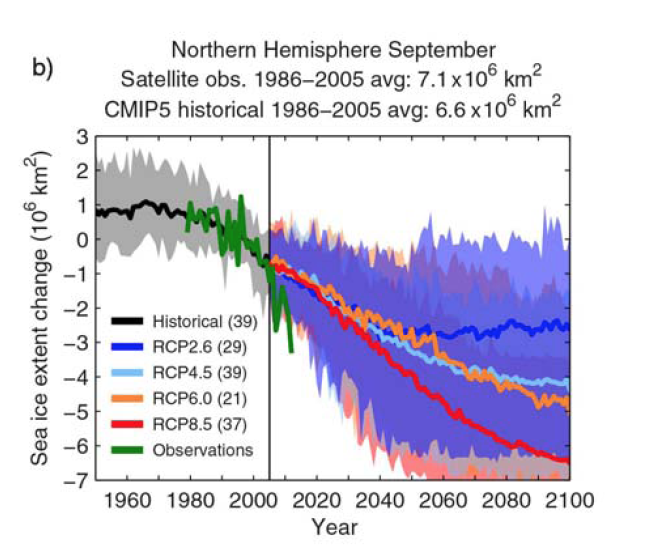
    3. ARCTIC SEA ICE  The IPCC’s carbon budget relies on Coupled Model Intercomparison Project Phase 5 (CMIP5) computer modelling results. In another part of the report, results are given for the ~2°C warming scenario (known as RCP2.6) of a 43% reduction in September Arctic sea-ice extent by end of 21st century (compared to a 1985–2005 reference period).  This is so at odds with the reality on the ground as to be not credible.  In just 30 years and with warming of less than 1°C, the sea-ice extent has dropped by half, and the sea-ice volume by more than three-quarters.  Switched-on Arctic researchers suggest that the Arctic will be sea-ice free in summer within the next decade or so, as discussed here and here and here.
    Changes in September sea-ice conditions from
    IPCC for four scenarios using CMIP5, and
    observations (green line)

    In fact the IPCC projection for September sea-ice extent by century’s end (deep blue line on figure at right) for ~2°C of warming is greater than the actual conditions now (green line) with less than 1°C of warming.  Losing the sea-ice earlier than the IPCC projects will change the planet’s surface reflectivity (albedo) and drive further warming. This, again, would reduce the carbon budget for 2°C this century, but in appears this has not been accounted for fully using the CMIP5 Arctic sea-ice results.

    4. CARBON STORES The Summary for Policymakers offers this qualification:

    A lower warming target, or a higher likelihood of remaining below a specific warming target, will require lower cumulative CO2 emissions. Accounting for warming effects of increases in non-CO2 greenhouse gases, reductions in aerosols, or the release of greenhouse gases from permafrost will also lower the cumulative CO2 emissions for a specific warming target.

    In December 2012, the UNEP reported that “the IPCC Fifth Assessment Report, due for release in stages between September 2013 and October 2014, will not include the potential effects of the permafrost carbon feedback on global climate.”  Yet even for the ~2°C warming pathway, permafrost release of greenhouse gases is pertinent. As I reported recently in Is climate change already dangerous?:

    A 2012 UNEP report on Policy implications of warming permafrost says the recent observations “indicate that large-scale thawing of permafrost may have already started.”  In February 2013, scientists using radiometric dating techniques on Russian cave formations to measure historic melting rates warned that a +1.5ºC global rise in temperature compared to pre-industrial was enough to start a general permafrost melt.  Vaks, Gutareva et al. found that “global climates only slightly warmer than today are sufficient to thaw extensive regions of permafrost.” Vaks says that: “1.5ºC appears to be something of a tipping point”.

    And in April 2011, the paper “Amount and timing of permafrost carbon release in response to climate warming” concluded:

    The thaw and release of carbon currently frozen in permafrost will increase atmospheric CO2 concentrations and amplify surface warming to initiate a positive permafrost carbon feedback (PCF) on climate…. [Our] estimate may be low because it does not account for amplified surface warming due to the PCF itself….
    We predict that the PCF will change the arctic from a carbon sink to a source after the mid-2020s and is strong enough to cancel 42-88% of the total global land sink. The thaw and decay of permafrost carbon is irreversible and accounting for the PCF will require larger reductions in fossil fuel emissions to reach a target atmospheric CO2 concentration.

    For the other three IPCC warming scenarios, permafrost must be a key component. Climate Progress reported in 2012 that:

    Back in 2005, before the IPCC’s Fourth Assessment, a major study led by NCAR climate researcher David Lawrence, found that virtually the entire top 11 feet of permafrost around the globe could disappear by the end of this century. Using the first “fully interactive climate system model” applied to study permafrost, the researchers found that if we tried to stabilize CO2 concentrations in the air at 550 ppm, permafrost would plummet from over 4 million square miles today to 1.5 million.
    That matters because the permafrost permamelt contains a staggering “1.5 trillion tons of frozen carbon, about twice as much carbon as contained in the atmosphere, much of which would be released as methane.  Methane is 25 times as potent a heat-trapping gas as CO2 over a 100 year time horizon, but 72 to 100 times as potent over 20 years!

    All of which suggests to me that for a high probability of not exceeding 2C of warming, and including the likely impacts of a period of sea-ice-free summer conditions in the Arctic sooner rather than later, and significant release of CO2 and methane from Arctic permafrost stores, then the available carbon budget is probably zero, or less.

    But that real-world question is not one to which I could find an answer in the IPCC report.

    NOT DISCUSSED: At a broader level, the IPCC physical basis report seems weak on many Arctic-related issues.  As far as I can see:

    • The predictions of sea-ice loss are so discordant with recent observations as to be not credible.
    • Decline in Arctic sea-ice thickness (a more robust indicator than extent) is not discussed.
    • While the release of CO2 or methane to the atmosphere from thawing permafrost carbon stocks over the 21st century is assessed,  the other very large sources of Arctic methane (such as sub-sea floor clathrates) are not mentioned.
    • The permafrost thaw emissions is only given as carbon, not assessed as methane and as CO2, which have very different radiative forcing impacts.
    • The impacts of Arctic-derived carbon cycle positive feedbacks such as permafrost loss on future temperature projections and on allowable carbon budgets are not given.
    • No mention is made of the cascading additive effect of multiple Arctic positive feedbacks on the rate of global warming, nor an assessment of Arctic amplification sensitivity.