Category: Uncategorized

  • IPCC: 30 years to climate calamity if we carry on blowing the carbon budget

    IPCC: 30 years to climate calamity if we carry on blowing the carbon budget

    Global 2C warming threshold will be breached within 30 years, leading scientists report, with humans unequivocally to blame

    FILE - Humans Are 'Dominant Cause' Of Global Warming According To IPCC Climate Report

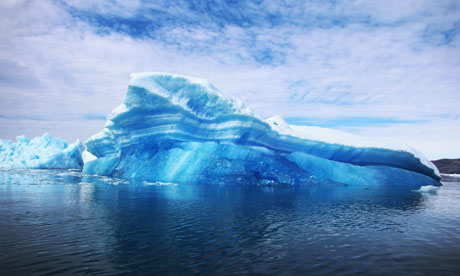
    Calved icebergs in Qaqortoq, Greenland. The IPCC report says the world is on the way to dangerous levels of global warming. Photograph: Joe Raedle/Getty Images

    The world’s leading climate scientists have set out in detail for the first time how much more carbon dioxide humans can pour into the atmosphere without triggering dangerous levels of climate change – and concluded that more than half of that global allowance has been used up.

    If people continue to emit greenhouse gases at current rates, the accumulation of carbon in the atmosphere could mean that within as little as two to three decades the world will face nearly inevitable warming of more than 2C, resulting in rising sea levels, heatwaves, droughts and more extreme weather.

    This calculation of the world’s “carbon budget” was one of the most striking findings of the Intergovernmental Panel on Climate Change (IPCC), the expert panel of global scientists who on Friday produced the most comprehensive assessment yet of our knowledge of climate change at the end of their four-day meeting in Stockholm.

    The 2,000-plus page report, written by 209 lead authors, also found it was “unequivocal” that global warming was happening as a result of human actions, and that without “substantial and sustained” reductions in greenhouse gas emissions we will breach the symbolic threshold of 2C of warming, which governments around the world have pledged not to do.

    Ban Ki-moon, the UN secretary-general, urged world leaders to pay heed to the “world’s authority on climate change” and forge a new global deal on cutting emissions. “The heat is on. Now we must act,” he said.

    John Kerry, the US secretary of state, said in a statement: “This is yet another wakeup call: those who deny the science or choose excuses over action are playing with fire.”

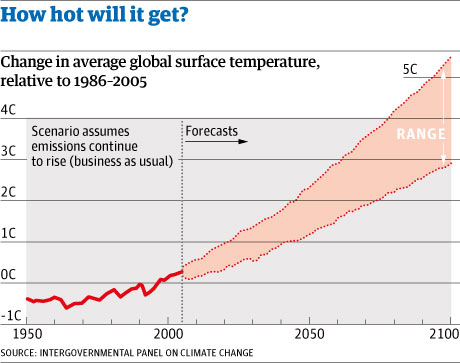
    Climate graphic Credit: Guardian graphics

    “Once again, the science grows clearer, the case grows more compelling, and the costs of inaction grow beyond anything that anyone with conscience or commonsense should be willing to even contemplate,” he added.

    The IPCC also rebuffed the argument made by climate sceptics that a “pause” for the last 10-15 years in the upward climb of global temperatures was evidence of flaws in their computer models. In the summary for policymakers, published on Friday morning after days of deliberations in the Swedish capital, the scientists said: “Each of the last three decades has been successively warmer at the Earth’s surface than any preceding decade since 1850. In the northern hemisphere, 1983-2012 was likely the warmest 30-year period of the last 1,400 years.”

    Thomas Stocker, co-chair of the report working group, said measuring recent years in comparison to 1998, an exceptionally hot year, was misleading and that temperature trends could only be observed over longer periods, of about 30 years.

    Natural variability was cited as one of the reasons for warming being less pronounced in the last 15 years, and the role of the oceans in absorbing heat, which is still poorly understood.

    “There are not sufficient observations of the uptake of heat, particularly into the deep ocean, that will be one of the possible mechanisms that would explain this warming hiatus,” said Stocker.

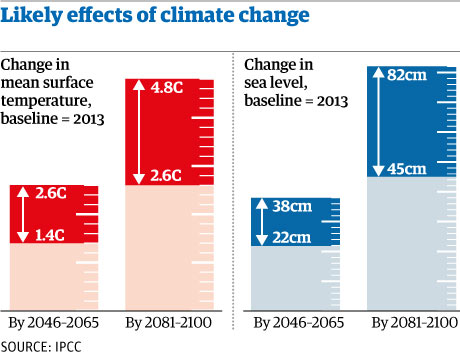
    Sea levels graphic Credit: Guardian graphics

    But the most controversial finding of the report was its “carbon budget”. Participants told the Guardian this was the last part of the summary to be decided, and the subject of hours of heated discussions in the early hours of Friday morning. Some countries were concerned that including the numbers would have political repercussions.

    The scientists found that to hold warming to 2C, total emissions cannot exceed 1,000 gigatons of carbon. Yet by 2011, more than half of that total “allowance” – 531 gigatons – had already been emitted.

    To ensure the budget is not exceeded, governments and businesses may have to leave valuable fossil fuel reserves unexploited. “There’s a finite amount of carbon you can burn if you don’t want to go over 2C,” Stocker told the Guardian. “That implies if there is more than that [in fossil fuel reserves], that you leave some of that carbon in the ground.”

    This raises key questions of how to allocate the remaining “carbon budget” fairly among countries, an issue that some climate negotiators fear could wreck the UN climate talks, which are supposed to culminate in a global agreement on emissions in 2015.

    Their other key findings in the report – the first such assessment since 2007 and only the fifth since 1988 – included:

    • Atmospheric concentrations of carbon dioxide, methane and nitrous oxide are now at levels “unprecedented in at least the last 800,000 years”.

    • Global temperatures are likely to rise by 0.3C to 4.8C by the end of the century depending on how much governments control carbon emissions.

    • Sea levels are expected to rise a further 26-82cm (10-32in) by 2100. The wide variation in part reflects the difficulty scientists still have in predicting sea level rises.

    • The oceans have acidified, having absorbed about a third of the carbon emissions

  • What the IPCC found: The big news from the new climate assessment

    What the IPCC found: The big news from the new climate assessment

    By

    developed-earth
    Shutterstock

    It’s extremely likely that humans have been the dominant cause of global warming since the 1950s, according to a landmark report from the world’s top panel of climate scientists. And we’re failing in our efforts to keep atmospheric warming below 2 degrees Celsius, or 3.6 Fahrenheit, which many scientists say is needed to avoid massive disruption.

    The Intergovernmental Panel on Climate Change conducted an epic review of climate research over the last three years. It is summarizing the most important findings in its fifth assessment report, which offers the clearest picture science has ever painted of how humans are reshaping the climate and the planet.

    Here, in a nutshell, are the main findings of a summary [PDF] of part one of the assessment report, which focuses on the science of climate change:

    Human influence has been detected in warming of the atmosphere and the ocean, in changes in the global water cycle, in reductions in snow and ice, in global mean sea level rise, and in changes in some climate extremes. …

    Warming of the climate system is unequivocal, and since the 1950s, many of the observed changes are unprecedented over decades to millennia.

    The IPCC also concludes that oceans have absorbed more of Earth’s excess heat since the 1990s than was the case during prior periods, explaining what climate deniers wrongly describe as a warming slowdown. And the panel revised downward the lower limit of warming that’s expected once we double the atmosphere’s CO2 concentrations, but left the upper limit unchanged from its 2007 assessment.

    For background on the IPCC and this assessment report, be sure to check out this explainer.

    And to save you the trouble of reading the dense 36-page summary released on Friday, we’ve rounded up highlights here — key numbers, facts, and graphs:

    Carbon emissions

    1 trillion tons: That’s the amount of carbon dioxide we could release into the atmosphere while keeping global warming under 3.6 degrees Fahrenheit.

    We’ve already released more than half that amount, mostly by burning fossil fuels and producing concrete, but also by tearing out forests and other ecosystems. A scientist involved with the study told The New York Times we will hit the limit in 2040 unless serious steps are taken to reduce carbon emissions.

    Click to embiggen.
    IPCC
    Click to embiggen.

    Land temperatures

    2.7 to 8.1 degrees Fahrenheit (1.5 to 4.5 Celsius): That’s the “likely” range of temperature rise once CO2 levels double in the atmosphere to 560 parts per million. The level was 280 ppm in pre-industrial times, and recently rose above 400 ppm.

    Although it’s “virtually certain” that there will be more extremely hot days and fewer extremely cold ones, occasional cold winter extremes will still occur.

    Click to embiggen.
    IPPA
    Click to embiggen.

    Ocean temperatures

    0.2 degrees Fahrenheit (0.1 Celsius): That’s the rate at which the upper 250 feet of the oceans are warming every decade.

    More than 90 percent of Earth’s extra heat is being absorbed by the oceans, where it’s affecting currents and causing water to expand, contributing to rising seas.

    Click to embiggen.
    IPCC
    Click to embiggen.

    Sea levels

    1/8th of an inch (3.2 mm): That’s the annual rate at which seas have been rising since 1993.

    The two main contributors to the rising seas are melting glaciers and warming waters, which expand as they heat up.

    Click to embiggen.
    IPCC
    Click to embiggen.

    Ocean acidification

    26 percent: That’s the increase in hydrogen ion concentration at the surface of the world’s oceans since the Industrial Revolution, corresponding to a pH decrease of 0.1.

    Oceans have absorbed about 30 percent of the CO2 that we have released into the atmosphere, and that’s what has caused the rise in acidity.

    Click to embiggen.
    IPCC
    Click to embiggen.

    Rain, snow, and hail

    It is “likely” that the number of regions where heavy rains have already become more common is greater than the number of regions where heavy rains are now occurring less frequently.

    The contrast between wet and dry regions will continue to increase, with wet areas getting wetter and dry regions growing more parched. Similarly, the contrast between wet and dry seasons will also become more pronounced.

    Click to embiggen.
    IPCC
    Click to embiggen.

    Snow cover

    11.7 percent: That’s the reduction in the extent of June snow cover every decade in the Northern Hemisphere between 1967 and 2012.

    Snowfall rates are expected to increase over Greenland and Antarctica. In Greenland, scientists have “high confidence” that snowfall will increase too slowly to make up for faster melting rates, though that may not be the case in Antarctica.

    Click to embiggen.
    IPCC
    Click to embiggen.

    Ice

    303 billion tons: That’s the amount of ice that the world’s glaciers have lost every year since 1993.

    The speed with which Greenland’s ice sheet is melting has increased substantially — 237 billion tons of ice were lost yearly from 2002 to 2011, up from 37 billion tons per year from 1992 to 2001. Meanwhile, Antarctica lost 162 tons of ice per year from 2002 to 2011, up from 33 billion tons annually from 1992 to 2001.

    Click to embiggen.
    IPCC
    Click to embiggen.
    John Upton is a science fan and green news boffin who tweets, posts articles to Facebook, and blogs about ecology. He welcomes reader questions, tips, and incoherent rants: johnupton@gmail.com.

    Find this article interesting? Donate now to support our work.
  • Is climate change already dangerous (5): Climate safety and an unavoidably radical future

    Fw: climate code red

    Inbox
    x
    NEVILLE GILLMORE
    7:58 PM (0 minutes ago)

    to me
    —– Forwarded Message —–
    From: Climate Code Red <noreply@blogger.com>
    To: ngarthurslea@yahoo.com.au
    Sent: Friday, 27 September 2013 6:26 PM
    Subject: climate code red


    climate code red


    Posted: 26 Sep 2013 01:50 AM PDT
    by David Spratt

    Fifth and last in a series

    Climate safety


    The research evidence and expert elicitations demonstrate that climate conditions are “dangerous” now – according to the generally accepted “safe boundary”, “five concerns” and “tipping point” metrics.

    • The 350 ppm “safe boundary” for atmospheric CO2 has already been exceeded by 50 ppm.
    • In 2007, at around +0.76ºC warming (equivalent to ~335 ppm CO2 at equilibrium), Arctic sea-ice passed its tipping point. The Greenland Ice Sheet may not be far behind, as the Arctic moves to sea-ice-free conditions in summer, triggering further tipping elements.
    • Around +1.5ºC warming may be the tipping point for the Greenland Ice Sheet and for the large-scale release of Arctic carbon permafrost stores. At +1.5ºC, coral reefs would be reduced to remnant systems.
    • The paleo-climate record shows that the current level of atmospheric CO2 at 400 ppm is enough to produce sea-level rises of 20–40 metres; is around the tipping point for large-scale release of Arctic carbon permafrost; and is sufficient to trigger powerful amplifying polar feedbacks.

    Holocene CO2  levels have varied between 270 and 330 ppm. The higher figure occurred in the early Holocene around 10,000 years ago when temperatures were around 0.5°C warmer (known as the Holocene maximum) than pre-industrial levels, when the CO2 level was around 280 ppm.

    A safe climate would not exceed the Holocene maximum.  The notion that +1.5ºC is a safe target is contradicted by the evidence, and even +1ºC degree is not safe given what we now know about the Arctic.

    Emission reduction challenges

    The dominant climate policy frame I have observed goes along these lines: “Let’s hope it’s not as bad as you say… Even if you are right about the Arctic… holding the system to +2ºC will be very difficult… and a huge political and economic challenge… but it’s the best we can hope for… and while it might be dangerous…that’s a hell of a lot better than +3 or 4ºC … which would be catastrophic.”

    The discussion on “doing the maths” for the carbon budget is about the total emissions available without exceeding 2ºC of warming.

    This task is very much more challenging than policy-makers accept, as Anderson and Bows demonstrate in their 2008 and 2011 papers on emission reduction scenarios. They make some optimistic assumptions about de-afforestation and food-related emissions for the rest of the century, and then ask what emission reduction scenarios would be compatible with holding warming to +2ºC, and find that:

    • Of the 18 scenarios tested, ten cannot be reconciled with ~450 ppm CO2e.
    • If emissions to do not peak till 2025, no scenarios are available.
    • 450 ppm CO2e requires energy emissions to be stabilised by 2015, then decline annually by 6-8 per cent for 2020–2040, with full de-carbonisation by 2050.
    • A five per cent annual reduction in emissions from a 2020 peak (and a 6–7 per cent annual reduction in energy and process emissions) correlates near 550 ppm CO2e, or +3ºC of warming. If the emissions reduction after a 2020 peak is three per cent, this correlates near 650 ppm CO2e, or +4ºC of warming. 
    • And looking at equity issues: if non-Annex 1 (developing) nation emissions grow three per cent a year to 2020 and then peak in 2025, there is no carbon budget available for Annex 1 (developed nations) after 2015, for the IPCC’s low-emissions carbon budget.

    Research published in August 2013 finds that terrestrial ecosystems absorb approximately 11 billion tons less CO2 every year as the result of the extreme climate events than they could if the events did not occur. That is equivalent to approximately a third of global CO2 emissions per year. As extreme events increase in scale and frequency with more warming, this may negatively affect the amount of emissions available for the carbon budgets discussed above.

    Two degrees, or four?

    In June 2013, a German research institute which advises Angela Merkel’s government concluded that “policy makers must come up with a new global target to cap temperature gains because the current goal…  limiting the increase in temperature to 2°C since industrialization is unrealistic”. It recommended that “world leaders either allow the 2°C goal to become a benchmark that can be temporarily overshot, accept a higher target, or give up on such an objective altogether”.

    International Energy Agency Chief Economist Fatih Birol calls the 2°C goal “a nice Utopia”: “It is becoming extremely challenging to remain below 2°C. The prospect is getting bleaker. That is what the numbers say.”

    The prevailing climate policy-making framework now poses a choice between a “dangerous but liveable” 2ºC of warming and the “catastrophe” of 4ºC or more, as reflected in the statement by John Holdren that opens this paper.

    The World Bank and PriceWaterhouseCoopers have recently published reports which complement a wide range of scientific research which concludes that the world is presently heading for 4ºC or more of warming this century, and as soon as 2060. Reuters correspondent Michael Rose (2012) quotes IEA Chief Economist, Fatih Birol as saying that emission trends are “perfectly in line with a temperature increase of 6°C, which would have devastating consequences for the planet”.

    Anderson says there is a widespread view amongst scientists that “a 4°C future is incompatible with an organised global community, is likely to be beyond ‘adaptation’, is devastating to the majority of eco-systems and has a high probability of not being stable”.

    Yet the 2ºC goal is not an option either, because, with climate and carbon cycle positive feedbacks in full swing, it is less a stable destination than a signpost on a highway to a much hotter place.  The real choice now is to try and keep the planet under a series of big tipping points by getting it back to a Holocene-like state, or accept that a 3-6ºC “catastrophe” is at hand.

    Radical choices

    Policy-makers officially focus on the 2ºC goal, without admitting the ambition entailed:

    …while the rhetoric of policy is to reduce emissions in line with avoiding dangerous climate change, most policy advice is to accept a high probability of extremely dangerous climate change rather than propose radical and immediate emission reductions. (Anderson and Bows)

    As Anderson and Bows show, if global emissions don’t peak till 2020, then the carbon budget for the developed world is… zero.  Even the 2ºC target requires actions that are completely outside the current climate policy-making framework, and therefore considered impossible.

    In “A new paradigm for climate change”, Anderson and Bows call for academic rigour in elaborating the scientific and economic choices:

    … academics may again have contributed to a misguided belief that commitments to avoid warming of 2°C can still be realized with incremental adjustments to economic incentives… as the remaining cumulative budget is consumed, so any contextual interpretation of the science demonstrates that the threshold of 2°C is no longer viable, at least within orthodox political and economic constraints…
    At the same time as climate change analyses are being subverted to reconcile them with the orthodoxy of economic growth, neoclassical economics has evidently failed to keep even its own house in order. This failure is not peripheral. It is prolonged, deep-rooted and disregards national boundaries, raising profound issues about the structures, values and framing of contemporary society… This catastrophic and ongoing failure of market economics and the laissez-faire rhetoric accompanying it (unfettered choice, deregulation and so on) could provide an opportunity to think differently about climate change…
    It is in this rapidly evolving context that the science underpinning climate change is being conducted and its findings communicated. This is an opportunity that should and must be grasped. Liberate the science from the economics, finance and astrology, stand by the conclusions however uncomfortable. But this is still not enough. In an increasingly interconnected world where the whole — the system — is often far removed from the sum of its parts, we need to be less afraid of making academic judgements. Not unsubstantiated opinions and prejudice, but applying a mix of academic rigour, courage and humility to bring new and interdisciplinary insights into the emerging era. Leave the market economists to fight among themselves over the right price of carbon — let them relive their groundhog day if they wish. The world is moving on and we need to have the audacity to think differently and conceive of alternative futures.

    Anderson is the Deputy Director of the Tyndall Centre for Climate Change Research, which in late 2013 is hosting a Radical Emission Reduction Conference, whose purpose is described as:

    Today, in 2013, we face an unavoidably radical future. We either continue with rising emissions and reap the radical repercussions of severe climate change, or we acknowledge that we have a choice and pursue radical emission reductions: No longer is there a non-radical option. Moreover, low-carbon supply technologies cannot deliver the necessary rate of emission reductions – they need to be complemented with rapid, deep and early reductions in energy consumption – the rationale for this conference.

    To repeat: “…we face an unavoidably radical future… no longer is there a non-radical option.”  Can this phrase help liberate us from the prevailing climate policy-making paradigm, from which no further hope can be wrung?

    In 2008, in a statement for the book Climate Code Red I authored with Philip Sutton, James Hansen wrote:

    We must begin to move rapidly to the post-fossil fuel clean energy system. Moreover, we must remove some carbon that has collected in the atmosphere since the Industrial Revolution. This is the story that Climate Code Red tells with conviction. It is a compelling case for recognising, as the UN secretary-general has said, that we face a climate emergency.

    And what would a radical, emergency-action option look like, and why it is absolutely necessary as the last, best hope we have?  We described some of its features in Climate Code Red, as has Paul Gilding in his 2011 book, The Great Disruption. And this year, Delina and Diesendorf published research from the University of NSW on the question: “Is wartime mobilisation a suitable policy model for rapid national climate mitigation?”

    In addition to stopping fossil fuel emissions, very large-scale carbon dioxide removal (CDR) would be a critical task, to reduce the level of atmospheric greenhouse.  Can CDR be achieved at the size and scale required to help get us back to safety? A recent and very good survey of CDR options and technologies, their costs, effectiveness and environmental consequences has been just published by Caldeira, Bala et al. As well, it now seems clear that if we are to prevent the world tripping past a number of critical tipping points, some forms of geo-engineering such as solar radiation management (SRM) will be necessary in the short term. This would be an adjunct to a zero-emissions program and CDR, especially as the “global dimming” effect of aerosols is reduced as emissions fall. Here, too, Caldeira, Bala et al. provide a useful survey, including the pitfalls, the challenging governance issues and the many “known unknowns”.

    All of this may seem like a lot of “ifs” and “buts” and “maybes”. We are now in a world of making the least-worst choices. There is no simple answer, and we do not yet know all the questions in detail, let alone all of the answers. Nobody ever does at the beginning of an emergency response. That’s what makes it an emergency.   But we do now know, with clear evidence that climate change is already “dangerous”, that we are heading towards a “catastrophe”, that we are in an emergency and, yes, we do face  “…an unavoidably radical future”. And we do know from past experience that once societies are in emergency mode, they are capable of facing up to and solving seemingly impossible problems.


    You are subscribed to email updates from Climate Code Red
    To stop receiving these emails, you may unsubscribe now.
    Email delivery powered by Google
    Google Inc., 20 West Kinzie, Chicago IL USA 60610
  • change.org and the value of people power,

    Karen Skinner, Change.org <mail@change.org>
    3:33 PM (4 minutes ago)

    to me
    Change.org
    Hi NEVILLE


    Most often, we pop into your inbox with breaking and popular petitions started by change.org users that you can support — today, we thought we’d share some of the fruits of your labour: the victories!

    Every week, hundreds of Australians start petitions using change.org‘s platform — about big national issues as well as local changes they want for their neighbourhood, town or state. Like these little beauties:

    • Lismore’s public library has been saved from closure and further budget cuts after 619 people signed Louise’s petition.
    • A local council in Victoria will ensure a kids playground is made safer after 47 people joined a parent’s petition to build a fence between the play area and a road.
    • Residents started a petition and came together to convince their body corporate and shopping centre to start recycling properly.

    What’s great, is that people like you are helping these petitions to win. By moving your cursor, signing your name, and sharing it with friends, you are making the difference between these changes happening or not. It’s a domino effect. What we like to call people power. 

    There’s a lot to celebrate — so have a read below about what people have won recently using petitions and people power, then start your own if you have something you want to change.

    Enjoy!

    Karen, Owen, Tony, Nathan and the Change.org team.


    The ones you might have seen in national media:

    Sapphires DVD distributor apologises over “racist, sexist” cover

    After the iconic Sapphires movie was released in the US with the cover relegating the Aboriginal female stars to the background, more than 18,000 people joined Lucy’s petition asking for it to be changed. Now Anchor Bay have issued an apology and committed to reviewing the DVD cover — with Lucy saying it helped shine a light on sexism and racism in the entertainment industry.

    Middle Earth is saved

    New Zealanders celebrated the protection of Milford Sounds, which played the part of Middle Earth in the Lord of the Rings movies. Over 30,000 signed a petition against the construction of a massive, environmentally destructive tunnel through the area, and in July, New Zealand’s Conservation Minister rejected the plan to build the tunnel!

    Twitter adds a “report abuse” button to crack down on rape threats

    Talitha, a 23 year old woman from Sydney, started her petition after experiencing an “horrific torrent” of abusive and threatening tweets, and hearing many other women were having the same issue of Twitter deeming them acceptable. After 130,000 people signed petitions across the globe, Twitter have now rolled out a “report abuse” button and other measures to protect users from abuse and rape threats.

    A heap of local wins happening around Australia:

    • At risk of being closed due to funding cuts, a local childcare centre in South Australia will now get ongoing funding thanks in part to this petition started by a mum.
    • Security and safety at O’Sullivan Beach boat ramp will be upgraded after 153 people signed a petition to their local Mayor.
    • After fans petitioned Sony Pictures, they gave the film “Evil Dead” a wider release in Australian cinemas.
    • Qantas have removed American Staffordshire Terriers from being banned on flights — 6,000+ people used Pauline’s petition to pressure the airline.
    • The Federal Government has granted a mother permanent residency so she can stay with her family after 900+ people signed her family’s petition. 
    • A “miracle” melanoma cancer drug will be made more affordable after families needing the drug and supporters petitioned the government to add it to the Pharmaceutical Benefits Scheme.
    • Bellingen Hospital replaces leaking roofs after online and offline petitions from staff, patients and families gathered 2,847 signatures.
    • A rape crisis support centre has been saved from closure after the Northern Territory government to reversed a decision to cut funding following a petition and media pressure.

    And there so, so many more… check out other victories from around the site right here — or stay up to date by joining us on Facebook.

    People are starting petitions every day on Change.org.
    NEVILLE, what will you change?
                                                   

              START A PETITION
  • Climate Sensitivity, Sea Level and Atmospheric Carbon Dioxide HANSEN

    Climate Sensitivity, Sea Level and Atmospheric Carbon Dioxide

    Inbox
    x
    James Hansen jimehansen@gmail.com via mail86.us4.mcsv.net
    1:07 PM (1 hour ago)

    to me
    Email not displaying correctly? View it in your browser.
    Climate Sensitivity, Sea Level and Atmospheric Carbon Dioxide

    Discussion of paper in Phil. Trans. Roy. Soc. available here or my web site.

    ~Jim
    26 September 2013

  • Australia’s new dictatorship

    Australia’s new dictatorship

    Posted by in Politics on 26 September, 2013 8:34 pm / 36 comments

    Even before Tony Abbott took over as prime minister he was already exercising autocratic power, says Torin Peel, but now he’s really starting to turn the screws.

    abbott3

    (Caricature by John Graham / johngraham.alphalink.com.au)

    Now in high office, Tony Abbott has full power to do whatever he chooses.

    He has the power to control his members of parliament and the party in which he leads. Not only that, but he now has control of the country, giving him the room to do as he pleases.

    In his first weeks, he has already exercised his right to do so.

    Some of these things include shutting down numerous bodies, such as the Climate Commission. He has also merged AusAid into the Department of Foreign Affairs and Trade, giving him more power to control international aid. These two manoeuvres alone will most likely cost hundreds of jobs in the public service.

    During the campaign, as leader of the opposition, Tony Abbott had the power to tell his party what to do and what not to do. He swiftly put a block on his candidates talking to the media without permission from him after the Jaymes Diaz incident. This meant that dozens of candidates from the Liberal party were unable to attend debates across the country.

    Tony Abbott once described Kevin Rudd as a ‘hyper-control freak’. It has now emerged that Abbott himself is gagging his own cabinet from the right to talk to media without prior approval from his office. This might spell the end of members of the Liberal party appearing on television programs like Q&A and 7:30, which are fundamental to our democracy.

    With so much control, you could almost say that Tony Abbott is now running our country as a dictatorship. His one-woman cabinet will no longer have a voice and will be unable to speak up about important issues in the public domain, which we weren’t expecting much of, anyway.

    The media-ban decision was made after Christopher Pyne revealed in an interview the government’s agenda to take an axe to the university sector. Seems a bit like the Diaz slip-up, doesn’t it?

    These aren’t the only media bans Tony Abbott has enforced. It was revealed recently that the government would attempt to cover-up boat arrival information, taking away our knowledge on how many boats are arriving. This decision has a huge impact on our democracy, taking away transparency.


    The Greens have stated they will use their senate powers to try and reveal boat numbers, which will help us to hold the Abbott government accountable on their promise to stop the boats.

    All of this hiding of information, blockade from media appearances and extreme use of government powers really makes you wonder whether we live in democracy anymore. Of course, the people of Australia did vote for the Coalition and Tony Abbott, but did we really expect everything to happen so quickly and so