Category: Uncategorized

  • Abbottalypse Now (MONBIOT)


    Abbottalypse Now

    September 5, 2013

    Tony Abbott intends to trash Australia on behalf of the super-rich.
    By George Monbiot, published in the Guardian 5th September 2013

    His views have changed, but don’t expect Tony Abbott to acknowledge this, let alone apologise to Australians for misleading them. In 2009 he maintained that manmade climate change is “absolute crap”. Now he says “I think that climate change is real, humanity makes a contribution.” But he has merely switched from denying global warming to denying the need to act on it.

    Abbott is following a familiar script, the 4 Ds of climate change inaction, promoted by fossil fuel lovers the world over. Deny, then defer, then delay, then despair.

    His Direct Action programme for reducing emissions is incapable of delivering the cuts it promises, absurdly underfunded and surrounded by a swarm of unanswered questions. Were it to become big enough to meet its promises, it would be far more expensive than a comparable carbon trading scheme, which Mr Abbott has falsely claimed would incur “almost unimaginable” costs. But it won’t be big enough, because he refuses to set aside the money it requires. Direct Action is a programme designed to create a semblance of policy, in the certain knowledge that it will fail to achieve its objectives.

    Why? The answer’s in the name. Coalition policies begin with Coal: getting it out of the ground, moving it through the ports, stripping away the regulations that prevent mining companies from wrecking the natural beauty of Australia – and from trashing the benign climate on which we all depend. The mining boom in the world’s biggest coal exporter has funded a new, harsher politics.

    Like the tar sands in Canada, coal has changed the character of the nation, brutalising and degrading public life. It has funded a vicious campaign of mud-slinging against those who argue for the careful use of resources, for peace and quiet and beauty and the health of the living planet. Australia, like Nigeria, Iraq and Saudi Arabia, suffers from a resource curse.

    To those four Ds you can add an R: retreat. Like Canada, Australia is slipping back down the development ladder, switching from secondary and tertiary industries towards primary resource extraction. Note Abbott’s disparagement of what he calls a “restaurant-led economy” in Tasmania, and his intention to replace it with the businesses that preceded it: logging and pulping, mining and unregulated fishing. A 21st-Century nation is returning to a 19th-Century economy. It makes no financial sense, but mining and logging corporations are more powerful lobbyists that restauranteurs and eco-tourism companies.

    That R also makes the difference between coal and coral. If, as we can expect, Tony Abbott allows a massive expansion of the coal port at Abbot Point, which means the dredging and dumping of 3 million cubic metres of material inside the Great Barrier Reef marine park, it would threaten coral, dugongs, turtles, dolphins and much of the rest of the reef’s profusion of life. If it happens, it will be a simple declaration that nothing – not even the Great Barrier Reef, on which so much of Australia’s image and revenue depends – will be allowed to stand in the way of extraction and destruction.

    Abbott will dump coal onto the bonfire of environmental protection lit by some of the state governments. He intends to cut what he calls “green tape” – the rules that protect humankind’s common heritage from greed and selfishness – and withdraw the federal powers that are often the last line of defence against state governments captured by the industries they are supposed to regulate.

    None of this is to suggest that Labor has distinguished itself on these issues. The announcements of the past few weeks look like a last minute scramble to help voters forget its record of vacillation and cowardice. Labor’s failure to protect the natural world ensures that Abbott’s philistinism is harder to contest. As usual, it’s only the Greens who have consistently been advocating responsibility and statesmanship.

    It’s been bad enough under Gillard and Rudd. If Tony Abbott is elected, the natural wonders that distinguish this nation will gradually be rubbed away until it looks like anywhere else: a degraded landscape and seascape, supporting just a few generic exotic species.

    The country will be run exclusively for the class to which Gina Reinhardt, Clive Palmer and Ivan Glasenberg belong: the one per cent of the One Per Cent. Forget the pious rhetoric and nationalistic bombast. Abbott’s policies are really about removing the social and environmental protections enjoyed by all Australians, to allow the filthy rich to become richer – and filthier.

  • Double Dissolutions of the Australian Parliament

    Double Dissolutions of the Australian Parliament

    A key feature of a bicameral parliamentary system of government is the possibility that a deadlock may arise between the two houses of parliament.

    In Australia, for a bill to become law, it must be passed by both houses of parliament, as prescribed by Section 58 of the Constitution:

    When a proposed law passed by both Houses of Parliament is presented to the Governor-General for the Queen’s assent, he shall declare, according to his discretion, but subject to this Constitution, that he assents in the Queen’s name, or that he withholds assent, or that he reserves the law for the Queen’s pleasure.

    Australian governments generally control the numbers in the House of Representatives (the lower house). This is because the party or parties that win a majority of lower house seats form the government.

    However, the proportional voting system used in the Senate means that governments generally do not control the Senate. The Senate may insist on amendments to government legislation passed by the House of Representatives. The Senate may also reject outright bills passed by the House.

    This disagreement between the houses reached its height in 1975 when the Senate refused to vote on the Whitlam Government’s budget bills, effectively threatening the government’s survival by refusing to grant it money.

    One means of resolving conflict between the two houses of parliament is by means of a double dissolution of the Parliament.

    A Double Dissolution of the Australian Parliament is allowed under Section 57 of the Australian Constitution:

    If the House of Representatives passes any proposed law, and the Senate rejects or fails to pass it, or passes it with amendments to which the House of Representatives will not agree, and if after an interval of three months the House of Representatives, in the same or the next session, again passes the proposed law with or without any amendments which have been made, suggested, or agreed to by the Senate, and the Senate rejects or fails to pass it, or passes it with amendments to which the House of Representatives will not agree, the Governor-General may dissolve the Senate and the House of Representatives simultaneously. But such dissolution shall not take place within six months before the date of the expiry of the House of Representatives by effluxion of time.

    If after such dissolution the House of Representatives again passes the proposed law, with or without any amendments which have been made, suggested, or agreed to by the Senate, and the Senate rejects or fails to pass it, or passes it with amendments to which the House of Representatives will not agree, the Governor-General may convene a joint sitting of the members of the Senate and of the House of Representatives.

    The members present at the joint sitting may deliberate and shall vote together upon the proposed law as last proposed by the House of Representatives, and upon amendments, if any, which have been made therein by one House and not agreed to by the other, and any such amendments which are affirmed by an absolute majority of the total number of the members of the Senate and House of Representatives shall be taken to have been carried, and if the proposed law, with the amendments, if any, so carried is affirmed by an absolute majority of the total number of the members of the Senate and House of Representatives, it shall be taken to have been duly passed by both Houses of Parliament, and shall be presented to the Governor-General for the Queen’s assent.

    Essentially, this section of the Constitution can be summarised as follows:

    1. House passes bill
    2. Senate rejects bill
    3. 3 months elapse
    4. House passes bill again
    5. Senate rejects bill again
    6. Prime Minister may advise Governor-General to dissolve both houses
    7. Assuming government is returned at election, House passes bill for the third time
    8. Senate rejects bill for the third time
    9. Joint Sitting may be held to finally resolve the disagreement between the houses

    There have been six double dissolutions of the Australian Parliament:

    Double Dissolutions of the Australian Parliament
    Year Party in Govt. Prime Minister Election Result Joint Sitting
    1914 Liberal Joseph Cook Government Defeated No
    1951 Liberal Robert Menzies Government Returned No
    1974 ALP Gough Whitlam Government Returned Yes
    1975 L/NCP Malcolm Fraser Elected Whitlam Government Defeated,
    Caretaker Fraser Government Elected
    No
    1983 L/NCP Malcolm Fraser Government Defeated No
    1987 ALP Bob Hawke Government Returned No

    Joint Sittings
    There has only been one joint sitting of the Australian Parliament. It was held in August 1974 following the May double dissolution election. The Whitlam government was able to pass a number of key pieces of legislation at the joint sitting. Click here to download a paper on ‘The 1974 Joint Sitting of Parliament’ (PDF).

    Senate Terms Following A Double Dissolution
    Whereas a normal general election involves the election of all members of the House of Representatives (currently 150) and one-half of the Senate, (40, including the four senators from the two territories), a double dissolution means that all of the Senate positions are up for election.

    Accordingly, the new Senate then has to be divided into long term (6 year) and short term (3 year) senators, in order to re-establish the rotation of senators at normal general elections. This division is usually achieved by allocating the long term positions to the first 6 senators elected in each state.

    The terms of all senators chosen in a double dissolution election are backdated to the previous July, in accordance with Section 13 of the Constitution:

    ….For the purposes of this section the term of service of a senator shall be taken to begin on the first day of July following the day of his election, except in the case of the first election and of the election next after any dissolution of the Senate, when it shall be taken to begin on the first day of July preceding the day of his election.

    The effect of this provision is such that a double dissolution can throw out the synchronicity of House and Senate elections. This can be seen in the situation that existed following the double dissolution of February 1983. Following this election, the House of Representatives term expired in April-May 1986, but a half-Senate election was due by June 1985, since the terms of senators elected in March 1983 were backdated to July 1982. The early election called by Prime Minister Bob Hawke in December 1984 put the electoral cycle back in kilter because the senators then elected did not take up their positions until the following July. The double dissolution of 1987 did not create the 1983 problem because the elections took place in July and the two houses were more or less in kilter.

    May 25, 2013: Would A Double Dissolution In Early 2014 Be Unconstitutional?

    January 2013 Update: There will be no double dissolution of the 43rd parliament. There are no bills that fit, or could fit, the requirements of Section 57, as outlined above. The double dissolution option expires on March 27.

    This means there could be a House election alone between February-June, 2013. This would necessitate a separate half-Senate election between July 1, 2013 and June 30, 2014. More likely, a House and half-Senate election will take place between August-November 2013. The terms of senators chosen in that election will begin on July 1, 2014.

    May 2012 Update: No deadlock exists between the two houses. Despite the minority status of the Gillard Labor government, no bill has been twice rejected by the Senate. A double dissolution appears unlikely.

    The next half-Senate election cannot be held until after July 1, 2013. If the Gillard government were to be fall before then, an election could only be held for the House of Representatives and a separate half-Senate election would have to be held between July 2013 and June 2014.

    November 2003 Update: A number of double dissolution triggers now exist, with the likelihood of more in the new year, notably the full privatisation of Telstra. It is theoretically possible for a double dissolution to take place before June 2004, but this remains an unlikely possibility.

    The decision by the Prime Minister, John Howard, in June 2003, to remain indefinitely as leader of the Liberal Party, suggests that the election will take place close to its normal time in the period August-December 2004.

    The earliest possible date for a combined House and half-Senate election is Saturday August 7, 2004.

    A double dissolution could take place at any time until August 11, 2004. Voting in a double dissolution can take place as late as Saturday October 16, 2004.

    A House and half-Senate election can take place anytime between August 7, 2004 and April 16, 2005.

    June 2002 Update: There has been much discussion during this month of the possibility of a double dissolution election. The Howard Government’s legislation excising thousands of islands from Australia’s migration zone was defeated in the Senate in June and can be reintroduced in the September-October session. It is also expected that legislation on Unfair Dismissals, Pharmaceutical Benefits, Disability Pensions and Telstra privatisation may become double dissolution triggers during this time.

    Federal Parliament sat for the first time on February 11, 2002. This means that the next dissolution of the House of Representatives must take place by February 11, 2005. If the maximum times permitted under the Constitution and the Electoral Act are exploited, the latest possible date for an election is Saturday April 16, 2005.

    A half-Senate election must be held sometime between July 1, 2004 and June 30, 2005. Since the last election was in November 2001, it is most likely that a normal election for the House and half-Senate will be held around October-December 2004, or February-March 2005.

    A House election called before July 2004 would have to be held without a half-Senate election. It is unlikely that the Prime Minister would wish to create a situation where two elections would be required within a 12-month period.

    A double dissolution can be carried out at any time up to six months before the normal expiration of the House of Representatives, that is up until August 11, 2004. If the Parliament were dissolved on August 11, 2004, the elections could take place as late as Saturday October 16. Hence, we face the unusual prospect that the government, led by either Howard or Costello, could govern for a full three years and still have the double dissolution trigger available to it.

    Given that the terms of Senators are backdated to the previous July 1 following a double dissolution, it would be more logical to have a double dissolution election in the second half of 2002, 2003 or 2004, rather than in the first half. A double dissolution election in the first half of these years would throw the electoral cycle out of kilter again, necessitating either a separate half-Senate election two years later, or an early House election.

    January 2002 Update: With the re-election of the Howard Government, the process commences again. A double dissolution can not be held until the second half of 2002 because of the scheduled meetings times of the Parliament. A double dissolution would be constitutionally possible at any time during 2003.

    2001 Update: After May 2001, the Double Dissolution option no longer existed, despite the Senate’s blockage of legislation on Industrial Relations, because it was less than 6 months till the scheduled dissolution of the House. An election for the House of Representatives and half of the Senate took place on November 10, 2001.

    1999 Update: An election for the House of Representatives and half of the Senate was held on October 3, 1998. Since a compromise had been reached on the Wik legislation, there was no trigger for a double dissolution. Consequently, the next half-Senate election can not be held until after July 2001. The House of Representatives election has to be held by January 2002. A double dissolution election is a theoretical possibility during the latter part of 1999, 2000 or the first half of 2001.

    1998 Update: If Prime Minister John Howard had gone to a double dissolution election in the second half of 1996 or the first half of 1997, he would have been faced with the same problem created by the 1983 election, where a half-Senate election would be required up to one year in advance of a House election. If a double dissolution election had occurred in the first half of 1998, the houses would also have been thrown out of kilter again. A double dissolution in the second half of 1998 will not create this problem, thus an election over the Wik legislation is possible in the second half of 1998.

    A double dissolution cannot be held in 1999 because of the provision restricting such a dissolution within six months of the normal expiration of the term of the House. The last possible date on which both houses can be dissolved is October 29, 1998. This is because the House first sat on April 29, 1996. The Electoral Act requires that an election be held within 68 days of the dissolution, hence, whilst an election could be delayed until January, the most practical final date for a double dissolution election is sometime in late November or early December. It is difficult to see a double dissolution election being held later than December 12.

    Print Friendly
  • Scientists call for overhaul of UN ‘blockbuster’ climate reports

    Scientists call for overhaul of UN ‘blockbuster’ climate reports

    As the IPCC prepares for its next major assessment, experts and governments propose more targeted and frequent studies

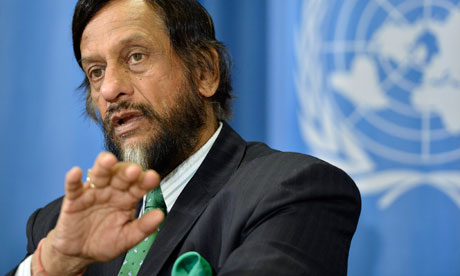
    IPCC chairman Rajendra Kumar Pachauri

    The IPCC, chaired by Rajendra Kumar Pachauri, above, is facing criticism from scientists who contribute to its climate reports. Photograph: Martial Trezzini/EPA

    International scientists are calling for an overhaul of the United Nations‘ “blockbuster” climate reports ahead of the delivery of the next big assessment.

    The reports from the Intergovernmental Panel on Climate Change are compiled by hundreds of scientists and are considered the definitive assessment of global climate risks, with the next big report due to be released in Stockholm this month.

    But the IPCC’s core mission is now under challenge from the very scientists who compiled those reports, as well as some governments.

    “There is the open question as to how we should be doing these assessments,” said Don Wuebbles, a climate scientist at the University of Illinois, who has been a leading author of the IPCC reports since they began in the late 1980s. “Should we be doing these major assessments every five years or so, or should we be doing more targeted assessments that policymakers need? It’s not so clear.”

    The governing body of the IPCC will discuss its future at a meeting in the Georgian resort town of Batumi in October and later in Berlin, a spokesman said.

    “What sort or products should the IPCC be producing, over what kind of time scale? Do we need this blockbuster report every six or seven years or do we need more frequent reports? That is the sort of thing that is going to be discussed there,” IPCC spokesman Jonathan Lynn said.

    Governments have begun weighing in on the IPCC’s future, with America and some European countries pushing hardest for change.

    The next big push could well come from the climate scientists responsible for producing the reports.

    Thomas Stocker, a climate scientist at the University of Bern and a co-chair of the UN climate panel, said he had sought permission to convene a public debate on the future of the IPCC at one of the biggest gatherings on the scientific calendar, the fall meeting of the American Geophysical Union (AGU).

    Some 22,000 people are expected at the meeting, which takes place in San Francisco in December. Stocker said he saw the meeting as a chance to broaden the discussion on the future of the IPCC.

    “With that input directly bottom-up from the scientists, I can help in this discussion and certainly facilitate that the views of scientists, those individuals and colleague that carry the burden of the assessment and provide their time and intellectual expertise, are heard,” Stocker said.

    The AGU would not respond directly to questions about the climate science town hall.

    Other expert contributors to the IPCC reports said they believed it was time the panel shifted focus – from production of mega reports to more targeted studies, looking more closely at certain regions, or phenomena.

    The IPCC was set up in 1988 to provide the most authoritative report on global climate change, enabling governments to prepare for a future of rising seas, droughts, extreme weather events, and other consequences.

    It has delivered its landmark reports every six or seven years since then, relying on the participation of some 1,300 scientists from around the world to arrive at an expert consensus on the pace of climate change, and its effects.

    The IPCC shared the Nobel peace prize with Al Gore in 2007. But in 2010, the UN climate panel was forced to admit there was an error in the report on the rate of retreat of Himalayan glaciers.

    The error was in one paragraph in a 900-page report. But it was seized on by those who doubt the science behind climate change, and those who oppose controls on carbon pollution, to try to damage the credibility of the entire IPCC exercise.

    Now, as the IPCC puts the finishing touches to the latest report, some of the climate scientists involved argue the mammoth effort of getting hundreds of scientists to review hundreds of journal articles – all on a volunteer basis – would be better put to studying regional impacts of climate change, or specific phenomena.

    “I think myself that the IPCC has outgrown its usefulness in the way in which it does things,” said Kevin Trenberth, a climate scientist at the National Centre for Atmospheric Research in Colorado.

    Andrew Weaver, a lead IPCC author and a Green party leader who earlier this year was elected to the British Columbia legislature, agreed it was time to shift away from the blockbuster style of reports.

    The scientists said the science on the causes of climate change and its global effects was already well-established. Given the rate and extent of climate change, it would be more useful to governments which rely on the IPCC reports to have scientists working on more targeted reports on specific topics, which would be delivered every year or two.

    “My own view is that … it would be healthy for the IPCC to focus on regional impacts and to focus on individual phenomena rather than the big global thing. The way to go forward would be to pick an issue and to work together in an interdisciplinary way,” Weaver said.

    Scientists could then look at the drivers of regional and specific effects of climate change, which are still not entirely understood, he said.

    Trenberth argued that with the effects of climate change already visible in real-time in terms of extreme weather events, the international community could not afford to wait for several years to hear from scientists.

    “We can’t wait seven years between assessments,” he said.

    Stocker said he wanted to discuss ways of easing the burden on IPCC scientists.

    Scientists involved in compiling the reports sift through huge amounts of material. The report due out this month contains some 1,250 new scientific graphs alone.

    But Stocker said scientists must squeeze in the work along other obligations. The scientists are not paid for their work on the IPCC.

    “The top issue is really the burden that is placed towards the scientists, that you have to keep track of so much peer-reviewed material. You also are confronted with a huge amount of model simulations. We are talking about petabytes of data,” he said.

    “There is a simple question: can the scientific community do that still on a voluntary basis, with basically no institutional support other than the support you have for carrying out your research as you would do normally?”

  • Groundwater Wake Up

    Author of the water books Mirage and Blue Revolution

    August 19, 2013 — Stretching from the white limestone mountains of southern Turkey through the floodplains of the Tigris and Euphrates rivers into what is now northern Syria, Iraq and Iran, ancient Mesopotamia gave rise to some of the earliest irrigated agriculture, and then to the first cities in the world.

    Now, 8,000 years after prehistoric farmers dug canals to water arid crops here, NASA satellites tracking global changes to freshwater resources reveal the same region that helped birth agricultural civilization is signaling one of the strongest warnings of its mortality.

    Analyzing data from twin satellites that detect water mass by measuring changes in Earth’s gravity, scientists say the Middle East lost 117 million acre-feet of freshwater between 2003 and 2009 — nearly enough to fill the Dead Sea. The researchers attributed about one-fifth of the loss to dwindling snowpack and drying soils, the result of drought. Surface water decreases from lakes and reservoirs made up another fifth. But groundwater pulled the biggest vanishing act. Sixty percent of the loss was pumped up and out of the region’s fragile aquifers, with irrigation the primary drain.

    “We’ve never been able to see, this clearly, the widespread nature of groundwater depletion,” says Jay Famiglietti, director of the University of California’s Center for Hydrologic Modeling at UC Irvine and lead investigator on NASA’s Gravity Recovery and Climate Experiment groundwater studies. Now in its 12th year of orbit, GRACE offers an unprecedented view of global aquifer storage and the movement of groundwater — least understood of all freshwater, and source of nearly half the irrigation and drinking water in the world.

    Northwest India is another region losing a troubling quantity of the water stored underground. In 2009, Famiglietti’s team found that in just six years, the states of Rajasthan, Punjab and Haryana — the nation’s wheat belt and home to 114 million people — had lost 88 million acre-feet of groundwater, twice the capacity of India’s largest surface-water reservoir.
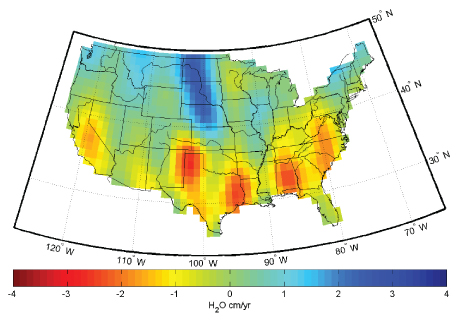
    GRACE data map

    GRACE data paint a striking portrait of regions in which U.S. freshwater reserves (largely groundwater) have increased (blue) or decreased (red) since 2003. Areas of concern include California’s Central Valley, the southern High Plains Aquifer, drought-stricken areas in the South, and the Upper Missouri River Basin region. Image courtesy of Jay Famiglietti and Caroline de Linage, UC Irvine.

    GRACE data also reveal shrinking aquifers beneath the North China Plain, North Africa, southern Europe and a quintuplet of hot zones in the United States. In a new analysis of total U.S. freshwater storage — all the surface water, snow, soil moisture and groundwater in the land — GRACE reveals five areas where groundwater pumping far outstrips the ability of aquifers to recharge. Some are well known: California’s Central Valley, the southern High Plains Aquifer and Houston. Others, tucked into some of the nation’s wettest corners, come as a surprise: a wide swath of Virginia and the Carolinas, and almost all of Alabama — home to Mobile,  the rainiest major city in the continental U.S. While the groundwater losses in other parts of the world are spread across much larger regions, Famiglietti warns that America’s hot spots “are right up there with the Middle East and India in terms of the rates of depletion.”

    Exploited Aquifers

    Trying to comprehend Earth’s groundwater is like trying to fathom all the information on the Internet. And like the Internet, groundwater gives rise to a considerable amount of misinformation — from books that leave readers thinking of aquifers as “underground rivers” to the EPA’s public Twitter feed, which not long ago repeated the common myth that the Great Lakes hold one-fifth of all the world’s freshwater reserves.

    Surface waters are just the hyperlinks — mostly connected, but not always — to vast and layered stores of freshwater below ground.In reality, groundwater does not flow so much as seep through porous rock, clay or sand aquifers, built up over millions of years under most of Earth’s land. And while it’s true that the Great Lakes hold one-fifth of the world’s fresh, unfrozen surface water, all the freshwater we see — rivers, streams, lakes and wetlands — is a tiny fraction of all freshwater, less than 1 percent. Surface waters are just the hyperlinks — mostly connected, but not always — to vast and layered stores of freshwater below ground.

    Throughout human history, this largely invisible water acquired a great mysticism as it bubbled up in wells and springs, sometimes deep and other times shallow, sometimes icy and other times hot. Its witching nature remains so enduring that the United States has a vigorous Society of Dowsers, and children still toss pennies into fountains to make a wish.

    In a famous ruling in 1861, the Ohio Supreme Court codified the mystery when it declared the movement of water underground “so secret, occult and concealed” that it would be “practically impossible” to regulate. The case led to widespread adoption of the English common law rule of “absolute ownership” for groundwater in the United States, still practiced in some parts of the nation, such as Texas with its law of the biggest pump: Landowners could pump as much as they wanted from their own property, regardless of harm to neighboring wells and ecosystems.

    While states including Texas and nations have made some attempts to manage groundwater in the 150 years since, the biggest pump represents the cardinal problem for groundwater in the U.S. and around the world. Aquifers may be mysterious, but they’re not magic. Despite their vastness, they cannot maintain water if the rate of pumping exceeds that of recharge.

    The most-exploited aquifers in the world are those in major agricultural regions that are slow to recharge. These include the Central Valley and High Plains in the United States, the Nile Delta of Egypt, and the Upper Ganges of India and Pakistan. A stress index published in 2012 in the journal Nature found that 20 percent of the world’s aquifers are being overpumped, some massively so. The researchers, from McGill University in Montreal and Utrecht University in the Netherlands, found the Upper Ganges is being pumped more than 50 times its ability to recharge.
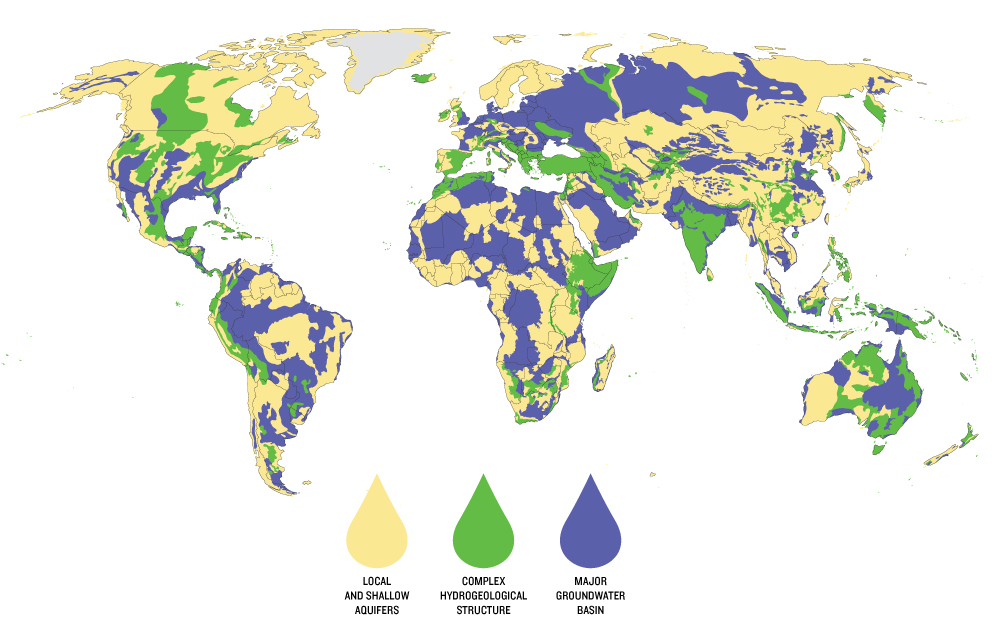
    Just as the distribution of lakes and rivers varies around the world, so too does the distribution of aquifers.  Major basins (purple) hold abundant, relatively easily extracted groundwater.  More complex basins (green) might contain multiple aquifers separated by impermeable rock or have layers of saltwater as well as fresh. Local and shallow aquifers provide only limited quantities of water. Map created by Peder Engstrom and Kate Brauman of the Institute on the Environment's Global Landscape Initiative. Data provided by BGR & UNESCO (2008): Groundwater Resources of the World 1 : 25 000 000. Hannover, Paris.
    Just as the distribution of lakes and rivers varies around the world, so too does the distribution of aquifers. Major basins (purple) hold abundant, relatively easily extracted groundwater. More complex basins (green) might contain multiple aquifers separated by impermeable rock or have layers of saltwater as well as fresh. Local and shallow aquifers provide only limited quantities of water. Map created by Peder Engstrom and Kate Brauman of the Institute on the Environment’s Global Landscape Initiative. Data provided by BGR & UNESCO (2008): Groundwater Resources of the World 1 : 25 000 000. Hannover, Paris.

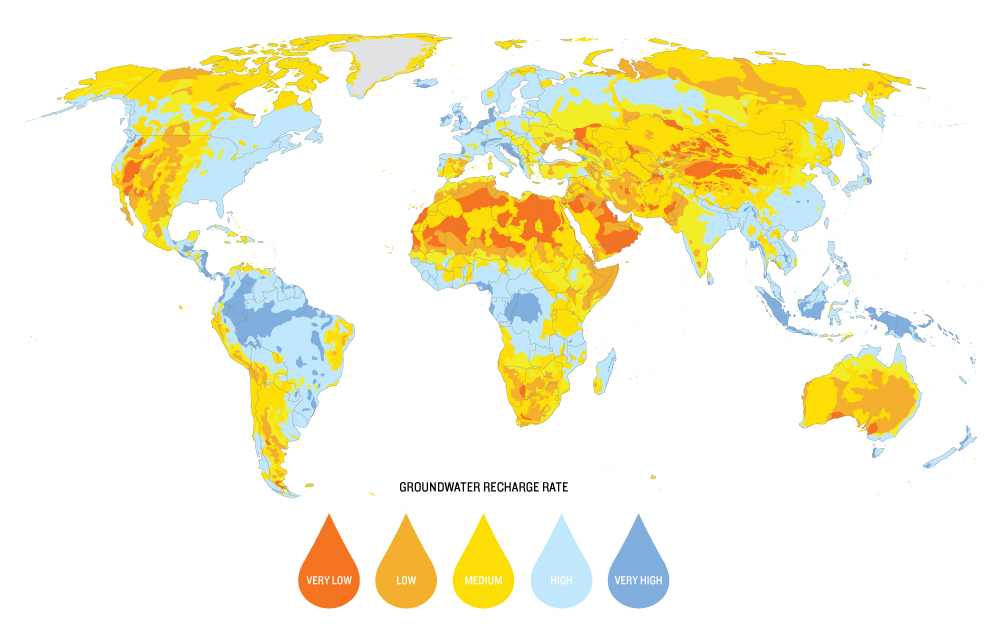
    The rate at which rain, snow and surface waters are able to replenish groundwater varies tremendously from one place to another, mostly due to geology and climate. Along with aquifer size and type, the recharge rate determines the extent to which groundwater can be sustainably withdrawn for human use. Map created by Peder Engstrom and Kate Brauman of the Institute on the Environment's Global Landscape Initiative. Data provided by BGR & UNESCO (2008): Groundwater Resources of the World 1 : 25 000 000. Hannover, Paris.

    The rate at which rain, snow and surface waters are able to replenish groundwater varies tremendously from one place to another, mostly due to geology and climate. Along with aquifer size and type, the recharge rate determines the extent to which groundwater can be sustainably withdrawn for human use. Map created by Peder Engstrom and Kate Brauman of the Institute on the Environment’s Global Landscape Initiative. Data provided by BGR & UNESCO (2008): Groundwater Resources of the World 1 : 25 000 000. Hannover, Paris.

    Scientists fear climate change and associated drought will worsen the picture. “With surface water disappearing because of climate change, groundwater increasingly becomes the water of necessity,” says Oregon State University professor Michael Campana, a hydrogeologist who has studied groundwater management for four decades. “It’s a problem for aquifers, and a potential conflict for people.”

    Using Less, Banking More

    The solutions to overdrawn aquifers are similar to those for overdrawn bank accounts. Foremost is reining in overconsumption. Cities and farmers alike have shown that we can live with less water. Facing severe groundwater depletion in the 1980s, residents of Tucson, Ariz., have managed to reduce their daily Big Gulp from 200 gallons per person in 1985 to 130 gallons today. At the same time, the city has transitioned away from mining the aquifer as its primary source. Three-fourths of Tucson’s water supply in 2003, groundwater now accounts for less than half — with the remainder drawn from the Colorado River and reclaimed sewer and industrial sources.

    From the coastal plains of India to the High Plains of Kansas, meanwhile, some farmers are proving the power of local solutions. In Andhra Pradesh on India’s southeastern coast, a project to put groundwater data and management into the hands of local farmers has led to reduced use — through diversified crops and water-saving irrigation — with no reduction to profit. Following a package of water management bills that passed the Kansas Legislature last year, irrigators in a section of the Northwest Kansas Groundwater Management District have approved a self-imposed 20 percent reduction in pumping from their shrinking aquifer in exchange for more flexibility in the way they use their water rights.

    Replenishing aquifers is another potential solution. This summer, Georgia is testing a technological peace offering known as ASR — Aquifer Storage and Recovery — in its 20-year water war with Florida and Alabama. The idea is to drill a well into the Floridan Aquifer that underlies the region and draw water from it in rainy times, storing the extra water deeper underground. In dry seasons when farmers fire up their pumps and the region’s streams and rivers begin to choke, the reserved water would be drawn back up into the Floridan Aquifer to help increase the flow.

    The idea of replenishing aquifers “is going to be vitally important here and around the globe” as aquifers continue to decline and as massive reservoirs fall out of favor due to costs and evaporative losses.Georgia officials hope their demonstration will prove the potential of a water-sharing plan. But environmentalists worry the region hasn’t done nearly enough to reduce water demand. And ASR isn’t always an option. While an estimated 1,900 ASR wells operate in the U.S., some aquifers are too prone to contamination for the technology to be used.

    David Pyne of ASR Systems, who is designing the Georgia project, says the idea of replenishing aquifers “is going to be vitally important here and around the globe” as aquifers continue to decline and as massive reservoirs fall out of favor due to costs and evaporative losses. Saudi Arabia is using aquifer storage to bank desalinated water during periods of low use and pump it back up when demand is high. Orange County, Calif., has a different twist. Its Groundwater Replenishment System purifies wastewater that used to dump into the Pacific Ocean, shoots it down into the aquifer, then uses it over and over again. The cycle requires far less energy than importing water from northern California or desalinating water from the sea.

    Of course, any technology is only as good as the people and institutions managing the water. Aquifers storing injected water can be overtapped as readily as those holding native groundwater. Places such as California with scant statewide groundwater regulation can see the resource well managed in Orange County and exploited in the Central Valley, where overpumping continues to deplete aquifers, sink land and degrade water quality.

    Tough Decisions

    Ultimately, solutions hinge more on leadership and ethics than pipes and pumps — and willingness to make tough decisions on behalf of the future. In some areas, for example, “we should consider retiring groundwater pumping,” Campana says. “It’s time to ask ourselves: Is it worth it to mortgage our future water supply to grow alfalfa?”

    In Texas, economic incentives have helped convert irrigated cotton crops to native grasslands — in some cases funded by third-party businesses as a mitigation credit. When it comes to food, agricultural researchers predict dryland farming will become crucial to meeting the production demands of a growing world.

    Geopolitical cooperation is the next act on an international stage that has featured shared Water has more often been a source of international cooperation than of war.rivers, but paid less attention to shared aquifers such as the Upper Ganges, which irrigates crops in both India and Pakistan. Argentina, Brazil, Paraguay and Uruguay have taken the unusual step of signing a transboundary agreement on the Guarani Aquifer before any conflicts have arisen; the plan is the first under the United Nations’ new Law of Transboundary Aquifers.

    The real test is whether people already in conflict can come to share and restore aquifers. Contrary to conventional wisdom, the Pacific Institute, which has tracked water conflict throughout human history, found that water has more often been a source of international cooperation than of war.

    Crunching his satellite data, UC Irvine’s Famiglietti hopes the clear new science on aquifers once considered “secret, occult and concealed” will help lead to sustainable groundwater management as depletion becomes impossible to deny.

    “We can now see the aquifer being depleted, the river basin running out of water, even unauthorized releases,” he says. A range of answers — technological, civil, policy and legal — are all “very much within grasp with vision and leadership. Inaction is not an option.”  View Ensia homepage

  • Population boost highest in region ( GUNNEDAH )

    Thursday September 5, 2013
    Larger / SmallerNight Mode

    Population boost highest in region

    Sept. 5, 2013, 1:30 p.m.

    New figures released by the Australian Bureau of Statistics show that Gunnedah was the fastest growing town between 2007 and 2012, with a population increase of 6.1 per cent.

    The town saw a jump in numbers from 11,879 in 2007, to 12,598 in 2012.

    It edged out Tamworth as the fastest growing regional town in the North West, which saw a six per increase from 55,607 to 58,922.

    Narrabri experienced a 1.3 per cent increase in the last five years, while Moree saw a decline of 0.1 per cent.

    Gunnedah Mayor Owen Hasler said the results reflects predictions as far back as the early 1980s where Gunnedah was earmarked as the “preferred location and residential site for most of the permanent workforce related to the extractive industries which are established in the area”.

    “I believe that these latest figures reflect that view and the fact that a large amount of the service industries and associated industry centring on Gunnedah as increased mining activity takes place,” Cr Hasler said.

    “This is reflected in the record house and unit building activity we have experienced over the last two years with over 75 in both years with approximately eight duplexes/units being presently built in one street alone (Silversmith Street) which demonstrates that response to the rapid growth in population.

    “With the large project at Maules Creek, the re- employment of a further 70 workers at Idemitsu’s Boggabri Coal, and the likely commencement of the Shenhua Watermark operation in 2015, I would expect this trend to continue for the foreseeable future,” Cr Hasler concluded.

    Save today
    • 1.5kW Solar System

      (6 panels)

      Save up to $1,147.

      with solar incentives.

    • 3.0kW Solar System

      (12 panels)

      Save up to $2,294.

      with solar incentives.

    • 5.0kW Solar System

      (20 panels)

      Save up to $3,811.

      with solar incentives.

    Local News

    Namoi Valley Independent Local News

    Featured News

    Key water issues

    Key water issues

    EXTRACTIVE industries and the effects on the water table, as well as changes to the Murray Darling Basin …  0 Comments

  • Rather than choosing the least worst option… Inbox x

    1 of 4
    Why this ad?
    Financial HardshipFoxSymes.com.au – As seen on Today Tonight Eliminate debt fast. Free consultation today.

    Rather than choosing the least worst option…

    Inbox
    x
    Blair Palese, 350.org Australia <australia@350.org>
    4:45 PM (1 hour ago)

    to me
    Images are not displayed. Display images below – Always display images from australia@350.org

    Dear Friend,

    Frustrated with the prospect of voting for the least worst choice at the upcoming election?

    What happened to voting for something rather than against something? How is it that, despite the best efforts of so many, both inside and outside of politics, action on climate change is proceeding at a glacial pace?

    Our expectation was that our leaders would address our big national problems but right now that doesn’t seem to be the case. It’s clear that it’s up to those of us who care about issues such as climate change to drive the change we need. 

    This election, rather than choosing the least worst option, let’s make an active choice. Let’s choose candidates for what they stand for. Up to 9% of people don’t decide who they will vote for until they get to the polls so, over the next 48 hours, let’s actively reach out to those around us and discuss the issues we know will have the biggest impact this year and in the decades to come.

    If you’re looking for information to guide your conversations and your vote, there are a stack of fantastic organisations and resources out there, including:

    • WWF’s Election Scorecard on how the parties rate on Reef protection and climate change
    • Care2’s overview of the challenges Australia faces going into the election
    • The Climate Institute’s Pollute-o-Meter which ranks the major parties’ policy responses to climate change
    • The Australian Youth Climate Coalition’s analysis of how the parties stack up
    • Solar Citizen’s solar scorecard which shows where your MP or candidate stands on renewable energy
    • Vote Climate’s summary of where the major party’s stand on climate
    • This article by Professor Ian Lowe on the urgent environmental issues that should be at the forefront of our minds as we head to the polls

    It’s inspiring to see how many of you have been working so hard to put climate change squarely on the political radar. For all you’ve done and all you will do, thank you so much!

    And for all the frustration we’re currently feeling about how this election is panning out, let’s channel it into positive action for the months ahead!

    Yours for a bright future,