Category: Uncategorized

  • Who are you really voting for in the Senate?

    Who are you really voting for in the Senate?

    Posted 15 minutes ago

    Senate preferences can easily leave you unwittingly voting for parties or policies you oppose, but any changes to this system rely on those who were elected by it, writes Anthony Pink.

    We are now past the deadline for the lodgement of preference tickets for the Senate.

    The week that leads up to that point is usually one of the most chaotic times behind the scenes for political parties and candidates as furious calls and demands are made, deals are made and broken, and political strategy is pitted against ideology in a battle to be above the competition.

    It’s also where the realities of representative democracy come under the most scrutiny, for the least benefit to the voting public, and the outcomes this time were as disappointing as ever.

    Take the Queensland preferences flows as an example. If you believe strongly in protecting Australian industry and breaking up monopolies, you may think a Senate vote for Katter’s Australia Party would be a good choice. But you would be wrong, as the free-trade-leaning ALP got second preferences.

    Thinking of voting for one of the interest groups? Even that can be problematic; for example, the Animal Justice party, a group you would suspect would favour the Greens, are dealing preferences to One Nation, who don’t rate environmental issues highly.

    Of the 36 groups on the ticket, only seven have any sort of regular coverage in the media. The remainder of those parties have shied heavily away from left, environmental and even libertarian interests, preferencing the LNP, KAP and ONP, and often using deliberately deceptive or irrelevant naming to direct votes against the original voter’s intentions.

    One deal that got a lot of attention was the WikiLeaks deal in Western Australia in which long-term supporter of Julian Assange and campaigner on digital freedoms, Senator Scott Ludlum, was placed below the Nationals on their Senate ticket, dealing a further blow to Ludlam’s chances for re-election.

    I suspect that WikiLeaks does not think any National party member will stand up for digital rights more than Ludlum, but that is not what the deal is about. WikiLeaks would probably have to poll better than the Greens in WA to have a chance of winning a seat; National preferences would then allow them to make it to later counts after the Nationals elect their members.

    This is the divide between ideology and strategy that makes us all cringe when we hear the outcomes of preference deals.

    But what if it wasn’t like that …

    How do Senate preferences work?

    • Senate candidates must reach a “quota” of votes to be elected.
    • This quota is determined by dividing the total number of formal ballot papers by one more than the number of senators to be elected and then adding ‘one’ to the result.
    • Candidates who reach their “quota” through first preference votes are elected. Their excess votes are transferred to other candidates based on preferences.
    • If any seats are not yet filled following this process, unelected candidates are excluded from the count, starting with those that received the fewest votes. Their preferences are distributed until all seats are filled.
    • People who vote “below the line” choose their own preferences. By voting above the line, people allow their selected party to choose their preferences for them.

    Source: Australian Electoral Commission.


    A statement of preferences is actually about you as a voter. It allows you to show who your top choices are; if your first option is not going to make it, your vote can be reallocated to someone knowing that while they aren’t your first choice, you would like that candidate more than the alternatives.

    In the Senate, however, a vote above the line allows parties to have the choice on where your vote will go. The parties know that most people will vote above the line rather than number all 82 (in Queensland) boxes below the line, and take the risk that their vote will be made invalid if they make a serious numbering error.

    Even armed with the information that is available through the AEC, a few good blog posts, articles and party materials (potentially biased as they are), it becomes almost an impossible nightmare for all but the most prepared to show their preferences on the largest possible Senate ballot with the smallest possible fonts.

    There are many approaches to fixing this issue, like allowing for full or partial optional preferences below the line, or allowing for a full preference above the line, which would give the power to preference back to the voter.

    We could change the way votes are counted; we could introduce a Condorcet system like the schulze method where each candidate is compared against every other candidate after a distribution of preferences, or introduce a borda count, where based on the preference given, the candidate gets a certain amount of ‘points’ (similar to the way championship points are given in motorsports).

    These are certainly only ideas, and I am not advocating (or discounting) any in particular, but if we believe in a healthy debate about our democracy we should consider our options. Unfortunately the decision to change the system rests with the people who are elected by it, and in the case of parties that have on and off ruled for over a century, there is considerable risk to their fortunes and little to gain. It makes true reform a much more difficult task.

    How the public achieves the sort of change that puts them at the negotiating table on issues of importance is a topic for another day, but there is something to take away from this.

    Our preferences should not be the bargaining chips of any party, and I would be suspicious of anyone willing to use them in a way you didn’t intend. Knowledge and preparation is your best defence for this election, but we also have to get serious about what democracy means and ensure that preferences meet that goal.

    You always have a right to choose: don’t throw it away.

    Anthony Pink is an Information Technology expert, democracy policy contributor, and regular returning officer for internal elections within the Queensland Greens. Follow him on Twitter @anthonypinkgr. View his full profile here.

    Topics: federal-elections

  • Methane found in Rajasthan, to power Jaipur, economy

    Methane found in Rajasthan, to power Jaipur, economy

    Sunday, Aug 18, 2013, 11:51 IST | Place: Jaipur | Agency: DNA

    Deposits of Methane have been discovered in at least a dozen places in Bikaner, Barmer-Sanchore basin during the ongoing exploration work signaling abundance of this precious gas in the state.

    The exploration work in Ranasar in Bikaner has revealed that Methane exists in the lignite coal belts in several blocks in Bikaner, Barmer and Sanchore.

    Methane is usually used as an energy source. Methane is widely used in making fuel, steel production and as fuel in its natural gas form. It can also be used to create electricity. In industries it is also used as an ingredient for making ammonia, ethanol etc.

    Currently the exploration work is going on in Ranasar and the agencies involved in exploration have identified at least 3 blocks in which there exists a massive potential of Methane extraction. The discovery is expected to lead to exploration activities soon.

    The relative abundance of methane makes it an attractive fuel worldwide. Notably, the state government has also started getting financial aid from Oil Industry Development Board to help and expedite the exploration of this gas from the state. Officials in the department of petroleum informed dna that OIDB has given a grant of Rs3.72 crore for exploration of this gas.

    “The project Coalbed Methane Research and Development  – Rajasthan is in progress,” an official of the petroleum department said.

    Previous
    Next

  • “We Have a Planetary Emergency” Hansen, Leading NASA Climate Scientist, Urges Unions to Act

    “We Have a Planetary Emergency” Hansen, Leading NASA Climate Scientist, Urges Unions to Act

    By

    admin

    October 31, 2012Posted in: Action Alerts, News and Analysis, Uncategorized

    October 23 2012

    ILR News Center


    “… there is a danger that the ice sheets will begin to collapse and we could get several meters (of rising sea levels) in one year – which would be disastrous,” – James Hansen


    JamesHansen_webThe world’s most well-known climate scientist, James Hansen of NASA’s Goddard Institute, addressed 75 union leaders and allies at a global trade union roundtable in New York City this month.

    Entitled “Energy Emergency, Energy Transition,” the event was convened by ILR’s Global Labor Institute (GLI), part of the new Worker Institute at Cornell. The Rosa Luxemburg Foundation’s New York City office partnered with GLI in organizing the Oct. 10-12 event.

    “The truth is, we have a planetary emergency,” Hansen said. Union representatives from 18 countries listened in silence as Hansen described what is happening to the earth’s climate, ice sheets, oceans and weather patterns.

    Hansen’s presentation can be seen at http://www.youtube.com/watch?v=-dbmqhon5TY.

    “The volume of Arctic sea ice has been reduced by 75 percent in just 30 years. Greenland’s ice sheet is losing mass at about 300 cubic kilometers per year. Sea levels are going up, and there is a danger that the ice sheets will begin to collapse and we could get several meters (of rising sea levels) in one year – which would be disastrous,” Hansen said.

    “The frequency of extreme weather events is changing because the planet is getting warmer. It was exceedingly hot this past summer, and the frequency and area covered by these events are both increasing.”

    “We have only burned a small fraction of the fossil fuels, but we can not burn all of them. And yet the governments are going right ahead, encouraging even more use of fossil fuels through mountain top removal, tar sands, tar shale, drilling in the Arctic. We can’t do that if we want to be fair to our children.”

    Solutions for the climate problem and for our children’s futures are really going to depend on workers understanding the situation, he said.

    “It’s hard to communicate with people if they feel their job is threatened, but the jobs associated with clean energy technologies would be good jobs. Workers will get much better opportunities. We need to have cooperation and understanding between labor and environmental organizations and people who are concerned about the future of their children.”

    In an interview following the presentation, Hansen said, “Unions are an important force globally. They represent hundreds of millions of workers and their families. The thought of having them joining in the effort to bring about an energy revolution to fight climate change is very exciting. Stabilizing the climate is a battle for survival that needs everyone involved.” Hansen said he was speaking as a citizen, and not a NASA employee.

    In his talk, Hansen urged that a price be placed on carbon emissions at source. This, in turn, he said, would unleash the development of clean and renewable energy, energy conservation and next-generation nuclear power, which Hansen regards as an important option in the global effort to reduce global warming pollution.

    Hansen’s policy proposals sparked a spirited debate among the attendees. Union representatives from Latin America and South Africa questioned whether pricing carbon should be the main solution, given the capacity of the fossil fuel companies to control the political debate.

    Energy unions from Canada, Nigeria, Trinidad and Tobago, and Russia echoed Hansen’s call for unions to be part of the solution to climate change and to seize the opportunities to build unions and create jobs.

    Others addressing the international group included leading commentator James Gustave Speth, a professor at Vermont Law School; Wenonah Hauter, executive director of Food and Water Watch; and Robert Howarth, a Cornell scientist concerned with the global warming effects of methane leakage from “fracking” for shale gas.

    More information about the roundtable, including participants, presentations and trade union statements on climate change and energy, is available at
    http://energyemergencyenergytransition.org/.

    About admin

  • World Ocean currents

    Ocean currents

    Apr 3, 2013 by

    Ocean currents

    Introduction:

    ocean current is a ongoing, instructed activity of sea water produced by the causes performing upon this mean circulation, such as splitting waves, wind, Coriolis impact, cabbeling, heat range and salinity variations and tides brought on by the gravitational take of the Moon and the Sun. Detail shapes, coastline options and connections with other voltages impact a current’s route and durability. Ocean currents can circulation for great distances, and together they create the excellent circulation of the international conveyor belt which performs a prominent part in identifying the environment of many of Planet’s areas.

    Function:

    Ocean currents are generally wind-driven and develop their common clockwise spirals in the north hemisphere and counter-clockwise spinning inAn image dispalying the ocean_currents the southeast hemisphere because of the enforced breeze pressures. In wind-driven currents, the Ekman spiral effect results in the currents streaming at a position to the driving gusts of wind. The areas of surface ocean currents move somewhat with the seasons; this is most significant in equatorial currents.

    Ocean sinks generally have a non-symmetric surface current, in that the southern equator ward-flowing division is wide and dissipate whereas the European poleward-flowing division is very filter. These European border voltages are a consequence of basic liquid characteristics. Deep ocean voltages are motivated by solidity and temperature gradients. Thermohaline movement, also known as the ocean’s conveyor belt, represents the strong ocean density-driven ocean basin currents. These voltages, which flow under the outer lining area of the water and are thus invisible from immediate recognition, are known as submarine rivers. These are currently being investigated using a navy of marine spiders known as Argo. Upwelling and down welling places in the sea are places where significant vertical movement of ocean water is observed.

    Surface currents make up about 10% of all the water in the sea. Surface currents are generally restricted to the upper 400 m (1,300 ft) of the sea. The movement of strong water in the ocean basins is by solidity driven forces and severity. The solidity difference is a function of different temperature ranges and salinity. Deep waters permeate the strong sea sinks at high permission where the temperature ranges are cold enough to cause the solidity to increase.

    Related Posts

    Tags

    Share This

  • AUSTRALIAN OCEAN CURRENTS

    Ocean Currents in Australia

    Spending a day by the sea you may notice some ocean currents at work, such as localised rips or larger-scale tidal movements. Currents in the ocean can be quite complicated and may be driven by wind, temperature differences, water densities or tides.

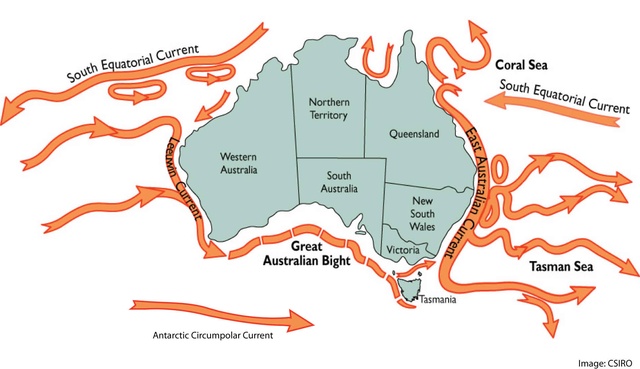
    The main currents around Australia, pictured left, include the East Australian Current (EAC), Leeuwin and Antarctic circumpolar currents (Image: CSIRO).

    What affects the movement of water in the ocean? If you think of a current flowing in a river, the direction of the current is effectively downhill with gravity causing the water to flow along a path of least resistance into a lake or the ocean. Does the sea work like a river?

    Spending a day by the sea you may notice some ocean currents at work, such as localised rips or larger-scale tidal movements. Currents in the ocean can be quite complicated and may be driven by wind, temperature differences, water densities or tides.

    There are four major currents in Australian waters: the East Australian Current (EAC), the Leeuwin, the Antarctic Circumpolar Current and the Indonesian Throughflow.

    East Australian Current:

    The EAC moves southward from near Fraser Island in Queensland to the eastern shores of Tasmania. Remember the movie Finding Nemo? The EAC is the current that helped Marlin find his way to Sydney. The EAC is usually stronger in summer, when it reaches further south, often bringing with it northern tropical species such as tuna.

    Leeuwin and Zeehan Current:

    Beginning about mid-way down the Western Australian coast, the Leeuwin Current flows south-east across the Great Australian Bight and reaches the west coast of Tasmania as the Zeehan Current. This current is strongest in winter when it has been recorded travelling south, rounding the southern coast and travelling north again as far as Freycinet Peninsula (eastern Tasmania).

    Antarctic Circumpolar Current:

    A third current system, the Global Conveyor Belt, originates in the southern ocean as the Antarctic Circumpolar Current. This is an ocean current created by density and temperature variations in the water, (thermohaline circulation). Thermohaline describes currents that are the result of differences in temperature (thermo) and salinity (haline). As the Antarctic water begins to freeze, very cold and salty water is left behind. The density of this water becomes quite high and it sinks below the surface (euphotic zone), deep into the ocean, and moves toward the equator. Eventually this water will warm, and as it does, it rises to the surface bringing with it nutrients from the deep.

    The Indonesian Throughflow:

    This current brings warm water from the Pacific to the Indian Ocean via Indonesia. This is unique because it is the only area in which warm water from the equator flows from one ocean to another. It is an important source of heat transport to the Indian Ocean.

    Links and further Information:

    CSIRO currents showing the latest maps http://www.cmar.csiro.au/remotesensing/oceancurrents/

    CSIRO animation of the currents circumnavigating Australia http://www.cmar.csiro.au/currents/animations.htm

    Integrated Marine Observing System: http://oceancurrent.imos.org.au/

    CSIRO website Australasian ocean currents fact sheet: http://www.csiro.au/resources/AustralasianOceanCurrents.html

    http://www.csiro.au/en/Outcomes/Climate/Understanding/AustralasianOceanCurrents.aspx

    Seas at the Millennium: An Environmental Evaluation, The Tasmanian Region CH 95, Ed C.Sheppard

    Hobday, A. J., E. S. Poloczanska, and R. J. Matear (eds) (2008). Implications of Climate Change for Australian Fisheries and Aquaculture: a preliminary assessment. Report to the Department of Climate Change, Canberra, Australia. August 2008.

  • SF Bay Area building demolition fuels quake study

    SF Bay Area building demolition fuels quake study

    • Like
    • Dislike
    Associated Press

    MIHIR ZAVERI 3 hours ago Nature
    Workers walk away from Warren Hall on the California State University, East Bay Hayward Campus Thursday, Aug. 15, 2013, in Hayward, Calif. The 13-story Warren Hall, which opened in 1971, was determined by the California State University Seismic Review Board to be the most vulnerable building in the CSU system, and will be demolished on Saturday, Aug. 17, 2013. (AP Photo/Ben Margot)

    .View gallery

    • .
    • .

    HAYWARD, Calif. (AP) — Every time the ground trembles in the San Francisco Bay Area, people ask themselves: Could this be the big one?

    For years now, the region has been bracing for a major earthquake that many worry could level vulnerable schools, hospitals and apartment buildings and unleash near-apocalyptic chaos. The U.S. Geological Survey estimates there is a 63 percent chance of a major earthquake in the region within the next three decades.

    On Saturday, scientists hope to get one-up on the looming temblor, courtesy of the demolition of a university building.

    Workers plan to implode the 13-story Warren Hall, a fixture of the East Bay hillside and of Cal State East Bay, which was built about 2000 feet from what researchers call one of the most dangerous fault lines in the country: the Hayward fault.

    The building is expected to crumple into 12,500 tons of concrete and steel, which will slam against the ground sending out shockwaves similar to a magnitude-2.0 earthquake. Scientists have placed more than 600 seismographs in concentric circles within a mile of the building to pick up the vibrations.

    View gallery.”

    United States Geological Survey Physical Science technician …

    United States Geological Survey Physical Science technician Coyn Criley installs seismographs Thursd …

    USGS scientists hope the unique experiment will help map out where the ground might shake the most when the big one hits.

    “We’re just getting an idea of the distribution of the shaking,” said Rufus Catchings, the lead USGS scientist on the project.

    Many vividly remember the magnitude-6.9 Loma Prieta earthquake in 1989 that killed 63 people, injured almost 3,800, caused up to $10 billion damage, including a collapsed freeway that killed dozens of drivers. That quake was centered near Santa Cruz, about 50 miles south of here.

    But in the East Bay, the Hayward fault — which runs through East Bay cities and under the University of California, Berkeley’s football stadium — is the most likely to act up and cause a major earthquake in the next few decades, experts say.

    The last major temblor on the Hayward fault was in 1868, Catchings said. He said the fault triggers a major earthquake every 140 years on average.

    View gallery.”

    United States Geological Survey research geophysicist …

    United States Geological Survey research geophysicist Rufus Catchings gestures as he holds a seismog …

    And it’s not just the fault line residents have to worry about. Additional fault lines —called traces — split off from the main fault, and the location of many is unknown. The vibrations set off by Warren Hall’s implosion will help scientists figure out where they are.

    “In the event of a large earthquake, oftentimes it’s not just one break in the ground, it’s spread out over some distance,” Catchings said. “You’d kind of like to know where all these things are if you really want to understand the hazard.”

    Mark Salinas, Hayward’s mayor pro tem, said knowing where the ground shakes will help the city decide where to put new housing and other buildings. “This data, when it’s available, will inform us on future development,” he said.

    The idea to use the building’s demolition came from Luther Strayer, a geology professor at the university who called the USGS to see if they would be interested.

    “Anybody in my position who is trained like I am would have recognized the opportunity,” Strayer said. “That’s really the cool part; it was sort of a simple obvious thing to do.