Category: Uncategorized

  • Sea Level Rise ‘Locking In’ Quickly, Cities Threatened

    Sea Level Rise ‘Locking In’ Quickly, Cities Threatened

    • Published: July 29th, 2013
     15.8K  1926  4983  79

    Repost This

    To embed this interactive, click the preferred size for the code: 700 x 559 | 500 x 399


    By Ben Strauss
    ANALYSIS

    Measurements tell us that global average sea level is currently rising by about 1 inch per decade. But in an invisible shadow process, our long-term sea level rise commitment or “lock-in” — the sea level rise we don’t see now, but which carbon emissions and warming have locked in for later years — is growing 10 times faster, and this growth rate is accelerating.

    An international team of scientists led by Anders Levermann recently published a study that found for every degree Fahrenheit of global warming due to carbon pollution, global average sea level will rise by about 4.2 feet in the long run. When multiplied by the current rate of carbon emissions, and the best estimate of global temperature sensitivity to pollution, this translates to a long-term sea level rise commitment that is now growing at about 1 foot per decade.

    We have two sea levels: the sea level of today, and the far higher sea level that is already being locked in for some distant tomorrow.

    In a new paper published Monday in the Proceedings of the National Academy of Sciences (PNAS), I analyze the growth of the locked-in amount of sea level rise and other implications of Levermann and colleagues’ work. This article and its interactive map are based on this new PNAS paper, and they include extended results.

    To begin with, it appears that the amount of carbon pollution to date has already locked in more than 4 feet of sea level rise past today’s levels. That is enough, at high tide, to submerge more than half of today’s population in 316 coastal cities and towns (home to 3.6 million) in the lower 48 states.

    By the end of this century, if global climate emissions continue to increase, that may lock in 23 feet of sea level rise, and threaten 1,429 municipalities that would be mostly submerged at high tide. Those cities have a total population of 18 million. But under a very low emissions scenario, our sea level rise commitment might be limited to about 7.5 feet, which would threaten 555 coastal municipalities: some 900 fewer communities than in the higher-emissions scenario.

    To develop such figures, I combined my sea level debt findings with analysis from Climate Central’s Surging Seas project, which is a national assessment and mapping of coastal vulnerability in the U.S. based primarily on elevation and census data.

    A quick tour of the interactive map on this page shows that Florida is by far the most vulnerable state under any emissions scenario. Louisiana, New Jersey and North Carolina would also face enormous difficulties. If we call a place “threatened” when at least half of today’s population lives below the locked-in future high tide line, then by 2100, under the current emissions trend, more than 100 cities and towns would be threatened in each of these states.

    Nationally, the largest threatened cities at this level are Miami, Virginia Beach, Va., Sacramento, Calif., and Jacksonville, Fla.

    If we choose 25 percent instead of 50 percent as the threat threshold, the lists all increase, and would include major cities like Boston, Long Beach, Calif., and New York City. The lists shrink if we choose 100 percent as the threshold for calling a community “threatened.”

    But each fraction is arbitrary, and true critical levels will depend on geography and economics. Some places when partly or wholly below sea level may be defensible, at least to some degree — like New Orleans with its network of levees and flood barriers. Other places may be indefensible with well under 25 percent of exposure. For example, South Florida will be very difficult to protect, due in large part to the porous bedrock underlying it.

    Overall, this analysis does not account for potential engineering solutions; it is based simply on elevations.

    The low-emissions scenario could reduce impacts substantially — by almost threefold — but is profoundly ambitious compared to current trends and policy discussions. It includes a halt to global emissions growth by 2020, followed by rapid global emissions reductions, and a massive program to remove carbon from the atmosphere, resulting in net negative emissions — atmospheric clean-up — by late in the century.

    The big question hanging over this analysis is how quickly sea levels will rise to the committed levels. Neither Levermann and colleagues’ analysis, nor my new paper, address this question.

    In a loose analogy, it is much easier to know that a pile of ice in a warm room will melt, than to know exactly how fast it will melt.

    Levermann and company do put an upper limit of 2,000 years on how long it will take the sea level commitments described here to play out. Recent research indicates that warming from carbon emitted today is essentially irreversible on the relevant timescales (in the absence of its massive-scale engineered removal from the atmosphere), and will endure for hundreds or thousands of years, driving this long run unstoppable sea level rise.

    On the other hand, our sea level rise commitment may be realized well before two millennia from now. The average rate of global sea level rise during the 20th century was about half a foot per century. The current rate is 1 foot, or twice that. And middle-of-the-road projections point to rates in the vicinity of 5 feet per century by 2100.

    Such rates, if sustained, would realize the highest levels of sea level rise contemplated here in hundreds, not thousands of years — fast enough to apply continual pressure, as well as threaten the heritage, and very existence, of coastal communities everywhere.

    Related Content
    Surging Seas: Sea Level Rise Analysis by Climate Central
    Cutting Short-Lived Pollutants Can Slow Sea Level Rise
    U.S. Airports Face Increasing Threat From Rising Seas
    Rising Sea Level May Trigger Groundwater Floods
    Report: Can U.S. Carbon Emissions Keep Falling?
    Global Emissions Hit Record High, Report Finds
    Stabilization Targets and Irreversible Climate Change
    Two Key Climate Change Topics are ‘Misunderstood’

    Comments

    By Eric Peterson (Front Royal, VA 22630)
    on July 30th, 2013

    “The average rate of global sea level rise during the 20th century was about half a foot per century. The current rate is 1 foot, or twice that”

    It is not valid to compare the current decade average to the past century average because the past century had intervals of higher and lower rises.  For example, the rate from the 1930’s through the 1940’s was also about twice the 20th century average.  Here’s a graph of that: http://en.wikipedia.org/wiki/File:Trends_in_global_average_absolute_sea_level,_1870-2008_(US_EPA).png

    By Kay Mann (Orlando, FL 32807)
    on July 30th, 2013

    my biggest concern/gripe with the global warming talk is that the educated ****** are always trying to make people believe that the problem is ‘man made’ when in fact every planet in our solar system is warming at the same rate as the earth. the common denominator is the sun, not an SUV. anyone who’s ever sat around a camp fire knows that as the flames rise and fall you’ll feel it getting warmer and then cooling. now start paying attention to all the articles about solar activity and you will see images of the flames on the sun leaping out towards the earth and the other planets – there’s your camp fire.

    why do they do it? some actually believe the tripe even though the historical evidence doesn’t support it – make note that many of these same ‘educated’ ****** who are selling global warming now were warning us about the quickly approaching ice age back in the 1970’s. but for most of the so called experts, it’s all about the money (just ask al gore who’s making his fortune jet setting around the world deriding people other than himself for burning fossil fuels). some people in the field have realized that in every grant money application they submit, if they mention the term ‘global warming’ they’ll get a warm reception by those who dole out the money. and why do the governments of the world go along with it? it’s the cash cow of all time. the governments can charge fees, taxes, and surcharges to individuals, companies, and a myriad of processes and no one can audit, regulate, or even argue the action without being labeled or demonized as a “climate change denier.”

    the idea that a Toyota Land Rover is warming up the Earth, Venus, Saturn, and Uranus, is foolishness. these so called experts spout that CO2 is a major greenhouse gas and that it’s causing the oceans to warm up and forests to die off is ludicrous. in fact what is actually happening is that as the SUN heats up the ocean (remember the solar flares), it kills off plant life and microorganisms in the sea which emit or ‘gas off’ CO2 as they decay. the exact same thing occurs when the sun heats up forests or grass lands; CO2 gas does not cause the vegetation to die off – but rather, as the SUN’s solar activity heats up and kills vegetation, as those greens die off they create, gas off, emanate, or give off CO2 gas as part of the decaying process.

    just as the experts were wrong about the coming ice age they ranted about in the 70’s, they’re just wrong about this ‘man made global warming’ spiel. it’s all about the coins, so look out as we’re bowled over by crooked politicians around the world who see the cold hard cash in global warming.

    By Steve Ocean
    on July 30th, 2013

    Global climate change is upon us.

    However, projections with such long timelines, e.g.to 2100, are ludicrous. Regardless of what any model may predict, there is no way to know what is actually going to happen in 87 years.

    Why not?

    Because we humans are the most important variable. The great challenge and opportunity of our age is not just reducing our impact, but pro-active remediation. Just as we can have profound negative effects, we can also have profound positive effects.

    Do we know how to “fix” all our mistakes now? No. Can we learn? We are beginning to now. Will we make the needed changes in time? Maybe. We are only “locked in” to an outcome if can’t or won’t make the needed changes.

    And therein lies the rub with long term predictions. A well balanced climate, a prosperous garden earth that gracefully sustains us all, is also a possibility. In fact, as we can see from these predictions, it is the only acceptable option.

    It will be much better for us to focus on the next 10 years instead of worrying about things at the end of the century. By that time, none of us are going to recognize this place or ourselves anyway, no matter what the climate does.

    By Linda Settle (Atlanta, Georgia 30087)
    on July 30th, 2013

    I don’t care about this being public, but I would REALLY like to understand the maps but I don’t. I am an intelligent person
    but I am just guessing when I look at this map. There’s this light blue outline and dots???

    By Steve O (Arlington VA 22205)
    on July 30th, 2013

    Sacramento?  That can’t be right.  Really?  It’s an inland city.  The text is unclear, however.  Is the reference to a 23 foot rise?  If so, then I can accept Sacramento.  If the reference is to the 7.5 foot rise, then not.

    @Kay Mann – love a good chuckle every day.  Thanks!!
    (Just a tip: It’s always good to make sure you are up to date before spouting stuff off.  It was way back in 2008 that the American Meteorological Society did our homework for us and discovered that scientists were actually NOT predicting an ice age back in the 70’s.  Here’s the paper: http://journals.ametsoc.org/doi/pdf/10.1175/2008BAMS2370.1)

    By Steve O (Arlington VA 22205)
    on July 30th, 2013

    @Steve Ocean
    You are so correct.  The greatest variable in future predictions of climate change is the actions we humans take or don’t.
    Many skeptics/deniers will point out the enormous range of predictions in the IPCC reports as some sort of indication that scientists don’t know squat.  The large range is not because scientists don’t fundamentally understand how CO2, other gases, land use changes and other factors affect the climate.  It’s because they have no idea what our future GHG concentrations will be.  The answer to that is up to us.

    Unfortunately, we seem to be on the path to testing the high end predictions.

    “A well balanced climate, a prosperous garden earth that gracefully sustains us all, is also a possibility. In fact, as we can see from these predictions, it is the only acceptable option.”

    Perhaps it’s a possibility, but I see very little evidence it’s a plausible one.
    Options: Mitigate, Adapt, Suffer.  Those are the three, alone or in combination.  There are no others.

    By Tom Arnold (Lubbock/Texas)
    on July 30th, 2013

    Forget the flood predictions, I am particularly concerned about a term used in this article which was simply glossed over but to would have serious ramifications. Did anyone else notice the term “atmosphere cleaning” as part of the “Deep Cuts” scenario? Yikes, they say it as if it is just some simple task we’ll have to do as part of a broader program.

    By Bill Hilton (94087)
    on July 30th, 2013

    Regarding Sacramento, it is indeed an inland city but the Sacramento River is 10-12 ft above sea level and the river bank about 15-18 ft in front of downtown.  So with a rise of sea level as predicted in the study, the state legislators will be getting their feet wet every day (the capitol building is about 20 ft above sea level now).

    By Gastón (Buenos Aires / Argentina)
    on July 30th, 2013

    could inform the rest of the cities of the world?
    what about Latin American cities?

    By Jim Holm (Kalamazoo, MI, 49009)
    on July 30th, 2013

    Skyscrubber.com is working on a way we can back out of Global Warming.

    By Frazer Kirkman (Eden Hills)
    on July 31st, 2013

    I’d love to see this interactive map, made for the whole world

    By gordon neilson (Skokomish Tribe, Washington 98584)
    on July 31st, 2013

    This is the most severe analysis we have seen to date. In all of the studies we have read concerning sea-level rise we have yet to see any mention of Tribal nations, over 1/2 of Washington State’s Tribes have coastal reservations that will be grossly affected if not devastated by 4’ sea level rise. Why is the case of sea-level rise not inclusive of Tribes who were consigned to these reservations. Although the focus is on municipalities and cities affected I doubt that even their populations have been included in the populations numbers included in this research.

    By Dave (Basking Ridge, NJ 07920)
    on July 31st, 2013

    Regardless of gravitational caveats for high latitudes and absent any discussion of error bars it seems that for most parts of the world, the millennial scale SLR message from this is “more than 4 feet” above current level is fully “locked in” today and this rises to something like 23 feet by 2100 for business as usual.

    Although a message is clearly intended, a millennial timeline provides only an intellectual perspective. Even those that consider themselves long range thinkers may be unperturbed upon reflection. In today’s environment coming up with strategies for how to cope with SLR projections out to 2100 is the natural, immediate and currently challenging human objective. Compared with that, planning for the next few thousand years is a fantasy that amounts to planning a new civilization. If this teaches us something new about the curve on the nearer term then I have obviously missed that point. But for now I can’t see that it does – although academically it is interesting.

    By Byron Rot (Sequim/WA/98032)
    on July 31st, 2013

    The attached website offers better data and insight into the sun is also warming other planets idea Kay raises, see http://www.skepticalscience.com/global-warming-other-planets-solar-system.htm

    By ACMESalesRep (Vancouver)
    on July 31st, 2013

    Kay Mann: You’re wrong. Global warming is man-made – that is what the available evidence tells us. The educated “experts” – that is the word you refused to type, right? – are experts for a reason. They know more than uneducated rubes do. That’s what being an expert entails. You’re merely spouting the same talking points that the oil industry and other special-interest groups with vested interests in denying climate change have used for years to try to divert attention from the actual facts.

    You don’t know more than the experts. Please don’t be so arrogant as to think you do.

    By john werneken (vancouver wa 98661)
    on August 1st, 2013

    So what. 4 million people can move easier than 4 billion can give up progress and prosperity.

    By Robert W Easton (02863)
    on August 1st, 2013

    How did you miss Providence, Rhode Island??  RI is, Ironically, The Ocean State, and much of it would be gone in your worst-case scenario. The coast of Connecticut as well, but neither are in danger on your list

    By Anon (Texas)
    on August 1st, 2013

    Dumb! “So what. 4 million people can move easier than 4 billion can give up progress and prosperity.” The largest percentage of that which produces ‘progress and prosperity’ is also on the ‘sinker’ list.

    By Don (Melbourne, FL, 32935)
    on August 1st, 2013

    Look at this from a scientific point of view.  I have yet to see any model, and all of this is based on modeling, that can be shown as being biase-free.  The creators of the models play with the numbers to make the model produce the result they want.

    Extraordinary claims require solid evidence and while there is evidence for some warming, I have seen no compelling evidence that man-made carbon dioxide is the call.

    By Skeptic (Madison, WI 53217)
    on August 1st, 2013

    This is from the same folks who can’t forecast tomorrow’s weather.  The “experts” have zero credibility, only a huge desire to collect government welfare checks disguised as grants.

    By Doug (Burlingame, CA 94010)
    on August 1st, 2013

    @Kay Mann. I’d posit that there is much more money to be made in being a climate change denying scientist than in being the opposite. Furthermore, the new ice age story from the 70s had legs for about two months, if that.

    By Kevin Cody (64803)
    on August 2nd, 2013

    what about chicago and the great lakes?

    how will snow pack melt affect the great lakes, please?

    By Khannea SunTzu (Voorburg)
    on August 2nd, 2013

    Unless someone develops life extension and rejuvenation treatments why should I give a damn? I’ll be dead by the end of the century.

    Let the unborn deal with this crap. Not my concern.

    By Paul Budline (Princeton)
    on August 2nd, 2013

    “Warmer World Likely to be More Violent,” reads one headline, while another warns of impending Noah-like (or is it NOAA??) flooding.  Am I more likely to be stabbed to death or drown?  Please advise … and quickly!

    Also, when perusing your “Who We Are” section I found myself wondering whether there are any alarmists of color.  Very very monochromatic staff.

    By IQ Matters (San Francisco, CA)
    on August 2nd, 2013

    Another silly, silly misinterpretation of badly accululated data.  Hurry!  Change society to match my beliefs!  If you don’t you will all die.  DIE!  Hurry!  Change!  Give me money to run another biased study!!

    This is nothing but fanatics pushing their religion.

    By Richard A Karlin (Pittsburgh)
    on August 2nd, 2013

    Kay Mann is bothered by the “man made” tag.  It does not matter Kay. If the ice melts, the waters rise and our cities drown (review New Orleans for reference) it is a problem, man made or not. I know of no scientifically vetted data whatsoever that shows any other planet warming. Are you getting this from scientists or from Fox News. In the past, the sun has warmed, and what you describe has happened, but many things can happen in more than one way. One hundred years ago we would not have been able to take an accurate sun temperature. Today we can, and I assure you, it has not gone up in the past few decades.

    In summary, the ice on earth is melting, by observation not by guessing. The CO2 in the atmosphere is rising, by measurement, not by guesses or opinions. We have burned about 1/2 of earth’s oil supply in 50-100 years. These three things fit together in harmony. That is the reality, which of course some will reject, but that always happens.

    By Richard A Karlin (Pittsburgh)
    on August 2nd, 2013

    In the past, warming from a hotter sun has caused CO2 to rise by warming and thus out-gassing, the oceans. In the present, CO2 is up in both air and water, so no out-gassing! In the past, sun temperature was largely a guess. In the present, we get very accurate sun temperature readings.

    Our present binge burning of oil, natural gas, coal, and wood is in lock step with the CO2 increase. Of course, we could try to blame it on the plants, but that fixes nothing. Melting ice is in lock step with warming.

    All models have errors. The actual water rise may be more or less than the models predict, but rise it shall, and this is a big problem. Crop maladjustments and disease spread are other warming problems.

    We can fix them all by shifting to improved nuclear and nuclear based electric, plus some for-real recycling (not the current charade)!!  The result can be an increase in standard of living. Worldwide flooding is a decrease, as is crop failures and disease spread!! Your choice!!

    By Richard A Karlin (Pittsburgh)
    on August 2nd, 2013

    Okay Kay Mann. The following is from your post of July 30:
    “when in fact every planet in our solar system is warming at the same rate as the earth”

    It is fessup time.  Tell us where you got this absurd and totally false statement from!!

    By Paul Zorka (honolulu, hawaii 96822)
    on August 3rd, 2013

    where does hawaii factor in here?

    By Don (Denver/CO/80212)
    on August 3rd, 2013

    Helpful hint:  Anyone who cannot comment without making a derisive reference to Al Gore is probably a troll.

    By Fred (Memphis, TN)
    on August 3rd, 2013

    Junk science.

    By Leslie Graham
    on August 4th, 2013

    “…So what. 4 million people can move easier than 4 billion can give up progress and prosperity….”

    There’s more than that in London alone – something like 20 million in Bangladesh.

    And who is talking about “…giving up progress and prosperity….”!!? Only deniers who don’t have a clue what is happening here.
    One of the first things that climate change is going to wreck is YOUR standard of living. And that’s because you’re one of the lucky ones who doesn’t depend on what you grow for yourself.
    If you check the stats the figures suggest exactly the opposite of what you are suggesting.
    Those countries that have embraced the renewables industrial revolution are the very same countries whose economies are expanding the fastest.
    The US is being leapfrogged by China, India, Brazil, South Korea, Germany and even Mexico in the fastest expanding industrial sector on the planet bar none.
    If the US is backward enough to invest heavily in carbon assets they are going to see the biggest crash in history when that carbon bubble bursts, And make no mistake – it will burst. Now that climate change is obvious the markets are already getting nervous. The oil companies alone stand to lose six trillion in stranded assets.
    Put your money in renewables – it’s a no-brainer in the long term.

    By John Barltrop (Adelaide South Australia)
    on August 4th, 2013

    There are a lot of comments by so called intelligent people………..HOWEVER, it is apparent that they have no idea about how to use the the interactive maps and see exactly what is being pointed out in this particular article.
    I would also recommend that you listen to what intelligent scientists have to say say instead of feeding off each others repetetive BS and get your head out of the sand and realise what is going in the world and not just in your own dung hill!

    By James Hazelton (Sydney, Australia)
    on August 7th, 2013

    Misleading graphic. My first thought from the chart was that you’re predicting a 23ft sea level increase by the year 2100, which sounds absurd. It took me a minute to figure out you’re forecasting that by 2100 we’ll potentially have committed to a (forecasted) 23ft sea level rise to be realised by some 2000 years in the future. Forecasting forecasts is like two errors having sex, and not quite how the article is presenting the results.

    I recently saw a doco on James Balog who does epic interyear timelapse of glacier melts, recording undoubtable evidence. He makes the point that science is usually bad at conveying the evidence, which leads to induce unnecessary debate and often just confusing the general public – ^^ case in point.

    By Craig (Miami)
    on August 8th, 2013

    I’ve lived in Miami 40 years and I can tell you the sea level has not risen 4”.
    These tree huggers view data with blinders on, obviously its for their own financial gain.
    If one looks at the data from the last 10,000 year, the fact is, the sea level has risen over 100 METERS , yes meters, not talking inches. The rise of C02 in the atmosphere is mostly the result of the warming not the cause of it. Almost all of the CO2 in the atmostphere is the result of releases from the oceans, The solubility of CO2 in the water decreases as the temperature rises. Thus we have rising C02 levels that follow temperature rise. NOT the other way around.

    By Ken (Westminster, MD)
    on August 9th, 2013

    @ Craig
    “These tree huggers view data with blinders on, obviously its for their own financial gain.”
    I had no idea the Koch brothers were tree huggers. Man, you opened my eyes.

    By Josh Barnes (Honolulu/Hawaii/96816)
    on August 12th, 2013

    How about adding Hawaii and Alaska to the map?

    By cwolf88 (VA 23188)
    on August 13th, 2013

    I’d rather see the map as terrain elevations.  Obviously there are mountains on both the east and west coasts that would affect what gets flooded.

    Clearly some areas are flooding today.

    Going to be interesting.  At a minimum, it’ll keep the trolls busy.  The entire point (what causes climate change) may be moot; afterall, fossil fuels will run out at some point.  If water doesn’t run out first (the aquifers are dry in some places today).

    Or if food doesn’t keep pace with population.  They’re projecting 400 million in the US.

    By Haraldur Sigurdsson (Stykkisholmur/Iceland)
    on August 13th, 2013

    It is a shame that such good scientists are still working with Fahrenheit and Inches and feet. Maybe one day…

    By Anna ( California)
    on August 13th, 2013

    Climate Central needs a comment bot, to address misinformation (and to spare human readers the need to take time to do so).  Name it Jeeves?

    By Guest
    on August 13th, 2013

    Why no world map? It seems to be a key problem of US journalism that they always take this narrow-minded focus on so many issues that are global.

    By James Kelly (TRACY)
    on August 13th, 2013

    When Is big flood going to start in california
    My mother house is in san lorenzo ca.
    one mile the Bay 25 feet above sea level
    during minus tide parts of the water would be so low
    that you can walk out on mud several hundred feet
    I have not been out their lately but
    low tides were low and high tides were high
    during seasons
    the tide was higher than usual
    but seasons come and seasons go
    and the seas do not appear to be any higher
    than they were before 50 years ago
    if you just look at them with your eyes

    By actuator
    on August 13th, 2013

    The amount of CO2 we humans contribute to the atmosphere is about 3.5 percent of the total.  That being the case how is it possible that reducing that measly contribution will have a significant impact on climate when any attempt at reduction will make life much more difficult for most of humanity.  As Craig states and as ice core studies going back hundreds of thousands of years have shown, warming precedes increasing CO2.  The big problem with climate modeling is that no one knows all the variables, cycles, variations in cycles, etc., etc., etc. that impact climate and for that reason alone when anyone makes a long term prediction for future climate it fails.  But those who depend on grants for sustaining their existence know full well that they must cry ‘catastrophe is coming’ and generate something for the politicians to protect us from to keep the cash flowing.

    Name (required):
    Email (required):
    City/State/Zip:
    Enter the word “climate” in the box below:

    [+] View our comment guidelines.

    Please note: Comment moderation is enabled. Your comment will not appear until reviewed by Climate Central staff. Thank you for your patience.

  • Are you ready to embrace the apocalypse?

    Are you ready to embrace the apocalypse?

    Facing up to the slow collapse of our planet is hard, but thinking apocalyptically could help us prepare for the crises to come

    Dead fire-damaged trees near Emu Bay, Kangaroo Island, Australia

    ‘How we live now is going to determine how well we’ll do when the great factories of Guangdong fall fallow.’ Photograph: Jason Roberts/Alamy

    This weekend the Sustainability Centre in Hampshire will be home to Uncivilisation 2013, which describes itself as “a gathering of people searching for answers to questions about our collective future in a rapidly changing and depleting world”. At Uncivilisation about 400 people are expected to attend sessions including a wild-food foraging workshop, a talk on moving beyond a monetary-based economy, and a ceremony of singers and storytellers leading the group in a “liturgy of loss”.

    I’ve been thinking a lot about the future lately. I’ve got two daughters. The youngest turned two this spring, an occasion that gave me the opportunity to carve out the mental space to start a new writing project and reflect on what the world is going to look like in 40 years, when she’s my age. Most popular imaginings of the future veer to extremes: the future is going to be a hi-tech paradise of machine-human mindmeld; or it’s going to be an overpopulated disease-ridden desert of zombies and armed zones of privilege. The rhetoric around the future swirls endlessly but almost effortlessly gravitates to the hyperbolic of Hollywood and the hype of Silicon Valley.

    But the more I look into how and why we think the way we do about the future, the more it has become clear to me that neither future scenario has been helping me find a way forward; I’m left still looking for a way to understand what comes next for a planet so obviously under severe stress it seems hardly histrionic to worry about what will be left for my daughters when they’re 40 and I’m on my way out.

    The Uncivilisation festival is put on by Dark Mountain, a publishing venture founded in 2009 with an annual journal and ongoing blog. One of Dark Mountain’s primary sustainers is Paul Kingsnorth, a disillusioned former environmental journalist who has come to the conclusion that we are in an inexorable period of “slow collapse”. To Kingsnorth and his Dark Mountain followers the problems are intractable. There is no turning back, halting global warming, ending our lifestyle of rampant overconsumption and environmental destruction. The Dark Mountain goal, then, is to give a forum to voices willing to acknowledge that no matter how ardent we are about recycling and voting green, we will still be living in a time of disintegration, a time of ongoing loss.

    Kingsnorth’s Dark Mountain reminded me of a short tract I had come across written by journalism professor and activist Robert Jensen. Jensen teaches at the University of Texas at Austin and recently self-published a manifesto called We Are All Apocalyptic Now. In it, he argues that “responsible intellectuals need to think apocalyptically”. For Jensen, thinkers and environmentalists need to reclaim the apocalypse from survivalists, religious fanatics and pop culture. As he writes: “Thinking apocalyptically can help us confront honestly the crises of our time and strategise constructively about possible responses.”

    My take is a bit of a hybrid – part Kingsnorth’s Dark Mountain spirituality and part Jensen’s pragmatic acceptance. Kingsnorth wants to reclaim apocalypse, create a space for people to celebrate what they still have and lament what they have lost. After that, it’s up to them to decide how to go forward. Jensen believes we can and should do something to prepare for the coming collapse. For Jensen, how we live now is going to determine how well we’ll do when the great factories of Guangdong fall fallow. Jensen says people should “prepare for it on a local level”, rebuild communities as much as they can, put in place alternative systems of local governance, think about their food supply.

    It’s hard to imagine people around the world rising up to embrace slow decay and the local apocalypse. Both men seem to sense that, and neither is claiming they are at the helm of any looming revolution. Dark Mountain’s slow decay is more like slow food – a metaphoric way to reconceptualise our lives. The reclaimed apocalypse of Robert Jensen is more like the buy local movement – incremental actions we can do that remind us of our inherent humanity more than they challenge the terms governing our lives. For both, that seems to be the goal: the retaining of our humanity during and, possibly even after, the collapse. For me, it’s a revelation and a relief. I can mourn the spectre of future and celebrate what I still can.

  • A grand solar minimum would barely make a dent in human-caused global warming

    A grand solar minimum would barely make a dent in human-caused global warming

    Research has shown that a grand solar minimum would offset no more than 0.3°C of global warming

    sunset cardiff

    Fortunately for us, solar activity is quite stable, and a solar minimum would only have a small effect on global temperatures. Photograph: saesnes

    Recent articles in the Danish newspaper Jyllands-Posten (translation available here) and in the Irish Times both ran headlines claiming that another grand solar minimum could potentially trigger an “ice age” or “mini ice age” this century. These articles actually refer to the Little Ice Age (LIA) – a period about 500 to 150 years ago when global surface temperatures were approximately 1°C colder than they are today. This is quite different from an ice age, which are more like 5°C colder than today. The LIA was not actually very cold on a global scale.

    So, in order to trigger another LIA, a new grand solar minimum would have to cause about 1°C cooling, plus it would have to offset the continued human-caused global warming of 1 to 5°C by 2100, depending on how our greenhouse gas emissions change over the next century.

    In the Jyllands-Posten article, Henrik Svensmark (the main scientist behind the hypothesis that the sun has a significant indirect impact on global climate via galactic cosmic rays) was a bit more measured, suggesting,

    “I can imagine that it will become 0.2°C colder. I would be surprised if it became 1–2°C”

    So these two articles are suggesting that a grand solar minimum could have a net cooling effect in the ballpark of 1 to 6°C, depending on how human greenhouse gas emissions change over the next century. Is it plausible that a grand solar minimum could make that happen?

    The short answer is, ‘No.’

    Fortunately, Solar Output is Stable

    We’re fortunate that the amount of solar radiation reaching the Earth’s surface is very stable. Climate contrarians will often ask if we’d prefer if the planet were warming or cooling, suggesting that global warming is a good thing because at least the planet isn’t getting colder. This is a false dichotomy – an ideal climate is a stable one.

    The relatively stable climate over the past 10,000 years has allowed establishment of human civilization, by making it possible to create large stationary agricultural farms because we could rely on stable weather patterns. During that time, net global surface temperatures changes haven’t exceeded 1°C from the coldest to the hottest climates, though we’re now approaching that degree of change, with 1°C warming since the LIA, 0.8°C of that over the past century, with much more to come.

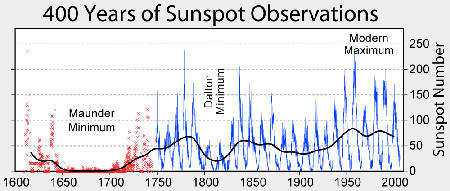
    What difference would a grand solar minimum make in the amount of solar energy reaching Earth? Two examples are the Maunder Minimum, a period of very low solar activity between 1645 and 1715, and the Dalton Minimum, a period of low (but not as low as the Maunder Minimum) solar activity between 1790 and 1830.

    400 years of sunspot observations data, via Wikipedia 400 years of sunspot observations data. Created by Robert Rohde, via Wikipedia.Relative to current levels, the Dalton Minimum represents a 0.08% decrease in the amount of solar radiation reaching the Earth’s surface, and the Maunder Minimum represents a 0.25% decline. That’s how stable solar activity is. That’s also why we’re playing with fire by increasing the greenhouse effect so much and so quickly. We’re threatening the stability of the climate that has been so favorable to our development.
    Peer-Reviewed Research Says Global Warming will Continue

    There have been several studies in recent years investigating what impact another grand solar minimum would have on global surface temperatures, since solar research suggests it’s possible we could be due for another extended solar minimum. Generally these studies will run climate model simulations under a given greenhouse gas emissions scenario with stable solar activity, then run the same scenario with the sun going into a grand minimum, and look at the difference in resulting global surface temperature changes.

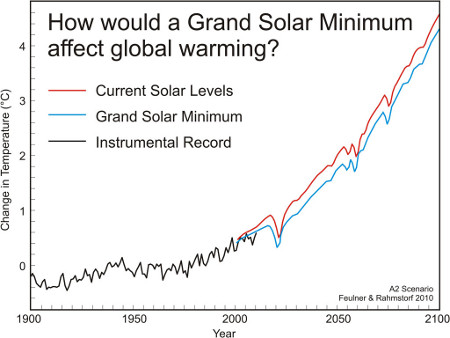
    Using this approach, Feulner & Rahmstorf (2010) (PDF available here) estimated that another solar minimum equivalent to the Dalton and Maunder minima would cause 0.09°C and 0.26°C cooling, respectively.

    The global mean temperature difference is shown for the time period 1900 to 2100 for the IPCC A2 emissions scenario (relative to zero for the average temperature during the years 1961 to 1990). The red line shows predicted temperature change for the current level of solar activity, the blue line shows predicted temperature change for solar activity at the much lower level of the Maunder Minimum, and the black line shows observed temperatures from the NASA GISS dataset through 2010.  Adapted from Feulner & Rahmstorf (2010). The global mean temperature difference is shown for the time period 1900 to 2100 for the IPCC A2 emissions scenario. The red line shows predicted temperature change for the current level of solar activity, the blue line shows predicted temperature change for solar activity at the much lower level of the Maunder Minimum, and the black line shows observed temperatures through 2010. Adapted from Feulner & Rahmstorf (2010) by SkepticalScience.comJones et al. (2012) (PDF available here) arrived at a nearly identical result, with cooling from another Dalton and Maunder minimum at 0.09°C and 0.26°C, respectively. Similarly, a new paper by Anet et al. (2013) found that a grand solar minimum will cause no more than 0.3°C cooling over the 21st century.
    Consistent with these previous studies, Meehl et al. (2013) (PDF available here) estimate a Maunder Minimum would cause about 0.26°C cooling, but as soon as solar activity began to rise again, that cooling would be offset by solar warming. This is a key point, because a grand solar minimum would not be a permanent change. These solar minima last for a few decades, but eventually solar activity rises once again. Thus any cooling caused by a solar minimum would only be temporary.

    The cooling effect of a grand solar minimum can also be estimated very easily without the aid of climate models, because the change in the amount of solar radiation reaching the Earth’s surface is directly proportional to the temperature change it causes. Performing this calculation yields the same result as the model-based research: approximately 0.3°C cooling from another Maunder-type grand solar minimum. Click here to see the details behind the calculation.

    The Heating of the Deep Oceans

    In the Jyllands-Posten article, Svensmark also disputes the data showing the accelerated accumulation of heat in the deep oceans.

    “How can the ocean below 700 meters be heated up, without the upper ocean warming up accordingly?”

    This is an increasingly common argument made by climate contrarians, and a bit of a strange one. The data are what they are – we’ve measured the deep ocean warming, including with reliable instruments on Argo buoys for close to a decade now. Even if we couldn’t explain how the heat got there, it’s there.

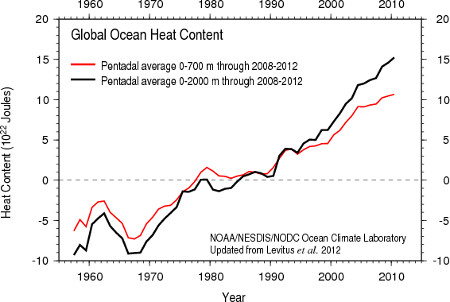
    Ocean heat content 0-700 meters (red) and 0-2000 meters (lback) from the National Oceanographic Data Center 5-year averages of ocean heat content 0-700 meters (red) and 0-2000 meters (black), from the National Oceanographic Data CenterBut let’s address the question anyway – do we expect to have seen some obvious indication of heat being transferred from the shallow to deep ocean layers?

    It’s certainly not clear that we should. Consider the analogy of a bathtub. Water from the faucet represents heat entering the shallow ocean layer. Water exiting the drain represents heat leaving the shallow oceans and entering the deep oceans. The water level in the bathtub represents the heat in the shallow ocean layer (which is what we measure).

    If the amount of water entering the tub from the faucet is the same as the amount of water draining out of the tub, the water level in the tub won’t change. Yet the water still flows down the drain. Climate scientist Gavin Schmidt has discussed this point, summarized here.

    In short, we wouldn’t necessarily see the heat being transferred through the shallow to the deep oceans. However, there has been plenty of warming of the shallow oceans that could have been transferred to the deeper oceans. In our case, the water is flowing into the tub faster than it’s draining out – the shallow oceans are warming fast, as the figure above illustrates.

    Svensmark Gets Ocean Warming Wrong

    Unfortunately Svensmark appears to be unfamiliar with this ocean heating data, saying,

    “The thousands of buoys that we have deployed after 2003 to measure the ocean temperature, have not registered any temperature rise.”

    This is just totally wrong, even if we ignore the rapid warming of the deep oceans (as is clear from a simple examination of the figure above). The ocean heat content data can be downloaded from the National Oceanographic Data Center here. The heating trend since 2003 in the upper 700 meters of oceans is equivalent to nearly 1 Hiroshima atomic bomb detonation per second (plus another 3 per second in the deep oceans). Both the shallow and deep oceans are accumulating a whole lot of heat, with no signs of slowing whatsoever. If anything, the heating of the oceans and the planet as a whole is accelerating.

    Human Influence on Climate Change is Bigger than the Sun’s

    The bottom line is that the sun and the amount of solar radiation reaching Earth are very stable. Even during the Maunder and Dalton grand solar minima, global cooling was relatively small – smaller than the amount of global warming caused by human greenhouse gas emissions over the past century.

    A new grand solar minimum would not trigger another LIA; in fact, the maximum 0.3°C cooling would barely make a dent in the human-caused global warming over the next century. While it would be enough to offset to about a decade’s worth of human-caused warming, it’s also important to bear in mind that any solar cooling would only be temporary, until the end of the solar minimum.

    The science is quite clear that the human influence on climate change has become bigger than the sun’s. At this point, speculation about another mini ice age is pure fantasy.

  • Power grid increasingly vulnerable to severe weather, report says

    Power grid increasingly vulnerable to severe weather, report says

    Americans can expect more major power outages because of severe weather driven by climate change, a federal report says.

    • Email
      Share
      87
    Power grid increasingly vulnerable A utility worker helps restore power in Bethlehem, Pa., after a storm. The national power grid is increasingly vulnerable to outages from extreme weather, a federal report concludes. (Michael Kubel / Morning Call / July 19, 2007)
    By Neela BanerjeeAugust 13, 2013, 5:00 a.m.

    WASHINGTON — A decade after a vast power outage shut down the Northeast, the electricity grid remains “highly vulnerable” to blackouts because of extreme weather fueled by climate change, a report by the White House and the Energy Department concludes.

    The Aug. 14, 2003, blackout occurred when an alarm failed in an Ohio utility control room, leading to a cascade of blackouts that affected 50 million people from Michigan to Massachusetts. More recent power outages have been caused by severe weather, such as storms in the East and wildfires in the West.

    Between 2003 and 2012, 679 blackouts occurred because of weather events, each affecting at least 50,000 customers. Over the same period, weather-related outages cost the economy between $18 billion and $33 billion annually, depending on the number and severity of events.

    “The aging nature of the grid — much of which was constructed over a period of more than 100 years — has made Americans more susceptible to outages caused by severe weather,” the report said.

    The analysis of the power grid, released Monday, was conducted in response to a plan that President Obama laid out in June to combat climate change and better prepare for it. Already, weather shaped by human activity has hit the United States faster than had been predicted, threatening infrastructure, water supplies, crops and shorelines, according to the draft Third National Climate Assessment, a federal report released in January.

    Last year, Superstorm Sandy knocked out power for 8.5 million customers. Strong winds from hurricanes and tornadoes are the main cause of the kind of infrastructure damage that leads to blackouts, the report said.

    Power plants, especially those that burn coal, contribute to climate change by emitting heat-trapping carbon dioxide. Obama directed the Environmental Protection Agency to develop rules to curtail carbon dioxide released by new and existing power plants, with the next round of proposals due in September.

    The new report on the power grid spotlights the system’s vulnerabilities and offers suggestions for improvement. But it also underscores how little the administration can do to boost electricity reliability.

    Most utilities are publicly traded corporations and their activities are generally regulated by the states. The Obama administration allocated $4.5 billion for investments in energy efficiency and reliability systems, called “smart grid” technology, as part of its 2009 stimulus plan. But during a conference call to discuss the report, senior administration officials were unable to name other ways to improve the electricity network at a time when threats from climate change are mounting.

    Instead, the power grid report recommended replacing wooden utility poles with those made of concrete, steel and other stronger material. Burying power lines is an oft-discussed option, but the report noted it is extremely costly and, in coastal areas, underground wires are vulnerable to flooding from storm surges.

    The report also recommended greater use of small-scale power sources, such as from renewable energy, that could be installed in communities or near crucial facilities, such as hospitals, to avoid outrages caused by downed power lines or flooded transmission substations.

    Electric utilities have invested $478 billion in infrastructure improvements since 2007 and are expected to spend more than $90 billion annually on capital projects through 2015, said Richard McMahon, vice president of energy supply and finance at the Edison Electric Institute, a Washington trade group.

    The American Society of Civil Engineers estimated that $673 billion in investments would be needed by 2020 to upgrade the grid to meet future demand. But the costs of such improvements are recouped through rate increases, often unpopular moves that must be ratified by state regulators.

    neela.banerjee@latimes.com

    Copyright © 2013, Los Angeles Times

    • Email
      Share
      87

    MORE FROM THE TIMES
    • Goldie Hawn and Kurt Russell bail out of their Malibu beach house
    • Scientists say sugar at levels considered safe is harmful
    • Scientology leader’s wife located by LAPD after Leah Remini inquiry
    • Kourtney Kardashian hit with paternity lawsuit by male model
    • Hannah Anderson’s mother, brother were tortured, warrants say
    Comments are filtered for language and registration is required. The Times makes no guarantee of comments’ factual accuracy. Readers may report inappropriate comments by clicking the Report Abuse link next to a comment. Here are the full legal terms you agree to by using this comment form.

    Advertisement
  • Vote Compass data confirms Labor had ‘bloke problem’ under Julia Gillard By Antony Green Vte Compass data confirms Labor had ‘bloke problem’ under Julia Gillard By Antony Green

    Updated 1 hour 15 minutes ago

    It may rarely receive much attention in general political discussion but gender and politics has long been a matter of debate among political scientists.

    The arrival of Julia Gillard as Australia’s first female prime minister made gender more central to the political debate, especially given Ms Gillard on several occasions specifically attacked Mr Abbott on gender issues.

    That opinion polls tended to show Mr Abbott polling less well among female voters was another factor in bringing gender into the general political debate.

    Labor regularly highlighted Mr Abbott’s polling with female voters and the Liberal Party’s decision to feature Mr Abbott more often with his family and with his female colleagues and candidates suggested Liberal Party polling revealed something similar.

    Yet there are two dimensions to issues of gender and voting patterns. A gap in voting by gender can be caused by shifts in female voting patterns, but equally can be due to shifts in male voting patterns.

    On July 16, after the change of Labor leadership, the Australian featured a special analysis of Newspoll looking at the shift in gender voting with the change in leadership.

    The article pointed to Labor’s support among women having lifted from 34 per cent to 38 per cent with the change of leadership. The article’s headline was all about Rudd being more popular among women than Gillard, the story re-visiting the misogyny and gender debate.

    What I thought more revealing in the Australian’s table was the shift in the male vote after the change of leadership. Labor’s vote among men rose 7 per cent from 28 per cent to 35 per cent.

    Before the change, a Fairfax Nielsen poll published on June 16 had highlighted a slump in Labor support among male voters; Labor slipping from its traditional position of polling more strongly among men than women had been evident earlier.

    For all the talk of Mr Abbott’s problem with female voters, not nearly as much attention was paid to a clearly evident problem that Ms Gillard had with male voters, the other dimension to a gender gap in voting.

    Labor had a bloke problem.

    And a bloke problem is something of a worry for the Labor Party. While the gap in gender voting has declined over the past four decades, it is still unusual for Labor to poll better than the Coalition among female voters but Labor normally polls better among male voters.

    After the switch in leadership from Julia Gillard to Kevin Rudd, Labor achieved one of the biggest poll boosts in Australian polling history, a seven-point jump according to some polls.

    Such a dramatic shift was worth investigating with Vote Compass and for the first week of the tool’s operation, we included a ‘question of the day’ on voter attitudes to the change in Labor leadership.

    To try to measure sentiment properly, the question was asked three different ways, though each respondent was asked only one of the questions. In a sample of about 300,000 respondents who gave their demographic details, one third received each question.

    The results reveal there was a vast gender difference in respondent attitudes to the change in leadership, but it was the shift in attitude among male voters that was more important to Labor’s poll recovery than the reaction of female voters.

    The first question asked was:

    Regardless of which party you intend to vote for on election day, do you prefer Kevin Rudd or Julia Gillard as leader of the Labor Party?

    As shown in the graph below, the strongest support for Kevin Rudd was among intended Labor voters, who 63 per cent to 31 per cent stated they preferred Mr Rudd. The approval number would have been boosted by the number of voters switching to Labor because of the change, a consequence of the question being asked after the event.

    Among ‘Other’ voters, preference for Kevin Rudd was 47 per cent to 26 per cent; among undecided voters 42 per cent to 36 per cent; but Green supporters backed Gillard 51 per cent to 35 per cent.

    Coalition voters were evenly split, perhaps reflecting some Coalition supporters thinking Gillard was the better option for ensuring a Coalition victory.


    Looking at respondents’ self-selected left-right ideology, an even more interesting pattern emerges. The group giving greatest support to Mr Rudd were respondents who considered themselves ideologically in the centre. Australian elections are always won in the centre, so such a finding suggests bad polling could in part be sheeted home to Ms Gillard’s lack of appeal to this group compared to Mr Rudd.

    Respondents of both left and right persuasion were more evenly split, probably for a variety of reasons. The graph below shows the full results.


    Unsurprisingly, support for the change was strongest in Mr Rudd’s home state of Queensland, followed by New South Wales and Tasmania, the three states where Labor’s polling had been weakest. The only jurisdiction where voters supported Ms Gillard was the ACT.


    As shown below, the gender difference on this question was stark. Men preferred Mr Rudd 56 per cent to 27 per cent, while women backed Ms Gillard 44 per cent to 36 per cent. This finding backs my suggestion that it was Julia Gillard’s problem with male voters that was the gender issue driving the change of Labor leadership.


    The second question asked voters to look backwards and state what they would have done at an election were Julia Gillard still Prime Minister. Would they be more or less likely to support Labor?

    If Julia Gillard were still Prime Minister would you be more or less likely to vote for the Labor Party?

    The response based on intended party vote is a bit confused, probably because the group that really mattered, those who switched back to Labor with Rudd becoming leader, were hidden by the rest of the Labor voters who still intended to vote Labor.

    The analysis based on self-assigned ideology shown in the graph below displays the overall picture more clearly.


    The response of Right and Centre-Right voters can be ignored, as most would not have voted Labor anyway. Left-aligned voters stated they were slightly more likely to vote Labor with Gillard as leader than Rudd.

    But among Centre voters the gap was vast, 47 per cent less likely with Gillard compared to only 15 per cent more likely. And as I said, Australian elections are won in the centre.

    As you would expect, the gender gap on this question was stark. Among male voters, 50 per cent stated they were less likely to vote Labor as opposed to 12 per cent more likely. Among female voters, 31 per cent were less likely to vote Labor, 26 per cent more likely. All the upside for Labor’s vote on a change of leadership was among male voters, with little likely change in female support because of the switch.


    The final question asked more specifically whether Labor had made the right decision. It didn’t ask about intended change of vote, just simply whether the decision was ‘right’ by whatever criteria the respondent chose to use:

    In your opinion, did the Labor Party make the right decision in changing leaders from Julia Gillard to Kevin Rudd?

    Among Labor intended voters the response was overwhelming, 74 per cent saying yes and only 16 per cent saying no. Was this Labor voters falling in behind the new leader? Perhaps.

    Green supporters were evenly split on the question, supporters of ‘Others’ were in favour 58 per cent to 29 per cent, and Undecided voters were in favour 44 per cent to 33 per cent.

    Only Coalition supporters said the change was not the right thing to do. Again, some Coalition intended voters may have been thinking the right thing for their party was for Julia Gillard to remain as Labor leader.


    Below is the breakdown by ideology, and every group except Right voters considered the change was the correct decision by Labor. By far the strongest support was among Centre and Centre-Left respondents, the sort of groups Labor needed to retain support from to avoid a landslide defeat, and to even hope for possible victory.


    Again there were stark differences along gender lines. Male voters thought the change was the right decision 61 per cent to 27 per cent, while female voters split in favour 44 per cent to 40 per cent.


    In summary it is clear that in changing leader, Labor received overall support among intended Labor voters, received greatest backing for the change from among Centre voters, and received overwhelming backing from male voters – with little evidence of a major backlash among female voters.

    As Julia Gillard said in her farewell press conference, gender didn’t explain everything about her troubled Prime Ministership, it didn’t explain nothing, but it explained something.

    Books have already appeared on the role of gender in Julia Gillard’s political demise, and many a thesis will yet be written.

    Yet what was seen in the polls beforehand, and what is clearly shown in the Vote Compass data, is that it is the reaction among male voters to Julia Gillard’s demise that has played an important part in Labor’s poll recovery.

    The misogyny debate had focused political attention on Tony Abbott’s perceived problems with female voters while not nearly as much attention was paid to Labor’s and Julia Gillard’s growing problem with male voters.

    Labor’s base electoral percentage vote is in the mid to high 30s. Under Julia Gillard, Labor was polling below this base level. In the circumstances, a change of leadership was always on the cards when a reticent Labor Caucus finally faced up to looming political oblivion.

    Whether Labor’s problems were caused by sexism in the electorate, sexism by Ms Gillard’s opponents, sexism in the media, or missteps by Ms Gillard herself, clearly Labor couldn’t allow the impasse on the leadership to persist.

    Labor’s bounce in the polls after the leadership change has subsided, and the Coalition are still favourites to win the election.

    But Labor is still polling better than before the leadership change, and the Vote Compass data reveals that the story is not about Tony Abbot and female voters, but male voter attitudes to Julia Gillard.

    Topics: federal-elections, gillard-julia, rudd-kevin, australia

  • Antarctica: How current ice melts follow past patterns

    Antarctica: How current ice melts follow past patterns

    Different regions of Antarctica are warming at different rates. This differential melting occurred similarly during ancient warming periods, researchers have found. Now scientists hope understanding the past will help them to better predict the future.

    By Becky Oskin, Livescience.com / August 14, 2013

    A West Antarctica Ice Sheet Divide researcher stands next to an ice core with data from 68,000 years ago. The current melting pattern of Antarctic ice sheets mirrors melts of ancient warming periods, researchers have found.

    Kendrick Taylor/Desert Research Institute

    Enlarge


    The modern meltdown of the Antarctic Ice Sheet mirrors the frozen continent’s big thaw after the last ice age ended 20,000 years ago, a new study finds.

    Skip to next paragraph

    Ads by Google
    150+ online & distance courses.
    20% off all courses this month!

    Subscribe Today to the Monitor

    Click Here for your FREE 30 DAYS of
    The Christian Science Monitor
    Weekly Digital Edition

    New ice core records from West Antarctica show the huge ice sheet started heating up about 20,000 to 22,000 years ago, 2,000 to 4,000 years earlier than previously thought. But in East Antarctica, which was higher in elevation, colder and drier than the West, the continent stayed in its deep-freeze cycle until 18,000 years ago. The results were published today (Aug. 14) in the journal Nature.

    The mismatch between West and East is similar to today’s Antarctica. Modern West Antarctica is one of the fastest-warming places on the planet. The middle of West Antarctica has warmed by 4.4 degrees Fahrenheit (2.4 degrees Celsius) since 1958, three times as fast as the overall rate of global warming. But relatively little warming — half a degree or less — has been measured in East Antarctica. [In Photos: Stunning Photos of Antarctic Ice]

    Looking at how Antarctica melted in response to past climate change can help researchers better predict the ice sheet’s future behavior, said lead study author T.J. Fudge, a doctoral student at the University of Washington. “This most recent deglacial warming is the spot in time we can look at to really understand how our climate goes through big changes,” Fudge told LiveScience.

    The study is based on an ice core more than 2 miles (3,405 meters) long, covering 68,000 years, the longest U.S. ice core ever drilled. The five-year effort to retrieve the core ended in December 2011. Scientists are only halfway through the ice, having analyzed 30,000 years’ worth of annual layers, according to a statement from the University of Washington.

    The authors — a consortium of 42 researchers signed off on the study — suggest that 20,000 years ago, warming in the Southern Ocean melted sea ice around Antarctica. The missing ice meant more storms traveled inland, boosting West Antarctica’s warming.

    West Antarctica is influenced by the ocean much more than the ice up high in East Antarctica, so you are able to see this [warming] happening before you notice it in East Antarctica,” Fudge said. “We’re seeing something similar in the modern climate, where West Antarctica seems to be changing more quickly.”

    The findings also resolve a long-standing problem: The timing of polar melting when the ice age ended. Based on earlier ice core records, mainly from East Antarctica, researchers had thought Antarctica warmed up 18,000 years ago, about 2,000 years after the Northern Hemisphere had warmed. Climate modelers sought to explain the delay through shutdowns in ocean currents (which help carry heat across the globe), among other factors.

    Now, the warming in West Antarctica matches the onset of warming in the Northern Hemisphere, also pegged at 20,000 years ago.

    Email Becky Oskin or follow her @beckyoskin. Follow us @livescienceFacebook & Google+. Original article on LiveScience.