Category: Uncategorized

  • Utilities to battery-powered solar: Get off our lawn

    eather Smith

    Signs of movement

    Utilities to battery-powered solar: Get off our lawn

    By

    solar-panels-no
    Shutterstock

    In Wisconsin, utilities are jacking up the price to connect to their electrical grid. In Oklahoma, utilities pushed through a law this spring that allows them to charge the people who own solar panels and wind turbines more to connect to their electrical grid. In Arizona, the state has decided to charge extra property taxes to households that are leasing solar panels.

    Welcome to the solar backlash. In Grist’s “Utilities for Dummies” series last year, David Roberts prophesied that solar and other renewables could “lay waste to U.S. power utilities and burn the utility business model, which has remained virtually unchanged for a century, to the ground.” And lo, it is coming to pass — though not without a fight from the utilities first.

    This May, Barclays downgraded its rating of America’s electricity sector from “market weight” to “underweight.” Its rationale? Solar — or, more specifically, the great leaps that are happening or expected to happen in technology for storing the energy that solar generates. While the solar industry took a roller-coaster ride over the last decade, the R&D that went into electric cars created the killer add-on it was waiting for: really awesome batteries.

    It’s not a coincidence that Tesla formed a sales partnership last year with the solar panel development giant Solar City. The two companies are basically smushing solar panels and fancy electric cars together to create a Transformers-like superhouse that could join with similar houses to form a microgrid, no utility necessary. In their utopia, a house could be powered in the off-hours by the battery from the car parked in the garage. Or, if you’re not car people, you could just buy the battery. Tesla is claiming that the cost of their batteries will drop in half by 2020.

    For this reason, it’s not surprising that some utilities are specifically going after solar arrays with batteries. In California, utilities are demanding that any solar panel installation that features batteries add an extra meter just for the battery (which adds about $1300 to the overall cost of the installation) before it can be allowed to sell electricity back to the grid.

    PG&E, the company that owns California’s biggest utility, refuses outright to buy energy from customers that have both solar panels and batteries, as does San Diego Gas & Electric. The utility companies argue that such storage systems could, in theory, be used fraudulently: Consumers with solar panels could fill their batteries directly with power sourced from the grid during times when the power is cheap and then send it back under a false “clean” label during periods of high demand when it’s worth more. (Although solar suppliers say no one is actually gaming the system this way, the industry admits that the technology has outpaced monitoring policies.)

    It makes sense that utilities are freaking out about the risk of solar. Today, 43 states require utilities to buy electricity from consumer solar installations, typically at the same price that customers pay for power from the grid. Utilities argue that this arrangement is unfair to them, because they have to maintain a ton of infrastructure (power lines, power plants) that a cute house with a solar panel does not. However, utilities have typically had decades of low-cost loans and steady regulated profits, plus some opportunities for crazy price-gouging here and there, precisely because of this infrastructure. In most cases, it has already more than paid for itself.

    If solar achieves anywhere near its projected growth, utilities stand to lose a lot of money. But by working against solar, instead of with it, they risk creating a two-tiered system — one where people who are wealthy or organized enough separate from the grid entirely and link together in little gated communities, and one where people who can’t get it together enough to install a fancy solar array end up paying higher and higher utility prices on a steadily shrinking network — sort of like how poor people get stuck paying higher gas prices because they don’t have the $25,000 to own a Prius, or higher utilities because they can’t afford the outlay for energy-efficient anything.

    Which is to say, there are changes coming, and the next few years will determine the shape of the energy system of the future. Of course, our need to cut carbon emissions is urgent enough that we just might want to say to the utilities: Get out of the way. And if there ever was a time to run for your local public utilities commission, it’s now.

    Heather Smith (on Twitter, @strangerworks) is interested in the various ways that humans try to save the environment: past, present, and future.

  • Solar industry defeats Government in £132m High Court damages case

    2 of 2
    Why this ad?
    Get 3 Free Solar Quotessolarquotes.com.au/_3_Best_Quotes – Get 3 No Obligation Solar Quotes Totally Free & No Obligation. Save!

    Solar industry defeats Government in £132m High Court damages case & more news

    Inbox
    x

    Nextgen sq@clickgreen.org.uk via nw005.com

    9:33 PM (15 minutes ago)

    to me
    Web Version | Update your profile | Unsubscribe
    Please add sq@clickgreen.org.uk to your address book to ensure that our emails reach your inbox.
    Solar industry defeats Government in £132m High Court damages case & more news | Update your profile 11 July 2014

    Tell a friend        Subscribe         Contact Us        Print all        Newsletter archive    Nextgen    RSS

    Solar industry defeats Government in £132m High Court damages case

    The High Court has ruled in favour of solar energy firms in a £132 million damages claim brought against the Department of Energy and Climate Change for the losses they suffered as a result of unlawful cuts to the Feed-in Tariff scheme.

    Read More

    LikeLike | Facebook Twitter LinkedIn Del.icio.us Digg Yammer
    In this issue
    Solar industry defeats Government in £132m High Court damages case
    Industry leader calls for a “balanced debate” on UK shale gas
    British Gas unveils £60m community solar energy partnership

    Company chiefs urge Prime Minister to step in and back UK solar power

    £1m of investment reached in record time for wind turbine project

    Politicians opposing wind energy lose twice as many votes as they gain

    Scotland gives go-ahead for 22-turbine onshore wind farm

    New onshore wind farm generates discounted bills for local residents

    REA welcomes Minister’s reassurances on green gas policy changes

    Traffic is public’s biggest fear of anaerobic digesters, new research finds

    Govt to recruit an “army of volunteers” to help households save energy

    Construction completed at Tamar Energy’s 2MW Halstead Anaerobic Digestion facility

    New clean energy investment bounces back to two-year high

    UK opens up more seabed to match renewable energy demand

    White Rose carbon capture project wins €300 million of European funding

    Europe uses €1 billion of polluters’ revenues to fund clean energy projects

    The climate effects of the looming methane energy economy

    Oxford City Council signs pioneering investment deal with renewable energy firm

    Renewable energy generation jumps by more than a third in South West

    Onsite renewable generation by business jumps by more than a quarter

  • Is a 2014 El Niño still on the way? CLIMATE CODE RED

    lick here to enable desktop notifications for Gmail.   Learn more  Hide

    1 of 4

    climate code red

    Inbox
    x

    Climate Code Red noreply@blogger.com via google.com

    6:15 PM (2 minutes ago)

    to me

    climate code red


    Is a 2014 El Niño still on the way?

    Posted: 11 Jul 2014 12:51 AM PDT

    by Rob Painting, via Skeptical Science
    Main points
    • Development of El Niño in 2014 continues to edge closer with sea surface temperatures (SST) in the key indicator equatorial regions approaching El Niño thresholds.
    • The discharge of ocean heat to the atmosphere associated with the build-up of the El Niño phenomenon has predictably seen a rise in global surface temperatures, resulting in May 2014 being the warmest May ever recorded.
    • Despite the strong initial build-up of a large warm water volume anomaly (WWV) in the equatorial subsurface ocean earlier in the year, the atmosphere has so far not provided sufficient reinforcement to maintain this large pool of warmer-than-average water and a substantial portion has been eroded.
    • The last half-century of observations, however, still favour the development of an extreme El Niño event, but the substantial reduction of the warm water volume anomaly (thankfully) diminishes the odds of a powerful event rivaling that of 1997-1998 from taking hold.
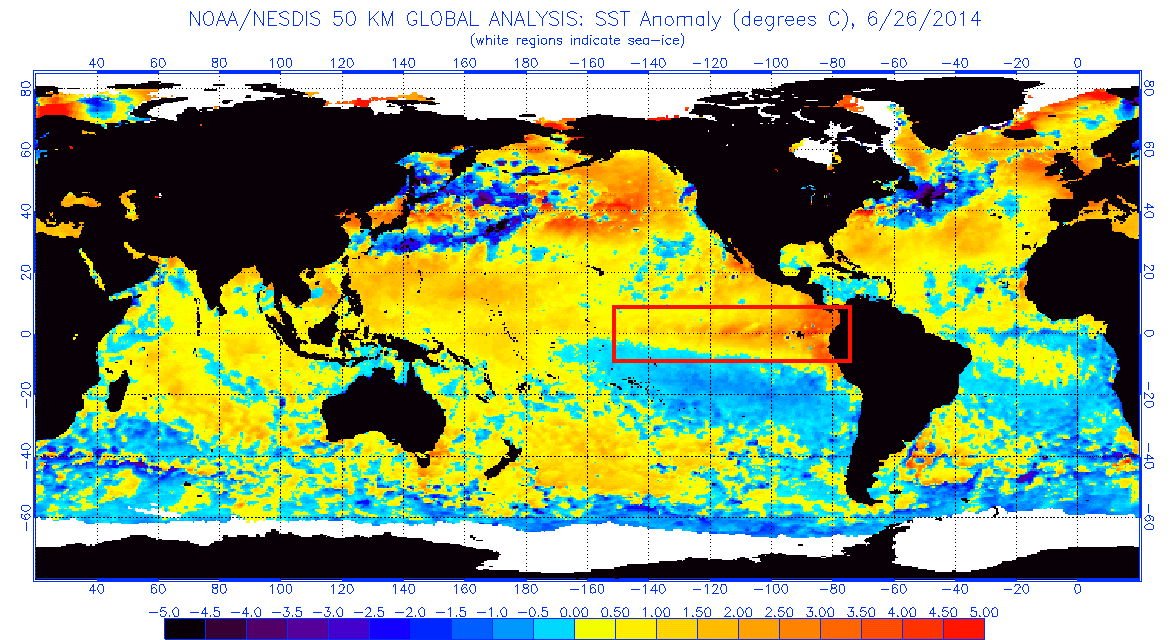
    Figure 1 – global sea surface temperature (SST) anomalies (departures from the long-term average) as at 26th June 2014. Strong equatorial SST warming off the coast of South America (shown in red rectangle) is a tell-tale signature of El Nino conditions beginning to form. Image from NOAA Coral Reef Watch.
    El Niño on the Wane?
    The intensity of El Niño is determined by a number of factors but, as discussed in the previous 2014 El Niño post, the size of the equatorial warm water volume (WWV) anomaly is a crucial ingredient because the heat from this warm water volume is discharged to the atmosphere as El Niño matures.
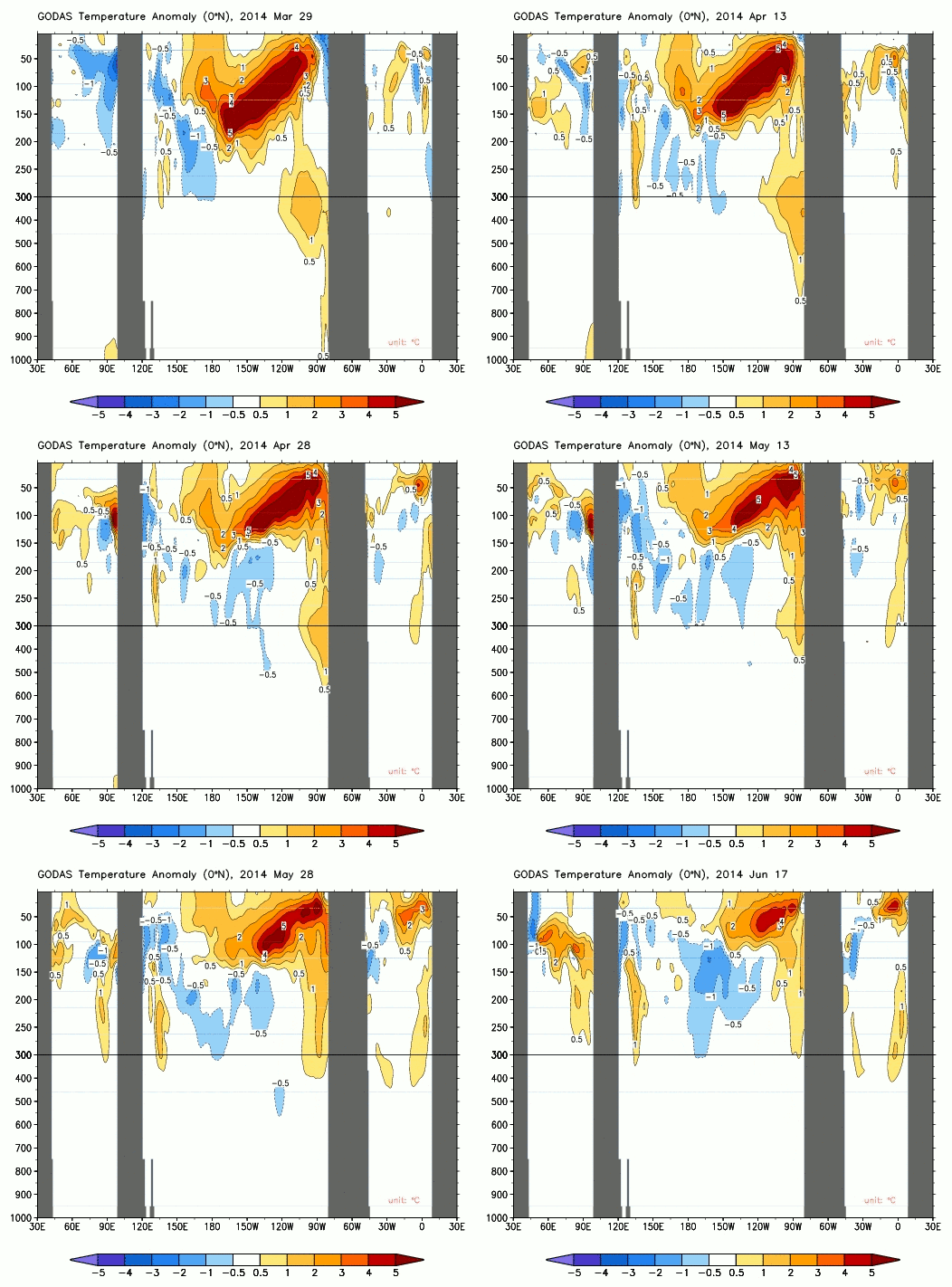
    Earlier this year we saw the largest March WWV anomaly ever recorded. This warm anomaly exceeded even that of the monster El Niño of 1997-1998, raising fears of a similarly devastating El Niño in 2014. Fortunately, the chances of a repeat of 1997-1998 appear to have greatly diminished. The atmosphere needs to provide reinforcement in order for El Niño to fully take hold,  and although there have been brief episodes of westerly wind bursts, which allow near-surface warm ocean currents to flow back toward the east and shut off the upwelling of cold water there, these have not been of sufficient strength, or persistence, to shut off the upwelling entirely. As a result, the anomalous pool of warm water sitting beneath the eastern Pacific Ocean has been eaten away (moved out of the equatorial region)  and is now substantially smaller than before – see Figure 2.
    Figure 2 – Global ocean temperature anomaly for the period 29th March-17th June 2014 (the Pacific Ocean is in the centre frame). Note that these are anomalies, not absolute temperatures, so the warmest water is still at the surface. The decline in the equatorial WWV anomaly is obvious as time progresses. Image adapted from CPC GODAS.
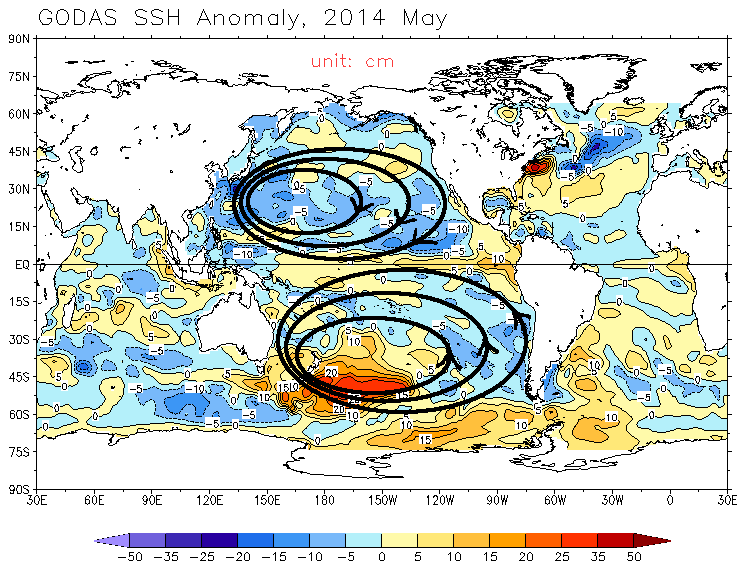
    One striking aspect of Pacific sea surface temperature patterns in Figure 1 is the difference between the North and South. In the North Pacific, the subtropical gyre – the large rotating mass of surface water in the equatorial to mid latitudes – appears to have spun-down. Consequently, the poleward export of warm surface water northwards out of the tropics has been greatly reduced, and the Pacific Decadal Oscillation (PDO) – an index of sea surface temperatures north of 20° latitude – has switched to a positive (warm) phase in 2014.
    This isn’t the case for the South Pacific subtropical gyre. The persistent easterly trade winds have the gyre still exporting heat poleward out of the tropics. The two main indicators of this, aside from the ongoing trade winds themselves, are the anomalously warm sea surface temperatures, and anomalous sea surface height, west of New Zealand (the centre of the gyre), and the ongoing upwelling of cold water off the coast of South America.

    Figure 3 – Global sea surface height (SSH) anomaly for May 2014. The black ellipses are a (very) rough sketch of the Pacific Ocean subtropical gyres, with the arrows denoting the direction of their rotation. Above-average SSH in the South Pacific gyre indicates warm water mass (exported from the tropics) piling up in the centre of the gyre, whereas below average SSH in the North Pacific indicates weaker-than-normal circulation. Units are in centimetres Image adapted from CPC GODAS.

    Or Extreme, Irreversible, El Niño Already Set in Motion?

    So, with the subsurface blob of warm water in the eastern equatorial Pacific having decreased substantially, does that mean that there’s no risk of an extreme El Niño happening? Well, no, not if the last 50 years of ENSO observations are anything to to go by.

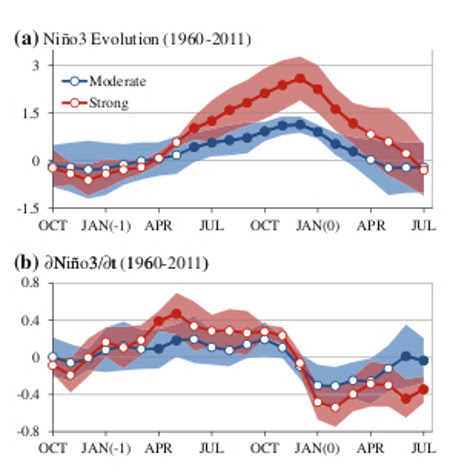
    Kim & Cai (2014) looked at the various phases of ENSO since 1960 and found that a strong flow of warm water (Kelvin waves) toward the eastern Pacific during the early, developing, phase of El Niño, specifically the months of April and May, only occurred in the lead-up to events which later matured into extreme El Niño. Kim & Cai (2014) defined an extreme El Niño as those events where sea surface temperatures in the Niño 3 region reached a peak anomaly in excess of 1.2°C above long-term mean. 4 of 16 El Niño in the 50-year observational record fell into the extreme category, namely; 1972-73, 1982-83, 1997-98, and 2009/10.
    Figure 4 –  from Kim & Cai (2014). SST change in the Niño3 region for El Niño years between 1960-2011 with the solid lines indicating the mean. The evolution in Nino 3 SST anomalies for strong & moderate events through the year is shown in (a), and the bottom panel (b) shows the rate of SST change throughout El Niño. The bottom panel demonstrates the importance of the warming rate in the months of April & May in creating the stronger SST warming later in the year. Image from Kim & Cai (2014).
     What the authors found is that whenever this strong horizontal transport of warm water from western to eastern Pacific occurs over the critical April-May period, it is inevitably the precursor to an extreme El Niño taking place later in the year (El Niño reaches a peak around December). If this relationship still holds true, then the strong Kelvin wave activity, corresponding anomalous eastward flow of warm water, and the change in sea surface temperatures in the Niño 3 region during April-May this year, portends an extreme El Niño making its presence felt later in 2014. 
    Reinforcements May be on the Way 

    Unlike some previous El Nino years, notably the monster 1997-1998 one, the trade winds have picked up strength again over the last 4 weeks, which has held back further El Niño development. This is seen in the Southern Oscillation Index (SOI), which has been positive over the past month – indicating a lower sea level pressure at Darwin than at Tahiti.

    For El Niño to keep evolving the atmosphere needs to respond and provide encouragement. This is typically accomplished by convection (evaporation/clouds/rainfall) moving out from the western Pacific to the central Pacific and beyond. Doing so reduces or reverses the sea level pressure gradient between Tahiti and Darwin (and shifts the SOI into negative values), thus shutting down the trade winds temporarily.
    Some models predicted that the Madden-Julian Oscillation (MJO), a tropical pulse of cloud and rainfall (i.e. strong convection) that moves eastward along the equator with a cycle of 1-2 months, was due to move eastward out over the equatorial Pacific at the time of writing. If so, we should expect to see westerly wind bursts (WWB) in the western Pacific develop, and early indications are that they have.
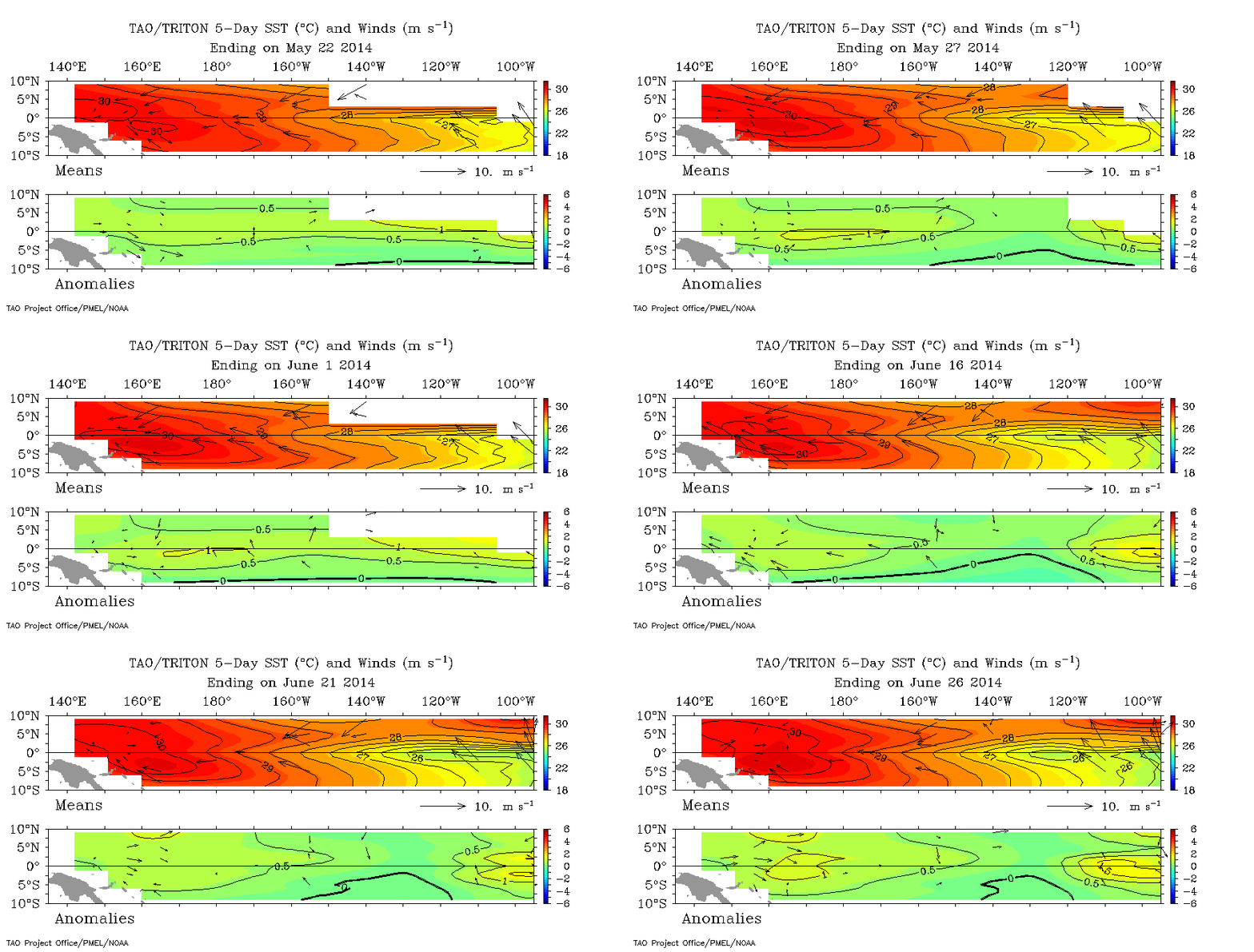
    Figure 5 – Tropical SST and wind five-day means (top panel) and anomalies (bottom panel) from 22nd May-26th June 2014. Westerly wind bursts (arrows pointing to the right in bottom panel) die out on May 22, followed by a lull before strengthening again in late June. White areas of the animation are missing data. Note the pool of warmer-than-normal surface water moving westward in the last few frames. Images from the TAO Project.
    This means that further Kelvin waves will makes their way across the Pacific Ocean, thus transporting more ocean heat from west to east, and giving the system a further nudge toward El Niño when it reaches the eastern Pacific in about two months time. But for El Niño to take a firm hold, the atmosphere is going to have to play ball by persistently shifting convection out toward the central and eastern Pacific, thereby relaxing the trade winds. Once the trade winds weaken sufficiently, so too will the upwelling of cold water in the east, and the poleward transport of warm surface water out of the tropics. 

    Let’s Not Party Like it’s 1997-1998

    Earth’s weather continues to slowly inch toward El Niño, but the failure of the trade winds to persistently weaken has seen El Niño’s development in 2014 delayed. If, as some indicators suggest, the system does develop into a full-blown El Niño we can expect tropical sea surface temperatures to continue to increase right up to the end of the year (see Figure 4) before gradually diminishing in 2015.

    Fortunately there has been a marked reduction in the equatorial warm water volume anomaly in the last month, so an El Niño rivaling that of 1997-1998 – the most powerful El Niño of the 20th Century – seems unlikely. But even so, Pacific Ocean trends of the last 50 years demonstrate that the strong equatorial flow of ocean currents toward the eastern Pacific in the critical April-May period, have always preceded extreme El Niño events later the same year. Should this trend continue, and based on observations earlier this year, we  could still experience an extreme El Niño in 2014. Only time will tell.
  • Daily update: 5 things to know about new Senate and clean energy

    1 of 7
    Why this ad?
    Lowest Price = A Red Flagsolarquotes.com.au/_3_Best_Quotes – Get 3 Free Local Solar Quotes Totally Free & No Obligation. Save!

    Daily update: 5 things to know about new Senate and clean energy

    Inbox
    x

    Renew Economy editor@reneweconomy.com.au via mail31.atl111.rsgsv.net

    12:27 PM (9 minutes ago)

    to me
    5 things to know about new Senate and clean energy; Why fossil fuel generators hate wind energy; Modi accelerates solar revolution, doubles tax on coal; What fossil fuel industry thinks of the ‘carbon bubble; and 5 reasons solar installers are vertically integrating.. for now.
    Is this email not displaying correctly?
    View it in your browser.
    RenewEconomy Daily News
    The Parkinson Report
    Mike Willesee interview with Ricky Muir saved renewables in Australia; will Abbott go for a 30/30 target; renewable investment to remain at standstill; ARENA still uncertain; solar industry still exposed; and Tony Windsor’s helping hand to Palmer.
    Wind energy has a significant impact on wholesale prices, particularly in those peak demand events when fossil fuel generators used to make most money.
    New India PM Modi announces suite of new solar projects, partly funded by a doubling of tax on production of coal.
    We asked oil, gas and coal companies for their take on carbon bubble research. None considered it a threat to their business this century.
    Vertical integration, the process of companies owning more and more of their own supply chains is a curious trend that has been washing through U.S. solar.
  • Daily update: Solar, wind to beat coal on costs in China, India by 2020

    1 of 2
    Why this ad?
    Get 3 Local Solar Quotessolarquotes.com.au/_3_Best_Quotes – w/ 12,000+ Real Installer Reviews. 1 Form + 2 Minutes = 3 Free Quotes!

    Daily update: Solar, wind to beat coal on costs in China, India by 2020

    Inbox
    x

    Renew Economy editor@reneweconomy.com.au via mail15.wdc01.mcdlv.net

    3:10 PM (25 minutes ago)

    to me
    Solar, wind to beat coal on costs in China, India by 2020; Carbon tax voted down again; Abbott courts controversy over solar trade at G20; Ergon confirms rule changes to send solar households off-grid; Solar PV module prices fell 50% in 2013; Climate adaption in cities better for business; Experts at Intersolar talk about growth markets as solar eyes storage; and new energy storage demo rides on pacific northwest winds.
    Is this email not displaying correctly?
    View it in your browser.
    RenewEconomy Daily News
    The Parkinson Report
    Australia’s biggest coal customers are expected to turn away from fossil fuels because solar and wind energy will provide a cheaper option within 5 years. While Australia looks to stop renewables, India and China are looking at renewable shares of up to 45%.
    Abbott government again loses vote to get carbon tax repeal through the Senate, as PUP switches sides over ‘double-cross’, and backs ARENA.
    EU, US and China have begun talks to free trade in environmental goods such as solar panels. They want it in G20, Abbott says no.
    Qld power distributor Ergon Eenergy confirms new standards to limit power exports from the booming rooftop solar market, paving the way for its PV customers to quit the grid.
    Report says Australian solar PV module prices fell from $1.50/Wp in 2012 to 0.75/Wp in 2013; storage market gaining momentum.
    Report finds most of world’s major cities see climate resilience as a major factor affecting economic competitiveness – and are doing something about it.
    Battery-backed solar, regulatory “carrots versus sticks” approaches, and China’s role were all discussed.
    Three Washington State utilities with big investments in wind power have signed on to a new $14.m energy storage and s
  • Is the Abbott Government in a Position to Request a Double Dissolution?

    Position to Request a Double Dissolution?

    Is the Abbott Government in a Position to Request a Double Dissolution?

    Posted in Uncategorized By Neville On July 4, 2014

    « Napthine Government Starts from Behind in Key Marginal Seats | Main

    July 04, 2014

    Is the Abbott Government in a Position to Request a Double Disslution?

    Several weeks ago Green’s Leader Senator Christine Milne announced that her party had delivered the Abbott government a trigger for a double dissolution by helping to block, for a second time, legislation to repeal the Clean Energy Finance Corporation.

    While it is true blocking the legislation created a double dissolution trigger, is is unlikely that the Prime Minister yet has constitutional justification to request double dissolution. That is assuming he was of a mind to do so.

    An overlooked aspect of calling a double dissolution, and an aspect that tripped up Malcolm Fraser in 1983, is that while possession of a trigger is necessary for calling a double dissolution, on its own a trigger is not a sufficient reason.

    This necessary but not sufficient condition relating to double dissolution triggers goes back to legal advice at the time of the first double dissolution one hundred years ago this month in 1914.

    June/July this year is not only the centenary of the path to the First World War. The same two months in 1914 saw the debate that led to the proroguing of the Parliament in 29 June 1914, followed by the proclamation of the parliament’s dissolution on 30 July 1914.

    The power of a Governor-General to dissolve both houses of the Commonwealth Parliament for an election is not one inherited from the British Crown. It is a power created by the deadlock provisions of the Constitution (Section 57) and is bound by interpretation of that section’s wording.

    When the Cook Liberal government was elected at the 1913 Commonwealth election, it had a one seat majority in the House (38-37) but was in a significant minority in the Senate (7-29). By May 1914 the government had created a trigger based on legislation blocked twice by the Senate, and in June announced that the Governor-General had agreed to a double dissolution, pending the passage of supply to carry on government until the new parliament could convene after the election.

    This supply issue meant that the calling of the first double dissolution received a thorough debate in the Parliament, with the Senate addressing the Governor-General on the matter and requesting that correspondence be released. The Governor-General did not respond, referring to the statement made to the House by the Prime Minister.

    With supply passed, both houses were prorogued on 29 June 1914, not long after a certain event took place on the other side of the world in Sarajevo. The proclamation of dissolution was issued on 30 July 1914. For unrelated reasons, five days later Britain and Australia were at war with Germany.

    Labor won the election on 5 September, but by then the political and international situation had changed dramatically from when former Prime Minister Cook had written to the Governor-General on 4 June requesting the double dissolution.

    On 8 October new Prime Minister Andrew Fisher released all correspondence between Prime Minister Cook and Governor-General Sir Ronald Munro-Ferguson. It set a precedent that has resulted in correspondence for all subsequent double dissolutions being made public.

    For this first first use of the novel double dissolution power, the Governor-General requested, with Prime Minister Cook’s consent, advice from Chief Justice of the High Court Sir Samuel Griffith on the use of the power granted to the Governor-General by Section 57.

    Griffith was in a unique position to offer advice, having attended the 1890s Constitutional Conventions and been one of the authors of the Constitution’s several drafts.

    In the released advice, Griffith advised Munro-Ferguson that the exercise of power under Section 57 was not automatic based on the existence of a trigger, but required the Governor-General to be personally satisfied of several conditions related to the trigger. To quote from the advice –

    An occasion for the exercise of the power of double dissolution under Section 57 formally exists … whenever the event specified in that Section has occurred, but it does not follow that the power can be regarded as an ordinary one which may properly be exercised whenever the occasion formally exists. It should, to the contrary, be regarded as an extraordinary power, to be exercised only in cases which the Governor-General is personally satisfied, after independent consideration of the case, either that the proposed law as to to which the Houses have differed in opinion is one of such public importance that it should be referred to the electors of the Commonwealth for immediate decision by means of a complete renewal of both Houses, or that there exists such a state of practical deadlock in legislation as can only be ended in that way. As to the existence of either condition he must form his own judgment. Although he cannot act except upon advice of his Ministers, he is not bound to follow their advice but is in the position of an independent arbiter.

    Since 1914 there have been five further double dissolutions, one in 1951, and four in 13 years in 1974, 1975, 1983 and 1987.

    As with the 1914 double dissolution, the 1951 request related to a single piece of legislation that the government argued had recently met the requirements of Section 57 of the Constitution. As with 1914, Menzies in 1951 also faced a Senate under control of the Opposition, 34-26.

    The 1974 request was different, resting on six pieces of legislation for which triggers had been built up over the previous 18 months. The 1974 double dissolution led to the only use of the second part of the deadlock provision, a joint sitting of the houses to deal with the disputed legislation. The process ran in parallel with a series of High Court cases that clarified the meaning of Section 57.

    One of the Justices who sat on those High Court cases in 1974 was Sir Ninian Stephen. In July 1982 he was appointed Governor-General, which meant he was particularly well informed on the operation of Section 57 when Malcolm Fraser made the next request for a double dissolution on 3 February 1983.

    The background to Fraser’s request was the political situation surrounding the Labor leadership that day. Labor’s National Executive was due to meet in Brisbane that morning, and an acrimonious debate was expected in defending Bill Hayden’s leadership against supporters of Bob Hawke.

    What Fraser did not know was that Bill Hayden had already made up his mind to stand aside in favour of Bob Hawke. What Labor did not know as they started their meeting was the Malcolm Fraser had headed out to the Governor-General’s residence with a request for a double dissolution. Such were the joys of politics before mobile phones and twitter.

    Embarrassingly for Fraser, Sir Ninian Stephen also did not know Fraser was on his way to Yarralumla. Fraser arrived with his listing of double dissolution triggers, but his advice lacked argument on the existence of practical deadlock. Knowing well the legal position related to Section 57, Stephen asked Fraser to provide further advice.

    Fraser had already called an unscheduled press conference for 12:30, at which he expected to announce a double dissolution. However, he had left the Governor-General no time to consider his request, especially as he was about to engage in an important diplomatic lunch with the Polish Ambassador. Fraser was forced to return to Parliament House, by which time knowledge of his request had leaked and Labor had resolved that Bob Hawke would be the new Labor leader.

    Through the afternoon Fraser provided further advice on the parliamentary situation to the Governor-General, and by evening had been granted his request for a double dissolution. But by then Bill Hayden had resigned, Labor had not imploded in acrimony, and Fraser had four weeks to try and destroy Bob Hawke’s Labor leadership. He failed.

    The relevance of this story is that while the Abbott government now has a double dissolution trigger on legislation to repeal the Clean Energy Finance Corporation, it has no grounds to argue that a situation of practical deadlock exists with the Senate.

    The trigger was achieved in a Senate that ceased to exist on 30 June. The new Senate’s term began in 1 July and new Senators will be sworn in next week.

    If in the highly unlikely situation that the Abbott government were to suddenly request a double dissolution based on this legislative trigger, the Governor-General would be entirely entitled to ask for evidence that a practical deadlock exists with the Senate. As the new Senate has yet to meet, and as the new Senate has not debated the legislation, the Governor-General would be entitled to say a practical deadlock does not exist.

    But beyond these constitutional issues, there are more practical issues about why we are not going to see a double dissolution election any time in the near future. These are

    • There is no way the Abbott government would call a double dissolution based on one part of the carbon legislation. It will build up triggers on all the different pieces of rejected carbon legislation before it even considers a double dissolution.
    • The government would also be keen to gather as many other legislative triggers, to have as many irons in the fire as it can before listing all as triggers for a double dissolution.
    • A double dissolution under the current electoral laws would be a farce. There will not be a double dissolution until the senate’s electoral system is changed.
    • The government would be wary of a double dissolution until it knows how it can work with the new balance of power Senators.
    • The government would want to know whether the Palmer United Party has a long term future, something that will take time and several state elections to assess.


    The option for a double dissolution is available until mid-May 2016. There is no reason to rush to a double dissolution early, especially before assessing the performance of the new Senate.

    Above all, those pining for an early double dissolution need to remember that while the Senate can put the bullets in the double dissolution gun, it is entirely the Prime Minister’s choice whether and when he fires the loaded gun.

    Overlooking the event of November 1975 (which as always is the exception to the rule), governments are never forced to a double dissolution. It is a government’s choice to call double dissolution, and it is the government’s choice to do so at a time most advantageous to its chances of re-election.

    Given the tough budget it introduced in May, the Abbott government shows little sign of firing the gun to start a double dissolution at any time in the near future.

    Posted by on July 04, 2014 at 04:25 PM in Double Dissolutions,