Category: Uncategorized

  • Rapid Upper Ocean Warming Linked to Declining Aerosols

    Rapid Upper Ocean Warming Linked to Declining Aerosols

    July 23, 2013 — Australian scientists have identified causes of a rapid warming in the upper subtropical oceans of the Southern Hemisphere.


    Share This:

    They partly attribute the observed warming, and preceding cooling trends to ocean circulation changes induced by global greenhouse gas emissions and aerosols predominantly generated in the Northern Hemisphere from human activity.

    The research, by scientists from CSIRO and the University of NSW, was published today in Scientific Reports.

    Mr Tim Cowan, lead author of the study, says his group was initially interested in the three decade long cooling below the surface of the Southern Hemisphere subtropical oceans from the 1960s and 1990s. “But what really caught our eye was a rapid warming of these subtropical oceans from the mid-1990s, most noticeably in the Indian Ocean between 300 m to 1000 m depth,” said Mr Cowan.

    This had the research team asking whether this rapid warming was partly a response to greenhouse gases overcoming the cooling effect of aerosols that peaked globally in the 1980s due to the introduction of clean air legislation across United States and Europe.

    To test this, the researchers examined more than 40 state-of-the-art climate simulations that included historical changes to greenhouse gases and aerosols over the twentieth century. “What we found was that the models do a good job at simulating the late twentieth century cooling and rapid warming in the subtropical southern Atlantic and Pacific Oceans, however they show an around 30-year delay in the warming in the Indian Ocean” said Mr Cowan.

    “This delay in the modelled Indian Ocean warming is likely due to the presence of atmospheric aerosols, generated through transport emissions, biomass burning, and industrial smog, together with natural emissions of sea salt and dust — these were also the main cause of the late twentieth century subtropical Indian Ocean below-surface cooling” said Mr Cowan.

    The researchers found that models with a delayed peak in Northern Hemisphere aerosol levels after the 1980s had a tendency to simulate a delayed rapid Indian Ocean warming until well after 2020, and that the rate of warming related to how quickly the aerosol levels declined after their peak.

    “We know that aerosols in the atmosphere generally cool the Northern Hemisphere by scattering incoming sunlight. This, in turn, increases the movement of heat from the Southern Hemisphere oceans to the Northern Hemisphere oceans via a global oceanic conveyor belt, travelling south from the subtropical Indian Ocean, passing the southern tip of Africa into the south Atlantic and then north along the Gulf Stream” said co-author Dr Wenju Cai.

    “Together with a greenhouse gas-induced southward shift the Indian subtropical ocean gyres towards the Antarctic, these processes delay the Indian Ocean warming in the models,” Dr Cai said.

    “What makes this work fascinating is the fact that human-emitted aerosols have such a large impact on remote ocean temperatures” says Mr Cowan. “For many years aerosols have masked the direct surface warming induced by greenhouse gases in many Northern Hemisphere regions, however in the Southern subtropical Indian Ocean both aerosols and greenhouse gases have historically conspired to produce a net oceanic cooling, and now the reverse of some of these processes is occurring.”

    Mr Cowan said that despite the observed rapid ocean warming, quantifying exactly how much is due to declining aerosols or increasing greenhouse gases remains difficult, but as human-generated air pollution is all-together phased out, this will undoubtedly reveal the full impact of greenhouse gases.

    The research has been supported by the CSIRO Wealth from Oceans National Research Flagship, The Australian Climate Change Science Program and the Australian Research Council Centre of Excellence in Climate System Science.

    Share this story on Facebook, Twitter, and Google:
  • Coastal Antarctic Permafrost Melting Faster Than Expected: Arctic-Like Melt Rates Appearing in Coastal Antarctica

    Coastal Antarctic Permafrost Melting Faster Than Expected: Arctic-Like Melt Rates Appearing in Coastal Antarctica

    July 24, 2013 — For the first time, scientists have documented an acceleration in the melt rate of permafrost, or ground ice, in a section of Antarctica where the ice had been considered stable. The melt rates are comparable with the Arctic, where accelerated melting of permafrost has become a regularly recurring phenomenon, and the change could offer a preview of melting permafrost in other parts of a warming Antarctic continent.


    Share This:

    Tracking data from Garwood Valley in the McMurdo Dry Valleys region of Antarctica, Joseph Levy, a research associate at The University of Texas at Austin’s Institute for Geophysics, shows that melt rates accelerated consistently from 2001 to 2012, rising to about 10 times the valley’s historical average for the present geologic epoch, as documented in the July 24 edition of Scientific Reports.

    Scientists had previously considered the region’s ground ice to be in equilibrium, meaning its seasonal melting and refreezing did not, over time, diminish the valley’s overall mass of ground ice.

    Instead, Levy documented through LIDAR and time-lapse photography a rapid retreat of ground ice in Garwood Valley, similar to the lower rates of permafrost melt observed in the coastal Arctic and Tibet.

    “The big tell here is that the ice is vanishing — it’s melting faster each time we measure,” said Levy, who noted that there are no signs in the geologic record that the valley’s ground ice has retreated similarly in the past. “This is a dramatic shift from recent history.”

    Ground ice is more prevalent in the Arctic than in Antarctica, where glaciers and ice sheets dominate the landscape. In contrast to glaciers and ice sheets, which sit on the ground, ground ice sits in the ground, mixed with frozen soil or buried under layers of sediment. Antarctica’s Dry Valleys contain some of the continent’s largest stretches of ground ice, along the coast of the Ross Sea.

    After Levy and colleagues noted visible effects of ground ice retreat in Garwood Valley, they began to monitor the valley, combining time-lapse photography and weather-station data at 15-minute intervals to create a detailed view of the conditions under which the ice, a relict from the last ice age, is being lost.

    Rising temperatures do not account for the increased melting in Garwood Valley. The Dry Valleys overall experienced a well-documented cooling trend from 1986 to 2000, followed by stabilized temperatures to the present.

    Rather, Levy and his co-authors attribute the melting to an increase in radiation from sunlight stemming from changes in weather patterns that have resulted in an increase in the amount of sunlight reaching the ground.

    Sunlight tends to bounce off the white, reflective surfaces of glaciers and ice sheets, but the darker surfaces of dirty ground ice can absorb greater amounts of solar radiation. Thick layers of sediment tend to insulate deeply buried ground ice from sunlight and inhibit melting. But thin sediment layers have the opposite effect, effectively cooking the nearby ice and accelerating melt rates.

    As the ground ice melts, the frozen landscape sinks and buckles, creating what scientists describe as “retrogressive thaw slumps.” An acceleration in the prevalence of such slumps has been well documented in the Arctic and other permafrost regions, but not in Antarctica.

    Levy’s research shows that even under the stable temperature conditions of the Dry Valleys, recent increases in sunlight are leading to Arctic-like slump conditions.

    If Antarctica warms as predicted during the coming century, the melting and slumping could become that much more dramatic as warmer air temperatures combine with sunlight-driven melting to thaw ground ice even more quickly.

    Ground ice is not the major component of Antarctica’s vast reserves of frozen water, but there are major expanses of ground ice in the Dry Valleys, the Antarctic Peninsula and the continent’s ice-free islands.

    Garwood Valley could tell the story of what will happen in these “coastal thaw zones,” says Levy.

    “There’s a lot of buried ice in these low-elevation coastal regions, and it is primed to melt.”

    Share this story on Facebook, Twitter, and Google:

    Other social bookmarking and sharing tools:

  • Major China coal plant drains lake, wells: Greenpeace

    (The dangers of fracking and Coal Mining)

    Major China coal plant drains lake, wells: Greenpeace

    AFP Updated July 23, 2013, 5:01 pm

    BEIJING (AFP) – A major Chinese state-owned coal producer has caused “drastic drops” in groundwater near one of its projects, the environmental group Greenpeace said in a report.

    Lakes have shrunk, wells have dried up and sand dunes are spreading near a plant in Inner Mongolia run by coal conglomerate Shenhua Group, the organisation said on Tuesday.

    It called the project a “classic example of the unchecked expansion of coal-reliant industries that is in growing conflict with China’s water resources”.

    China — the world’s biggest energy consumer — relies heavily on coal to power its economy, but is facing popular pressure to balance growth with tackling pollution.

    The plant in Ordos, the capital of Inner Mongolia, a major coal-producing region, is one of an initial handful of projects using coal to make chemicals.

    Greenpeace targeted the Shenhua plant because it might become a model as the water-intensive business expands in China, said campaigner Li Yan.

    “These projects are very important not only for Shenhua but also for the whole industry,” she said.

    Li added that the company — which would receive a copy of the findings on Tuesday — was the first state-owned enterprise that Greenpeace has so directly criticised.

    Such firms often command dominant positions across China’s economy and enjoy close official backing.

    Shenhua Group is not the same company as the firm which owns Didier Drogba’s former football club Shanghai Shenhua.

    Company representatives could not immediately be reached for comment by AFP.

    To enable production the Shenhua plant extracts water from the Haolebaoji area 100 kilometres (60 miles) away, Greenpeace said, citing 11 visits to the area over five months this year.

    A lake called Subeinaoer has dropped in surface area by 62 percent from 2004 to 2011, it said, while farmers and herders have complained of disappearing grazing, and sand dunes have spread as land covered by vegetation has shrunk.

    Residents used to dig wells 10 to 20 metres (33 to 66 feet) deep to obtain water, said report director Deng Ping.

    “Now they have a few well-digging teams that have to get down to 100 metres or even 150 metres in some places to reach water,” she said.

    China is the world’s largest producer and user of coal, accounting for nearly half of worldwide consumption.

    Pollution has become a popular grievance, with communities around the country protesting about industrial plants that they fear could harm the environment or their health.

    A study released earlier this month by a US scientific journal found that a decades-old Chinese policy of giving out free coal for winter heating in the north of the country had reduced life expectancy there by more than five years.

    Beijing has set a target of raising non-fossil energy use to 15 percent of its total consumption by 2020, up from 10 percent in 2010.

  • Polar Thaw Opens Shortcut for Russian Natural Gas

    Polar Thaw Opens Shortcut for Russian Natural Gas

    Andrew Kramer for The New York Times

    A helicopter view of energy facilities in the Russian Arctic. The company Novatek controls natural gas fields there.

    By
    Published: July 24, 2013

    YURKHAROVSKOYE GAS FIELD, Russia — The polar ice cap is melting, and if executives at the Russian energy company Novatek feel guilty about profiting from that, they do not let it be known in public.

    Novatek

    A rendering of Novatek’s proposed $20 billion liquefied natural gas plant on Russia’s Arctic coast, scheduled to be done by 2016.

    From this windswept shore on the Arctic Ocean, where Novatek owns enormous natural gas deposits, a stretch of thousands of miles of ice-free water leads to China. The company intends to ship the gas directly there.

    “If we don’t sell them the fuel, somebody else will,” Mikhail Lozovoi, a spokesman for Novatek, said last month with a shrug.

    Novatek, in partnership with the French energy company Total and the China National Petroleum Corporation, is building a $20 billion liquefied natural gas plant on the central Arctic coast of Russia. It is one of the first major energy projects to take advantage of the summer thawing of the Arctic caused by global warming.

    The plant, called Yamal LNG, would send gas to Asia along the sea lanes known as the Northeast Passage, which opened for regular international shipping only four years ago.

    Whatever blame for the grim environmental consequences of global warming elsewhere in the world that might be placed on the petroleum industry, in the Far North, companies like Novatek and Total, Exxon Mobil of the United States and Statoil of Norway stand to make profit.

    “It’s a reality of what is available today, and commercially it is a route that cuts cost,” Emily Stromquist, a global energy analyst at the Eurasia Group, said in a telephone interview.

    Because of easing ice conditions and new hull designs, the tankers will not even require nuclear-powered icebreakers to lead the way — as is the practice now — except through the most northerly straits.

    Novatek’s alternative was extending the natural gas pipeline that goes to Europe over hundreds of miles of tundra, at great cost. While shipping the gas from the field on the Yamal Peninsula, one of the long, misshapen fingers of land that extend north of the Urals in Russia, remains expensive, it is relatively cheap to drill and produce from these rich fields, making the overall project competitive.

    In addition to making it easier to ship to Asia, the receding ice cap has opened more of the sea floor to exploration. This has upended the traditional business model of using pipelines to Europe. Thawing has proceeded more slowly in the Arctic above Alaska, Canada and Greenland, but one day what is happening in Russia could happen there.

    Still, the Arctic waters are particularly perilous for drilling because of the extreme cold. Tongues of ice that descend from the polar cap for hundreds of miles obstruct shipping and threaten rigs. After a rig ran aground last year, Shell canceled drilling this summer in the Chukchi Sea off Alaska.

    This is not the first Arctic venture to benefit from newly cleared sea lanes. The decision to open the Arctic Ocean to drilling passed Russia’s Parliament in 2008 as an amendment to a law on subsoil resources. Exxon and Rosneft, the Russian state oil company, are already in a joint venture to drill in the Kara Sea, and last month they agreed to expand to seven new exploration blocks in the Arctic. Fourteen wells are planned.

    With these ventures, Exxon has placed itself in the vanguard of oil companies exploring commercial opportunities in the newly ice-free waters.

    In Russia, the mining company Norilsk can now ship its nickel and copper across the Arctic Ocean without chartering icebreakers, saving millions of rubles for shareholders.

    Norway is also drilling deep in Arctic waters, but has less territory to explore. Tschudi, a Norwegian shipping company, has bought and revived an idled iron ore mine in the north of Norway to ship ore to China via the northern route.

    In northwest Alaska, the Red Dog lead and zinc mine moves its ore through the Bering Strait, which is less often clogged with packed ice than in past decades.

    • Save
    • E-mail
    • Share
  • Ice-free Arctic in two years heralds methane catastrophe – scientist

    Ice-free Arctic in two years heralds methane catastrophe – scientist

    Professor Peter Wadhams, co-author of new Nature paper on costs of Arctic warming, explains the danger of inaction

    Arctic iceberg

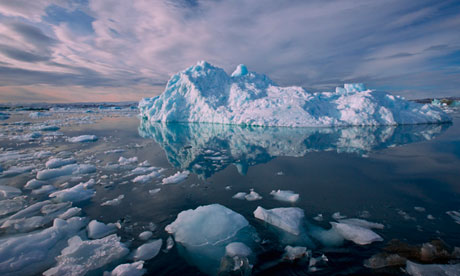
    Leading Arctic expert Prof Wadhams warns that a summer ice free Arctic in 2 years could trigger dangerous methane release. Photograph: Jenny E Ross/Corbis

    A new paper in the journal Nature argues that the release of a 50 Gigatonne (Gt) methane pulse from thawing Arctic permafrost could destabilise the climate system and trigger costs as high as the value of the entire world’s GDP. The East Siberian Arctic Shelf’s (ESAS) reservoir of methane gas hydrates could be released slowly over 50 years or “catastrophically fast” in a matter of decades – if not even one decade – the researchers said.

    Not everyone agrees that the paper’s scenario of a catastrophic and imminent methane release is plausible. Nasa’s Gavin Schmidt has previously argued that the danger of such a methane release is low, whereas scientists like Prof Tim Lenton from Exeter University who specialises in climate tipping points, says the process would take thousands if not tens of thousands of years, let alone a decade.

    But do most models underestimate the problem? A new paper in Proceedings of the National Academy of Sciences (PNAS) projects that the Arctic will be ice free in September by around 2054-58. This, however, departs significantly from empirical observations of the rapid loss of Arctic summer sea ice which is heading for disappearance within two or three years according to Nature co-author and renowned Arctic expert Prof Peter Wadhams, head of the Polar ocean physics group at Cambridge University.

    If Prof Wadhams is correct in his forecast that the summer sea ice could be gone by 2015, then we might be closer to the tipping point than we realise. To get to the bottom of the scientific basis for the Nature paper’s scenarios, I interviewed Prof Wadhams. Here’s what he had to say:

    How long do we have before the Arctic summer sea ice disappears?

    Given present trends in extent and thickness, the ice in September will be gone in a very short while, perhaps by 2015. In subsequent years, the ice-free window will widen, to 2-3 months, then 4-5 months etc, and the trends suggest that within 20 years time we may have six ice-free months per year.

    Why do the climate models not match empirical observations – and why is your estimate of the Arctic sea ice disappearance so different from most model projections?

    The modellers did not pay sufficient regard to observations, especially of ice thickness. They considered certain physical processes in the model, then when the rate of retreat greatly outstripped the predictions of the model, they ignored the observations and stuck with the model. A very great physicist, Richard Feynmann, said that when a model comes up against measurements that contradict it, it is the measurements that must be preferred and the model must be abandoned or changed. Scientists who have a lot of their credibility bound up in a model are reluctant to do this. Then there are a number of key processes that can only be represented if the model has a very fine grid scale, such effects as the break-up of ice due to waves generated in the large areas of open water that we now have in summer; or the additional weakening of the ice by meltwater pools that melt their way right through the ice sheet. A modeller who represents all these fine scale processes is Wiselaw Maslowsky (Monterey) and his models agree with my empirical predictions.

    Our global emissions trajectory is already on track to breach 2C in coming decades. What does a 2C world imply for the Arctic melt and the potential for methane release?

    We are already in a 2C world in terms of the heating potential of carbon dioxide that we have already put into the atmosphere. The heating will reach 2C before 2050 and will then go on to 3-4C globally by the end of the century. Even a 2C world involves the probable loss of Arctic sea ice for much of the year (and 4C for most of it), which will ensure maximum methane release from the exposed shallow seas of the continental shelves.

    What does the loss of the Arctic summer sea ice mean for the climate? How will this impact on society and the economy?

    Our own model shows that the methane release from the ice retreat will add about 0.6C to global warming by 2040. Adding on the faster sea level rise, and trend towards greater extremes in weather (due to jet stream displacement) means increased risk of catastrophic floods in less developed countries and a decrease in food production at a time when world population is rapidly increasing.

    What is the link between permafrost melt, methane release and the loss of the Arctic sea ice? After 2015, if the Arctic becomes ice free in the summer, is there a heightened danger of methane release?

    The loss of sea ice leads to seabed warming, which leads to offshore permafrost melt , which leads to methane release, which leads to enhanced warming, which leads to even more rapid uncovering of seabed. If a large release has not occurred by 2016 the danger will be continuously increasing. It is thought that at 2-3C of global warming, which means 6-8C of Arctic warming, methane release from permafrost on land will be greatly increased.

    Some people say that a catastrophic methane release over 10 years – your worst-case scenario – is a very low probability event and we don’t really need to worry about it. What’s your response to that?

    Those who understand Arctic seabed geology and the oceanography of water column warming from ice retreat do not say that this is a low probability event. I think one should trust those who know about a subject rather than those who don’t. As far as I’m concerned, the experts in this area are the people who have been actively working on the seabed conditions in the East Siberian Sea in summer during the past few summers where the ice cover has disappeared and the water has warmed. The rapid disappearance of offshore permafrost through water heating is a unique phenomenon, so clearly no “expert” would have found a mechanism elsewhere to compare with this.

    Would Arctic experts agree with you?

    I think that most Arctic specialists would agree that this scenario is plausible.

    What about scientists like Prof Tim Lenton, a climate tipping point expert, who argues that a methane release is a long-term problem, not an immediate danger?

    His earlier conclusions are out of date. His oft-cited paper on tipping points is two years old now and was based on literature surveys rather than direct research. An ice-free summer (September) Arctic is clearly nearly upon us, and will be achieved within three years or less – this is plain from the observational data on ice extent (satellites) and thickness (submarines and altimeter satellites). I am sure that he is about to revise his views if he hasn’t already done so.

    Dr Nafeez Ahmed is executive director of the Institute for Policy Research & Development and author of A User’s Guide to the Crisis of Civilisation: And How to Save It among other books. Follow him on Twitter @nafeezahmed

  • Vast costs of Arctic change

    Vast costs of Arctic change
    Methane released by melting permafrost will have global impacts that must be better
    modelled, say
    Gail Whiteman
    ,
    Chris Hope
    and
    Peter Wadhams
    .
    U
    nlike the loss of sea ice, the vulner

    ability of polar bears and the rising
    human population, the economic
    impacts of a warming Arctic are being
    ignored.
    Most economic discussion so far assumes
    that opening up the region will be beneficial.
    The Arctic is thought to be home to 30% of
    the world’s undiscovered gas and 13% of its
    undiscovered oil, and new polar shipping
    routes would increase regional trade
    1,2
    . The
    insurance market Lloyd’s of London esti

    mates that investment in the Arctic could
    reach US$100 billion within ten years
    3
    .
    The costliness of environmental damage
    from development is recognized by some,
    such as Lloyd’s
    3
    and the French oil giant
    Total, and the dangers of Arctic oil spills are
    the subject of a current panel investigation
    by the US National Research Council. What
    is missing from the equation is a worldwide
    perspective on Arctic change. Economic
    modelling of the resulting impacts on the
    world’s climate, in particular, has been scant.
    We calculate that the costs of a melting
    Arctic will be huge, because the region is
    pivotal to the functioning of Earth systems
    such as oceans and the climate. The release
    of methane from thawing permafrost
    beneath the East Siberian Sea, off northern
    Russia, alone comes with an average global
    price tag of $60 trillion in the absence of
    mitigating action — a figure comparable to
    the size of the world economy in 2012 (about
    $70 trillion). The total cost of Arctic change
    will be much higher.
    Much of the cost will be borne by devel

    oping countries, which will face extreme
    weather, poorer health and lower
    Pipes transport oil from rigs on Endicott Island in Alaska.
    B&C ALEXANDER/ARCTICPHOTO
    25 JULY 2013 | VOL 499 | NATURE | 401
    COMMENT
    © 2013 Macmillan Publishers Limited. All rights reserved
    agricultural production as Arctic warming
    affects climate. All nations will be affected, not
    just those in the far north, and all should be
    concerned about changes occurring in this
    region. More modelling is needed to under

    stand which regions and parts of the world
    economy will be most vulnerable.
    ECONOMIC TIME BOMB
    As the amount of Arctic sea ice declines
    at an unprecedented rate
    4,5
    , the thawing of
    offshore permafrost releases methane. A
    50-gigatonne (Gt) reservoir of methane,
    stored in the form of hydrates, exists on the
    East Siberian Arctic Shelf. It is likely to be
    emitted as the seabed warms, either steadily
    over 50 years or suddenly
    6
    . Higher meth

    ane concentrations in the atmosphere will
    accelerate global warming and hasten local
    changes in the Arctic, speeding up sea-ice
    retreat, reducing the reflection of solar
    energy and accelerating the melting of the
    Greenland ice sheet. The ramifications will
    be felt far from the poles.
    To quantify the effects of Arctic meth

    ane release on the global economy, we used
    PAGE09. This integrated assessment model
    calculates the impacts of climate change and
    the costs of mitigation and adaptation meas

    ures. An earlier version of the PAGE model
    was used in the UK government’s 2006 Stern
    Review on the Economics of Climate Change
    to evaluate the effect of extra greenhouse-gas
    emissions on sea level, temperature, flood
    risks, health and extreme weather while taking
    account of uncertainty
    7
    . The model assesses
    how the net present value of climate effects
    varies with each tonne of carbon dioxide
    emitted or saved.
    We ran the PAGE09 model 10,000 times to
    calculate confidence intervals and to assess
    the range of risks arising from climate change
    until the year 2200, taking into account sea-
    level changes, economic and non-economic
    sectors and discontinuities such as the melt

    ing of the Greenland and West Antarctic
    ice sheets (see Supplementary Information;
    go.nature.com/rueid5). We superposed
    a decade-long pulse of 50 Gt of methane,
    released into the atmosphere between
    2015 and 2025, on two standard emissions
    scenarios. First was ‘business as usual’:
    increasing emissions
    of CO
    2
    and other
    greenhouse gases
    with no mitigation
    action (the scenario
    used by the Inter

    governmental Panel
    on Climate Change
    Special Report on
    Emissions Scenarios
    A1B). Second was a ‘low-emissions’ case, in
    which there is a 50% chance of keeping the
    rise in global mean temperatures below 2°C
    (the 2016r5low scenario from the UK Met
    Office). We also explored the impacts of later,
    longer-lasting or smaller pulses of methane.
    In all of these cases there is a steep global
    price tag attached to physical changes in
    the Arctic, notwithstanding the short-term
    economic gains for Arctic nations and some
    industries.
    The methane pulse will bring forward by
    15–35 years the average date at which the
    global mean temperature rise exceeds 2°C
    above pre-industrial levels — to 2035 for the
    business-as-usual scenario and to 2040 for
    the low-emissions case (see ‘Arctic methane’).
    This will lead to an extra $60 trillion (net pre

    sent value) of mean climate-change impacts
    for the scenario with no mitigation, or 15%
    of the mean total predicted cost of climate-
    change impacts (about $400 trillion). In the
    low-emissions case, the mean net present
    value of global climate-change impacts is
    $82 trillion without the methane release;
    with the pulse, an extra $37 trillion, or 45%
    is added (see Supplementary Information).
    These costs remain the same irrespective of
    whether the methane emission is delayed
    by up to 20 years, kicking in at 2035 rather
    than 2015, or stretched out over two or three
    decades, rather than one. A pulse of 25 Gt of
    methane has half the impact of a 50 Gt pulse.
    The economic consequences will be
    distributed around the globe, but the model

    ling shows that about 80% of them will occur
    in the poorer economies of Africa, Asia and
    South America. The extra methane magni

    fies flooding of low-lying areas, extreme heat
    stress, droughts and storms.
    GLOBAL PROBLEM
    The full impacts of a warming Arctic, includ

    ing, for example, ocean acidification and
    altered ocean and atmospheric circulation,
    will be much greater than our cost estimate
    for methane release alone.
    To find out the actual cost, better models
    are needed to incorporate feedbacks that
    JOSH HANER/
    THE NEW YORK TIMES
    /REDUX/EYEVINE
    Bubbles of methane emerge from sediments below a frozen Alaskan lake.
    402 | NATURE | VOL 499 | 25 JULY 2013
    COMMENT
    “There is a
    steep global
    price tag
    attached
    to physical
    changes in the
    Arctic.”
    © 2013 Macmillan Publishers Limited. All rights reserved