Category: Uncategorized

  • New model could give 12 months warning on El Niño

    New model could give 12 months warning on El Niño

    Updated 1 hour 37 minutes ago

    Scientists hope a new method for forecasting El Niño weather events earlier will help Pacific farmers and fishermen adapt to droughts and floods.

    El Niño weather events lead to floods in the eastern Pacific and droughts in the west, severely affecting agriculture and fishing.

    El Niños typically happen every two to seven years, but current techniques measuring water temperature only allow scientists to forecast at most six months in advance.

    Professor Armin Bunde, from the University of Giessen in Germany, has told Pacific Beat their approach is different.

    “We do not consider the water temperature, but we consider the atmospheric temperature in all areas of the Pacific Ocean,” he said.

    “Then we study how the temperatures at different place in the Pacific are linked to each other…so by doing this we find that well before an El Niño event – in the year before – the data connections build up strongly.

    “This…we can use to forecast an El Niño event [and] when we do this we find that we succeed in forecasting seven out of ten El Niños, with less than one false alarm in 20 years.”

    Professor Bunde says the ability to predict El Nino’s further in advance allows those most at risk from unusual weather patterns to plan ahead.

    “During an El Niño in the west the water gets colder, there’s less evaporation and this may lead to droughts,” he said.

    “In the east where the water gets warmer, this may lead to heavy rainfall and floods.

    “Both results – droughts in the west and floods in the east – are bad for agriculture.”

    “By predicting El Niño events one year in advance, one can help the farmers to adapt better – to invest in drought or flood resistant crops.”

    Australian lecturer in climate change research, Dr Alex Sen Gupta, has told ABC Science the new model is “almost too good to be true”.

    “There’s no real physics behind it,” he said.

    “At the moment they’ve found a pattern, but they’re not really explaining where that pattern comes from.

    “I think give it another two or three El Niños and if it predicts those correctly more than a year in advance you’d start to think we’re on to something.”

    El Niño is Spanish for “the child”, named after the baby Jesus because it often appeared off Peru around Christmas.

    The pattern has been known to cause drought in some parts of Australia, Indonesia, and South America and heavy flooding in places like Peru and Ecuador.

    It’s also been linked to severe winters in Europe, unusual monsoons in East Asia and hurricanes in the Caribbean.

    Topics: weather, agricultural-crops, climate-change, germany, pacific, australia

    First posted 2 hours 15 minutes ago

  • Shock at Damage to Sydney Drinking Water Catchment Areas

    Shock at mining damage to Cordeaux Catchment
    by Stop Mining in Sydney Drinking Water Catchments (Notes) on Saturday, 6 July 2013 at 00:14

    Below a recent media statement from John Wrigley, a retired manager for Sydney Water, following an inspection of Cordeaux dam.


    Shock at Damage to Sydney Drinking Water Catchment Areas

    July 2013


    A recent inspection of the damage apparently caused by long-wall coal mining on the Cordeaux Catchment Area of Sydney and the Macarthur area’s water supply has shocked a former catchment manager.


    John Wrigley who worked for twenty four years managing the areas was horrified to see the devastation caused to the natural bushland areas above the coal mining. “I saw previously beautiful waterfalls and ponds now totally dry, unnatural red staining of creek lines with iron leachates, dying vegetation and widespread cracking of natural rock surfaces. I urge more people to show an interest in seeing this damage to the beautiful catchments. We can no longer trust government decision-making of either political party to protect our catchments for posterity. In a series of appalling decisions, most of the catchments of Woronora, Cataract, Cordeaux, Avon and Nepean Dams are now in line for similar damaging treatment by mining companies. And no politician seems to care!


    The irony is that these areas are closed to public visitation for good reason of prevention of pollution, but that the much more serious damage to the catchments’ integrity is being caused by the state government’s own decisions to allow this industrial-scale damage to occur.


    Don’t just take my word for it. I urge our local state members of parliament and the public to come out and see these areas for themselves. After over one hundred years of careful protection they are otherwise in a beautiful condition. But ‘Blind Freddy’ can see the appalling damage the underground mining is doing to them. The damage can be easily seen, I believe, to be directly above where the latest Dendrobium Mine long-wall activities are, of the BHP Billiton-Illawarra Coal Company.  All the damage was predicted by witnesses and in submissions in the decision making process and which are now seen to have been correct. We can no longer leave it to government ‘experts’ who are often seen to be associated with the mining industry lobby and powerbrokers.”


    John Wrigley OAM

    BSc Forestry, Dip Environmental Studies.


  • Climate Change Conjures Up ‘Alarming’ Scenarios In Southeast Asia – Analysis July 7, 2013

    Climate Change Conjures Up ‘Alarming’ Scenarios In Southeast Asia – Analysis

    July 7, 2013

    By

    By Parameswaran Ponnudurai

    Imagine these scenarios: The rice bowl of Vietnam cracking. Popular diving spots in the Philippines, Malaysia, and Indonesia lying idle with no tourists. Nearly half of Bangkok inundated with water.

    Well, they could become a reality in 20 to 30 years—no thanks to the adverse effects of climate change in Southeast Asia exacerbated by forest fires particularly in Indonesia which recently blanketed the region with deadly smoky haze.

    Scientists warn in a new World Bank report of major impacts on the region if the temperature rises by up to 2 degrees Celsius—warming which they say may be reached in two to three decades—fueled by the burning of fossil fuels and deforestation.

    The warming climate will push up the sea level in the region and cause an increase in heat extremes, a higher intensity of tropical cyclones, and ocean acidification stemming from excess carbon dioxide in the air, according to the latest edition of the bank’s “Turn Down the Heat” report.

    The scientific report predicts a drop in agricultural production and widespread food shortages, rapidly diminishing fish catch, increasing water- and vector-borne diseases, and diarrheal illnesses, impacting mostly the urban poor, who constitute large proportions of city populations in the region.

    The climate change effects will also dampen the region’s tourism industry, a top money-spinner, as coral reefs in pristine waters that lure divers and help fish breed are rapidly destroyed.

    ‘Alarming scenario’

    The World Bank issued its first “Turn Down the Heat” report last year, likening it to a wake-up call to climate change. It concluded that the world would warm by 4 degrees Celsius by the end of this century if no concerted action is taken.

    In the new report, scientists say that if the temperature rises by just 2 degrees Celsius, warming may be reached in 20 to 30 years.

    It gives a more detailed look at how the ongoing negative impacts of climate change could create devastating conditions especially for those vulnerable, predicting what the bank’s chief Jim Yong Kim calls an “alarming scenario for the days and years ahead.”

    “The displacement of impacted rural and coastal communities resulting from the loss of livelihood into urban areas could lead to ever higher numbers of people in informal settlements being exposed to multiple climate impacts, including heat waves, flooding, and disease,” the report said.

    “Basically, you’ll have a range of impacts on countries but the incidence on that will fall disproportionately on poor people, because fisheries and agriculture [are the key areas to be affected],” John Roome, the bank’s director for sustainable development in the East Asia Pacific Region, told RFA.

    He said that while there is greater awareness by governments to combat climate change, efforts needed to be accelerated by putting in place early warning, monitoring and evaluation systems, and allocating special budgets to mitigate the crisis.

    “The alarming part is that a 4-degree world [where the temperatures are 4 degrees warmer] is not going to be a very pleasant place to live in for all the reasons that are set out in the report but there are things that can be done if countries act soon to stem the temperature rise so that [the rise] doesn’t reach 4 degrees,” Roome said.

    Mekong Delta crop production drop

    The new report, based on analysis using advanced computer simulations to paint the clearest picture of vulnerabilities, says that as early as 2040, Southeast Asia’s major rice-growing region—the Mekong River Delta in Vietnam—will see crop production drop by about 12 percent due to an estimated sea-level rise of 30 cm (nearly 1 foot).

    The Mekong Delta, popularly known as the “rice bowl” of Vietnam and home to some 17 million people, makes up half of Vietnam’s total agricultural production and contributes significantly to the country’s rice exports.

    “Any shortfall in rice production in this area because of climate change would not only affect the economy and food security of Vietnam but would also have repercussions for the international rice market,” the report said.

    The Mekong Delta is also Vietnam’s most important fishing region. It is home to almost half of Vietnam’s marine fishing vessels and produces two thirds of Vietnam’s fish from aquaculture.

    But saltwater intrusion associated with sea-level rise is already affecting freshwater and brackish aquaculture farms.

    By 2050, the sea-level rise is expected to increase by over 30 percent of the total current area—1.3 million hectares— affected by saltwater intrusion in the delta, the report said.

    Sea levels rising

    It also warns that floods due to sea-level rise will engulf 43 percent of Thailand’s capital Bangkok around 2025, and about 70 percent in 2100.

    Bangkok together with Jakarta, Yangon, Manila, and Ho Chi Minh City are projected to be among cities in Southeast Asia to be most affected by sea-level rise and increased storm surges.

    Coral reefs, fish catches vulnerable

    The report said that rising ocean acidity caused by excessive carbon dioxide will lead to a significant loss of coral reefs and the benefits they provide as fish habitats, protection against storms, and revenue-generators in the form of tourism.

    Thailand, Indonesia, the Philippines, Myanmar, and Cambodia were cited as “among the most vulnerable tourism destinations.”

    Based on the projections, all coral reefs in the Southeast Asia region are very likely to experience severe thermal stress by the year 2050, as well as chemical stress due to ocean acidification.

    “Coral bleaching and reef degradation and losses are very likely to accelerate in the next 10–20 years; hence, revenue generated from diving and sport fishing also appears likely to be affected in the near term,” the report said.

    It also said that ocean fish catch in the southern Philippines is expected to be slashed by half due to warmer water temperatures and habitat destruction.

    Fish in the Java Sea in Indonesia and the Gulf of Thailand are also projected to be severely affected, with “very large reductions” in average maximum body size by 2050.

    Weather extremes and forest fires

    Scientists are also forecasting a significant increase in Southeast Asia in the intensity and maximum wind speed of tropical cyclones making landfall. Heat extremes are expected to surge in the region.

    More important, Southeast Asia is one of two regions—the other being the Amazon—which is projected to see, in the “near-term,” a strong increase in monthly heat extremes with the number of warm days projected to increase to 45–90 days per year under a 2-degree temperature rise scenario or to 300 days in a 4-degree scenario.

    The heat scare has also fueled concerns over a rise in brush, forest, and peat fires across Indonesia’s Sumatra Island and in nearby Borneo Island.

    Such fires recently caused a smoky haze in Indonesia, Malaysia, and Singapore and raised air pollution to hazardous levels.

    The burning “causes a short-term problem with the smoky haze but in the medium- and longer-term would exacerbate climate change and warming,” Roome said, calling for a concerted regional action to stem the crisis.

    “If countries could put in place actions that could better manage the forest resource and the peat land to preserve the green cover and to preserve peat land, you will get two benefits—in the short term you wouldn’t get the smoky haze and in the medium and longer term, it would reduce the impact on climate change,” he said.

    In all of East Asia, the biggest contribution to global warming come from China, particularly its energy sector, but the second biggest culprit is forest cutting in Indonesia, the biggest Southeast Asian nation.

    “So one of the most important ways of mitigating climate change in Southeast Asia is to mitigate the reduction of forest cover—stop the rate at which forests are being burned or being chopped and stop the conversion of peat land,” Roome said.

  • These dew ponds have been on the Downs possibly since medieval times

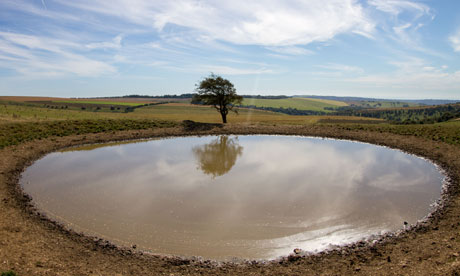
    These dew ponds have been on the Downs possibly since medieval times

    North Stoke, near Arundel: The chalky soil allows rainwater to drain straight down into the ground, so farmers dug circular troughs to catch water for their flocks

    Country Diary: A tree is reflected in a dew pond on the South Downs

    A tree is reflected in a dew pond on the South Downs. Photograph: Paul Mansfield/Getty Images/Flickr RF

    The trees cast long shadows over the curving slopes of the South Downs as the sun rises. Dark clouds dissipate and drift off towards the sea. A chalk and grass track winds up and down into the distance. Beside the track is a large dish-shaped mound, edged by bushes. This dew pond – as with the others along the Downs – has been here as long as the sheep, possibly dating back to medieval times. The chalky soil allows rainwater to drain straight down into the ground, so farmers dug circular troughs to catch water for their flocks.

    The base of the pond was usually lined with straw and puddled clay, which was wetted and beaten down to create an impermeable surface. A layer of burnt lime was used to stop worms breaking up the clay. It was once thought that the main source of water was the dew but the ponds simply catch rain. Sheep still graze in the neighbouring field.

    Nearby, in one of the field margins, an open area attracts dozens of rabbits, which hop, chase, chew and wash. A grey partridge stands guard while its chicks bounce around it. A brown hare emerges from the tall grass and flowers, its black-tipped ears flicking over its back. Soft peewit cries announce the arrival of a group of five lapwings. They too linger on the chalk, picking up insects among the stones and small flowers. One of the lapwings is paler than the others, with scalloping on its lighter green back, and grey-green neck markings. Its short tuft is the final clue that this is a juvenile – a very rare sign that these birds still breed on the South Downs.

    Suddenly the rabbits dart for cover and the young lapwing scurries into the long grass while two adults swoop into the air, calling furiously. The low-flying shapes of two red kites cast broad shadows across the ground. The lapwings dive-bomb the raptors, which unhurriedly float away over the fields and down the slopes.

  • Methane leaks may burst natural-gas bubble

    Originally published Saturday, July 6, 2013 at 8:03 PM

    Methane leaks may burst natural-gas bubble

    President Obama’s climate-change plan calls for a closer look at the scope of leaks from gas wells, pipelines and compressor plants. Depending on what is found, new regulations could be imposed.

    By Mark Drajem

    Bloomberg News

    PREV 1 of 5 NEXT

    Contractors work on a  natural-gas power plant under construction in Utah. The administration has been upbeat on natural gas.

    Enlarge this photoGeorge Frey / Bloomberg

    Contractors work on a natural-gas power plant under construction in Utah. The administration has been upbeat on natural gas.

    A natural-gas pipeline burns after an explosion last month in a wooded area of  Louisiana.

    Enlarge this photoMike Haley / Washington Parish Sheriff’s Office

    A natural-gas pipeline burns after an explosion last month in a wooded area of Louisiana.

    President Obama is seeking an accounting of leaks in the production of natural gas.

    Enlarge this photoThe Associated Press

    President Obama is seeking an accounting of leaks in the production of natural gas.

    Protesters rally against fracking, or hydraulic fracturing, at the Capitol in Albany, N.Y., last month. Some citizen and activist groups blame fracking for contaminating water.

    Enlarge this photoTim Roske / The Associated Press

    Protesters rally against fracking, or hydraulic fracturing, at the Capitol in Albany, N.Y., last month. Some citizen and activist groups blame fracking for contaminating water.

    Workers oversee the transfer of sand from  trucks at a natural-gas production site in Camptown, Pa. The expanding use of a drilling technique known as fracking has boosted natural-gas production.

    Enlarge this photoJulia Schmalz / Bloomberg

    Workers oversee the transfer of sand from trucks at a natural-gas production site in Camptown, Pa. The expanding use of a drilling technique known as fracking has boosted natural-gas production.

    Related

    Most Popular Comments

    Hide / Show comments

    No comments have been posted to this article.
    Start the conversation >

    advertising

    Click here

    Riding shotgun in a Toyota 4Runner rigged with a carbon-fiber pipe and a spectrometer, Duke University researcher Rob Jackson trolled through Washington, D.C., searching for evidence that natural gas is not quite the climate champion President Obama claimed last month.

    He was replicating a study he did in Boston, measuring leaks from creaky natural-gas pipes. In addition to being a possible safety risk, methane, the key component of natural gas, is 25 times as potent a greenhouse gas as carbon dioxide. And leaks may undercut much of the climate benefits of gas.

    “First and foremost this is a greenhouse-gas question,” Jackson said as he drove near the Capitol. “What we are trying to find out is how big a problem this is for cities.”

    In a climate plan released with a speech at Georgetown University on June 25, Obama called for an accounting of leaks across the natural-gas production and transport sector. The address was mostly upbeat for gas, highlighting the benefits of shifting from coal, and shares of gas companies such as Chesapeake Energy and Cabot Oil & Gas rose.

    “We should strengthen our position as the top natural-gas producer because, in the medium term at least, it not only can provide safe, cheap power, but it can also help reduce our carbon emissions,” Obama said. “It’s the transition fuel that can power our economy with less carbon pollution.”

    Included in the fine print of the White House climate plan, however, are measures that could complicate the industry’s growth, such as a closer look at the scope of leaks from gas wells, pipelines and compressor plants. Depending on what it finds, new regulations could be imposed.

    Obama also called for new and upgraded pipelines to reduce leaks. And an “interagency methane strategy” was announced to get a better handle on emissions data and identifying technologies and opportunities to cut them.

    This comes on top of a proposal by the Environmental Protection Agency (EPA) in April to change its calculation of methane’s climate intensity. The agency said it is considering raising the global-warming potential multiplier for methane to 25 from 21, a change that would increase the official estimate of U.S. emissions, which had been declining. Last year, they were down more than 12 percent from the peak in 2007, the steepest drop since the late 1970s.

    Critics such as Cornell University engineering professor Tony Ingraffea say that even at 25, the EPA is under counting the true threat.

    “Any decrease in carbon-dioxide emissions is more than offset by the methane,” Ingraffea said. The EPA is looking at the impact of methane over 100 years, “but we don’t have a hundred years to do something about global warming.”

    Scope of leakage

    The issue has gained importance as natural-gas production in the U.S. has soared, boosted by the expanding use of a drilling technique known as hydraulic fracturing that frees gas trapped in shale deposits deep underground. That boom drove prices to decade lows last year.

    Burning coal produces twice the carbon-dioxide emissions as natural gas, and carbon dioxide remains in the atmosphere for up to 200 years compared with 12 years for methane, according to the EPA.

    The scope of gas leakage is the key to determining what climate benefit natural gas delivers over coal, which accounted for 37 percent of electricity generation last year, down from 49 percent in 2007. As rules from the EPA curb coal use, determining where gas leaks are happening and stopping them is the key to making sure one climate pollutant doesn’t replace another, according to environmental groups such as the World Resources Institute.

    “Given the support we’ve seen for natural gas in this administration and the way the industry has grown and is expected to grow, getting a handle on these emissions is really important,” said James Bradbury, a senior associate in the climate program at the institute. “While natural gas is better than coal, coal is a very poor benchmark to use.”

    Gas versus coal

    The gas industry responded largely favorably to Obama’s climate plan, a different response than coal producers and coal-state governors who trashed the plan as a job killer.

    “We now have a great opportunity to explain the role natural gas can play,” said Paula Gant, senior vice president of policy and planning at the American Gas Association. Gas is “part of the climate solution the president highlighted.”

    The gas utilities are spending $7 billion a year upgrading their pipeline and delivery systems, and partnering with the Environmental Defense Fund on what else they can do to cut down on any methane losses, she said.

    “We want to continue to find ways to drive down” emissions, she said. “Gas is the future.”

    For many environmental groups, that’s just what they fear. They warn that the short-term benefits of switching to natural gas may not be worth long-term problems, making it a poor “transition fuel.”

    On the local level, hydraulic fracturing, or fracking, is blamed for contaminating water by some citizens and activist groups.

    “The president’s ongoing infatuation with natural gas was one false step,” Stephen Kretzmann, executive director of Oil Change International, said in a statement that broadly praised Obama’s climate speech.

    Methane releases

    The climate impact of methane is another concern. In December, seven states notified the EPA that it would sue the agency for failing to adopt curbs on methane from oil and gas drilling. And the scope of those emissions are a matter of dispute, with industry and critics awaiting a study by the Environmental Defense Fund that will serve as a new benchmark. It’s scheduled to be released in the coming weeks.

    For Jackson, who funded his study through the Nicholas School of the Environment at Duke, his part of the equation is to find out how much methane is leaking out once the gas is being piped to homes.

    In Washington, D.C., he is spending a week in a silver 4Runner, outfitted with the pipe sticking up 8 feet to determine how high the flume of gas is rising, an anemometer on the roof to measure wind speed, and the spectrometer in the rear for methane readings. At sites with especially high readings, the researchers get out of the car to test inside manholes by hand.

    In Boston, his team found 3,356 leaks with concentrations up to 15 times naturally occurring levels, according to the study published last year. In D.C., they have found the number of leaks are fewer per mile, but each one is bigger.

    “So far the cities look leakier than people anticipated,” Jackson said.

  • Allowable carbon emissions lowered by multiple climate targets

    Allowable carbon emissions lowered by multiple climate targets

    Published 5 July 2013 Science Leave a Comment
    Tags: , ,

    Climate targets are designed to inform policies that would limit the magnitude and impacts of climate change caused by anthropogenic emissions of greenhouse gases and other substances. The target that is currently recognized by most world governments1 places a limit of two degrees Celsius on the global mean warming since preindustrial times. This would require large sustained reductions in carbon dioxide emissions during the twenty-first century and beyond2, 3, 4. Such a global temperature target, however, is not sufficient to control many other quantities, such as transient sea level rise5, ocean acidification6, 7 and net primary production on land8, 9. Here, using an Earth system model of intermediate complexity (EMIC) in an observation-informed Bayesian approach, we show that allowable carbon emissions are substantially reduced when multiple climate targets are set. We take into account uncertainties in physical and carbon cycle model parameters, radiative efficiencies10, climate sensitivity11 and carbon cycle feedbacks12, 13 along with a large set of observational constraints. Within this framework, we explore a broad range of economically feasible greenhouse gas scenarios from the integrated assessment community14, 15, 16, 17 to determine the likelihood of meeting a combination of specific global and regional targets under various assumptions. For any given likelihood of meeting a set of such targets, the allowable cumulative emissions are greatly reduced from those inferred from the temperature target alone. Therefore, temperature targets alone are unable to comprehensively limit the risks from anthropogenic emissions.


    Steinacher M., Joos F. & Stocker T. F., in press. Allowable carbon emissions lowered by multiple climate targets. Nature. Article (subscription required).