Category: Uncategorized

  • Bradford’s branding – Methane issues.

    Bradford’s branding

    National Media Museum Bradford

    National Media Museum: an exercise in the dark arts of rebranding?

    The difficulties at the National Media Museum (Report, 3 July) might be to do with the redevelopment of Bradford city centre and associated building work, but the fall in visitor numbers could also be linked to the change in name. The National Museum of Photography, Film and Television may have been a bit of a mouthful, but had something people could relate to, whereas the NMM is vague and does not resonate with the majority of potential visitors. Branding and rebranding are dark arts affecting the way things are perceived, and in this case may have back-fired.
    Nigel Hamilton
    Oxford

    • It’s a lot worse than David England thinks (Letters, 2 July). Methane actually has 21 times the greenhouse effect of carbon dioxide so just the leakage of 16% of methane causes 3.36 times as much greenhouse effect as burning it. All in all that would make it a far dirtier fuel than coal, which is only about twice as bad.
    Peter Hanson
    Exeter

    • Someone should tell Nursultan Nazarbayev that the prime minister of the UK is not an elected position (‘I’d vote for you’, 2 July). He could only vote for Cameron (as his local MP) if he lived in the constituency of Witney. Perhaps he is planning to move there?
    Michael Short
    St Leonards-on-Sea, East Sussex

    Derek Middlemiss is obviously correct about your unwillingness to review what are essentially cover bands (Letters, 3 July), and while you’re about it, there’s too much coverage of artists enacting other people’s plays rather than their own. And don’t get me started about those so-called “dancers” who have never composed a ballet in their lives.
    Martin Skinner
    Leamington Spa, Warwickshire

    • Peter Leach asks how he might become consummate (Letters, 3 July). With ease, Peter, with ease.
    Alan Saunders
    Yattendon, Berkshire

    • Taxpayers, customers, people, fairness and creativity are at the heart of various organisations. Is there any other part of the anatomy they’re ever put?
    Mike Smith
    Southampton

  • That’s deep – scientists harness power of ocean’s currents

    That’s deep – scientists harness power of ocean’s currents

    Posted on 04 July 2013 by Vicky Ellis

    That’s deep – scientists harness power of ocean’s currents

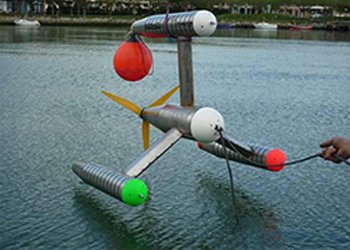
    Scientists in Madrid say they have designed a device which could harness the power of ocean currents in deeper water and potentially at a cheaper cost than existing technology.

    Researchers at Madrid’s Polytechnic University (UPM) conducted sea trials of their remote controlled prototype which can anchor underwater at about 40 metres with the help of a buoy and can be made to float to the top for repairs. First generation underwater ocean devices were limited to 30-35 metres, say the researchers.

    Made from stainless steel it has a cylindrical central body and three external parts which resemble rockets attached by arms. These arms turn like a rotor in ocean currents to power the generator. The device is built at a tenth of the size of an industrial unit which could generate 1MW of electricity.

    The university said test results were “very successful” and showed the prototype hit their objectives of “reducing costs of construction, installation and maintenance”.

  • Coalition to reduce funds available for ‘green army’ of environment volunteers

    Coalition to reduce funds available for ‘green army’ of environment volunteers

    Tony Abbott says it will now take five years for ‘troop’ numbers to reach the 15,000 initially promised

    tony abbott georges river

    Tony Abbott (left) plants a tree as part of the bush regeneration works in Carss bush park in Kogarah. Sydney on Friday. Photograph: AAP Image/Damian Shaw

    Tony Abbott has pared back the money available to his “green army”, recommitting to the 2010 election policy but saying it will now take five years for its “troops” to grow to the promised 15,000.

    In 2010 Abbott’s green army – a voluntary program for 17-to-24 year olds to do practical environmental work – was allocated $400 million over four years. The 2013 version has $300 million to spend.

    In both 2010 and 2013 the program began with a $50 million allocation. In 2010, that was estimated to be enough to pay for 4000 six-month training places, or 2000 army recruits at any one time. In 2013, after increases in the national training wage, the starting numbers in the army would have to be fewer than 2000.

    The Coalition has not provided a detailed year-by-year cost breakdown for the 2013 version of the green army. It says it will still build to a 15,000 strong workforce, but this will now take five years. In the first four years no more than the new allocation of $300 million will be available. It says that will be enough for 1,500 projects.

    Announcing the policy yesterday, the opposition leader said one of the first green army projects would be along the Georges River in Sydney.

    Army recruits can be school leavers, students on a gap year, or young unemployed for whom it can act as an alternative work for the dole program. It will be administered by the environment department and projects will be chosen for their environmental benefit, contribution to the local community and capacity to provide the participants with training in specific skills.

    As examples of possible projects, the coalition policy paper cites weed eradication, construction of sea walls, rehabilitating river banks and restoring walking tracks.

    Abbott said the army “complements” the coalition’s “direct action” approach to climate change.

    “At the same time as improving the local environment, the green army will foster teamwork, local ownership and community spirit in our young people,” he said.

    Daily Email

    close

    Sign up for the Guardian Today

    Our editors’ picks for the day’s top news and commentary delivered to your inbox each morning.

    Sign up for the daily email

    Daily Email

    close

    Get the Guardian’s daily US email

    Our editors’ picks for the day’s top news and commentary delivered to your inbox each morning. Enter your email address to subscribe.

    Sign up now
    Daily Email

    close

    Get the Guardian’s daily Australia email

    Our editors’ picks for the day’s top news and commentary delivered to your inbox every weekday.

  • China’s largest algal bloom turns the Yellow Sea green

    China’s largest algal bloom turns the Yellow Sea green

    The algae, which can suffocate marine life, is thought to be caused by pollution from agriculture and industry

    Tourists bath at a beach covered by a thick layer of green algae in Qingdao, China.

    Tourists bath at a beach covered by a thick layer of green algae in Qingdao, China. Photograph: ChinaFotoPress/Getty Images

    The largest algal bloom ever recorded in China has turned the Yellow Sea green and may be related to pollution from agriculture and industry.

    Officials in the city of Qingdao had used bulldozers to remove 7,335 tonnes of the growth from beaches according to the Xinhua news agency.

    The phenomenon has become an annual occurrence in the region over the past six summers. This year’s incident has swathed 28 900 sq km (11 158 sq miles), twice as much as the previous biggest bloom in 2008.

    The algae, called Enteromorpha prolifera, is not toxic to humans or animals.

    However the carpet on the surface can dramatically change the ecology of the environment beneath it. It blocks sunlight from entering the ocean and sucks oxygen from the water suffocating marine life.

    The algae thrives on an abundance of nutrients in the sea. University of Cambridge and EnAlgae Project researcher Dr Brenda Parker said that the Chinese bloom may well be linked to industrial pollution.

    “Algal blooms often follow a massive discharge of phosphates or nitrates into the water. Whether it’s farming, untreated sewage or some kind of industrial plant that is discharging waste into the water,” she said.

    The recent explosion of the algae pointed to a dramatic change in the ecosystem which was probably not natural.

    “That would probably be an indicator that something is a little bit unbalanced,” said Parker.

    She said that the 2009 example algal bloom on the Brittany coast was a similar example of a human-induced algal bloom.

  • Dissolution of ophiuroid ossicles on the shallow Antarctic shelf: implications for the fossil record and ocean acidification

    Dissolution of ophiuroid ossicles on the shallow Antarctic shelf: implications for the fossil record and ocean acidification

    Published 3 July 2013 Science Leave a Comment
    Tags: , , , ,

    The brittlestar, Ophionotus victoriae, is abundant in Explorers Cove, offshore Taylor Valley. However its ossicles, composed of high-Mg calcite, have not been reported from Cenozoic cores taken from McMurdo Sound. To identify taphonomic processes we analyzed (1) ossicle dissolution and silhouette area loss during a 2-year in situ experiment in which whole dead brittlestars were suspended above or placed on the sediment-water interface at water depths of 7–25 m; (2) ossicle dissolution in a 27-day, in situ experiment using ossicles freed of soft tissue; (3) porosities of experimental and pristine ossicles; and (4) abundance of ossicles in short cores taken at shallow depths in Explorers Cove. SEM analysis demonstrates significantly higher levels of dissolution in ossicles submerged for two years than in pristine ossicles. Submerged ossicles also had significant breakage reflected in silhouette area loss. During the 27-day experiment, submerged ossicles lost between 0.07 wt% and 1.31 wt%. At the observed rate of dissolution it would take between 6 and 105 years for vertebral ossicles to dissolve completely. Ossicles submerged for two years had a slightly higher mean porosity than pristine ossicles; porosity is controlled by variability in the porous stereom structure as well as dissolution. Results demonstrate that ossicle dissolution starts soon after death and that the stratigraphic record does not accurately reflect the presence and abundance of ophiuroids, thus complicating their use in paleoenvironmental, paleoclimatic, and paleoecologic reconstructions. These results also provide baseline information about CaCO3 skeletal dissolution needed to monitor the ocean acidification that is predicted to affect high-latitude benthic ecosystems within decades.


    Walker B. J., Miller M. F., Bowser S. S., Furbish D. J. & Gualda G. A. R., 2013. Dissolution of ophiuroid ossicles on the shallow Antarctic shelf: implications for the fossil record and ocean acidification. Palaios 28(5): 317-332. Article (subscription required).

  • Unprecedented ocean acidification from greenhouse gases putting Canadian waters at risk, says report

    Unprecedented ocean acidification from greenhouse gases putting Canadian waters at risk, says report

    Published 4 July 2013 Media coverage Leave a Comment

    OTTAWA – Canada’s Atlantic waters may be “particularly vulnerable” to increased carbon dioxide emissions in the atmosphere that are causing “unprecedented” acidification of the planet’s oceans, says a report by scientists at the Department of Fisheries and Oceans.

    Quoting from numerous scientific publications, the government report, posted on a website without a formal announcement or news release, noted that the world’s oceans have absorbed a significant amount of carbon dioxide emissions from the atmosphere since the industrial revolution, with profound effects on marine ecosystems that could damage the Canadian economy.


    The report, which focused on the Scotian Shelf region of Atlantic Canada, says that “adaptive measures coupled with a reduction in carbon dioxide emissions to the atmosphere will have to be pursued to protect ecosystems and human livelihoods against this phenomenon,” since it is not easy to reverse ocean acidification and its effects.

    Carbon dioxide emissions — a byproduct of consuming fossil fuels such as oil, gas or coal — also trap heat in the atmosphere and can contribute to global warming.

    Co-authors Kristian Curran and Kumiko Azetsu-Scott, from the department, wrote that marine ecosystems might be able to adapt to changes in their acidity over time periods greater than 10,000 years, but would have difficulty with emerging changes that are equivalent to a 30 per cent increase in acidity since the industrial revolution.

    “Today’s concern regarding ocean acidification resides in its unprecedented rate of occurrence, due to the significant amount of carbon dioxide that has been added to the atmosphere over the past 250 years,” said the “Ocean Acidification” report, dated October 2012.

    The study also noted that there was limited research about potential biological effects, but that many of those “could be severe” in the North Atlantic Scotian Shelf, due to its “exceptional capacity to uptake atmospheric carbon dioxide.”

    It said that the compounding effects of climate change, including acidification and warming, posed the greatest uncertainty, “although it is is believed ocean acidification alone will be enough of a driver to alter species composition and dominance in a manner that could profoundly alter marine ecosystem and functioning.”

    Giving her first major interview on the report since its release in October 2012, Azetsu-Scott told Postmedia News she was now studying how lobsters respond to the combined effects of different ocean temperatures and acidity levels.

    Dr. Kumiko Azetsu-Scott of the Department of Fisheries and Oceans says there’s a direct link between carbon dioxide emissions and ocean acidification.

    “To adapt to the changing environment we have to identify where the most vulnerable area is and try to reduce that added stress like pollution (and/or) overfishing,” said Azetsu-Scott, who has a PhD in oceanography and works at the department’s Bedford Institute of Oceanography in Dartmouth, N.S. ”But still a lot of work needs to be done for adaptation.”

    She added that there was a direct link between atmospheric carbon dioxide emissions and ocean acidification, which she described as an “urgent and serious problem” particularly for the polar marine environment around Canada.

    Azetsu-Scott also said that some recent studies, looking at oysters and mussels on the United States west coast, have demonstrated those species are negatively affected by chemical changes underway in the oceans, which also has impacts on the local shellfish industries.

    The Fisheries and Oceans report described the North Atlantic as a “global hotspot” for carbon dioxide absorption, accounting for 23 per cent of the ocean’s total uptake of the gas between 1800 and 1994, even though it only constitutes 15 per cent of the global ocean’s surface area.

    The department’s research also quoted recent peer-reviewed research that concluded climate change threatened to cause “numerous local extinctions and simultaneous species invasions likely to affect a range of marine ecosystem services.” In Atlantic Canada, the report said that some shellfish — including scallop, lobster and crab — worth hundreds of millions of dollars and responsible for thousands of jobs, may be “particularly vulnerable.”

    Azetsu-Scott said she was expecting to complete her experimental research on lobsters, including examining survival of babies in different conditions, by the end of the summer.

    Luke Gaulton, a department spokesman, said the federal government didn’t issue a news release when it published the report. But he noted that it was posted on the website of a network with representation from government, industry, academia and non-governmental organizations allowing for “widespread exposure” among those groups.

    Mike De Souza, Postmedia News, 2 July 2013. Article.