Category: Uncategorized

  • Kevin Rudd challenges Tony Abbott to a series of debates before election campaign

    Kevin Rudd challenges Tony Abbott to a series of debates before election campaign

    Updated Wed Jul 3, 2013 9:10pm AEST

    Prime Minister Kevin Rudd has challenged Opposition Leader Tony Abbott to a series of head-to-head debates before the election campaign.

    In an exclusive interview with 7.30, Mr Rudd called for a series of debates and said Mr Abbott could choose the topics.

    “Mr Abbott, I think it’s time you demonstrated to the country you had a bit of ticker on this,” he said.

    “I mean, he’s the boxing blue, I’m the glasses-wearing kid in the library.

    “Come on, let’s have the Australian people form a view about whether his policies actually have substance, whether they actually work or whether they are just slogans.”

    Mr Abbott has resisted Mr Rudd’s repeated calls to take parts in debates outside of the traditional election campaign.

    Mr Rudd also attacked the Coalition’s asylum seeker policy and said Mr Abbott’s campaigning had been run on “lies”.

    “[The] whole program rests on house of cards based on lies [about] debt and deficit and Indonesia,” he said.

    However Mr Rudd conceded that there may have been mistakes on asylum policy during his first term as leader.

    He dismantled the Howard Government Pacific Solution after he was elected in 2007, and the Coalition says there is a link between that decision and increasing numbers of asylum seekers coming to Australia.

    “If we have made a mistake, let me just say this,” Mr Rudd said.

    “It was in perhaps not being quick enough to respond to the new change in external circumstances with an outflow from Sri Lanka from a civil war in 2009-10.”

    Topics: federal-government, federal-parliament, government-and-politics, rudd-kevin, elections, australia

    First posted Wed Jul 3, 2013 6:43pm AEST

  • Lack of flood protection spending threatening UK food security, say MPs

    Lack of flood protection spending threatening UK food security, say MPs

    Report says failure to protect valuable agricultural land from floods poses long-term risk to security of UK food production

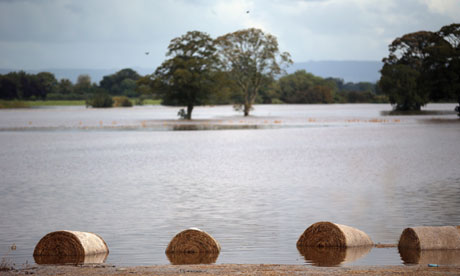
    Flood on agricultural land

    A high proportion of the most valuable agricultural land is at risk of flooding, the MPs said. Photograph: Christopher Furlong/Getty Images

    Ministers are failing to protect the UK’s most valuable farmland from flooding, posing a long-term risk to the security of UK food production, according to an influential group of MPs.

    A run of poor weather since 2011 has led to extensive flooding of properties but has also severely dented the production of many foods, with the UK now being a net importer of wheat.

    The environment select committee’s report also said the government’s spending by the Department for Environment, Food and Rural Affairs (Defra) to protect homes from flooding is not keeping pace with the rising risk, which is increasing as climate change intensifies downpours, and were also failing to act effectively to block the building of new homes on floodplains.

    “Record rainfall in the past two years has led to extensive flooding, cost the economy millions and caused disruption and distress to householders and communities across the UK,” said Anne McIntosh, a Conservative MP, and chair of the commons select committee on environment, food and rural affairs.

    “Additional capital funding for flood defences [announced last Thursday] is welcome since every £1 spent on flood defences to protect communities spurs growth and delivers economic benefits worth £8.”

    The report found that the current model for deciding which flood defences to build is biased towards protecting property. “This means funding is largely allocated to urban areas. Defra’s failure to protect rural areas poses a long term risk to the security of UK food production as a high proportion of the most valuable agricultural land is at risk of flooding,” the MPs reported.

    Flood defence spending crashed by over 25% year-on-year after the coalition came to power, despite the government’s scientists showing that global warming was driving up flood risk. One in five homes in England and Wales is at risk of river or coastal flooding, with more also threatened by flash flooding, according to the Environment Agency.

    Ministers announced on last Thursday that funding would jump to record levels of £370m a year from 2015-16 and then rise with inflation until the end of the decade, in part to boost economic growth and help seal a provisional deal with the insurance industry to keep premiums for homeowners in high-risk areas affordable.

    But the MPs concluded: “Funding has not kept pace in recent years with an increased risk of flooding from more frequent severe weather events, and the relatively modest additional sums to be provided up to 2020 will not be sufficient to plug the funding gap.”

    McIntosh said: “The chancellor must ensure that investment increases by £20m year on year. We need that money over the next 25 years to protect homes and businesses better.” In July 2012, the Guardian revealed that nearly 300 flood defence schemes that had been in line for funding remained unbuilt due to government cuts.

    A Defra spokeswoman noted the increased funding and insurance deal and said: “Flooding is terrible for those affected, which is why we’re working on long-term projects to protect people from its impacts.”

    The report, published on Wednesday, criticised ministers over planning policy. “We are disappointed that the coalition agreement’s commitment to end unnecessary building in floodplains has not yet been translated into effective action,” wrote the MPs. “Planning guidance allows building to take place too readily in areas at high flood risk.”

    Spending on the maintenance of flood defences and watercourses is at its lowest for many years, the MPs said, meaning cuts to those budgets were “short-sighted” and threatened to undermine the benefits gained from building new flood defences.

    Ministers have pointed to a new partnership scheme, through which the private sector can contribute to new flood defences, but the report said the government had failing to secure “significant” funding in this way.

    Mary Creagh, the shadow environment secretary, said: “Flooding is the biggest threat the UK faces from climate change, yet the government will spend less on flood defences in 2014/15 than Labour did in 2010. Ministers are creating uncertainty and stress for people in flood-prone areas.”

  • ALP national executive places NSW Labor into administration in corruption crackdown

    ALP national executive places NSW Labor into administration in corruption crackdown

    By chief political correspondent Emma Griffiths

    Updated 1 hour 0 minutes ago

    Property developers will be banned from standing as New South Wales Labor candidates under new party rules that have been dismissed by the Opposition as an “election fix”.

    Prime Minister Kevin Rudd has taken the rare step of launching a federal ALP intervention into the scandal-plagued NSW branch, saying he is “appalled” by the recent allegations of corruption levelled at former state ministers.

    The NSW Independent Commission Against Corruption (ICAC) has been investigating the property dealings of former powerbroker Eddie Obeid and former minister Ian McDonald, who have both been expelled from the party.

    Mr Rudd has demanded the NSW party implement changes within the next 30 days – a process that will be overseen by the ALP national executive.

    The changes include a “zero tolerance” stance on corruption and a ban on property developers standing as Labor candidates unless they “divest themselves of any major property development interest”.


    NSW State Secretary Sam Dastyari, who has welcomed the federal takeover, admits that it is “one of the more controversial measures”.

    Mr Rudd says the involvement of property developers is a problem, particularly in New South Wales.

    “Let’s just be frank. There’s a particular problem when it comes to the property development industry,” Mr Rudd said.

    “The reason is you have such enormous discretionary powers available.

    “I’m just calling it for what it is, rather than trying to be too pure about it all. This is a problem.

    “It’s not just a problem for the Labor party either and I think the other mob should have a look at themselves as well.”

    Abbott says zero tolerance approach an “election fix”

    But Opposition Leader Tony Abbott says the measures are “a joke”.


    “This isn’t a corruption cure, this is an election fix,” he said.

    “Let’s never forget that Mr Rudd was quite happy to be installed by the faceless men, then of course the faceless men sacked him, now he’s happy with the faceless men because they’ve put him back.

    “And all we’ve seen today is that for just 30 days the faceless men in Canberra will be giving direction to the faceless men in New South Wales. It’s just a joke.

    “The only way to clean up the Labor party is to give them time out in opposition so they can get their house in order.”

    Changes welcomed by ALP members

    NSW State Secretary Sam Dastyari says changing the culture of the state ALP will take time but described this federal intervention as “the biggest party reform act in over 40 years”.

    “There’s no silver bullet here, the Labor party in New South Wales knows it has to change and it is changing.


    “This is taking the governance of the party to the next step and frankly, if my inbox is anything to go by, it’s something that party members across the state are welcoming.”

    Mr Rudd has also flagged broader reform to the party nationally, saying: “this is the beginning”.

    “The time has come to modernise the Australian Labor Party, we need to open the windows and the doors of the great Australian Labor Party to the Australian community,” he said.

    “We want of course continued full participation from members of our great Australian trade unions. We must also recognise there is a broader church in Australia who must be represented within the Australian Labor movement as well.

    “The task of wider reform of the Australian Labor Party beyond New South Wales lies ahead of us.”

    The last time there was a federal intervention into NSW Labor was in 1971, a move that was prompted by allegations of rorting.

    Topics: alp, political-parties, government-and-politics, federal-government, federal—state-issues, states-and-territories, nsw, australia

    First posted 7 hours 27 minutes ago

  • Showers make up 25% of water use, says biggest ever study of households

    Showers make up 25% of water use, says biggest ever study of households

    Survey finds Britain could save £215m on energy every year with shorter showers and £68m by not overfilling kettles

    A man takes a shower

    A man washing his hair with shampoo in a shower cubicle Photograph: Luc Porus/© STOCK IMAGE/PIXLAND / Alamy

    It has become part of our daily routine, although few of us are likely aware of the full financial or environmental costs. Yet showering accounts for the biggest single use of water in the home – one quarter of the massive nine billion litres of water used by UK households every day – with much of our money spiralling down the plughole.

    Britons are also unnecessarily inflating their energy bills by overfilling kettles and hand-washing crockery rather than using more energy-efficient dishwashers.

    The findings have emerged from the biggest ever study of how Britons use water, published on Thursday, using data supplied by 86,000 British households and commissioned by the Energy Saving Trust.

    Showers are by far the biggest consumers of water in the home, consuming 25%, with toilets second at 22%. An average shower lasts seven-and-a-half minutes, yet cutting just a minute off that time would save British households £215m on energy bills each year, the report said. On average, Britons shower 4.4 times a week and take 1.3 baths.

    People living in larger households with more people take fewer showers each week but stay in them longer. While a quarter of respondents have efficient eco-showerheads installed, a similar proportion have high-flow – and wasteful – power showers.

    The study revealed that 22% of household water is used in the kitchen, with washing machines, dishwashers, kettles and taps all taking their share. Ninety-five percent of people boil the kettle every day and 40% do so five times a day or more. However, three-quarters of households still boil more water than they need – with overfilling costing £68m a year in aggregate.

    The average British household washes dishes by hand 10 times a week and only uses the dishwasher three times a week. But larger households could save energy and water by using an efficient modern dishwasher rather than washing by hand, says the trust. Households use their washing machine on average 4.5 times each week, yet only a quarter choose to wash at 30C or less.

    Andrew Tucker, the trust’s water strategy manager, said: “When people think of energy use they think of heating and lighting, running electrical appliances or filling the car with petrol. It’s all too easy to turn on the tap and not think about the consequences. But there is an environmental and energy cost attached to water which many people do not consider.

    “On average, hot water use contributes £228 to the average annual combined energy bill. It’s clear that we are all using more water-consuming appliances regularly, especially showers, but that doesn’t mean we’re powerless to control our water use.”

    The research was carried out in partnership with Defra, Procter and Gamble, Thames Water, the Consumer Council for Water and SaveWaterSaveMoney.

  • We keep moaning about population, but ignore consumption habits

    We keep moaning about population, but ignore consumption habits

    Sharing planet Earth’s finite resources in a better way is a more practical way of managing the needs of a rising population

    Earth population reaching seven billion

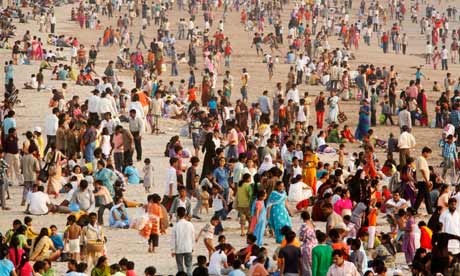
    Juhu beach in Mumbai, India, is crowded out with people. Photograph: David Levene for the Guardian

    At any public meeting on the environment over the past decade , there’s one question that almost always came up. It is a variation of ‘Why will no one talk about population?’ As a result, population is discussed endlessly while people grumble that no one ever talks about it.

    The same oddly circular conversation happened in the Observer Review section in an article relating to the new book, 10 Billion, by Stephen Emmott, head of Microsoft’s Research Lab. Five full pages of extract and interview warned, ‘we’re ignoring … the biggest crisis in human history.’

    Yet it’s hard to ignore, in the circumstances.

    We have World Population Day, the UN Population Awards, numerous organisations dedicated specifically to the issue, and just two weeks ago the UN published its latest, and widely reported, update on global population figures.

    Government policies around the world on population are untiringly controversial and debated, from countries in Europe (like Germany) worried about declining populations, to those in Asia (like China) worried about the opposite.

    Emmott, of course, does not appear to be anti-people, just concerned about the impact we’re having on the planet, with climate change being key. He covers what is now very familiar ground describing human pressure on resources, talks generally about the need to reduce consumption, identifies rising population more specifically within poorer countries and suggests that we could be facing a world of 28 billion people by the end of the century (a dangerously loose and wildly unlikely figure to use for someone with a scientific reputation).

    It’s welcome to have such a senior, corporate figure concerned about the prospects for life on earth. The tone and alarmism echo Paul Ehrlich’s 1968 classic, The Population Bomb.

    You might expect from someone associated with a dominant, hard-nosed global corporation like Microsoft, a hard-nosed strategy and business plan to sort the problem out. But, having lamented ‘the debate we urgently need,’ on ‘how billions more want to live, behave and consume,’ it was frustratingly difficult across five pages to find a single, specific, constructive proposal about what we might do differently.

    New energy from ‘artificial photosynthesis’, which Emmott mentions as one possible solution, might have novelty appeal but, you suspect, might be some way off from solving immediate problems. It was disappointing too because less novel but far more proven approaches are common knowledge. We’ve known for decades that universal primary education for women and good health services will do more to relieve the pressure for large families than any fiddling in the ‘magic bullet’ food lab.

    Three years ago the science writer Fred Pearce, a knowledgeable and long-term observer of climate change and other natural resource issues, published a book called Peoplequake.

    Although expecting population to grow (and level off later in the century), Pearce came to quite opposite conclusions. Future historians, he wrote, would look back on this period in history as marked by a, “dramatic decline in fertility and the transformation of the role of women in society.” In recent years, writes Pearce, fertility rates have generally fallen off a cliff.

    If there is an explosive problem, he wrote, it is to do with consumption, and it is a problem for a wealthy minority of humankind. The poorest three billion people on earth, short of half the world population accounted for about 7% of carbon emissions, while conversely, the richest 7% of people accounted for about half of all emissions.

    More recently still the economist Danny Dorling wrote Population 10 Billion, accepting head-on that rising number. But Dorling too, like Pearce, is more sanguine. And, like many before, he makes the point that with better, much more equal distribution of resources, managing the needs of a rising population is far from impossible. ‘There is more than enough to go round,’ he writes.

    The last point is no throw-away line. Current, extreme global inequality makes eradicating poverty impossible within planetary boundaries (and therefore impossible per se). That is because relying on trickle down, within a growth model already transgressing those boundaries, and in circumstances of great inequality creates the paradox of the already rich and over-consuming having to consume ever more for ever fewer benefits to reach the bottom of the income pile. This might be tastelessly political for some, but sharing better the resources we have to enable a rising number to thrive on a finite planet is also just plain maths, physics, biology and chemistry. An asymmetric consumption explosion remains our great problem.

    Last week, President Obama waded into the climate debate saying, “We don’t have time for a meeting of the Flat Earth Society … I am here to say we need to act.” A few years ago speaking in Cairo he said, ‘Given our interdependence, any world order that elevates one nation or group of people over another will inevitably fail.’ Apply that principle to the economy everywhere and we could solve several problems at once.

    Onehundredmonths.org

  • Climate change impacts on coral reefs: synergies with local effects, possibilities for acclimation, and management implications

    Climate change impacts on coral reefs: synergies with local effects, possibilities for acclimation, and management implications

    Published 2 July 2013 Science Leave a Comment
    Tags: , , , , , ,

    Most reviews concerning the impact of climate change on coral reefs discuss independent effects of warming or ocean acidification. However, the interactions between these, and between these and direct local stressors are less well addressed. This review underlines that coral bleaching, acidification, and diseases are expected to interact synergistically, and will negatively influence survival, growth, reproduction, larval development, settlement, and post-settlement development of corals. Interactions with local stress factors such as pollution, sedimentation, and overfishing are further expected to compound effects of climate change.

    Reduced coral cover and species composition following coral bleaching events affect coral reef fish community structure, with variable outcomes depending on their habitat dependence and trophic specialisation. Ocean acidification itself impacts fish mainly indirectly through disruption of predation- and habitat-associated behavior changes.

    Zooxanthellate octocorals on reefs are often overlooked but are substantial occupiers of space; these also are highly susceptible to bleaching but because they tend to be more heterotrophic, climate change impacts mainly manifest in terms of changes in species composition and population structure. Non-calcifying macroalgae are expected to respond positively to ocean acidification and promote microbe-induced coral mortality via the release of dissolved compounds, thus intensifying phase-shifts from coral to macroalgal domination.

    Adaptation of corals to these consequences of CO2 rise through increased tolerance of corals and successful mutualistic associations between corals and zooxanthellae is likely to be insufficient to match the rate and frequency of the projected changes.

    Impacts are interactive and magnified, and because there is a limited capacity for corals to adapt to climate change, global targets of carbon emission reductions are insufficient for coral reefs, so lower targets should be pursued. Alleviation of most local stress factors such as nutrient discharges, sedimentation, and overfishing is also imperative if sufficient overall resilience of reefs to climate change is to be achieved.


    Ateweberhan M., Feary D. A., Keshavmurthy S., Chen A., Schleyer M. H. & Sheppard C. R. C., in press. Climate change impacts on coral reefs: synergies with local effects, possibilities for acclimation, and management implications. Marine Pollution Bulletin. Article (subscription required).