Category: Uncategorized

  • Coastal Ocean Temperatures Changed Dramatically Over The Past Three Decades, Research Finds

    Coastal Ocean Temperatures Changed Dramatically Over The Past Three Decades, Research Finds

    Posted on July 2, 2013 by
    Print Friendly
    0 Share 5 Tweet 0 Share 6 6 Share

    Local changes in coastal ocean temperatures have been much more dramatic over the past 30 years than than global averages imply, new research has found. The research suggests that there are very distinct regional differences — differences which have significant ecological implications.

    Image Credit: Coastline via Wikimedia Commons

    Image Credit: Coastline via Wikimedia Commons

    The new research was done by mapping and analyzing the differences amongst the world’s coastlines with regards temperature changes over the past three decades. The analysis led to the realization that there is great regional diversity in warming and cooling patterns. “For example, the South American Pacific coasts have been cooling over the last few decades. To some, these cooling trends may be counterintuitive, but they are consistent with global climate change predictions, such as increases in upwelling (i.e., a process that brings cold, deep ocean water to the coast).”

    But then over in the North Pacific and North Atlantic, there has been a very clear and obvious warming trend. Including some areas where detected changes in temperature were as high as +/-2.5 degrees Celsius, that’s three times higher than the global average. “Climate change is happening everywhere — just not necessarily at the same rate, or even in the same direction. For example, if you live on Cape Cod, your conditions are warming three times faster than global averages imply, while in Santiago, Chile, coastal waters have been getting cooler.”

    “The world is getting flatter,” stated Dr Hannes Baumann of the Stony Brook University School of Marine and Atmospheric Sciences. “Coastal waters at high (cold) latitudes warm much faster than at low (warm) latitudes, hence the majority of the world’s coastal temperature gradients are getting shallower. This could cause dramatic reorganization of organisms and ecosystems, from small plankton communities to larger fish populations.

    “We already know, in general, that marine life changes in its characteristics along these North-South temperature gradients,” Baumann continues. “For example, many coastal fish populations differ genetically from north to south, an adaptation to grow best a local temperature conditions. With further study, we want to explore how changes in coastal ocean temperature gradients could predict large-scale changes in the ecosystem.”

    The new research is a good reminder of just how much the effects of climate change will vary by region — we’re used to certain weather patterns which could very well completely change with the changing climate. Something to keep in mind.

    The new research was just published in the journal PLoS ONE.

    Read more at http://planetsave.com/2013/07/02/coastal-ocean-temperatures-changed-dramatically-over-the-past-three-decades-research-finds/#g8V6FX5YBThhFQfQ.99

  • Obama’s Climate Pledge: The Keystone XL Fracking Double Standard

    Obama’s Climate Pledge: The Keystone XL Fracking Double Standard

    Repost This
    Comment on this StoryEmail this story

    President Obama, during his climate speech last week, surprised many observers by his unexpected remarks about the Keystone XL pipeline.   The President, for the first time, placed a clear condition on the pipeline’s approval – its impact on the climate.

    “The net effects of the pipeline’s impact on our climate will be absolutely critical to determining whether this project is allowed to go forward” he said, calling on the United States to |lead international efforts to combat a changing climate.”

    Later in the speech, Mr. Obama spoke in favor of the increased use of natural gas as a ‘transition fuel’ and called on the United States to “strengthen our position as the top natural gas producer because, in the medium term at least, it not only can provide safe, cheap power, but it can also help reduce our carbon emissions.”

    In a speech focused entirely on climate change, however, these two positions – placing climate change conditions on one fossil-fuel (tar sands oil) project while ignoring the climate implications (indeed touting the merits) of another fossil fuel industry (natural gas) – contradict each other and call into question Mr. Obama’s pledges, “as President, as a father, and as an American,” to take meaningful action on climate change.

    Mr. Obama cited, correctly, that natural gas emits far less carbon than oil or coal when burned. This is true, but carbon is not the only potent greenhouse gas contributing to climate change.  If the goal is fighting climate change, the President thus omitted an inconvenient truth: Methane – the principal component of natural gas – is a potent greenhouse gas, with some reports suggesting its global warming potential is greater than carbon.

    There have been few scientific studies that examine the global warming effects of natural gas, but the few that have been published are significant.  A 2011 study out of Cornell University concluded that methane has a “global warming potential that is far greater than that of carbon dioxide” and warned that methane’s short-term properties (its effect on climate during the first twenty years after emission) are considered even more significant than the carbon emissions from oil or coal.   The report summarized its findings this way:  “Methane contributes substantially to the greenhouse gas footprint of shale gas…”

    Another study, co-authored by climate researcher Ken Caldeira, of the Carnegie Institution for Science, and physicist Nathan Myhrvold (the former lead technology officer at Microsoft), and published in the journal, Environmental Research Letters, concluded that natural gas is “worthless for fighting climate change.”

    Gavin Schmidt, a climate model scientist with NASA, explained how methane, in addition to its own direct warming effects, also contributes to global warming indirectly by decreasing an important atmospheric coolant, OH (hydroxyls):

    “we found that methane’s (warming) impacts increased even further since increasing methane lowers OH (hydoxyls) and so slows the formation of sulphate aerosol and, since sulphates are cooling, having less of them is an additional warming effect. This leads to an increase in the historical attribution to methane (by a small amount), but actually makes a much bigger difference to the GWP (Global Warming Potential) of methane.”

    Addressing the industry’s assertion, repeated by President Obama, that natural gas is a logical, safe ‘transition fuel’ the author of the Cornell report, Robert Howarth, said, “The large greenhouse gas footprint of shale gas undercuts the logic of its use as a bridging fuel over coming decades, if the goal is to reduce global warming.”

    Thus, Mr. Obama’s climate speech last week contained two opposing principals:

    He conditions one fossil fuel project (Keystone XL) on its climate implications, while he ignores the significant climate implications of another fossil fuel – natural gas.

    The rules of science will not accommodate such conflicting principals.

    President Obama will either combat climate change… or he won’t.

    Photo credit: Forward on Climate rally via Shutterstock

  • Robber Barons ( MONBIOT )

    Monbiot.com


    Robber Barons

    Posted: 01 Jul 2013 12:26 PM PDT

    Why do we ignore the most blatant transfer of money from the poor to the rich?


    By George Monbiot, published in the Guardian 2nd July 2013.

    It’s the silence that puzzles me. Last week, the Chancellor stood up in parliament to announce that benefits for the very poor would be cut yet again(1). On the same day, in Luxembourg, our government battled to maintain benefits for the very rich. It won. As a result, some of the richest people in Britain will each continue to receive millions of pounds in income support from taxpayers.

    There has been not a whimper of protest. The Guardian hasn’t mentioned it. UK Uncut is silent. So – at the other end of the spectrum – is the UK Independence Party.

    I’m talking about the most blatant transfer of money from the poor to the rich that has occurred in the era of universal suffrage. Farm subsidies. The main subsidy – the single farm payment – is doled out by the hectare. The more you own or rent, the more money you receive.

    Since 1999, more progressive European nations have been trying to limit the amount of public money a farmer can capture under the Common Agricultural Policy(2). It looked as if, this year, they might at last succeed. But two governments in particular resisted, throughout the negotiations that ended last week: those resolute champions of the free market, Germany and the United Kingdom(3,4,5). Thanks to their lobbying, any decision has yet again been deferred(6).

    There were two proposals for limiting handouts to the super-rich, known as capping and degressivity. Capping means that no one should receive more than a certain amount: the proposed limit was €300,000 a year(7). Degressivity means that, beyond a certain point, the rate received per hectare begins to fall. This was supposed to have kicked in at €150,000(8). The UK’s environment secretary, Owen Paterson, knocked both proposals down.

    When our government says “we must help the farmers”, it means “we must help the 0.1%”. Most of the land here is owned by exceedingly wealthy people.

    Some of them are millionaires from elsewhere: sheikhs, oligarchs and mining magnates who own vast estates in this country. Though they might pay no taxes in the UK, they receive millions in farm subsidies. They are the world’s most successful benefit tourists. Yet, amid the manufactured terror of immigrants living off British welfare payments, we scarcely hear a word raised against them.

    The minister responsible for cutting income support for the poor, Iain Duncan Smith, lives on an estate owned by his wife’s family. Over the past ten years, it has received €1.5m in income support from taxpayers(9). How much more obvious do these double standards have to be before we begin to notice?

    Thanks in large part to subsidies, the value of farmland in the UK has tripled in ten years(10): it has risen faster than almost any other speculative asset. Farmers are exempted from inheritance tax and capital gains tax. They can build, without planning permission, structures which lesser mortals would be forbidden to erect, boosting both their capital and income. And they have a guaranteed income from the state. Yet all we hear from their leaders is one long whinge(10).

    I have yet to detect a word of gratitude from the National Farmers’ Union to the hard-pressed taxpayers who keep its members in such style. The NFU, dominated by the biggest landowners, has a peculiar genius for bringing out the violins. It pushes forward small, struggling hill farmers. The real beneficiaries of its policies are the arable barons hiding behind them.

    An uncapped subsidy system damages the interests of small farmers. It reinforces the economies of scale enjoyed by the biggest landlords, helping them to drive the small producers out of business. A fair cap (say €30,000) would help small farmers compete with the big ones.

    So here’s the question: why do we keep deferring to Big Farmer? Why do its sob stories go unchallenged? Why is this spectacular feudal boondoggle tolerated in the 21st Century?

    Here are three possible explanations. A high proportion of the books aimed at very young children are about farm animals. There is usually one family of every kind of animal, and they live in harmony with each other and the rosy-cheeked farmer. Understandably, slaughter, butchery, castration, separation, crates and cages, pesticides and slurry never feature. The petting farms which have sprung up around Britain reify and reinforce this fantasy. Perhaps these books unintentionally implant, at the very onset of consciousness, a deep, unquestioned faith in the virtues of the farm economy(11).

    Perhaps too, after being brutally evicted from the land through centuries of enclosure, we have learnt not to go there, even in our minds. To engage in this question feels like trespass, though we have handed over so much of our money that we could have bought all the land in Britain several times over. Perhaps we also suffer from a cultural cringe towards people who make their living from the land and the sea, seeing their lives – however rich and cossetted they are – as somehow authentic while ours feel artificial.

    Whatever the reason may be, it’s time we overcame these inhibitions and confronted this unembarrassed robbery of the poor by the rich. The current structure of farm subsidies epitomises the British government’s defining project: capitalism for the poor, socialism for the rich.

    www.monbiot.com

    References:

    1. https://www.gov.uk/government/speeches/spending-round-2013-speech

    2. http://europa.eu/rapid/press-release_MEMO-13-631_en.htm

    3. The UK government laid out its negotiating position here. http://archive.defra.gov.uk/foodfarm/policy/capreform/documents/110128-uk-cap-response.pdf It stated “the UK is opposed to the Commission’s suggestion that direct payments to large farms should be capped. The CAP should encourage greater competitiveness, including by consolidation, which capping would discourage.”

    4. The BBC reported last week that the UK and Germany crushed the capping proposal: http://www.bbc.co.uk/news/world-europe-22986953

    5. On July 1st 2013, Defra confirmed to me in a phone call that it has been lobbying to ensure that any capping or degressivity remain voluntary: in other words, if they are applied at all, the UK and other nations will be able to opt out of them.

    6. Officially, these issues will now be “dealt with separately within the negotiations on the Multi-Annual Financial Framework (MFF) for 2014-2020”.  http://europa.eu/rapid/press-release_MEMO-13-621_en.htm Given the record to date, that is likely to mean “never”.

    7. http://ictsd.org/i/news/biores/170846/

    8. http://ictsd.org/i/news/biores/170846/

    9. http://www.guardian.co.uk/politics/2013/may/30/hugh-muir-diary-iain-duncan-smith

    10. “New Bio-Waste Spreader”, 12th June 2013. The Agri Brigade. Private Eye.

    11. Something like this was proposed by “Charlemagne”, writing in the Economist. He or she called it the Richard Scarry rule: “politicians will rarely challenge interests that feature in children’s books.” But while it seems to apply to farmers, it doesn’t seem to apply to other sectors: they willingly do battle with train drivers and doctors, for example. Charlemagne, 30th October 2008. Europe’s baleful bail-outs. http://www.economist.com/node/12510261

    You are subscribed to email updates from George Monbiot
    To stop receiving these emails, you may unsubscribe now.
    Email delivery powered by Google
    Google Inc., 20 West Kinzie, Chicago IL USA 60610
  • We said never again ( avaaz )

    Dear friends,

    Most people didn’t know who the Rwandans were until 800,000 had been killed. Now, the fate of the Rohingya people of Burma is hanging by a thread as mobs attack them while the police look on. The Burmese President could stop the violence – all he has to do is approve a plan to protect them and ensure it is enforced, while granting them citizenship. Let’s appeal to European leaders to press him when he visits them in days, and stop the next Rwanda:

    Sign the Petition

    Most people didn’t know who the Rwandans were until it was too late, and 800,000 of them were dead. Right now, the fate of Burma’s Rohingya people is hanging by a thread. Racist thugs have distributed leaflets threatening to wipe out this small Burmese minority. Already children have been hacked to death and unspeakable murders committed. All signs are pointing to a coming horror, unless we act.

    Genocides happen because we don’t get concerned enough until the crime is committed. The Rohingya are a peaceful and very poor people. They’re hated because their skin is darker and the majority fear they’re ‘taking jobs away’. There are 800,000 of them, and they could be gone if we don’t act. We’ve failed too many peoples, let’s not fail the Rohingya.

    Burmese President Thein Sein has the power, personnel and resources to protect the Rohingya, all he has to do is give the word to make it happen. In days, he’ll arrive in Europe to sell his country’s new openness to trade. If EU leaders greet him with a strong request to protect the Rohingya, he’s likely to do it. Let’s get 1 million voices and plaster images of what’s happening in Burma outside his meetings with key EU heads of state:

    https://secure.avaaz.org/en/we_said_never_again_b/?bBYMjdb&v=26519

    Torture, gang rape, execution style killings — human rights groups are using the term “ethnic cleansing” to describe the brutality in Burma. Already more than 120,000 Rohingya have been forced to flee, many to makeshift camps near the border, while others have fled in boats only to drown, starve, or be shot at by coastguards from neighboring countries. Reports show that violence is escalating — earlier this year President Thein Sein declared a state of emergency after another round of deadly attacks, and it’s just a matter of time until there is a large scale massacre.

    Genocides don’t happen when governments oppose them, but the Burmese regime has been leaning the wrong way. Recently, a government spokesperson admitted that authorities were enforcing a rule that limits the Rohingya population to having only two children and forces couples seeking to get married to obtain special permission. And experts report that government authorities have stood by or even participated in acts of “ethnic cleansing.” President Sein has finally been forced to acknowledge what’s happening to the Rohingya, but he has so far refused to implement plans to stop the violence and protect those at risk.

    Until he does, the risk of genocide hovers like a dark cloud over not just Burma, but the world. Through their trade relations, UK PM Cameron and French President Hollande have massive leverage with Sein — if they press him to act when he meets with them this month, it could save lives. Let’s make sure they do. We’ve failed too many peoples, let’s not fail the Rohingya. Join the call now and share this with everyone:

    https://secure.avaaz.org/en/we_said_never_again_b/?bBYMjdb&v=26519

    Time and again, the Avaaz community has stood with the people of Burma in their fight for democracy. When the regime brutally cracked down on Buddhist monks in 2007, Avaazers donated hundreds of thousands of dollars/euros/pounds to provide technical support and training to activists to fight a communications blackout. In 2008, when a devastating cyclone killed at least 100,000 Burmese, but the venal military regime stopped all official international aid from coming in, our community donated millions directly to monks on the front line of the aid effort.

    Our community didn’t exist when genocide was committed in Rwanda, 20 years ago. Would we have done enough to stop it? Let’s show the Rohingya our answer to that question.

    With hope and determination,

    Luis, Jeremy, Aldine, Oliver, Marie, Jooyea and the whole Avaaz team

    PS – Many Avaaz campaigns are started by members of our community! Start yours now and win on any issue – local, national or global: http://www.avaaz.org/en/petition/start_a_petition/?bgMYedb&v=23917

    MORE INFORMATION

    Burma riots: Video shows police failing to stop attack (BBC)
    http://www.bbc.co.uk/news/world-asia-22243676

    Burma: End ‘Ethnic Cleansing’ of Rohingya Muslims (Human Rights Watch)
    http://www.hrw.org/news/2013/04/22/burma-end-ethnic-cleansing-rohingya-muslims

    Video shows Burmese police standing by as Buddhists attack Muslims (The Guardian)
    http://www.guardian.co.uk/world/2013/apr/22/burmese-police-buddhists-attack-muslims

    The unending plight of Burma’s unwanted Rohingyas (BBC)
    http://www.bbc.co.uk/news/world-asia-23077537

    Dalai Lama Pleads for Myanmar Monks to End Violence Amid Damning Rights Report (ABC News)
    http://abcnews.go.com/International/dalai-lama-pleads-myanmar-monks-end-violence-amid/story?id=19013148#.UXV3vCt4a5w

    Thein Sein to visit Britain, France in July (AFP)
    http://www.dvb.no/news/thein-sein-to-visit-britain-france-in-july/28815

    Support the Avaaz Community!
    We’re entirely funded by donations and receive no money from governments or corporations. Our dedicated team ensures even the smallest contributions go a long way. Donate to Avaaz
  • Deep soils store up to five times more carbon than first thought: study

    Deep soils store up to five times more carbon than first thought: study

    Deep soils store up to five times more carbon than is commonly reported, a new study by Murdoch University and Cranfield University in the UK has found. Soil locks in greenhouse gases by storing carbon, making it a crucial player in the fight against global warming. Greenhouse gases are released when…

    Ztsfpwjf-1372424359
    Soil represents one of the world’s largest carbon stocks. J.Kelley/http://SoilScience.info

    Deep soils store up to five times more carbon than is commonly reported, a new study by Murdoch University and Cranfield University in the UK has found.

    Soil locks in greenhouse gases by storing carbon, making it a crucial player in the fight against global warming. Greenhouse gases are released when soils are exposed to air by farming, peat drainage and deforestation.

    Current estimates of soil organic carbon are based largely on measurements to depths of 30 cm. This approach has evolved in North America and Europe, where soil is generally more shallow.

    However, many plant species have roots extending many metres deep, suggesting there is also carbon stored at such depth and inspiring researchers to explore the storage potential of deeper soils in older landscapes such as the Amazon or Australia. Researchers in the Amazon had previously sampled soils to 8 m.

    The researchers took soil measurements from samples taken to almost 40 metres deep at a range of sites in south-western Australia.

    They found that small amounts of carbon were present throughout the soils all the way to the bedrock, and that deep soils store up to five times more carbon than is normally reported.

    “This finding may have major implications for estimates of global carbon storage and modelling of the potential global impacts of climate change and land-use change on carbon cycles,” the researchers said in their paper, which was published in the journal Plant and Soil.

    Lead researcher Professor Richard Harper, an expert in water management and sustainability at Murdoch University said the findings extend our concept of the amounts and potential of carbon stored in soils.

    “This carbon has been previously overlooked, and this opens up several lines of inquiry – for example, what happens to this carbon with land use change such as deforestation and reforestation?” Professor Harper said.

    “There is likely more carbon stored in the world’s soils than previously considered. What will happen to this carbon – that is, will it be released as a result of either land-use change or climate change – is unknown. This is what we are working on now,” he said.

    Landmark study

    Professor of Horticulture and Viticulture at the University of Melbourne, Snow Barlow, said the study highlights the significant impact of land use change on global carbon cycles.

    “This paper is a timely reminder of the impacts of land use change, as this carbon has clearly originated in the earlier forested era of these landscapes,” said Professor Barlow, adding that Australia’s position on the UN Kyoto Protocol climate change agreement was strongly based on the significance of land use change through decreasing land clearing.

    “It is also a strong reminder of how much carbon is actually stored in soils, particularly deep soils, and that even Australia has deep soils that contain significant carbon at moderate rainfalls.”

    Dr Robert Edis, a soil scientist from the University of Melbourne said the study was “robustly and rigorously executed and then elegantly interpreted”, but added that the importance of deep soil carbon for climate change, “hinges on how stable the carbon is, and will determine if the study is just interesting or pivotal.”

    Dr Edis said the study was a “landmark quantification of a pool of carbon only qualitatively suspected.”

    Andrea Koch, project manager of the Soil Carbon Initiative at the University of Sydney said the study highlights how much we have underestimated the potential for soils to act as a critical sink for carbon.

    “As a society, we are pretty focused on what we can get from the top 30cm of the soil profile, and the mineral and energy resources that are deep below the surface, but the soil in between the deeper soil is a frontier that is yet to be understood. Managing and maintaining soil carbon is fundamental to food and water security, biodiversity and energy security, as well as climate regulation, so if we can work out ways to manage soil carbon at depth that can only be a good thing,” Ms Koch said.

    “Finding ways to manage and account for soil carbon at depth will not only require new soil management practices and technologies, it will also need to be met with public policies that support and encourage these efforts,” she said.

  • Dealing with uncertainty: the insurance industry and climate change

    Dealing with uncertainty: the insurance industry and climate change

    Insurers are paying out heavily for extreme weather events – but the industry could be doing more to engage with climate change

    UK floods

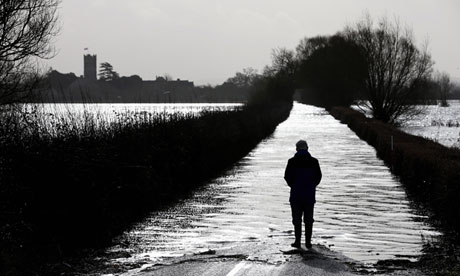
    Extreme weather events are pounding the insurance industry: last year’s floods cost more than £400m. Photograph: Matt Cardy/Getty Images

    Bad weather does a lot more than spoil barbecues. Last year’s floods in the UK caused £400m-worth of damage, while this summer’s floods in central Europe could lead to insurance claims for as much as €6bn (£5.1bn); at the other extreme, last year’s droughts in the US Midwest’s corn belt caused around $20bn (£13bn) of damage to agricultural crops.

    There is still not 100% agreement in the industry as to whether or not man-made climate change exists but arguing the point rather misses the bigger issue, said Laurence Baxter, the head of policy and research at the Chartered Insurance Institute, the professional body.

    “I have seen the debate waged over the last few years – individuals in and out of the industry – and in that they miss the whole point, which is that extreme weather events are on the rise and a number of weather-related records have been broken in the last few years. The climate is changing and as the sector responsible for managing risk and how it is mitigated… the insurance industry does play a big part.”

    The industry is starting to recognise this. The CII incorporates the issue into its qualifications and continuing professional development resources for its members, while a number of insurers got together six years ago to set up the ClimateWise leadership group to work together investigating the issue.

    The group’s members have recognised that the number of extreme weather events and other climate-linked changes have significant implications for their businesses, said Katharine Thoday, head of the ClimateWise secretariat at the University of Cambridge Programme for Sustainability Leadership. The group has set up six principles, including informing public policy, incorporating climate change into members’ investment strategies and reducing the environmental impacts of their business.

    One of the underlying challenges is that climate change is still far from fully understood, meaning that companies are always dealing with uncertainty, said Dr Stefan Straub, Munich Re’s spokesman on climate change and renewable energy. “No one can say ‘that’s the last piece of the puzzle’. The research is still going on. We still don’t know enough, which makes it difficult to assess the risks in the right way.” It funds or is otherwise involved in a large number of research initiatives to help improve understanding of the issues involved, as well as supporting the development of renewable energy technology.

    Knowledge may not yet be complete but it is improving, said Jon Williams, a partner at PricewaterhouseCoopers, which reviews insurers’ performance against the ClimateWise principles. The industry is making the most progress in research and development and risk modelling, engagement with policymakers, and product innovation, he said. “For example, in the UK 10 years ago flood-risk modelling was a high-level crude postcode lottery,” he said. “Now it’s sub-postcode mapping of how water will flow across terrain.”

    Companies are also starting to create products that try to change consumer behaviour, said Williams. Aviva’s “pay as you drive” policy, which means heavy car users pay higher premiums than those who drive for short distances, is one example; another is the way in which insurers make assets more resilient to risk after they have had to pay out. “So in a flood-risk area, expect to have your power points reinstalled 24 inches up so that if it floods again it won’t take out all your electrics.”

    But the picture is not all positive. For a start, there is still much more that could be done to develop new products that help mitigate risk, said Williams. “And another area where relatively little has been done is understanding the risks of climate change to those more exposed to them, especially in developing countries.” This is becoming increasingly important as insurers look to these markets for new opportunities for growth now that the UK market is saturated – Williams’ pun.

    “What that does is take them into markets where governments are typically less able to adapt to climate change so risks are higher, and much higher for insurers,” he said.

    Even insurers with no direct involvement in developing markets need to understand the issues there, he said. “About a third of premiums insured in this market come from overseas so they are already exposed to overseas. Secondly, the world is pretty connected and the biggest threat to the UK from climate change is through the supply chain, particularly through food security.” A British insurer that offers business continuity insurance to a company based in the UK could easily be exposed to climate change risks down the line, for example if a drought in Kenya wiped out a major supplier’s crop.

    He also believes that insurers need to think harder about what they can do with their asset portfolios. This is a tricky area, said Thoday. “The outside perception is that, because insurers from the underwriting side have been thinking about these issues… there’s a strong sense that they should be applying it to their investments,” she said. “In reality as a business those two things are very separate. For all kinds of regulatory reasons you don’t share your risk analysis from the underwriting side with the investment decision side.” That said, this is a question that’s starting to get on the agenda of the investment side, she added.

    This content is brought to you by Guardian Professional. Become GSB member to get more stories like this direct to your inbox

    • Sustainable business courses

      Practical half-day courses from the Guardian on sustainability communications, brand, collaboration and leadership. Book now.

    About Guardian Professional

    • Guardian Professional Networks

      Guardian Professional Networks are community-focused sites, where we bring together advice, best practice and insight from a wide range of professional communities.

      Some of our specialist hubs within these sites are supported by funding from external companies and organisations. All editorial content is independent of any sponsorship, unless otherwise clearly stated. We make Partner Zones available for sponsors’ own content. Guardian Professional is a division of Guardian News & Media