Category: Uncategorized

  • Carbon in Arctic Reservoirs Vulnerability Experiment

    Carbon in Arctic Reservoirs Vulnerability Experiment

    Phase: Operating

    Start Date: 2012

    Mission Project Home Page

    Program(s):Earth System Science Pathfinder

    Pin it

    Investigation Homepage

    The carbon budget of Arctic ecosystems is not known with confidence since fundamental elements of the complex Arctic biological-climatologic-hydrologic system are poorly quantified. Carbon in Arctic Reservoirs Vulnerability Experiment (CARVE) is collecting detailed measurements of important greenhouse gases on local to regional scales in the Alaskan Arctic and demonstrating new remote sensing and improved modeling capabilities to quantify Arctic carbon fluxes and carbon cycle-climate processes. Ultimately, CARVE will provide an integrated set of data that will provide unprecedented experimental insights into Arctic carbon cycling.

    AirMOSS mission graphic CARVE is using the Arctic-proven C-23 Sherpa aircraft to fly an innovative airborne remote sensing payload. It includes an L-band radiometer/radar and a nadir-viewing spectrometer to deliver the first simultaneous measurements of surface parameters that control gas emissions (i.e., soil moisture, freeze/thaw state, surface temperature) and total atmospheric columns of carbon dioxide, methane, and carbon monoxide. The aircraft payload also includes a gas analyzer that links greenhouse gas measurements directly to World Meteorological Organization standards. Deployments occur during the spring, summer and early fall when Arctic carbon fluxes are large and change rapidly. Further, at these times, the sensitivities of ecosystems to external forces such as fire and anomalous variability of temperature and precipitation are maximized. Continuous ground-based measurements provide temporal and regional context as well as calibration for CARVE airborne measurements.

    CARVE science fills a critical gap in Earth science knowledge and satisfies high priority objectives across NASA’s Carbon Cycle & Ecosystems, Atmospheric Composition, and Climate Variability & Change focus areas as well as the Air Quality and Ecosystems elements of the Applied Sciences program. CARVE complements and enhances the science return from current NASA and non-NASA satellite sensors.

    Principal Investigator: Charles Miller
    NASA Jet Propulsion Laboratory, Pasadena, CA

    Project Manager: Steve Dinardo
    NASA Jet Propulsion Laboratory, Pasadena, CA

    Mission Manager:Anthony Guillory@nasa.gov
    Langley Research Center (LaRC), Hampton, VA

    HomeBig QuestionsEarthHeliophysicsPlanetsAstrophysicsMissionsTechnologyScience News
    For ResearchersFor EducatorsFor KidsCitizen ScientistsAsk a Scientist

  • Coalition plans to punish those who boycott Israel

    Find More Stories

    25 June 2013

    Protest held against Israel

    Coalition plans to punish those who boycott Israel

    Be first to comment

    Jake Lynch

    Jake Lynch

    The charge that the Boycott, Divestment and Sanctions campaign against Israel is anti-semitic fails its only salient test. The target of BDS is not Jews or Judaism, but militarism and lawlessness, argues Jake Lynch.

    The number two in the incoming government has vowed to use the coercive power of the state to stifle dissent on a contested policy issue.

    In Uzbekistan? Equatorial Guinea? No – Australia.

    According to Julie Bishop, shadow foreign minister and deputy Liberal leader, I and other supporters of an academic boycott of Israel will be penalised under the Coalition, by having our access to public research funds summarily cut off.

    It appears to be a gesture to pro-Israel groups, who are backing what they – like everyone else – assume will be the winner in September’s federal election. Prominent members of both main parties, including Prime Minister Julia Gillard, have signed the ‘London declaration on combating anti-semitism‘, but Labor has resisted calls to use the machinery of government to enforce its claims.

    Chief among them are that calls for Boycott, Divestment and Sanctions on Israel are themselves a form of anti-semitism.

    That can easily be disproved. Imagine a Venn diagram with four circles. In one: states occupying territory recognised as not their own. Armenia would be there, for its seizure of Nagorno-Karabakh, and Morocco in Western Sahara.

    The second contains countries whose military actions give rise to well-founded allegations of war crimes, in particular the indiscriminate targeting of civilians. Of recent concern have been the bloody end to Sri Lanka’s civil war, and US drone strikes in Pakistan.

    In a third, we would find nuclear-armed states that refuse to join the Non-Proliferation Treaty, with its transparency requirements and onus to negotiate eventual disarmament. Obvious residents: South Asian neighbours India and Pakistan.

    The fourth circle is partly shadowed, since it concerns violations of the 1973 International Convention on the Suppression and Punishment of Apartheid. Iran, for one, might qualify, with its persecution of the Bahá’í as Exhibit A, but the question has never been systematically studied.

    The one country that sits unambiguously in the overlap of all four circles, is Israel. There is no non-Jewish state in that central domain, so Israel is not being discriminated against. The charge of anti-semitism fails its only salient test. The target of BDS is not Jews or Judaism, but militarism and lawlessness.

    A systematic study by an international expert panel found that discriminatory laws and practices, confining non-Jews to second-class status, do indeed put Israel in breach of the Apartheid Convention. That obliges governments to “co-operate to end the violation; not to recognise the illegal situation arising from it; and not to render aid or assistance to the State committing it”, as the report – commissioned by the social science research council of South Africa – points out.

    As with Israel’s other transgressions, however, it incurs no meaningful cost. Governments point to the ‘peace process’, periodically revived from Washington and officially the responsibility of the ‘Quartet’ of the UN, US, EU and Russia, as a fig leaf to cover quiescence and inaction. But whatever tattered credibility it retained is now being ripped away by increasingly candid statements from Israeli politicians, ruling out a Palestinian state.

    Its besetting weakness has been to treat Israel’s occupation of Palestinian territory not, essentially, as inadmissible but instead on the terms favoured by successive Israeli governments: a ‘fact on the ground’, to be used as a bargaining chip.

    Meanwhile, ever more Palestinians are driven from their homes.

    This must change, according to the European Eminent Persons Group on the Middle East Peace Process, which includes four former Prime Ministers. Europe should instead demand that Israeli settlements be dismantled forthwith.

    Last November’s motion at the UN General Assembly, in which many EU members voted to give Palestine the status of ‘non-member observer state’, proves the need for a new approach.

    Gillard wanted Australia to join just eight other countries in rejecting this resolution, but a furious Labor Party caucus ‘rolled’ her into backing abstention, instead. This gave the Liberals their opening, to appear even more pro-Israel than Labor – with their move against boycott advocates, a way of proving it.

    Universities come into BDS because Israel uses academic exchange as a distraction from its lawless and militaristic behaviour. The Neaman Report on public diplomacy, published by Technion University Haifa and commissioned by the Ministry of Foreign Affairs, recommends targeting “educational organisations” as “beneficial clients” in efforts to sanitise its image abroad.

    It was when Professor Stephen Hawking rumbled this plan that he withdrew from a conference in Israel last month. The British Committee for the Universities of Palestine, which recently fended off an anti-semitism case in court, now believes “it will likely be only a matter of time” before the UK’s University and College Union backs a boycott.

    Peace advocates in Israel will never make headway as long as the alternative – tightening the screw on the Palestinians – appears cost-free. Why bother to negotiate seriously if you can simply hang on to your ill-gotten gains, while everyone else turns a blind eye?

    It is to challenge such impunity that the BDS call was issued.

    When the case wins a chance to be heard and considered, it gains widespread support. That is why its opponents want to suppress it.

    Jake Lynch is director of the University of Sydney’s Centre for Peace and conflict Studies. View his full profile here.

    The Centre recently refused to assist Israeli academic Dan Avnon on a visit to Australia in line

  • Is Arctic Permafrost the “Sleeping Giant” of Climate Change?

    Is Arctic Permafrost the “Sleeping Giant” of Climate Change?

    Inbox
    x
    NASA Science News <noreply@nasascience.org>
    1:03 PM (1 hour ago)

    to NASA
    NASA Science News for June 24, 2013Arctic permafrost soils contain more accumulated carbon than all the human fossil-fuel emissions since 1850 combined. Warming permafrost, poised to release its own gases into the atmosphere, could be the “sleeping giant” of climate change.VIDEO: http://www.youtube.com/watch?v=hZSM8GcmJKg

    FULL STORY: http://science.nasa.gov/science-news/science-at-nasa/2013/24jun_permafrost/

    You are currently subscribed to snglist as: nevilleg729@gmail.com.

    YouTube – Videos from this email
  • Solar power still better than nuclear in the fight against climate change

    Solar power still better than nuclear in the fight against climate change

    I concede I’ve lost the £100 bet, but it’s a folly to put faith in costly reactors to cut emissions

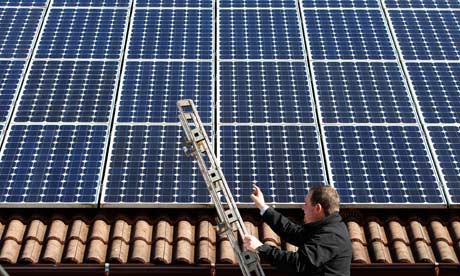
    Solar power :  56 photovoltaic (solar) panels at the roof of his house

    The price of residential solar PV has fallen by 60% in three years, according to industry data. Photograph: Michaela Rehle/Reuters

    George Monbiot claims in a gentlemanly article to have won our £100 bet, made three years ago, that solar PV would be at grid parity – the same cost as conventional retail electricity – by 2013.

    The very good news is that over the past three years, the actual average price of installed residential solar PV has come down some 60%, while the cost of new nuclear has gone up 70% and is still rising. I base the former on the real achievement at my company Solarcentury and the latter on a recent compilation in Le Monde of data for EDF’s Flamanville EPR reactor, the type of nuclear plant nuclear advocates like George want to foist on the UK economy at great cost to the public, starting at Hinkley Point.

    The slightly bad news is that I probably lost my bet. Solar-industry people have been e-mailing me pleading that I argue the toss, pointing out that solar markets like the Netherlands are already at grid parity, and that by using somewhat lawyerly points I can defend my ground when it comes to the UK. I can’t be bothered, because anyone studying the pattern of play in any detail will know that if I lost, it wasn’t by much.

    By way of illustration, read this extract of what Dave Edwards of Solarcentury said below George’s article. I can’t better it:

    Grid parity has a clear and widely accepted definition: when the levelised cost of solar (falling rapidly) crosses the cost of grid electricity (rising rapidly). The average retail price of electricity in the UK is 14.5p according to EST or Decc’s own statistics. Plenty of anecdotal evidence would suggest higher. ….Levelised cost of solar … is 15.3p, at a 5% discount rate. If you used the risk free rate of 3.5%, as some energy economists would argue you should, it is substantially less. So in my view, you [Monbiot] win this battle, if only by a matter of months; but PV is winning the war, at least on paper.

    Lest anyone think that this is an employee who has fallen victim to the prejudiced view of his chairman, let me bring in consultancy McKinsey, better known for its work for Big Energy than support of the solar industry. In its 2012 report Solar Power, Darkest Before the Dawn, their team concluded that big as the solar cost-down had been over the period in question, costs will continue to fall at about 10% a year, some markets already are at grid parity, many more will be by 2015, and that by 2020 fully a thousand gigawatts of solar PV could be installed around the world. This, they said, will change the face of the energy industry. I could have picked similar statistics out of reports from other old economy stalwarts such as Bloomberg, UBS or Lazard. Solar PV will be a key player in national energy mixes beyond 2020, in other words, including in the UK. EDF still won’t even be close to connecting their Hinkley Point version of Flamanville by 2020, by their own admission, even if they get the go ahead from the government for the huge subsidies they will need.

    George says I wouldn’t agree terms of the bet with him. I didn’t do so because he for his part never accepted my multiple invitations to come and visit Solarcentury, see solar engineers at work, and hear their voice on this. Had he done that, maybe his perspective might have been adjusted a little, or even changed.

    And so to George’s thoughtful point that we have both lost the bet, because the government is so bad on this and related issues. We are almost on the same page here.

    Clearly people like environment secretary, Owen Patterson, whose opinion he cites, are delusionists, intent on betraying their country’s long-term interests in defence of their dangerous belief system. But we have to hope that not all government ministers are in that camp. Some, Conservative and Lib Dem, do seem to be fighting for sanity. And Labour is showing way more form on these matters in opposition than it did in government.

    There is all to fight for, still, with the varied allies we have in the complex civil war that is the struggle to survive climate change. Solar and other green industries really could be cutting emissions meaningfully while taking disenfranchised young people off the streets and into fulfilling jobs.

    So for my part, £100 is on its way to my charity of choice, SolarAid, with no regrets. For his part, perhaps George would like to visit Solarcentury now? We are open tomorrow. Hinkley Point C won’t be for many years, if at all.

    Comments

    Click here to join the discussion.

    We can’t load the discussion on guardian.co.uk because you don’t have JavaScript enabled.

  • Windsor laments inaction on asylum seekers

    Windsor laments inaction on asylum seekers

    AAPUpdated June 25, 2013, 2:00 pm

    Independent MP Tony Windsor says it’s a tragedy that federal parliament has failed to agree on how to deal with asylum seekers, and has turned it into a “bumper sticker” issue.

    In the final sitting week before the September 14 election, Mr Windsor said he was “very proud” of the hung parliament and the “tremendous” amount it had achieved.

    But he lamented parliament’s failure to develop a regional strategy for dealing with asylum seekers, saying the issue had become far too political.

    “What the political process has done in this place is demean it (the issue) to a bumper sticker approach,” he told reporters in Canberra on Tuesday.

    “That never works.”

    It was far too easy to whip up fear and “do the (Pauline) Hanson stuff” around asylum seekers, but this approach would never solve the issue at hand, he said.

    Mr Windsor said only a regional solution involving the Indonesians and others could address the problem, and wished Prime Minister Julia Gillard good luck on her trip to Jakarta next week.

    Opposition immigration spokesman Scott Morrison said the arrival of another boat overnight brought the number to 25,000 asylum seekers who have made the journey to Australia this financial year.

    Those 25,000 people completely exhausted the increase in the refugee and humanitarian intake for the next four years, Mr Morrison added.

    “I think this just underscores the dire situation the government has got itself into, with their chronic failures which they continue to refuse to admit let alone correct,” he said.

    Australian Greens senator Sarah Hanson-Young said Australia needed a new and humane way of dealing with refugees and asylum seekers.

    “If we are to manage the needs of asylum seekers throughout the region we need to be more engaged with how they’re treated and the care they’re given in both Indonesia and Malaysia,” she told reporters in Canberra on Tuesday.

    She said former Defence Force Chief Angus Houston’s 2012 report on the issue recommended that $70 million be injected into services for refugees, but so far there was only $10 million on the table.

    “When the prime minister goes to Indonesia next week she should be talking about putting that money on the table, engaging with Indonesia about how they can provide some type of certainty and care for people while they’re waiting,” Senator Hanson-Young said.

    She also said Australia needed to boost its humanitarian intake of refugees by 10,000.

    “The only way to stop people taking dangerous boat journeys is by giving them a safer option.

    “We could negotiate that with Indonesia if we wanted to. The government has the power to do it – all they need is the courage.”

  • The penguins are calling you to action!

    The penguins are calling you to action!

    Inbox
    x
    Stephen Campbell steve@antarcticocean.org via createsend4.com
    11:57 AM (36 minutes ago)

    to me
    The penguins are calling you to action!

    Antarctic Ocean Alliance

    SHARE THIS EMAIL

    Dear NEVILLE,We’re calling on you to tell 25 key decision makers the time to protect Antarctica’s ocean is now!

    The map of Antarctica above shows you the 25 countries, including the EU, who collectively hold the fate of the Southern Ocean in their hands. These countries are meeting in less than 20 days to decide the fate of the last pristine ocean wilderness left on Earth.

    Will you help us send a strong message to these leaders?

    If your answer is yes then follow these steps:

    1. Head to our new interactive map here or click on the map above.

    2. Click on any of the ‘critical to success’ countries and email their decision maker to urge them to show leadership and protect the Southern Ocean next month.

    3. Share this url http://antarcticocean.org/our-impact with your friends and family asking them to take action as well.

    Last year, the body that manages Antarctica’s marine environment, CCAMLR, failed to reach agreement to protect two key areas — the Ross Sea and East Antarctica’s coastal region. The upcoming meeting in Germany faces the same challenges so we need public support in the call for them to take action.

    As all CCAMLR decisions require consensus of the 25 Members, it is critical to send a clear message to these leaders that we are relying on them to show collective vision in order to protect these waters for future generations.

    As the CCAMLR meeting in Germany approaches, we will be calling on your support again to spread the word and take action about this momentous decision.


    Thanks for your support
    The AOA Team
    FOLLOW THE CAMPAIGN:      
    Antarctic Ocean Alliance
    info@antarcticocean.org
    SIGN THE PETITION

    You’re receiving this email because you signed the petition to protect Antarctica’s waters with AOA or a partner.Edit your subscription  |  Unsubscribe instantly
    Antarctic Ocean Alliance

    Reply
    Forward
    Click here to Reply or Forward