Category: Uncategorized

  • Go Fossil Free Australia: Time for Action!

    Go Fossil Free Australia: Time for Action!

    Inbox
    x
    Charlie Wood – 350.org Australia <charlie@350.org>
    8:01 AM (1 hour ago)

    to me

    Dear Friend,

    The tour is over and the campaign begins! With almost 30 volunteer coordinators across the country swinging into action, Go Fossil Free Australia is heating up. In case you missed it in all the excitement of Bill’s talk, here are four simple ways you can get involved in building a fossil free Australia today:

    Action 1: Take your money out of fossil fuels

    Superannuation – Ask your super fund where they’re investing your money, ask them to stop funding fossil fuel projects and consider shifting to a better fund if they are not willing to stop this destructive funding. Click here to contact your fund today and click here to find out how well your fund performs and/or locate a better fund.

    Banks – Commit to moving your money if the Big 4 won’t stop funding fossil fuel expansion – click here. We are currently working with Market Forces to develop a comprehensive list of alternative banks who do not invest in fossil fuel projects but in the meantime, you might like to consider Bank MECU, Bendigo Bank or Community CPS Australia.
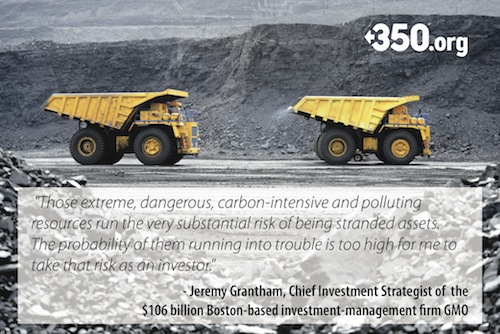
    Action 2: Start or join a local campaign

    Head to our campaign map to locate divestment campaigns in your area or start your own. To contact your local 350 divestment coordinators:

    Action 3: Join the Climate Action Frontline

    Send a powerful message to Government and industry that climate wreckage is unacceptable by committing your attendance at major events opposing fossil fuel expansion in Australia. Once you’ve signed up, we’ll send you regular event updates.

    Action 4: Make a Donation

    Pressed for time? Why not consider a small or big donation to the campaign? Every dollar goes straight into building a fossil free Australia – for resources, campaign materials, training organizers and running events. You can donate in one of 2 easy ways:

    1. Direct debit: Click here

    2. Crowd-funding: Chip in at: startsomegood.com/350ppm

    Your support and action will enable us to scale up at the urgency that is required to move Australia beyond fossil fuels. Onward we go!


    Charlie, Blair, Aaron and the whole 350 Australia team

    P.S. — If you haven’t already seen it, check out the Climate Commission’s latest report The Critical Decade 2013: Climate change science, risks and response, which concurs with Bill’s message that most of our carbon reserves must stay in the ground to have any hope of securing a safe climate future.


    350.org is building a global movement to solve the climate crisis. Connect with us on Facebook and Twitter, and sign up for email alerts. You can help power our work by getting involved locally, sharing your story, and donating here.To stop receiving emails from 350.org, click here.

  • 14,000 sq.km. land at risk with rising sea level: Report

    14,000 sq.km. land at risk with rising sea level: Report

    PTI

    Share  ·   Comment (2)   ·   print   ·   T+  T+  ·   T-
    Kolkata, June 18:

    The Indian sub-continent may lose close to 14,000 sq.km. of land with the rise of a one metre of sea level due to climate change.

    “Total area loss due to marine intrusion into coastal areas of the Indian sub-continent is estimated at approximately 13,973 sq.km. and 60,497 sq. km. of land area under 1m (metre) and 6m sea-level rise scenarios, respectively,” says a report published in the latest issue of Journal of Threatened Taxa.

    Prepared by a group of ecologists led by Dr M Zafar-ul Islam, the study presents an overview of the potential consequences of 1m and 6m sea-level rise for coastal conservation areas on the Indian sub-continent.

    Sea level is rising due to thermal expansion of the ocean, mountain glacier melting, and discharge from ice sheets as a result of global warming.

    Several coastal eco-regions and conservation areas are predicted to lose over half of their land areas to marine intrusion, particularly under the 6m sea level rise scenario.

    The report warns that marine intrusion might affect 18 of the 48 eco-regions in India.

    “Under the 1m sea level rise scenario, estimates of eco-region inundation range from 19 per cent to 59 per cent. While under the 6m sea-level rise scenario, estimates of eco-region inundation range from 27-58 per cent,” it says.

    Under the 1m sea level rise scenario, the Godavari-Krishna mangrove eco-region is predicted to lose more than a quarter of its area, while the UNESCO World Heritage site of Sundarbans in West Bengal is predicted to lose more than half of its area.

    While under the 6m sea level rise scenario, three eco-regions (Sundarbans freshwater swamp forests, Andaman Islands rain forests and Maldives Lakshadweep-Chagos Archipelago tropical moist forest) are predicted to lose more than a quarter of their land areas.

    Three more (Sundarbans mangroves, Godavari-Krishna mangroves, and Rann of Kutch seasonal salt marsh) are predicted to lose more than half of their land area.

    Seven protected areas — Bhitarkanika, Chilka Lake, Point Calimere, Interview Island, Lothian Island, Sajnakhali and Pulicat Lake — are expected to experience more than 50 per cent inundation under 1m sea level rise, and an additional four protected areas — Kachchh Desert, Velavadar, Pulicat, and Nal Sarovar — join this list under 6m sea level rise.

    Out of the 22 coastal conservation areas, nine will be spared from the effects of marine intrusion under 1m sea-level rise, but only one will be spared under a 6m sea-level rise scenario, says the report.

    Hundreds of species of flora and fauna, including globally threatened species, depend upon low-lying coastal eco-systems for their survival.

    Several important biodiversity areas, including in particular protected and non-protected IBAs (Important Bird Areas) in the Bay of Bengal and Arabian Sea, have already been stressed by numerous anthropogenic impacts as well as by invasive species.

    (This article was published on June 18, 2013)
  • Queensland property values at risk as sea levels rise due to climate change, CSIRO and University of Queensland say by: Peter Hall

    Queensland property values at risk as sea levels rise due to climate change, CSIRO and University of Queensland say

    severe weather system

    WEATHER WARNING: Severe storms of increasing frequency will combine with floods to drive property prices lower. Photo: AP Photo Source: News Limited

    RISING sea levels and intense storms will cut thousands of dollars from the value of low-lying homes in southeast Queensland, including Brisbane, according to an Australia-first climate change study.

    The Federal Government-funded analysis by scientists from the CSIRO and University of Queensland reveals homeowners and communities collectively could save billions of dollars by acting now to fortify properties and infrastructure.

    It factors in sea-level rises of up to 20cm by 2030 and 50cm by 2070.

    The study shows some buildings just above the 1-in-100-year flood level are expected to be affected in coming decades, resulting in a minimum 4 per cent price drop.

    It advocates “proactive adaptation measures’’, such as raising homes, modifying drainage and banning new development in at-risk areas.

    In extreme cases, a retreat to higher ground may be the best option.

    Digital Pass $1 for first 28 Days

    Advertisement

    Experts concede convincing people to follow the recommendations will be a great challenge.

    The study, Housing Shadow Prices in an Inundation-prone Suburb, looks at 4000 sales in an unnamed inner-Brisbane suburb.

    The location is described as close to the river but not riverfront and within 5km of the CBD. It contains properties worth up to $5 million.

    The research modelled buyers’ willingness to pay for land and homes in the flood-prone area and showed “significant property-price discounting of 5.5 per cent per metre below the defined flood level’’.

    Experts say the snapshot could be applied to 61,500 southeast Queensland properties soon expected to be under threat from a 2.5m storm tide.

    Project leader Dr Ryan McAllister told The Courier-Mail the main message was it made economic sense to adapt sooner rather than later.

    Dr McAllister said previous international studies found property prices in flood areas dropped by 10 per cent to 20 per cent in the short term.

    Prices usually bounced back as memories faded but his team’s detailed hedonic modelling had defined additional longer-term price impacts.

    “For a house that is already in the flood zone, then 50cm of sea level rise will result in an additional 2.75 per cent of price discounting. How much discounting occurred before sea level rise (SLR) depends on its place in the flood zone,’’ Dr McAllister said.

    “For a house that is just above the 1-in-100-year flood level, then 50cm of SLR will result in 4.05 per cent discounting,’’ he said.

    Dr McAllister said that while the impacts of climate change would not be catastrophic, there were going to be “some winners and losers’’.

    “The study recognises the challenge of convincing residents within exposed areas to participate in adaptation, which would require buy-in from the community,’’ he said.

    “Given that in Australia people’s wealth is largely tied up in the family home, we present a strong case to consider the effect of current and future climate risks on net wealth.’’

    HOUSE PRICES AND FLOOD RISK

    What the study says:

    – For flood-prone urban areas, the prospect of increasing population densities and more frequent extreme weather associated with climate change is alarming

    – Proactive adaptation can reduce potential flood risks but convincing residents in exposed areas to participate is challenging

    – The results of this study (4000 sales in a flood-prone inner-city Brisbane suburb) show significant property price discounting of 5.5 per cent per metre below the defined flood level

    – The suburb is close to the river but not at the riverfront, avoiding problems of disentangling river views from the adverse effects of flooding. Future sea-level rises are expected to proportionately affect local flood risks.

    INFORMATION: Housing Shadow Prices in an Inundation-prone Suburb (CSIRO, University of Queensland)

    BY THE NUMBERS

    – 20cm is the projection of sea level rise by 2030 and 50cm by 2070

    – 227,000 people in southeast Queensland are at risk of inundation from a 1-in-100-year storm tide

    – 273,000 will be exposed by 2070

    – 35,200 residential buildings in the southeast are at risk from a 2.5m storm tide

    – 61,500 properties will be affected by 2030, given current growth levels

    – 3.8 million Queenslanders – 85 per cent of the state’s population – live near the coastline

  • Ocean acidification reduces growth and calcification in a marine dinoflagellate

    Ocean acidification reduces growth and calcification in a marine dinoflagellate

    Published 18 June 2013 Science Leave a Comment
    Tags: , , , , , , , ,

    Ocean acidification is considered a major threat to marine ecosystems and may particularly affect calcifying organisms such as corals, foraminifera and coccolithophores. Here we investigate the impact of elevated pCO2 and lowered pH on growth and calcification in the common calcareous dinoflagellate Thoracosphaera heimii. We observe a substantial reduction in growth rate, calcification and cyst stability of T. heimii under elevated pCO2. Furthermore, transcriptomic analyses reveal CO2 sensitive regulation of many genes, particularly those being associated to inorganic carbon acquisition and calcification. Stable carbon isotope fractionation for organic carbon production increased with increasing pCO2 whereas it decreased for calcification, which suggests interdependence between both processes. We also found a strong effect of pCO2 on the stable oxygen isotopic composition of calcite, in line with earlier observations concerning another T. heimii strain. The observed changes in stable oxygen and carbon isotope composition of T. heimii cysts may provide an ideal tool for reconstructing past seawater carbonate chemistry, and ultimately past pCO2. Although the function of calcification in T. heimii remains unresolved, this trait likely plays an important role in the ecological and evolutionary success of this species. Acting on calcification as well as growth, ocean acidification may therefore impose a great threat for T. heimii.


    Van de Waal D. B., John U., Ziveri P., Reichart G.-J., Hoins M., Sluijs A. & Rost B., 2013. Ocean acidification reduces growth and calcification in a marine dinoflagellate. PLoS ONE 8(6): e65987. doi:10.1371/journal.pone.0065987. Article.

  • New ‘Embryonic’ Subduction Zone Found

    New ‘Embryonic’ Subduction Zone Found

    June 17, 2013 — A new subduction zone forming off the coast of Portugal heralds the beginning of a cycle that will see the Atlantic Ocean close as continental Europe moves closer to America.


    Share This:

    Published in Geology, new research led by Monash University geologists has detected the first evidence that a passive margin in the Atlantic ocean is becoming active. Subduction zones, such as the one beginning near Iberia, are areas where one of the tectonic plates that cover Earth’s surface dives beneath another plate into the mantle — the layer just below the crust.

    Lead author Dr João Duarte, from the School of Geosciences said the team mapped the ocean floor and found it was beginning to fracture, indicating tectonic activity around the apparently passive South West Iberia plate margin.

    “What we have detected is the very beginnings of an active margin — it’s like an embryonic subduction zone,” Dr Duarte said.

    “Significant earthquake activity, including the 1755 quake which devastated Lisbon, indicated that there might be convergent tectonic movement in the area. For the first time, we have been able to provide not only evidences that this is indeed the case, but also a consistent driving mechanism.”

    The incipient subduction in the Iberian zone could signal the start of a new phase of the Wilson Cycle — where plate movements break up supercontinents, like Pangaea, and open oceans, stabilise and then form new subduction zones which close the oceans and bring the scattered continents back together.

    This break-up and reformation of supercontinents has happened at least three times, over more than four billion years, on Earth. The Iberian subduction will gradually pull Iberia towards the United States over approximately 220 million years.

    The findings provide a unique opportunity to observe a passive margin becoming active — a process that will take around 20 million years. Even at this early phase the site will yield data that is crucial to refining the geodynamic models.

    “Understanding these processes will certainly provide new insights on how subduction zones may have initiated in the past and how oceans start to close,” Dr Duarte said.

    Share this story on Facebook, Twitter, and Google:
  • Jet Stream Changes Cause Climatically Exceptional Greenland Ice Sheet Melt

    Jet Stream Changes Cause Climatically Exceptional Greenland Ice Sheet Melt

    June 17, 2013 — Research from the University of Sheffield has shown that unusual changes in atmospheric jet stream circulation caused the exceptional surface melt of the Greenland Ice Sheet (GrIS) in summer 2012.


    Share This:

    An international team led by Professor Edward Hanna from the University of Sheffield’s Department of Geography used a computer model simulation (called SnowModel) and satellite data to confirm a record surface melting of the GrIS for at least the last 50 years — when on 11 July 2012, more than 90 percent of the ice-sheet surface melted. This far exceeded the previous surface melt extent record of 52 percent in 2010.

    The team also analysed weather station data from on top of and around the GrIS, largely collected by the Danish Meteorological Institute but also by US programmes, which showed that several new high Greenland temperature records were set in summer 2012.

    The research, published today in the International Journal of Climatology, clearly demonstrates that the record surface melting of the GrIS was mainly caused by highly unusual atmospheric circulation and jet stream changes, which were also responsible for last summer’s unusually wet weather in England.

    The analysis shows that ocean temperatures and Arctic sea-ice cover were relatively unimportant factors in causing the extra Greenland melt.

    Professor Hanna said: “The GrIS is a highly sensitive indicator of regional and global climate change, and has been undergoing rapid warming and mass loss during the last 5-20 years. Much attention has been given to the NASA announcement of record surface melting of the GrIS in mid-July 2012. This event was unprecedented in the satellite record of observations dating back to the 1970s and probably unlikely to have occurred previously for well over a century.

    “Our research found that a ‘heat dome’ of warm southerly winds over the ice sheet led to widespread surface melting. These jet stream changes over Greenland do not seem to be well captured in the latest Intergovernmental Panel on Climate Change (IPCC) computer model predictions of climate change, and this may indicate a deficiency in these models. According to our current understanding, the unusual atmospheric circulation and consequent warm conditions of summer 2012 do not appear to be climatically representative of future ‘average’ summers predicted later this century.

    “Taken together, our present results strongly suggest that the main forcing of the extreme GrIS surface melt in July 2012 was atmospheric, linked with changes in the summer North Atlantic Oscillation (NAO), Greenland Blocking Index (GBI, a high pressure system centred over Greenland) and polar jet stream which favoured southerly warm air advection along the western coast.

    “The next five-10 years will reveal whether or not 2012 was a rare event resulting from the natural variability of the NAO or part of an emerging pattern of new extreme high melt years. Because such atmospheric, and resulting GrIS surface climate, changes are not well projected by the current generation of global climate models, it is currently very hard to predict future changes in Greenland climate. Yet it is crucial to understand such changes much better if we are to have any hope of reliably predicting future changes in GrIS mass balance, which is likely to be a dominant contributor to global sea-level change over the next 100-1000 years.”

    Share this story on Facebook, Twitter, and Google: