Category: Uncategorized

  • Seismic Gap Outside of Istanbul: Is This Where the Expected Marmara Earthquake Will Originate From?

    Seismic Gap Outside of Istanbul: Is This Where the Expected Marmara Earthquake Will Originate From?

    June 18, 2013 — Earthquake researchers have now identified a 30 kilometers long and ten kilometers deep area along the North Anatolian fault zone just south of Istanbul that could be the starting point for a strong earthquake. The group of seismologists including Professor Marco Bohnhoff of the GFZ German Research Centre for Geosciences reported in the current online issue of the scientific journal Nature Communications that this potential earthquake source is only 15 to 20 kilometers from the historic city center of Istanbul.


    Share This:

    The Istanbul-Marmara region of northwestern Turkey with a population of more than 15 million faces a high probability of being exposed to an earthquake of magnitude 7 or more. To better understand the processes taking place before a strong earthquake at a critically pressurized fault zone, a seismic monitoring network was built on the Princes Islands in the Sea of Marmara off Istanbul under the auspices of the Potsdam Helmholtz Centre GFZ together with the Kandilli Earthquake Observatory in Istanbul. The Princes Islands offer the only opportunity to monitor the seismic zone running below the seafloor from a distance of few kilometers.

    The now available data allow the scientists around GFZ researcher Marco Bohnhoff to come to the conclusion that the area is locked in depth in front of the historic city of Istanbul: “The block we identified reaches ten kilometers deep along the fault zone and has displayed no seismic activity since measurements began over four years ago. This could be an indication that the expected Marmara earthquake could originate there,” says Bohnhoff.

    This is also supported by the fact that the fracture zone of the last strong earthquake in the region, in 1999, ended precisely in this area — probably at the same structure, which has been impeding the progressive shift of the Anatolian plate in the south against the Eurasian plate in the north since 1766 and building up pressure. The results are also being compared with findings from other fault zones, such as the San Andreas Fault in California, to better understand the physical processes before an earthquake.

    Currently, the GFZ is intensifying its activity to monitor the earthquake zone in front of Istanbul. Together with the Disaster and Emergency Management Presidency of Turkey AFAD, several 300 meter deep holes are currently being drilled around the eastern Marmara Sea, into which highly sensitive borehole seismometers will be placed. With this Geophysical borehole Observatory at the North Anatolian Fault GONAF, measurement accuracy and detection threshold for microearthquakes are improved many times over. In addition, the new data also provide insights on the expected ground motion in the event of an earthquake in the region. Bohnhoff: “Earthquake prediction is scientifically impossible. But studies such as this provide a way to better characterize earthquakes in advance in terms of location, magnitude and rupture progression, and therefore allow a better assessment of damage risk.”

    Share this story on Facebook, Twitter, and Google:
  • America’s Busiest Airports at Risk from Sea Level Rise

    America’s Busiest Airports at Risk from Sea Level Rise

    Becky Oskin, LiveScience Staff Writer
    Date: 18 June 2013 Time: 12:07 PM ET
    inShare0
    Ls-inbrief-logo
    Superstorm Sandy New York City
    Entrance to Battery Park flooded, NYC DOT truck seen submerged, blocking entrance after early closure on Oct. 29.
    CREDIT: New York Governor Andrew Cuomo

    During Hurricane Sandy, the ocean tried to take back the marshlands under New York’s LaGuardia Airport. Parts of the airport’s east-west runway and tarmac disappeared under Hurricane Sandy’s storm surge. The severe flooding was due to a combination of factors: Sea-level rise caused by global warming, a high tide, and the storm’s savagery, according to the National Oceanic and Atmospheric Administration (NOAA).

    New York’s major airports are among the 12 coastal hubs at risk of future storm flooding linked to sea level rise, according to a draft federal report, Climate Central reported. As sea levels inch higher at the coast, storms will cause more damage by pushing further inland, pounding critical infrastructure such as airports, power plants, highways and bridges. Twelve airports have runways within 12 feet (3.6 meters) of current sea level, according to the draft National Climate Assessment report. The list includes:

    • Ft. Lauderdale Int’l (FLL)
    • Honolulu International (HNL)
    • John F. Kennedy Int’l (JFK)
    • LaGuardia (LGA)
    • Miami Int’l (MIA)
    • New Orleans Louis Armstrong Int’l (MSY)
    • Newark Liberty Int’l (EWR)
    • Oakland International (OAK)
    • Philadelphia Int’l (PHL)
    • Ronald Reagan Washington National (DCA)
    • San Francisco Int’l (SFO)
    • Tampa International (TPA)

    Read more: National Climate Assessment

  • Singapore pollution soars as haze from Indonesia hits air quality

    Singapore pollution soars as haze from Indonesia hits air quality

    Air quality sinks to 15-year low as smoke plumes from Sumatran fires drift to neighbouring countries, prompting health alert

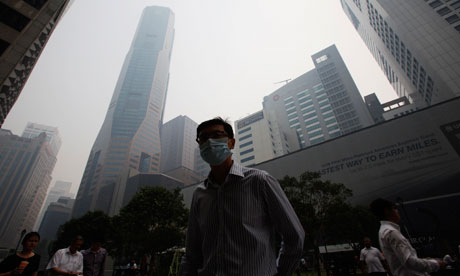
    A Singapore office worker walks to work through smoke haze

    An office worker in Singapore walks to work. Smoke haze is an annual problem for the country and its neighbour Malaysia. Photograph: Edgar Su/Reuters

    Singaporeans reduced military training exercises, kept cough-stricken children indoors and wore protective masks to work after a smoky haze triggered by forest fires in neighbouring Indonesia caused air pollution to hit its worst level in nearly 16 years.

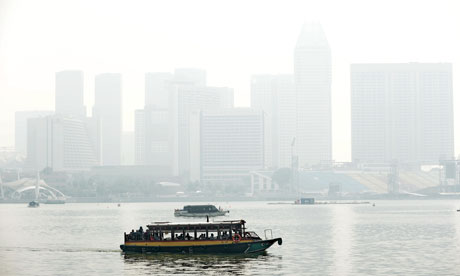
    Singapore‘s main measurement of air quality has hovered at the unhealthy classification as smoke from blazes on Sumatra island drifted across the sea and cast a grey pall over the city-state’s skyscrapers.

    The readings on the pollutant standards index were mostly between 104 and 123 on Tuesday, within the unhealthy range of between 101 and 200. A peak reading of 155 on Monday night was the highest since late 1997, when officials reported a 226 reading.

    Smoke haze is an annual problem for Singapore and its northern neighbour, Malaysia, often beginning midyear, when farmers in Indonesia seek to clear land cheaply by starting fires. It sometimes causes diplomatic strains as Malaysia and Singapore urge Indonesia to do more to prevent illegal burning.

    Malaysia has been only lightly affected so far this year, with pollution readings in Kuala Lumpur, its largest city, not breaching the unhealthy mark. Indonesia has said part of the current problem is caused by peat blazes that firefighters are struggling to extinguish during hot, dry weather.

    The forest ministry spokesman, Sumarto Suharno, said the government was continuing to educate farmers about alternatives to traditional slash-and-burn agriculture. “We have been able to reduce the regional haze problem significantly for years with help from local communities and will continue to undertake all efforts to prevent it from spreading,” he said.

    A boat sails along the Marina bay, Singapore, in front of buildings blanketed by haze A boat sails along Marina bay, Singapore. Photograph: Roslan Rahman/AFP/GettyIn Singapore, the defence ministry spokesman, Kenneth Liow, said the armed forces had reduced physical and outdoor training accordingly after the pollution index exceeded 100.
    Landscaper Hedrick Kwan blamed the haze after his two young sons started coughing as an acrid smell filled the air. “We usually leave the windows open but now we can’t do that because of all the dust and smoke,” he said.

    The National Environment Agency has advised Singaporeans, especially the elderly, children and people with respiratory problems, to avoid prolonged exposure outdoors.

    Melissa Cheah, a financial sector worker, said her office considered advising employees to wear protective masks.

    Singapore’s environment minister, Vivian Balakrishnan, said his agency had offered to help Indonesia extinguish the forest fires.

    Hospitals and clinics are expecting further smoke-related admissions next week.

    “Based on what we have seen over the years, when the haze hits us, it takes about three to four days before we see all these additional patients coming in for medication,” said Sarani Ng Omar, a GP, who predicted a rise in asthma-related cases, nasal problems and eye inflammation.

  • UN challenges Australia to protect Great Barrier Reef

    UN challenges Australia to protect Great Barrier Reef

    World Heritage Committee says reef will be listed as threatened ecosystem unless government takes steps to protect it

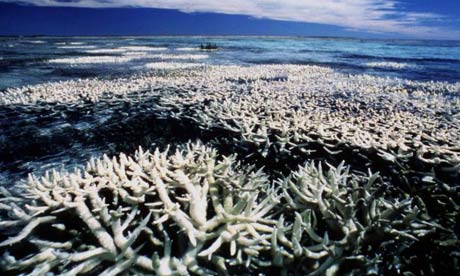
    Coral bleaching on the Great Barrier Reef.

    A UN report has urged Australia to ensure expansion of ports doesn’t damage the ‘outstanding value’ of the Great Barrier Reef. Photograph: Reuters

    The Great Barrier Reef will be listed as a threatened ecosystem by the United Nations from June next year unless the government follows a series of recommendations to protect it, the World Heritage Committee has decided.

    The committee, meeting in Cambodia, largely stood by a draft report it released in May, which noted “concern” at the “limited progress” in halting coastal development and other threats to the reef.

    A separate committee concern over the “lack of clarity” around water quality was amended, after the federal government pledged $200m in the May budget for the continuation of its “reef rescue” program, which aims to reduce the amount of agricultural chemicals flowing into the reef.

    The government has also produced, as the committee requested, an updated “scorecard” on the reef.

    However, the rest of the committee’s draft report findings were passed at the Cambodia meeting, effectively putting the government on notice that the Great Barrier Reef will join Unesco’s “in danger” list at its next annual meeting if improvements are not made.

    The committee is concerned that the Queensland and federal governments have made “no clear commitment toward limiting port development to existing port areas”. The report also urges Australia to ensure that the expansion of existing ports does not damage the “outstanding universal value” of the reef.

    More than 150 Australian and international scientists signed a letter on the eve of the World Heritage meeting calling for urgent action to safeguard the reef.

    Critics claim proposed expansion of coal and gas export terminals, such as at Townsville, and new major new export developments, such as Abbot Point, will hurt coral, turtles, dugongs and other wildlife through increased shipping and waste from dredging.

    Meanwhile, the Queensland government, which has previously referred to itself as being “in the coal business“, has also attacked the federal government for being too closely aligned to green groups and risking jobs and investment to the state.

    Tony Burke, the federal environment minister, said he was pleased that the committee had recognised progress that Australia had made on managing the reef.

    “The Great Barrier Reef is an iconic environmental asset and the Australian government is absolutely committed to the protection of the reef and our oceans. It’s one of the most precious places on Earth,” he said.

    “I am pleased that the final report takes into account more recent commitments by the government to safeguard the reef including a further $200m for the next stage of Reef Rescue.

    “The Australian government is also pleased that the decision recognises the progress Australia has made on the comprehensive strategic assessment, including important new research which will help ensure that the reef is protected in accordance with the best available science.

    “There are a number of threats facing the reef, including climate change, coastal developments, agricultural runoff, ocean acidification and outbreaks of the crown-of-thorns starfish. We are working to address each of these, on land and in the ocean.”

    A spokesperson for Greg Hunt, the shadow environment minister, said that an incoming Coalition government would focus on reducing the pollution that damages the reef.

    “We welcome the acknowledgement of the improvements in water management on the reef,” the spokesperson said. “It is an important responsibility of the Australian government and in that context it was disappointing that Minister Burke had delayed the re-commitment to the Reef Rescue funding.”

    “If elected, the Coalition will implement a Reef 2050 plan with a focus on water quality and increased action to address run-off and the subsequent threat posed by the Crown of Thorns.”

    Greens senator Larissa Waters, whose bill to halt new developments beside the reef was rejected by the government, said that urgent action was now needed to avoid the ‘in danger’ listing.

    “The old parties are letting the big mining companies treat the Great Barrier Reef as a dumping ground for dredge spoil and a shipping super highway and the world is watching and sending a clear warning that this is simply unacceptable,” she said.

    “The Queensland and federal governments now have a year to act on the World Heritage Committee’s recommendations to save the Great Barrier Reef from being added to the list of sites in danger.”

  • World Bank warns global warming woes closing in

    World Bank warns global warming woes closing in

    AFPUpdated June 19, 2013, 6:34 pm

    WASHINGTON (AFP) – The World Bank on Wednesday warned that severe hardships from global warming could be felt within a generation, with a new study detailing devastating impacts in Africa and Asia.

    The report presents “an alarming scenario for the days and years ahead — what we could face in our lifetime,” said World Bank President Jim Yong Kim.

    “The scientists tell us that if the world warms by two degrees Centigrade (3.6 degrees Fahrenheit) — warming which may be reached in 20 to 30 years — that will cause widespread food shortages, unprecedented heat waves, and more intense cyclones,” he said in a statement.

    An update of the Bank’s November “Turn Down the Heat” climate report, the Potsdam Institute for Climate Impact Research and Climate said there was evidence in the past seven months that previous projections for greenhouse gas emissions had been too low.

    Now, it said, there was a growing chance that warming will reach or exceed four degrees Celsius in this century “in the absence of near-term actions and further commitments to reduce emissions.”

    The United Nations has proposed the goal of limiting global warming to two degrees Celsius from pre-industrial levels, setting for the first time measurable targets to curb greenhouse-gas emissions.

    International negotiations are aimed at reaching an agreement on that limit by 2015, with the pact due to take effect by 2020.

    In the report, commissioned by the World Bank, scientists from around the world focused on the risks of climate change to development in Sub-Saharan Africa, Southeast Asia and South Asia, home to some of the world’s poorest people.

    They looked at the likely impacts from varying degrees of global warming in a range of areas, including agriculture, water resources, coastal erosion and vulnerability to flooding.

    The report noted that the current level of warming — 0.8 degrees Celsius above the pre-industrial levels of the 18th century — already had increased drought in Sub-Saharan Africa and coastal erosion in Southeast Asia.

    The impact of two-degree warming, expected by the 2040s, would have grave and sweeping consequences, it said.

    Unusual and unprecedented heat extremes would hammer the three regions, cutting crop production and causing widespread food shortages.

    Many regions would see 20 percent declines in water availability and, for South Asia, disturbances in the monsoon could put water and food resources “at severe risk.”

    Rachel Kyte, World Bank vice president for sustainable development, said the development lender has been working with some of the world’s burgeoning cities to mitigate the risks of global warming, for example helping Manila and Ho Chi Minh City on flood mitigation.

    She said the Bank was looking at a major initiative preparing cities to absorb investment for infrastructure projects that will help them deal with the impact of global warming, such as flood protection, and the report, by detailing risks, should encourage much-needed private investment.

    “When the investment community understands risks, then they always flip that into an opportunity in terms of investment vehicles,” she said in a conference call.

    Kyte said there was “a fundamental shift” in thinking at the World Bank that has put climate change at the heart of its development strategy.

    The World Bank doubled its investment in climate adjustment to $4.6 billion in fiscal year 2012 ending June 30 from $2.3 billion the prior year, she said.

    The report stressed that the risks were rising and a solution urgent, but there was a chance to avoid the worst of the crisis.

    “It is not too late to hold warming near two degrees Celsius, and build resilience to temperatures and other climate impacts that are expected to still pose significant risks to agriculture, water resources, coastal infrastructure, and human health,” the report said.

    “The window for holding warming below two degrees Celsius and avoiding a four degrees Celsius world is closing rapidly, and the time to act is now.”

    Oxfam welcomed the report but said the World Bank “must ensure its own lending meets the needs of the people who are most vulnerable to climate change.”

    Greenpeace pushed for the World Bank to stop funding fossil-fuels projects, which add to global warming.

    “Bold action is needed from all governments, and the World Bank must lead the way by shifting all its energy financing from fossil fuels to renewables and energy efficiency,” it said.

  • Labor risks majority crisis

    Labor risks majority crisis

    Date
    June 19, 2013
    • (0)
    Mark Kenny

    Mark Kenny

    Chief political correspondent

    View more articles from Mark Kenny

    Kevin Rudd.Pressure is building within Labor for a leadership showdown between Kevin Rudd and Prime Minister Julia Gillard Photo: Andrew Meares

    A late switch by Labor back to Kevin Rudd could provoke a constitutional crisis forcing Governor-General Quentin Bryce to consider options such as a sudden recall of Parliament to test Labor’s majority or even the appointment of Tony Abbott as prime minister.

    Another option would be the commencement of an immediate caretaker period before an early election.

    With pressure building within Labor for a leadership showdown between Mr Rudd and Prime Minister Julia Gillard, strategists on both sides of politics are waking up to the risk of unintended consequences of a leadership change in a party that does not have a majority in the House of Representatives. Legal experts say the Governor-General would be in uncharted waters because a new Labor leader would not necessarily command a parliamentary majority.

    Illustration: Ron Tandberg.Illustration: Ron Tandberg.

    University of NSW law professor George Williams said there would be several possibilities arising from a change, beginning with independent MPs Tony Windsor and Rob Oakeshott ”grudgingly indicating their support”, in which case Mr Rudd would be signed in as prime minister. Another option would see the independents switch to Opposition Leader Mr Abbott, in which case he would be made prime minister, while a third possibility is that their allegiance becomes unclear.

    Advertisement

    That possibility could lead to an early election or a one-off sitting of Parliament to test the majority on the floor of the House.

    Another legal expert, speaking on condition of anonymity, said it was possible that the Governor-General would conclude that Labor’s majority no longer existed and would consider ”letters” from the Labor and Liberal leaders making the case for their appointment.

    The uncertainty is likely to give pause to any Labor MPs believing that a switch to Mr Rudd could be done seamlessly next week.

    A Liberal source said the opposition was watching Labor’s internal leadership wrangling and was ”very much aware of the [constitutional] situation and giving it close consideration”.

    Mr Oakeshott said it was telling that the supposed architects of the move against Ms Gillard had not thought through the implications of their actions.

    ”They haven’t been on the phones and talking to us at all,” he said.

    Both pro-Rudd and pro-Gillard forces have been working on the assumption that the leadership stalemate would be brought to a head only after the final parliamentary question time on Thursday next week to avoid a parliamentary no-confidence vote.

    Ms Gillard addressed the caucus on Tuesday in an uneventful meeting in which the leadership was expressly not discussed.

    ”The elephant sat quietly in the corner,” was how one member characterised the meeting.

    The crossbench MPs have hinted previously that they would view their 2010 agreement with Labor on confidence and supply to be null and void if the leadership changed, because it had been struck with Ms Gillard personally.

    One of those MPs, Tasmania’s Andrew Wilkie, has already abandoned his formal agreement after being dudded on a commitment from Ms Gillard on poker machine reform.

    Asked on Tuesday what his attitude would be now if Labor changed its leader, Mr Wilkie said he did not know. ”I have a fairly neutral position and am genuinely open-minded,” he said.

    Follow the National Times on Twitter

    Read more: http://www.smh.com.au/opinion/political-news/labor-risks-majority-crisis-20130618-2ogwh.html#ixzz2WdsxsE6R