Category: Uncategorized

  • Daily updates Renew-Economy

    Click here to enable desktop notifications for Gmail.   Learn more  Hide
    1 of 2
    Why this ad?
    simplesite.comMake a Free Website – Australia’s Easiest Website with Blog, Online store and a Personal Domain (and no ads)

    Daily update: Energy prices crash as Queensland solar takes hold

    Inbox
    x

    Renew Economy editor@reneweconomy.com.au via mail8.wdc01.mcdlv.net

    3:22 PM (7 minutes ago)

    to me
    Energy prices crash as Queensland solar takes hold, Who’s responsible for over-capacity? Not renewables, The world’s $7.7tn energy boom, Solar bodies attack Abbott over ARENA & energy costs, Lessons from a failed energy revolution, How renewables in US were stopped, Can Australia avoid Kodak moment? Hydro energy storage a forgotten component of future electricity grids? and Dear Tony can you please stop lying about the RET.
    Is this email not displaying correctly?
    View it in your browser.
    RenewEconomy Daily News
    The Parkinson Report
    As Tony Abbott argues that renewables lift costs for consumers, energy prices in Queensland have plunged to unprecedented lows as rooftop solar “eats the midday” lunch of incumbent fossil fuel generators. That is why they want the RET stopped.
    Australia’s current over-capacity is not the fault of renewables, it’s because incumbent generators made bad bets on demand. Another anti-renewables myth exploded.
    Global energy markets facing watershed moment as BNEF predicts two thirds of new investment to 2030 will be in renewable energy.
    Solar bodies prepare defence of ARENA and attack Abbott over demonisation of rooftop solar systems.
    The transition to renewable energy is the only hope we have to overcome the resource crisis and the climate crisis we are facing. But to achieve that, we need to understand why nuclear failed.
    An inside story of how a push to renewable energy in the 1970s in the United States was stopped in its tracks.
    Can Australia avoid its ‘Kodak moment’ by aligning its economy and industry with global low-carbon trends, or are we headed for a long slow decline?
    I don’t like to publicly criticize leaders but I am compelled to take you to task. Can you please stop lying about the Renewable Energy Target?
    SolarEdge is coming to your town REGISTER
  • Carbon capture and storage enters the twilight zone

    27 Jun 2014
    Home  »  Uncategorized   »   Carbon capture and storage enters the twilight zone

    Carbon capture and storage enters the twilight zone

    Posted in Uncategorized By Neville On June 27, 2014

    twilight zone

    Carbon capture and storage enters the twilight zone

    Posted in Uncategorized By Neville On June 26, 2014


    Carbon capture and storage enters the twilight zone

    By on 26 June 2014
    Print Friendly

    In its latest annual review of the ailing prospects for the deployment of Carbon Capture and Storage (CCS), the International Energy Agency’s Clean Coal Centre (IEA CCC) has tentatively suggested that the cost of developing and deploying the expensive technology should be paid for by coal, oil and gas producers. It is, however, a suggestion guaranteed to be rejected by the coal industry which has most to lose.

    carbonThe glum title of the IEA CCC’s latest review –What’s in store for CCS? – is symptomatic of the gloom enveloping even the most ardent supporters of CCS. In their review, which was released earlier this week, the IEA CCC complains that “CCS investment, demonstration projects and large-scale deployment are well behind the targets envisaged by analysts, governments and industry”.

    One of the key factors in the slow rate of construction of demonstration plants has been the decade long tug of war over who carries the costs for CCS: fossil fuel producers, the companies that burn the fossil fuels or taxpayers? Or a mix of all three?

    For coal companies the widespread equipping of coal-fired power plants with CCS plants would be a boon.

    In an April 2013 presentation, the Policy Manager of the World Coal Association, Aleksandra Tomczak, explained (page 12) that “if CCS is viable and carbon prices high, coal power can be competitive with gas.” Even though CCS is far from being “viable” without taxpayer subsidies and the coal industry vehemently opposes “high” carbon prices, Tomczak bluntly pointed out a potential upside for coal companies: “coal demand further boosted by increase in coal consumption per GW [gigawatt] vs straight coal”. Estimates vary, but CCS plants could require an extra 20-30% more coal to produce the same power output.

    What is good about CCS for coal companies though is bad for utilities.

    The extra capital cost of a CCS increases the financing cost, not to mention the extra operational costs of increased coal and water consumption and the disposal costs of the compressed carbon dioxide in underground storage areas, if they exist in close proximity to the power plants.

    All up, the extra costs of CCS make coal-fired plans with the technology very expensive when designed into new plants. Earlier this year the US Department of Energy (DOE) estimated that based on current technology to capture 90-95 per cent of the carbon dioxide in waste stream would increase wholesale power prices by approximately 70 to 80 percent.  The costs of retrofitting CCS to existing plants, let alone those in old age, would be prohibitive.

    As the costs and difficulty of developing CCS have become apparent, utilities have become exceedingly wary of carrying the coal industry’s can. But if utilities don’t want to fund it, who will?

    For the best part of a decade the coal industry persuaded a number of governments to pledge to fund various R&D projects, map potential underground storage reservoirs, run pro-CCS PR campaigns and fund some test scale projects.

    Despite the expenditure of billions of dollars many projects have faltered while some in the US and Europe struggle on. The Global Financial Crisis and austerity budgets sapped the financial commitment of some governments. Even some of the hardest line pro-coal governments – such as that led by Australian Prime Minister Tony Abbot – have retreated from funding new CCS projects.

    New factors are in play too. In major economies the era of building new coal plants is all but over with electricity demand stalling, if not declining. The rise of renewables is depressing wholesale market prices while energy efficiency and rooftop solar are further cannibalising the profitable peak power spikes. The economic assumptions which underpinned the optimism towards CCS a decade ago have changed profoundly.

    Which is why the IEA CCC’s notes in its report that “in the case of power plants, operating in highly competitive electricity markets, special power purchase agreements including electricity price agreements are likely to be needed.” In other words, to be viable in the power sector, CCS needs to propped up by being shielded from falling wholesale electricity prices, which is precisely what energy efficiency and renewables deliver.

    The coal industry’s dilemma – to love or leave CCS?

    But having hyped the potential of CCS for the best part of twenty years, coal industry lobby groups now find themselves in a bind.

    In a historically coal-addicted country such as Australia, the Minerals Council of Australia (MCA) – which represents major coal companies such as BHP Billiton, Peabody Energy and Rio Tinto – hyped CCS as a solution to the greenhouse gas emissions of coal plants.  But even the MCA now cautions that “the cancellation or postponement of some CCS demonstration projects in Australia and around the world is not unexpected, particularly given global economic uncertainties, and should not be taken to reflect a failure of the technology itself.”

    At the same time, the National Mining Association (NMA) in the US – which represents some of the same companies as the MCA – recently launched an advertising campaign arguing against the Obama administration proposal requiring CCS to capture part of carbon dioxide emissions would dramatically push up electricity prices.

    Where once the coal industry had successfully sold the idea to policy makers and most commentators that CCS was an inescapable element of any emissions reduction strategy, that idea is now falling from favour.

    Three weeks ago Jonas Rooze, an analyst from Bloomberg New Energy Finance Europe said that they hadn’t included CCS-fitted power plants in their European generation scenario “because we don’t really see enough evidence of it happening enough to be relevant to our forecast.”

    If utilities don’t want to fund it and many governments are at best luke-warm to it, who is left?

    In the absence of better options the IEA’s CCC has floated the idea that fossil fuel industry itself should be the ones contributing most to the cost of developing CCS.

    For the thermal coal industry, most of which is struggling with low profit margins and in the midst of a vicious round of cost-cutting, the idea of stumping up billions of dollars for a technology that may never be viable is implausible.

    Nor is the gas industry, which has taken great pains to push coal to the fore as the fossil fuel industry’s bad boy, likely to come to the rescue of its rival.

    In the absence of enthusiastic deep-pocketed sponsors, CCS is gradually being pushed off into the twilight zone where it is likely to quietly fade away when existing government funded programs run out of cash.

    Bob Burton is a Contributing Editor of CoalSwarm and a Director of the Sunrise Project, a non-profit group promoting a shift away from fossil fuels. With Guy Pearse and David McKnight he co-authored Big Coal: Australia’s Dirtiest Habit. Bob Burton’s Twitter feed is here.

  • What really annoys scientists about the state of the climate change debate?

    What really annoys scientists about the state of the climate change debate?

    From misinformed politicians who should ‘shut up’, to a failure of large parts of society to grasp reality, climate scientists reveal their bugbears

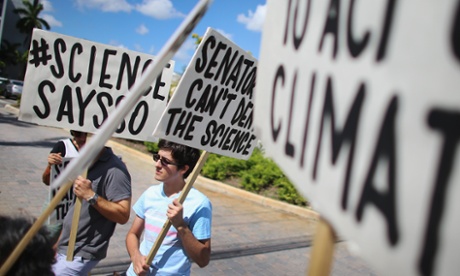
    Protesters at the office of a U.S. Senator who doubts the evidence of human-caused climate change. Photo: Joe Raedle/Getty Images
    Protesters at the office of a US senator who doubts the evidence of human-caused climate change. Photo: Joe Raedle/Getty Images

    “Don’t shoot the messenger,” so the saying goes.

    But what if that message warns we might want to rethink that whole fossil fuel burning thing pretty quick because it could seriously alter civilization and the natural world for centuries to come, and not in a good way?

    Time to get the bullets out and start firing, obviously.

    Climate scientists have been trying to dodge, catch or deflect those bullets for decades.

    They are now all too used to being shot at, kicked and maligned as their findings are misunderstood, misrepresented, trivialised or booted around like footballs between politicians and other warring ideological factions and self-interested industry groups.

    But if they had to pick one thing, what is it that really gets them annoyed?

    When the public tries to understand the implications of their scientific findings – or just understand the findings themselves – what’s the most common mistake they see?

    When the media gets hold of their findings, what makes climate scientists chuck a shoe, ice core or physics textbook at the screen in frustration?

    I decided to ask a few leading climate scientists from around the globe to articulate that one thing that leaves them totally tacked off.

    Some struggled to pick only a single bugbear (one even called to apologise for taking too long, so spoilt for choice were they), others took the chance to uncompromisingly unload their frustrations.

    Here’s what they had to say.

    Professor Andrew Pitman, director of the Australian Research Council’s Centre of Excellence for Climate System Science, University of New South Wales, Sydney

    Many people who would not dream to claim they understand how antibiotics, microprocessors or immunisations work seem happy to wax lyrical on their views on climate change.

    A politician or media identity who would be laughed out of office if they said “vaccines don’t work” or “I am certain the moon is made of cheese” happily speak equivalent rubbish on climate science, believing their views deserve credit.

    I want engineers to build bridges; I want a trained surgeon to operate on hearts and I want some of our decision-makers and commentators to either shut up, or familiarise themselves with climate science well enough to talk sense.

    Professor Michael Mann, director of Penn State Earth System Science Center, United States

    If there’s one concept that is typically misrepresented in the public discourse on climate change, it is the concept of uncertainty.

    There are uncertainties in model projections of future climate change. However, these uncertainties cut both ways, and in many cases it appears that model projections have underestimated the rate and magnitude of the climate changes resulting from our burning of fossil fuels and emission of greenhouse gases into the atmosphere. The rapid lost of Arctic sea ice is one such example.

    Rather than being cause for inaction, uncertainty is a reason to act all the sooner.

    Professor Michael Raupach, director of the Climate Change Institute, Australian National University, Canberra

    The greatest cause for sorrow is the widespread inability of the public discussion to recognise the whole picture.

    Much of the political discourse reduces the complexities of climate change to political football (“axe the tax”); much media reporting sees only the hook to today’s passing story; many interest groups want to use climate change to proselytise for their particular get-out-of-jail free card (nuclear power, carbon farming).

    All of this misses or trivialises the real, systemic significance of climate change: that humankind is encountering the finitude of our planet, confronting the need to share and protect our endowment from nature, and realising that much will have to change to make this possible.

    Professor Richard Betts, chair in Climate Impacts at the College of Life and Environmental Sciences, University of Exeter, UK

    The thing that bugs me most about the way climate change is talked about in the media is journalists citing scientific papers without providing a link to the original paper.

    Readers often want to get more details or simply check sources, but this is very difficult (or sometimes impossible) if the source is not given. I’ve raised this a few times, and get lame excuses like ‘readers get frustrated when the journals are paywalled’ but that’s not good enough. Media should provide sources – end of.

    Professor Steven Sherwood, director of the Climate Change Research Centre at the University of New South Wales, Sydney

    Where to start?

    These are things I don’t see (or don’t see enough).

    First is still that, even though it is clear greenhouse gas emissions raise the temperature of the Earth, we’ve known this for 50+ years and no reputable atmospheric scientist in the world disputes this, most people think scientists disagree. They’ve been misled by the media, and I’ve been told repeatedly by reporters in the US and Australia that this is due to pressure from management.

    Second is the fact that carbon dioxide emissions are effectively irreversible and will stay in the climate system for hundreds of generations is seldom noted. If we decide later that this was a huge mistake there is no going back (practically speaking).

    On the political side, I wish the media would note the obvious parallels of the carbon debate with past ones over restricting pollutants (mercury, lead, asbestos, CFCs), where claims that restrictions would be economically catastrophic never came true.

    These are things I do see that bug me.

    One would be phrases like “action on climate change”. We should be talking about “action on carbon dioxide” — and climate is only one reason (albeit the biggest) that too much of it is dangerous. Nothing we do with respect to any other influence on climate will prevent global warming if CO2 keeps climbing.

    Professor Stefan Rahmstorf, head of Earth System Analysis, Potsdam Institute for Climate Impact Research, Germany

    One of the phrases that makes me cringe is when I read in the media that a particular extreme weather event “is no evidence for climate change”. This is so bad it’s not even wrong, but it is quite misleading.

    Climate change is a measured fact seen in rising temperatures, vanishing ice, rising sea levels etc. – it needs no further evidence. And a single extreme event cannot possibly provide such evidence, because climate change increases the number of certain extremes. Some, like heat waves, have already increased massively thanks to global warming.

    Professor Roger Jones, research fellow at the Centre for Strategic and Economic Studies at Victoria University, Melbourne

    Who am I?

    I can be sued for calling a public individual fraudulent but not a whole scientific community or organisation – because climate scientists and the IPCC are fraudulent.

    I can publish proven lies in my newspaper day after day with no penalty.

    I can buy disaffected scientists to deny sound science with a plane fare to a bogus conference and a little publicity.

    I can anonymously threaten researchers online, especially the female ones.

    If anyone threatens me with facts, I can call them an antidemocratic, anti-jobs, McCarthyist, communist, anti-freedom, pagan environmentalist.

    Everyone says there is no consensus.

    I deny everything.

    Dr Sophie Lewis, research fellow in the School of Earth Sciences at the University of Melbourne

    I get annoyed when I hear yet another politician arguing that we can’t link extreme events to climate change. You know the spurious reasoning? Australia’s always had heatwaves/floods/fires, so this recent extreme is nothing to worry about. When I hear this, it’s time to turn off the TV.

    Climate scientists don’t just guess at what contributed to recent extremes. We methodically calculate changes in the risk of extremes due to human factors, like greenhouse gases. I don’t just get irate out of principle.

    Dismissing the link between climate change and extremes as hogwash leaves us vulnerable to a warmer climate.

    Dr Andrew Glikson, visiting fellow at the School of Archaeology and Anthropology, Australian National University

    I think the scale of the changes being seen now when compared to the Earth’s history is something the media and the public do not appreciate. Earth’s history is marked by a number of major mass extinctions of species, triggered by volcanic eruptions, asteroid impacts and release of methane from sediments.

    Major shifts in the state of the climate were caused either by pulsations in solar radiation or by release of carbon from the Earth. In each of these events a marked rise occurred in the concentration of greenhouse gases in the atmosphere.

    As the level of energy and temperature of the atmosphere increased, irreversible tipping points were reached where the synergy of feedback processes – ice melt, warming water, released methane, droughts and fires – combined to shift the climate from one state to the next.

    The current rise in energy of the atmosphere above that of pre-industrial times, by about 3 Watt per square meter, is about half that of the atmospheric energy rise during the last transition from glacial to interglacial state.

    The current shift is threatening to bring about irreversible tipping points in the climate, with the most serious consequences, likely indicated by the increase over the last 20 years or so in the intensity of extreme weather events around the globe.

    The current rise of atmospheric CO2 at a rate of near-three parts per million per year exceeds rates recorded in the history of the atmosphere for the last 55 million years, which retards the ability of species to adapt to environmental change in time.

    A consequent shift from conditions, which have allowed agriculture to take place from about 8,000 years ago, would render large parts of the continents unsuitable for cultivation.

    Green light

    Sign up for the Green light emai

  • Scientists discover how plastic solar panels work

    Scientists discover how plastic solar panels work

    Posted By News On July 1, 2014 – 9:30am

    Scientists discover how plastic solar panels work

    This news release is available in French.

    Scientists don’t fully understand how ‘plastic’ solar panels work, which complicates the improvement of their cost efficiency, thereby blocking the wider use of the technology. However, researchers at the University of Montreal, the Science and Technology Facilities Council, Imperial College London and the University of Cyprus have determined how light beams excite the chemicals in solar panels, enabling them to produce charge. “Our findings are of key importance for a fundamental mechanistic understanding, with molecular detail, of all solar conversion systems – we have made great progress towards reaching a ‘holy grail’ that has been actively sought for several decades,” said the study’s first author, Françoise Provencher of the University of Montreal. The findings were published today in Nature Communications.

    Three laser beams are needed to record the excited vibrational modes of PCDTBT with the method called femtosecond stimulated Raman spectroscopy. First, the green pulse is absorbed by the polymer, just as sunlight would be in a solar cell, which creates the excited state. Then, a pair of infra-red and white pulses probe this excited vibrational mode. Very short pulses of light and precise timing enable an impressive time resolution of less than 300 femtoseconds.

    (Photo Credit: University of Montreal)

    The researchers have been investigating the fundamental beginnings of the reactions that take place that underpin solar energy conversion devices, studying the new brand of photovoltaic diodes that are based on blends of polymeric semiconductors and fullerene derivatives. Polymers are large molecules made up of many smaller molecules of the same kind – consisting of so-called ‘organic’ building blocks because they are composed of atoms that also compose molecules for life (carbon, nitrogen, sulphur). A fullerene is a molecule in the shape of a football, made of carbon. “In these and other devices, the absorption of light fuels the formation of an electron and a positive charged species. To ultimately provide electricity, these two attractive species must separate and the electron must move away. If the electron is not able to move away fast enough then the positive and negative charges simple recombine and effectively nothing changes. The overall efficiency of solar devices compares how much recombines and how much separates,” explained Sophia Hayes of the University of Cyprus, last author of the study.

    Two major findings resulted from the team’s work. “We used femtosecond stimulated Raman spectroscopy,” explained Tony Parker of the Science and Technology Facilities Council’s Central Laser Facility. “Femtosecond stimulated Raman spectroscopy is an advanced ultrafast laser technique that provides details on how chemical bonds change during extremely fast chemical reactions. The laser provides information on the vibration of the molecules as they interact with the pulses of laser light.” Extremely complicated calculations on these vibrations enabled the scientists to ascertain how the molecules were evolving. Firstly, they found that after the electron moves away from the positive centre, the rapid molecular rearrangement must be prompt and resemble the final products within around 300 femtoseconds (0.0000000000003 s). A femtosecond is a quadrillionth of a second – a femtosecond is to a second as a second is to 3.7 million years. This promptness and speed enhances and helps maintain charge separation. Secondly, the researchers noted that any ongoing relaxation and molecular reorganisation processes following this initial charge separation, as visualised using the FSRS method, should be extremely small. “Our findings open avenues for future research into understanding the differences between material systems that actually produce efficient solar cells and systems that should as efficient but in fact do not perform as well. A greater understanding of what works and what doesn’t will obviously enable better solar panels to be designed in the future,” said the University of Montreal’s Carlos Silva, who was senior author of the study.


    About the study:

    The article “Direct observation of ultrafast long-range charge separation at polymer–fullerene heterojunctions,” was published in Nature Communications on July 1, 2014. Françoise Provencher is Carlos Silva’s student at the University of Montreal’s Department of Physics. Both are affiliated with the Regroupement québécois sur les matériaux de pointe. Silva is also a visiting professor at Imperial College London. Sophia Hayes is affiliated with the Department of Chemistry at the University of Cyprus. The instrumental scientists of the Science and Technology Facilities Council (UK) Anthony W. Parker, Gregory M. Greetham, Michael Towrie, set-up the laser system and experiments. Nicolas Bérubé, Christoph Hellmann, Michel Coté, and Natalie Stingelin also contributed to the research. The researchers received funding from the Natural Sciences and Engineering Research Council of Canada, the Canada Research Chair in Organic Semiconductor Materials, the Royal Society, the Leverhulme Trust, LASERLAB-EUROPE (grant agreement no. 284464, EC’s Seventh Framework Programme), the UK Engineering and Physical Sciences Research Council (EP/G060738/1 grant), the European Research Council (ERC) Starting Independent Research Fellowship (grant agreement No. 279587) and King Abdullah University of Science and Technology. The Science and Technology Facilities Council supported access to the FSRS facilities beyond the EU support typically offered. The University of Montreal is known as Université de Montréal.


  • Shorten vows to ‘re-litigate’ case for carbon pricing e for carbon

    The full story…

    Shorten vows to ‘re-litigate’ case for carbon pricing

    Alexandra Kirk reported this story on Tuesday, July 1, 2014 18:26:00

    MARK COLVIN: The Opposition Leader Bill Shorten has re-affirmed Labor’s commitment to a market based greenhouse emissions policy.

    At the same time he’s conceded that Labor failed to prosecute the case for action on climate change.

    Harking back to 2009, when Malcolm Turnbull was Liberal leader, he said Labor had underestimated the challenge Mr Turnbull faced from within his own party on climate change.

    From Canberra, Alexandra Kirk reports.

    ALEXANDRA KIRK: As of today there are 12 new senators who’ll take their seats when the Senate sits next week.

    The Coalition, with 33 senators, will need to secure the votes of six of the eight crossbenchers, if Labor and the Greens won’t play ball.

    TONY ABBOTT: Okay colleagues, well look, it’s good that we’re gathered here today on the first of July, the day the new senate starts.

    ALEXANDRA KIRK: The Prime Minister convened a cabinet meeting in Canberra today and provided some brief comments to mark the senate’s changing of the guard.

    TONY ABBOTT: We do welcome the new senate, we do want to work constructively and respectfully with the new senate and I am reasonably optimistic that we can do good things together for our country and for the benefit of our people.

    ALEXANDRA KIRK: As the Government considers its approach to corralling crossbench votes for contentious legislation, the latest Newspoll has support for the Coalition slipping back to its post-budget low, 10 points behind Labor after preferences.

    TONY ABBOTT: There’s been lots of political ups and downs, but nevertheless those fundamentals… those fundamentals that we made a commitment to the public on, we are delivering.

    ALEXANDRA KIRK: While much of the Government’s budget remains to be negotiated in the new senate, the carbon tax will be repealed with the support of Clive Palmer’s party. That’s prompted some reflection from Opposition Leader Bill Shorten.

    BILL SHORTEN: If you want people to get on board change with you, convince them of the merits of change and that lesson also is for Labor when it comes to climate, we’ve got to reiterate the case and I don’t think Labor was expecting that we’d have to go back to first principles.

    ALEXANDRA KIRK: Today he charted the demise of political support for a price on carbon.

    BILL SHORTEN: If you look at one of the key fault lines in Australia, it started in 2009, when Tony Abbott and the sceptics and the denialists and the internet trolls rolled Malcolm Turnbull. And ever since that day we’ve seen a break down in consensus. I’ve got no doubt that Labor underestimated the impact that the anti-climate change brigade had.

    ALEXANDRA KIRK: Bill Shorten says some business leaders, academics and members of the Greens and Liberal Party look back with some regret – as does he.

    BILL SHORTEN: I think in 2009 we underestimated the challenge that Turnbull was under internally.

    ALEXANDRA KIRK: And while championing the merits of consensus, he’s taken another swipe at the Government’s budget cuts.

    BILL SHORTEN: The real test of political leadership is a willingness to build consensus, to earn agreement, not just to yank the bell at the Downton Abbey political college and expect a servant class of obedient Australians to carry out your will.

    ALEXANDRA KIRK: One of the budget casualties is the nation’s first full-time Disability Discrimination Commissioner. Graeme Innes is retiring and his job will be taken on by the Age Discrimination Commissioner Susan Ryan.

    SUSAN RYAN: Look I think my work agenda kind of suggest itself in the light of the McClure report and the obvious interest in the Government and the sector group in finding pathways for people on disability pension to get back into the workforce. I think I will concentrate on barriers that are put in the way of people with disabilities, finding paid jobs and how to overcome those barriers.

    ALEXANDRA KIRK: And do you have a view about where the problem lies?

    SUSAN RYAN: Look I have a view that, but it needs to be a much more informed view than it is today. I have a view that employers have concerns about hiring people with disability, they don’t quite understand what their responsibilities are going to be, they need some back up support and information so that they can be confident that they can hire a person with disability and that person will fulfil the task involved. So I think employers need some back up and information and support. And of course I think bodies like Job Services Australia which, you know are charged with finding placements for people with disability, they also need to improve the way they operate and get better at matching the person who wants the job with the job that’s available.

    ALEXANDRA KIRK: Do you think it’ll require some financial incentives for employers to employ more people with disabilities?

    SUSAN RYAN: Look it well may and that’s an area I need to discuss further with employers and with people with disabilities and their representative organisation. Financial incentives can help but sometimes they don’t seem to get traction.

    MARK COLVIN: Susan Ryan, the Age Discrimination Commissioner with Alexandra Kirk.

  • This is how Nelson Mandela thought about policy

    This is how Nelson Mandela thought about policy

    By Lydia DePillis December 5, 2013
    The Washington Post’s Sudarsan Raghavan talks about the life and legacy of former South African president Nelson Mandela. (Thomas LeGro / The Washington Post)

    Nelson Mandela, the iconic freedom fighter who brought an end to apartheid in South Africa nearly two decades ago, has died. In the hail of inspirational quotes, we often forget that Mandela wasn’t just a leader and crusader for justice, but also someone who thought very pragmatically about how to achieve his ends: What allies to make, which levers to pull, and when to back down.

    Here are a few bits of his wisdom, and ways he explained the struggle.

    1. “We had, and I continue to have, the perhaps naïve expectation that the world — particularly the industrialised Western world — would rise to hail the end of apartheid and the achievement of a genuinely non-racial order with investment and support. Where some other parts of the world have experienced resurgence of old divisions and conflicts, we have as a nation come together to rise above racial divides of our past. One would have hoped, and continues to hope, that such a situation provides an exemplary model to the world — a model worth supporting through vigorous trade and investment.” —  Address at South African Breweries, October 2001.

    2. “There is at times a tendency to view civil liberties as distinct from socio-economic rights. They are sometimes postulated as the more abstract part of democracy and as of less immediate relevance to the masses of people who are poor and in want. There can be no more forceful refutation of that false distinction than the manner in which President Roosevelt formulated the generic freedoms of democracy.” — Speech on receiving the “Roosevelt Freedom Award,” June 2002.

    3. “Overcoming poverty is not a gesture of charity. It is an act of justice. It is the protection of a fundamental human right, the right to dignity and a decent life.” — Speech at Live 8, July 2005.

    4. “Protesters, could always point to unhealthy rivers, social inequity, debt burdens and say “Ngalamadami” — Xhosa for ‘It is the dams!’ But that is not so. It is not the dams. It is the hunger. It is the thirst. It is the darkness of the Alexandra I knew as a law student. It is townships and rural huts without running water, lights or sanitation. It is the time wasted gathering water by hand. There is a real, pressing need for power in every sense of the word. Rather than single out Ngalamadami for excessive blame, or credit, we must learn to answer ‘Sithi sonke!’ or ‘It is all of us!’ ” — Remarks at the release of the Final Report of the World Commission on Dams, November 2000.

    5. “It is perhaps difficult for white South Africans, with an ingrained prejudice against communism, to understand why experienced African politicians so readily accept communists as their friends. But to us the reason is obvious. Theoretical differences, amongst those fighting against oppression, is a luxury which cannot be afforded.” — Statement in his defense at the Rivonia Trial, April 1964.

    6. “We are aware that the expectations of what your Presidency will achieve are high and that the demands on you will be great. We therefore once more wish you and your family strength and fortitude in the challenging days and years that lie ahead. You will always be in our affection as a young man who dared to dream and to pursue that dream. We wish you well.” — Statement on the inauguration of Barack Obama, January 2009.

    7. “When I was released from prison I announced my belief in nationalization as a cornerstone of our economic policy. As I moved around the world and heard the opinions of leading business people and economists about how to grow an economy, I was persuaded and convinced about the free market. The question is how we match those demands of the free market with the burning social issues of the world.” — Address at a Johns Hopkins symposium, November 2003

    8. “As a movement for national liberation, the ANC has no mandate to espouse a Marxist ideology. But as a democratic movement, as a Parliament of the people of our country, the ANC has defended and will continue to defend the right of any South African to adhere to the Marxist ideology if that is their wish.” — Speech at a rally to relaunch the South African Communist Party, July 1990

    9. “Well, I have written to the businessman to say this is what the man who knows this field thinks we should do. No schools, no new schools, no new clinics, but water for the schools that are there, because that will go a long way in preventing cholera.” — Speech, August 2002, narrating a dispute with a rich American over whether schools or clinics are a better use of his donations.

    10. “What has become of our rationality, our ability to think? We have used our reason to make great advances in science and technology, though often using those for warfare and plunder. We have placed people on the moon and in space; we have split the atom and transplanted organs; we are cloning life and manipulating nature. Yet we have failed to sit down as rational beings and eliminate conflict, war and consequent suffering of innocent millions, mostly women, children and the aged.” — Address on receiving the International Gandhi Peace Prize, March 2001.