Category: Uncategorized

  • News Story – Bedmap2 gives scientists a more detailed view of Antarctica’s landmass

    News Story – Bedmap2 gives scientists a more detailed view of Antarctica’s landmass

    Date: 08 Mar 2013

    Scientists at the British Antarctic Survey have been working with a host of international collaborators to present the most detailed map yet of Antarctica’s landmass. Bedmap2 reveals a landscape of mountain ranges and plains cut by gorges and valleys much deeper than previously seen.

    In addition, the map allows scientists to analyse, in much greater detail, the bed below the Antarctic ice sheet.

    A different view: Antarctica without the ice

    A different view: Antarctica without the ice

    Several features of the bed have been revealed for the first time including a new deepest point. The bed under the Byrd Glacier in Victoria Land is 2,870 metres below sea level making it the lowest point on any of the Earth’s continental plates.The map was compiled using datasets collected from radio echo sounding measurements, seismic techniques, satellite readings and cartographic data.

    A number of key statistics emerge;

    • The volume of ice in Antarctica is 4.6% greater than previously thought
    • The mean bed depth of Antarctica, at 95 metres, is 60 m lower than estimated
    • The volume of ice that is grounded with a bed below sea level is 23% greater than originally thought meaning there is a larger volume of ice that is susceptible to rapid melting. The ice that rests just below sea level is vulnerable to warming from ocean currents
    • The total potential contribution to global sea level rise from Antarctica is 58 metres, similar to previous estimates but a much more accurate measurement
    • The new deepest point, under Byrd Glacier, is around 400 metres deeper than the previously identified deepest point

    Peter Fretwell, from the British Antarctic Survey, says:

    “The new Bedmap shows, with unprecedented detail, the bedrock beneath the ice sheets of Antarctica.  Before we had a regional overview of the topography, but this new map, with its much higher resolution, shows the landscape itself; a complex landscape of mountains, hills and rolling plains, dissected by valleys troughs and deep gorges.”

    Dr Hamish Pritchard, co-lead author of the study, says:

    “The Bedmap2 project is about more than making a map of the landscape. The data we’ve put together on the height and thickness of the ice and the shape of the landscape below are fundamental to modelling the behaviour of the ice sheet in the future. This matters because in some places, ice along the edges of Antarctica is being lost rapidly to the sea, driving up sea level. Knowing how much the sea will rise is of global importance, and these maps are a step towards that goal.”

    View the research paper

    For more information please contact Paul Seagrove in the British Antarctic Survey press office on +44 (0)1223 221414


  • Home » Uncategorized » Posted in Uncategorized By Neville On June 10, 2013 Call for sea level science at Lake Macquarie By DAMON CRONSHAW June 9, 2013, 10:30 p.m. Call for sea level science at Lake Macquarie ENVIRONMENT Minister Robyn Parker has advised Lake Macquarie City Council to use the most competent science when considering sea level rise risks to avoid being sued. See your ad here The Minister’s comments come as Lake Macquarie residents, especially those at Marks Point, are concerned about their properties being devalued over the council’s controversial actions on sea level rise. Liberal councillor Ken Paxinos said residents were being treated as ‘‘collateral damage’’. ‘‘We can’t leave these people hanging,’’ Cr Paxinos said. Labor councillor Barney Langford said the council was using ‘‘sound risk management’’ in its approach to sea level rise projections. Cr Langford said the council had a responsibility to ‘‘put in place controls to try to manage those risks’’. Lake Macquarie council wrote to Ms Parker requesting a copy of legal advice from the NSW Crown Solicitor on ‘‘liability issues arising from the withdrawal of the NSW sea level rise benchmarks’’. The O’Farrell government said last September it had ‘‘removed the need for councils to use state-wide sea level rise projections [of 0.4metres by 2050 and 0.9metres by 2100]’’. In a letter to the council, Ms Parker said the government had received legal advice on the matter. See your ad here ‘‘This advice noted that councils should consider adopting sea level rise projections that are widely accepted by competent scientific opinion to minimise their potential liability,’’ Ms Parker’s letter said. ‘‘The advice also noted it was not necessary for the science to be universally accepted, if it was otherwise widely accepted.’’ A council internal memo said coastal councils had received legal advice from insurer Statewide Mutual to ‘‘not move away from the benchmarks’’ until the state environment office provided guidance. About Author Neville Related Posts The Great Barrier Reef at a crossroads The Great Barrier Reef at a crossroads Australian government pledges to protect Great Barrier Reef Australian government pledges to protect Great Barrier Reef Record high for global carbon emissions Record high for global carbon emissions Leave a Reply Logged in as Neville. Log out? Comment HTML tags are not allowed. Meta Site Admin Log out

    Call for sea level science at Lake Macquarie

    By DAMON CRONSHAW

    June 9, 2013, 10:30 p.m.

    • Call for sea level science at Lake Macquarie

    ENVIRONMENT Minister Robyn Parker has advised Lake Macquarie City Council to use the most competent science when considering sea level rise risks to avoid being sued.

    The Minister’s comments come as Lake Macquarie residents, especially those at Marks Point, are concerned about their properties being devalued over the council’s controversial actions on sea level rise.

    Liberal councillor Ken Paxinos said residents were being treated as ‘‘collateral damage’’.

    ‘‘We can’t leave these people hanging,’’ Cr Paxinos said.

    Labor councillor Barney Langford said the council was using ‘‘sound risk management’’ in its approach to sea level rise projections.

    Cr Langford said the council had a responsibility to ‘‘put in place controls to try to manage those risks’’.

    Lake Macquarie council wrote to Ms Parker requesting a copy of legal advice from the NSW Crown Solicitor on ‘‘liability issues arising from the withdrawal of the NSW sea level rise benchmarks’’.

    The O’Farrell government said last September it had ‘‘removed the need for councils to use state-wide sea level rise projections [of 0.4metres by 2050 and 0.9metres by 2100]’’.

    In a letter to the council, Ms Parker said the government had received legal advice on the matter.

    ‘‘This advice noted that councils should consider adopting sea level rise projections that are widely accepted by competent scientific opinion to minimise their potential liability,’’ Ms Parker’s letter said.

    ‘‘The advice also noted it was not necessary for the science to be universally accepted, if it was otherwise widely accepted.’’

    A council internal memo said coastal councils had received legal advice from insurer Statewide Mutual to ‘‘not move away from the benchmarks’’ until the state environment office provided guidance.

  • In days, governments will discuss whether to plug a gigantic $1 trillion per year corporate tax loophole -AVAAZ

    Dear friends,

    In days, world leaders will decide whether to plug a gigantic $1 trillion per year corporate tax loophole – and get enough money to end poverty, put every child in school and double green investment! A deal is close, but US President Obama and Canadian PM Harper are being lobbied and on the fence – let’s press them to stand up to corruption and end the massive yearly heist:

    Sign the petition

    In days, governments will discuss whether to plug a gigantic $1 trillion per year corporate tax loophole – enough money to end poverty, put every child in school, and double green investment! Most governments want powerful multinationals to pay these taxes, but the US and Canada are on the fence. To get a deal, we need them to feel the pressure.

    $1 trillion is more than every country combined spends on their military. It’s bigger than the budgets of 176 nations. It’s $1000 each for every family on the planet. And believe it or not, it’s the amount that our largest corporations and wealthiest individuals evade each year in taxes.

    This should be a no-brainer. To massively boost our public finances in a time of painful cuts and debt, all we need to do is ensure that everyone pays the taxes they’re supposed to. But big US corporations are fiercely lobbying to protect their dodgy practices. A massive public campaign will help identify and hold accountable the two leaders – President Obama and Prime Minister Harper, who are considering siding with corruption over this gigantic step forward for the planet. Let’s get to one million voices and then Avaaz will deliver our call to leaders and the media in the middle of the negotiations:

    http://www.avaaz.org/en/g8_tax_havens_r/?bhPqncb&v=25627

    Apple, one of the world’s wealthiest companies, paid basically $0 in tax on $78 billion they made in recent years by setting up shell corporations in low-tax countries and posting profits abroad. This kind of global tax evasion gives multinational firms a huge advantage over smaller domestic companies. It’s as bad for a healthy market economy as it is for democracy and economic stability.

    But in days, governments will consider a plan that would make it harder for companies and individuals to evade taxes by hiding their money offshore and in tax shelters. The plan would require countries to share information to expose where the money is hidden and require “fake” companies to reveal who’s really behind them. If talks go well this week, the G8 could agree to the whole thing later this month.

    In hard times, when governments everywhere are cutting spending on vital social priorities, it’s particularly galling that the wealthiest get a free pass from paying their fair share. (Even more so when the hard times were caused by massive government handouts to bailout banks owned by the same people). Governments are finally getting serious about plugging these holes in our finances, but the US and Canada are falling sway to powerful business lobbies.

    A large public petition that’s well covered by the media will help highlight which countries are blocking the agreement, and make this a political issue for Obama and Harper to deal with. A powerful call from the world’s people to choose to give a massive boost to our planet instead of preserving corrupt loopholes will also help these leaders to find their consciences and good sense. We can’t let the lobbyists win this one in the shadows, let’s bring the spotlight of public attention to this massive decision for our planet:

    http://www.avaaz.org/en/g8_tax_havens_r/?bhPqncb&v=25627

    Every week, our community strives in and often wins fights for human rights, democracy, conservation and more. But some decisions have the power to affect thousands of causes at once, often preventing many problems from ever happening. $1 trillion per year in public funding would make a massive difference in the lives of children who could go to school, lives that could be saved, peace that could be built, habitats that could be protected, and so much more. For the sake of all these future struggles that we might not need to fight, let’s win this one.

    With hope,

    Alex, Jeremy, Christoph, Marie, Ian, David, Paul, Ricken and the whole Avaaz team

    PS – Many Avaaz campaigns are started by members of our community! Start yours now and win on any issue – local, national or global: http://www.avaaz.org/en/petition/start_a_petition/?bgMYedb&v=25479

    MORE INFORMATION:

    Europe’s push against tax fraud gains momentum (BBC)
    http://www.bbc.co.uk/news/world-europe-22627330

    The Corrosive Effect of Apple’s Tax Avoidance (New York Times)
    http://www.nytimes.com/2013/05/24/business/making-companies-pay-taxes-the-mccain-way.html

    Factbox: Apple, Amazon, Google and tax avoidance schemes (Reuters)
    http://in.reuters.com/article/2013/05/22/eu-tax-avoidance-idINDEE94L07Z20130522

    Tax havens are entrenching poverty in developing countries (The Guardian)
    http://www.guardian.co.uk/commentisfree/2013/may/14/tax-havens-entrenching-poverty-developing-countries

    The missing $20 trillion (The Economist)
    http://www.economist.com/news/leaders/21571873-how-stop-companies-and-people-dodging-tax-delaware-well-grand-cayman-missing-20

    Europe’s lost trillion in taxes (CNN)
    http://money.cnn.com/2013/05/21/news/economy/europe-taxes/index.html

    Military spending by country (The Economist)
    http://www.economist.com/blogs/graphicdetail/2013/04/daily-chart-9

    The Business Case Against Overseas Tax Havens (ASB Council)
    http://asbcouncil.org/sites/default/files/library/docs/taxhaven_report.pdf

    Support the Avaaz Community!
    We’re entirely funded by donations and receive no money from governments or corporations. Our dedicated team ensures even the smallest contributions go a long way. Donate to Avaaz


    Avaaz.org is a 21-million-person global campaign network
    that works to ensure that the views and values of the world’s people shape global decision-making. (“Avaaz” means “voice” or “song” in many languages.) Avaaz members live in every nation of the world; our team is spread across 18 countries on 6 continents and operates in 17 languages. Learn about some of Avaaz’s biggest campaigns here, or follow us on Facebook or Twitter.

    You are getting this message because you signed “Save our dying planet!” on 2011-12-08 using the email address nevilleg729@gmail.com.
    To ensure that Avaaz messages reach your inbox, please add avaaz@avaaz.org to your address book. To change your email address, language settings, or other personal information, contact us, or simply go here to unsubscribe.

    To contact Avaaz, please do not reply to this email. Instead, write to us at www.avaaz.org/en/contact or call us at +1-888-922-8229 (US).

    Reply
    Reply to all
    Forward
  • 82 die in Europe’s worst floods for decades

    82 die in Europe’s worst floods for decades

    By ANTHONY FRANCE, COLIN ADAMSON and HUMFREY HUNTER, Evening Standard

    Homes are submerged in
    Vienna, Austria

    Torrential rains across central Europe have led to the worst flooding in decades, claiming the lives of 82 people.

    At least 58 died in the Black Sea area at the weekend, where thousands of Russian tourists were caught out by floodwaters that swept cars and tents out to sea.

    Thousands of British tourists are being forced to cancel holidays amid the chaos. One of the worst-hit cities is Prague, where more than 50,000 people, including foreign visitors, were being evacuated today as the most devastating floods for more than a century threaten to engulf the Czech capital.

    Soldiers and hundreds of volunteers worked into the early hours building sandbag barriers. But as torrential rain continued to fall overnight much of the city looked likely to be under water by this evening and a state of emergency was declared.

    Parts of Mala Strana, the mediaeval area of the city centre, were almost certain to be flood-damaged as the deluge forced dams on the river Vltava to open their gates. Prague has not seen the river as high since 1890 with estimates putting the water flow at 20 times the average for the time of year.

    In Croatia, according to the country’s tourist board, 25,000 people – up to 8,000 of them British – have cancelled trips and those already on holiday have shortened their stay. Fearing for the future, Croatian tourism chiefs are now heading to the UK to get expert advice on how to offer the best holiday facilities when it rains.

    Croat tourism expert Ruzica Mikacic said: “This has been terrible for our country’s economy. We have had 8,000 British campers cancel and there are probably many more who decided not to come. Some actually made it here, did not like the weather and decided to head off back home or somewhere where it didn’t matter that it was raining.”

    A Welsh women’s under-21 hockey team was today stranded in hotel in Ceske Budejovice, two hours south of Prague, by a moat of water with the players unable to get to the airport to fly home. The 27 players and supporters are helping local residents fill sandbags to protect the hotel from the rising water after an international tournament was cancelled after just one game on Sunday.

    In Austria, Salzburg has been declared a disaster zone and Vienna is under threat. The Danube has been closed to all shipping as the river has swollen to a near 100-year high. Three people have been killed in towns near Salzburg. In the city itself 1,000 buildings were partially or totally submerged, and the sightseeing-boat Amadeus sank. Emergencyservices in Upper Austria, where over three-quarters of the region is affected by flooding, said 8,000 workers and volunteers were ready to help evacuate residents.

    Experts fear the Danube will rise by as much as 30 feet, threatening several villages. In Germany an eight-year-old girl was among four people who died because of the floods. Six districts in Bavaria and others in Saxony have been declared a state of emergency and the highway-between Munich and Salzburg through the Alps was closed. In Switzerland, torrential rains caused a series of small landslides.

    Worldwide, a mudslide ploughed through a mountain village in China’s Yunnan province, killing seven people. In the Philippines, at least 11 people died and more than 400 were evacuated as heavy rains and a waterspout triggered mudslides, damaged houses and washed out roads. At least 14 people have drowned in flash floods in Iran today. In Nepal, meanwhile, relief agencies say floods and landslides following torrential monsoon rains have killed at least 422 people, while scores more are missing and thousands have been left homeless.

    For a change, much of southern England was bathed in warm sunshine today. For the next few days London and the South-East can expect sunshine and temperatures as high as 27C. “For once it looks like we are the lucky ones weatherwise,” said a Met Office spokesman.
    Read more: http://www.dailymail.co.uk/news/article-133199/82-die-Europes-worst-floods-decades.html#ixzz2ViS7WWKg
    Follow us: @MailOnline on Twitter | DailyMail on Facebook

  • ACT hotter than hot for growth Date

    ACT hotter than hot for growth

    Date
    June 9, 2013
    • 9 reading now
    • (8)
    A housing report shows the ACT is performing remarkably when it comes to residential development and population growth.A housing report shows the ACT is performing remarkably when it comes to residential development and population growth. Photo: Graham Tidy
    A HOUSING report shows the ACT is punching above its weight when it comes to residential development and population growth.

    The Housing Industry Association Population and Residential Building Hotspots report indicates the region rates the third highest number of ”hot spots” of states and territories in a weighted comparison.

    Hot spots are areas where the annual population growth rate is above the national average and the value of residential building work is more than a benchmark set on a jurisdiction.

    NSW, Victoria and Western Australia had to record values in excess of $100 million, Queensland and South Australia $50 million, the ACT and the Northern Territory $20 million and Tasmania $10 million.

    Advertisement

    In 2011-12 the ACT recorded 12 hot spots, down from 14 in the previous 12 months.

    Victoria recorded 17, Queensland 13, Western Australia seven, South Australia three, Tasmania two and Northern Territory two.

    HIA ACT/Southern NSW acting executive director Adrian Langford said the ACT had a strong track record for development compared with the rest of the country.

    But he said the next financial year would probably return less positive results for the sector, particularly due to the lack of confidence since the announcement of the federal election.

    The HIA has welcomed the ACT government’s initiatives in the recent budget to stimulate the building industry.

    From September the First Home Owner Grant will rise from $7000 to $12,500 and will only be applicable for buyers of new homes or those they will ”substantially renovate”.

    According to the report issued during the week, the booming north filled the top six positions on the ACT’s list. These suburbs were Crace, Bonner, Forde, Harrison, Casey and Franklin.

    But the established areas of Belconnen, Macgregor, Civic, Kingston-Barton, Bruce and Braddon also recorded more than $20 million worth of building approvals and grew populations by more than 1.6 per cent.

    Kambah rated as the suburb with the highest value of approvals for alterations and additions in the ACT, recording $6.1 million worth of approved work during the 2011-12 financial year.

    This was followed by Ainslie ($5.4 million) and then O’Connor ($4.9 million).

    The report also showed that the ACT was the only jurisdiction other than the Northern Territory to record the bulk of its population growth (6907) from a natural increase of 3439.

    ”The ACT has seen something of a baby boom over most of the past decade, where most years during this period has seen an increased number of persons added to the population due to natural increase,” the report said.

    In 2011-12 net overseas immigration accounted for 2772 people and interstate immigration for 695 people.

    The ACT also had two areas make the nation’s top 20 hot spot list – Bonner was first on the list and Belconnen eighth.

    Bonner recorded more than $170 million of residential building approvals and a population growth rate of 99.7 per cent and Belconnen had $122 million in approvals and an annual population growth rate of 12.3 per cent.

    Read more: http://www.canberratimes.com.au/act-news/act-hotter-than-hot-for-growth-20130608-2nx7w.html#ixzz2ViNJECFp

  • Runoff: Measuring the North’s glacier wastage

    Runoff: Measuring the North’s glacier wastage

    Print
    Font Size:
    Default font size
    Larger font size
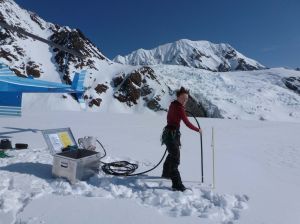
    Melting glaciers Photos by Regine Hock

    Melting glaciers

    Grad student Joanna Young drills a hole into the Susitna Glacier for a weather station and a melt stake to be installed in April.

    Posted: Saturday, June 8, 2013 11:45 pm

    Runoff: Measuring the North’s glacier wastage Molly Rettig newsminer.com | 0 comments

    Every summer, Alaska’s glaciers melt and send vast quantities of water gushing through silty gray rivers, past towns and villages and finally into the sea. Some glaciers calve directly into the ocean, instantly losing car-sized chunks of ice and wowing boats full of tourists.

    The world’s melting glaciers are boosting ocean levels 0.71 millimeters per year, accounting for roughly one-third of total sea level rise, according to a recent study.

    “That’s the equivalent of draining the Great Lakes once a month each year,” says Regine Hock. She and colleague Anthony Arendt, both glaciologists at the University of Alaska Fairbanks Geophysical Institute, just contributed to an article in Science on the role of glaciers in sea level rise.

    Alaska and Canada comprise nearly half of that — purging 100 gigatons of mass annually from frozen storage into the ocean.

    The mass loss, which scientists call wastage, is so massive that it changes the Earth’s gravity field and alters ocean currents around Alaska. So heavy is it that parts of the Earth can bounce up several centimeters in response.

    The scientists worked with an international team to calculate the ice loss of glaciers around the world from 2003 to 2009 using satellite data and ground measurements.

    “When many people think about sea level rise, they only think about the big ice sheets in Greenland and Antarctica. They don’t think these smaller ones can contribute anything,” says Hock.

    The other two-thirds of total sea level rise come from equal parts melting ice sheets and the warming and expansion of oceans. Overall, oceans have risen 2.5 millimeters per year since 2003.

    “In 10 years, that’s an inch. That’s quite a lot,” says Hock.

    It trickles in from the state’s favorite glaciers — Gulkana in the Alaska Range, Exit in Seward, Portage on the Kenai Peninsula, Mendenhall in Juneau, Columbia on Prince William Sound and all throughout the Wrangell mountains.

    Where does it go?

    “Most of the meltwater ends up in streams and eventually makes its way to the oceans,” Hock says.

    This affects not just the ocean but the overall hydrology of the Earth. Communities in the Andes, for example, rely on glacial runoff for water in the summer dry season. The more ice that is lost, the smaller their water source

    Glacier water is cold and fresh, which affects the temperature and chemistry of rivers and oceans — and can impact fisheries and ecosystems.

    “Salmon and other species are really sensitive to stream composition. If the temperature changes just a few degrees, that might affect whether salmon can spawn,” Arendt says.

    Glacier mass changes have traditionally been estimated by field measurements of individual glaciers.

    “It’s really old school,” Arendt says.

    Scientists dig a snow pit in the winter and measure the snow accumulation, calculate its density, and then convert it to water equivalent. This tells them the annual growth of the glacier.

    To calculate melting, they drill a stake into the ice at the beginning of summer and measure the height sticking above the surface. An end-of-summer measurement reveals how much was lost. This depth is converted to water equivalent and extrapolated to the whole basin.

    The melt has greatly outpaced the snowfall, according to these observations.

    But because of logistics, there are only a handful of such field sites over Alaska’s vast ice-covered region.

    To capture broader changes, the new study combined conventional field measurements with satellite data.

    One tool was measuring the gravitational force exerted by glaciers.

    From Newton, we know that greater mass means larger gravitational force. When a satellite crosses a large mass (like an ice sheet) it speeds up a little because of the greater force. Over areas with less mass, the satellite slows down. By tracking satellite positions over time, you can estimate changes in the ice sheet.

    They learned the volume loss by measuring the distance between a satellite and the glacier.

    “You bounce a laser off the surface and it tells you the height. You come back at a later time and map that height again,” says Arendt. What does this mean for the world — and Alaska?

    Some coastlines will be hit harder than others, depending on which glacier regions melt the most.

    Sea levels will actually drop in Alaska, as the weight of glaciers is lifted and the earth rises relative to the water.

    “As the glaciers disappear, and you take off that load, it allows the earth’s crust to rebound in response,” Hock says.

    Smaller glaciers, like those in the Brooks Range, will disappear faster than bigger, high-elevation glaciers like those on St. Elias. As glaciers shrink, so could tourism.

    Understanding glacier wastage can help predict flooding in river communities and plan energy projects.

    “With hydropower coming online, these companies need to know how much water will be transported into these watersheds and how that will change in the future,” Hock says.

    Since the late 1970s, the University of Alaska Fairbanks’ Geophysical Institute has provided this column in cooperation with the UAF research community.
