Category: Uncategorized

  • Climate change is happening but we can meet the challenge

    Climate change is happening but we can meet the challenge

    As carbon emissions rise inexorably, it’s easy to feel powerless as catastrophe looms. But activism is a chance to take control

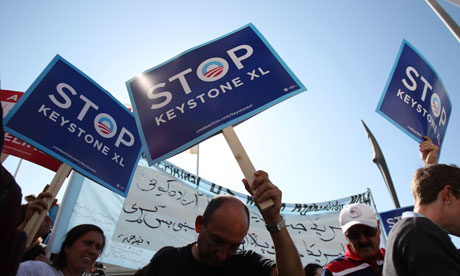
    Keystone XL pipeline protests

    Demonstrators in San Francisco rally against the Keystone XL oil pipeline. Photograph: Stephen Lam/Reuters

    “The level of carbon dioxide in the atmosphere just hit 400ppm,” I told Alex, my 23-year-old son, as we were catching up on news.

    “So that’s it, huh?” he asked.

    I couldn’t think what to say. Alex had just returned from college, a new graduate, ready to start his life as an adult. Like many members of his age group, Alex knows that 350ppm is the threshold for safe levels of carbon in the atmosphere. Pass that level and, climate scientists tell us, things get dicey: soils dry out, damaging food production. There is more frequent and more intense flooding, coastlines get inundated, species go extinct. Farming, which relies on predictable weather patterns, is disrupted, and dry land farming areas turn to desert. Forests die from new infestations and drought, and become more prone to monster fires.

    Young people like Alex are coming of age in a world that’s changing much faster than was predicted just a few years ago. Already, scenes of wildfires, floods, drought, and storms border on apocalyptic. And so far, temperatures have risen less than one degree centigrade.

    So what does a young person do when confronted with a global climate crisis? What does anyone do?

    Based on a roundtable discussion with young leaders and informal conversations with others of all ages, I’ve come to believe that these three steps are essential:

    First, let this reality sink in. This is not the future we thought we would have. Young people, especially, have the right to be disappointed, angry, and fearful. It will take courage to face this new normal, especially when so many others remain disconnected from what’s happening. By being mindful of your own emotions, you can experience fear or grief without being overwhelmed by those feelings. And by remaining alert to the way the climate crisis may show up in your life, you can be better prepared and more resilient.

    There’s controversy among some environmental leaders about whether to downplay the dangers for fear of frightening people or fostering nihilism. But if we are counting on the unique human genius for creative solutions, we need to be honest about the task at hand, and the consequences of inaction.

    Second, take a stand. We may be too late to stop the climate from shifting, but we can likely stop the most catastrophic effects of climate change. People of all ages are stepping up to block extraction, transportation, and burning of fossil fuels and to challenge the clout of the fossil fuel lobby. Some are doing it to protect their community’s water or air or their own health; others are motivated by concern for climate stability and the lives of generations to come. Here are some examples:

    • President Obama has the power to stop the Keystone XL Pipeline, which would expedite further extraction of tar sands, an extraordinarily destructive form of energy. Around the United States, people are pressing the president to reject the pipeline and make good on his promise to take on the climate challenge.

    • Fracking for natural gas has been sold as a climate-friendly alternative to coal and oil. It is not. Leakage of methane during extraction and shipment makes it as damaging to the climate as other fossil fuels, and it threatens precious groundwater supplies. Communities around the United States are joining up to block fracking.

    • In the Pacific Northwest, young people, Native American tribes, and others are mobilizing to stop the rail transport of huge quantities of Wyoming Powder River Basin coal to Northwest seaports for export to Asia.

    • Students and alumni are calling on colleges and universities to divest holdings in oil companies. While this might not immediately reduce the mammoth profits of these global corporations, it does help erode the legitimacy of this industry and therefore their claim on public subsidies and special benefits (like the right to use our atmosphere as a dumping ground).

    Third, consider ways to replace the consumer-oriented, energy-intensive ways of life that are unaffordable both for many of our families and for the planet. Young people are especially are turning to finding satisfaction in what they contribute, the depth of friendships, and in personal development – rather than in “having stuff”. Building relationships founded in trust and reciprocity increases quality of life and resilience today, and builds the foundation for the life-centered – rather than consumption-centered – world that can thrive within the constraints of a small planet.

    The news about the climate is daunting, but we don’t have to wait for skeptics or politicians to get it. We can act right now by getting real about what’s happening, taking a stand to stop further damage to our climate, and working together to build a world that treasures the precious diversity of life on this planet – including human life today and in the future.

  • Save oceans – save environment June 08, 2013

    Save oceans – save environment

    June 08, 2013

    ZARINA PATEL

    E-mailPrintPDF

    World Oceans Day is celebrated each year on 8th June to highlight the importance of oceans and to raise global awareness of the existing threats to oceans. The day is the official UN-designated international day of ocean celebration. The two-year theme for 2013 and 2014 is “together we have the power to protect the ocean”.

    OCEANS ARE IMPORTANT FOR ALL LIVING BEINGS “With every drop of water you drink, every breath you take, you are connected to the sea. No matter where on Earth you live” – Sylvia Earle

    Oceans provide us precious minerals, food and enormous highway for business. Oceans cover three quarters (70%) of our planet Earth and holds 97% of planet’s water. Surface of Earth contains (5) five oceans, including the Arctic, Atlantic, Indian, Pacific and Southern. The main oceans further subdivided into smaller regions called seas, gulfs, or bays. The world ocean has an area of about 361 million sq km (139,400,000 sq mi), an average depth of about 3,730 m (12,230 ft), and a total volume of about 1,347,000,000 cu km (322,280,000 cu mi). Each cubic mile of seawater weighs approximately 4.7 billion tons and holds 166 million tons of dissolved solids.

    Salinity is a main feature of oceans. Six elements (chlorine, sodium, magnesium, sulfur, calcium, and potassium) represent over 90% of the total salts dissolved in the oceans. On the deep ocean floor, manganese nodules, formed by the precipitation of manganese oxides and other metallic salts around a nucleus of rock or shell, represent a potentially rich and extensive resource. The ocean floor might hold more than the 110 million tones of rare earths elements. Countries such as Kuwait, and Israel, desalinate ocean water to produce freshwater.

    Oceans provide food resources for more than one billion people around the world. As much as 10% of human protein (rich in essential fatty acids) intake comes from the oceans. Pharmacists have been using coral reef plants, blue green algae and animals for making medicines of arthritis, Alzheimer’s, heart diseases and cancers.

    Oceans are full of natural treasures. Oysters are valuable sources of pearls. The oceans’ “shallow continental shelves” are a great source of sand and gravel. A study reveals that the great amount of deuterium present in the ocean water makes it a perfect source of energy that can be used in the development of the nuclear fusion reactors. Oceans provide recreational activities for people around the world. Fishing, scuba diving, boating, swimming, and water skiing are favourite pass time for water lovers.

    THE OCEANS AFFECT GLOBAL CLIMATE AND WEATHER The atmosphere and oceans influenced each other. Earth’s atmosphere mainly depends on oceans and ocean life. Oceans regulate weather and improve global temperature. They serve as global temperature stabilisers and help to buffer man caused carbon dioxide emission. Nearly half the CO2 produced by human activities in the last 200 years has dissolved into the ocean.

    Most of the sunlight absorbed by earth is absorbed at the top of the tropical ocean. The atmosphere does not absorb much sunlight. It is too transparent. Sunlight passes through the air and warms the surface of the ocean. Most of the ocean is a deep navy blue. It absorbs 98% of the solar radiation when the sun is high in the sky. Ocean plants such as mangroves, sea grass bed etc generate half of the world’s oxygen. According to UN oceans are lungs of our planet Earth.

    The action of winds blowing over the ocean surface creates waves and the great current systems of the oceans. When winds are strong enough to produce spray and whitecaps, tiny droplets of ocean water are thrown up into the atmosphere where some evaporate, leaving microscopic grains of salt sustained by the turbulence of the air. These tiny particles may become nuclei for the condensation of water vapour to form fogs and clouds.

    When water evaporates, heat removed from the oceans and stored in the atmosphere by the molecules of water vapour. When condensation occurs, this stored heat freed to the atmosphere to develop the mechanical energy of its motion. The atmosphere obtains nearly half of its energy for circulation from the condensation of evaporated ocean water.

    MAJOR THREATS TO OCEANS Human activities have imposed alarming danger to oceans life especially cetacean species (whales, dolphins and porpoises). Cetacean species are oceanic mammals found in both freshwater and marine environment. According to WWF for nature report, Nineteen species of cetaceans had so far been reported found in Pakistan, also home to the blue whale, known to be the world’s largest animal, as well as the finless porpoise, one of the smallest marine cetacean species. There are about 1,300 whales are living in River Indus. Of the 18 cetacean species found in Pakistan, three are baleen whales while the remaining are toothed whales and dolphins.

    These species are facing tremendous threats such as whaling, pollution, extinction of food resources, loss of habitat, climate change, toxic substances, plastic materials presence, net entanglement, and ship strikes and over fishing.

    In Pakistan, unregulated use of gillnets in profit-making fishing and a vast boost in fishing boats are major threats to the cetacean species. the precious cetaceans entangled in fishing nets each year. The fishing fleet increased from 2,133 and 4,355 (in 1986) to 6,636 and 10,689 in Sindh and Balochistan, respectively, in 2011. The United Nations resolution on gillnets has restricted its length to 2.5km. However, in Pakistan the average size of a gillnet is from 10km to 12km while exceptionally large size gillnets (up to 24km) are also in use.

    Overfishing is one big threat and directly changing aquatic ecosystems. Statistics reveal that global main marine fish stocks are in danger, increasingly pressured by overfishing and environmental degradation. Several important commercial fish populations have declined to the point where their survival is threatened. Unless the current situation improves, stocks of all species currently fished for food predicted to collapse by 2048.

    The latest data from the international scientific committee, which monitors tuna in the Pacific, showed blue fin tuna stocks were a small fraction of what they had been and were in danger of disappearing. According to a Food and Agriculture Organisation (FAO) estimate, over 70% of the world’s fish species either fully exploited or depleted. The dramatic increase of destructive fishing techniques world-wide destroys marine mammals and entire ecosystems. FAO reports that illegal, unreported and unregulated fishing world-wide appears to be increasing as fisher men seek to avoid stricter rules in many places in response to shrinking catches and declining fish stocks.

    The oceans are facing threats from global warming. Global warming have negative impacts on sea levels, coastlines, ocean acidification, ocean currents, seawater, sea surface temperature, tides and the sea floor. Human activities emit heat-trapping carbon dioxide causing rise of the average ocean temperature. Human-based carbon emissions as the primary culprit for average acidity increases of 30 percent in the world’s surface waters since the Industrial Revolution.

    Marine population is facing terrible time due to global warming. Algae produces food for other marine life through photosynthesis is vanishing due to ocean warming. The acidification of the oceans due to climate change impairs the ability of coral reefs and shelled organisms to form skeletons and shells. Research has shown that krill reproduce in significantly smaller numbers when ocean temperatures rise. This can have a disastrous effect by disrupting the life cycle of krill eaters, such as penguins and seals. According to the World Wildlife Fund, a small increase of two degrees Celsius would destroy almost all existing coral reefs. Additionally, ocean circulation changes due to warming would have disastrous impact on marine fisheries.

    Warmed ocean surface is leading to increased temperature. When water heats up, it expands. This expansion results in shoreline erosion, and powerful storms and hurricanes/cyclones. These stronger storms can increase damage to human structures when they make landfall. They can also harm marine ecosystems like coral reefs and kelp forests. An increase in storm frequency means more destruction for small habitats. Global warming has caused the global ocean temperatures to increase by an average of a third of a degree Celsius (about a half a degree Fahrenheit), and this change has fuelled the increase in hurricane intensity.

    Presence of pesticides, herbicides, chemical fertilisers, detergents, oil, sewage, plastics, and other solids are polluting our oceans. Solid waste like bags, foams, plastic materials are fatal for marine mammals, fish, and birds that mistake these materials for food.

    Scientists are discovering that pharmaceuticals ingested by humans but not fully processed by our bodies are eventually ending up in the fish we eat. According to a research, Pakistan has a coastline that stretches over 1050km, (990km measured as a straight line) along the Arabian Sea. The coast of Pakistan consists of sandy beaches that interrupted by rocky protruding points. The Indus delta located at the head of the Arabian Sea has found changing its characteristics due to damming upstream, which has reduced river borne sediments.

    Pakistani mangroves are located mainly along the delta of the Indus River eco region. Major mangrove forests are on the coastline of Sindh and Balochistan. The mangroves are bush like trees, which grow in shallow waters often on small islands, which regularly get swamped by changes.

    The mangroves provide a diverse habitat for a complex and inter-reliant community of invertebrates, fish, birds, and reptiles. News report revealed that despite their importance to this region the mangrove forests are constantly under attack from untreated chemicals and industry bi-products, which discarded directly into the sea. Near urban areas, mangroves are cleared for developmental activities. Reduced water flow in the River Indus after the construction of dams and barrages upstream is also causing damage to the mangrove forest and its surrounding ecosystem.

    The increased presence of loud or continual sounds from ships, sonar devices, oilrigs, and even from natural sources like earthquakes are disrupting the voyage, communication, hunting, and reproduction patterns of many marine animals, particularly aquatic mammals like whales and dolphins. The highest levels of noise appear in the northern parts of the Atlantic and Pacific Oceans and along popular shipping passages like the Suez Canal.

    Healthy, clean and unpolluted oceans ensure safe environment for present and future generation. Together we can protect oceans and our environment.

    Copyright Business Recorder, 2013

  • Warming, Rising Acidity and Pollution: Top Threats to the Ocean

    Warming, Rising Acidity and Pollution: Top Threats to the Ocean

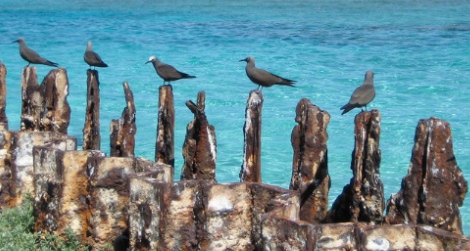
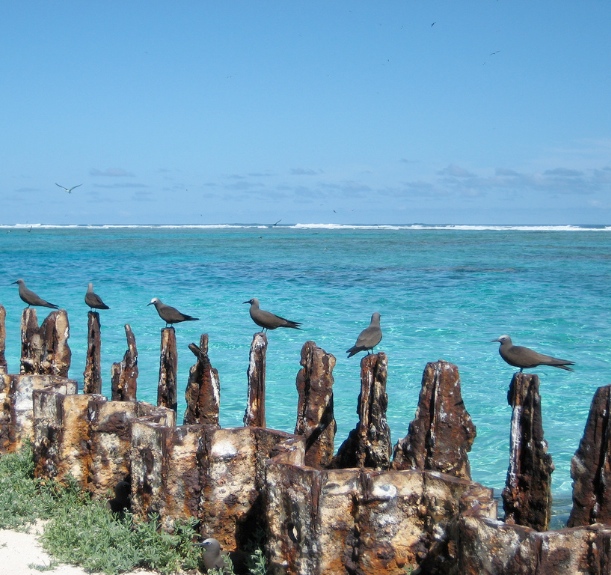
    Ruddy turnstones sit on an abandoned pier on the coast of Hawaii. Photo by LCDR Eric T. Johnson, NOAA Corps

    Ocean plants produce some 50% of the planet’s oxygen. Seawater absorbs a quarter of the carbon dioxide we pump into the atmosphere. Ocean currents distribute heat around the globe, regulating weather patterns and climate. And, for those who take pleasure in life’s simple rewards, a seaweed extract keeps your peanut butter and ice cream at the right consistency!

    Nonetheless, those of us who can’t see the ocean from our window still feel a disconnect—because the ocean feels far away, it’s easy to forget the critical role the ocean plays in human life and to think that problems concerning the ocean will only harm those people that fish or make their living directly from the sea. But this isn’t true: the sea is far more important than that.

    Every year, scientists learn more about the top threats to the ocean and what we can do to counter them. So for tomorrow’s World Oceans Day, here’s a run-down of what we’ve learned just in the past 12 months.

    A partially-bleached coral. The coral animals have abandoned the white, bleached section in response to warmer water. Photo by Klaus Stiefel

    Getting heated

    This year, we got the news that the apparent “slow down” in global warming may just be the ocean shouldering the load by absorbing more heat than usual. But this is no cause to celebrate: the extra heat may be out of sight, but it shouldn’t be out of mind. Ocean surface temperatures have been rising incrementally since the early 20th century, and the past three decades have been warmer than we’ve ever observed before. In fact, waters off the U.S. East Coast were hotter in 2012 than the past 150 years. This increase is already affecting wildlife. For example, fish are shifting their ranges globally to stay in the cooler water they prefer, altering ecosystems and fisheries’ harvests.

    Coral reefs are highly susceptible to warming: warm water (and other environmental changes) drives away the symbiotic algae that live inside coral animals and provide them food. This process, called bleaching, can kill corals outright by causing them to starve to death, or make it more likely that they will succumb to disease. A study out this year found that even if we reduce our emissions and stop warming the planet beyond 2°C, the number considered to be safe for most ecosystems, around 70% of corals will degrade and die by 2030.

    Although coral reefs can be quite resilient and can survive unimaginable disturbances, we need to get moving on reducing carbon dioxide emissions and creating protected areas where other stressors such as environmental pollutants are reduced.

    More than a hit of acid

    The ocean doesn’t just absorb heat from the atmosphere: it also absorbs carbon dioxide directly, which breaks down into carbonic acid and makes seawater more acidic. Since preindustrial times, the ocean has become 30% more acidic and scientists are just starting to unravel the diverse responses ecosystems and organisms have to acidification.

    And it really is a variety: some organisms (the “winners”) may not be harmed by acidification at all. Sea urchin larvae, for instance, develop just fine, despite having calcium carbonate skeletons that are susceptible to dissolving. Sponges that drill into shells and corals show an ability to drill faster in acidic seawater, but to the detriment of the organisms they’re boring into.

    Nonetheless, there will be plenty of losers. This year saw the first physical evidence of acidification in the wild: the shells of swimming snails called pteropods showed signs of dissolution in Antarctica. Researchers previously found that oyster larvae fail under acidic conditions, potentially explaining recent oyster hatchery collapses and smaller oysters. Acidification may also harm other fisheries.

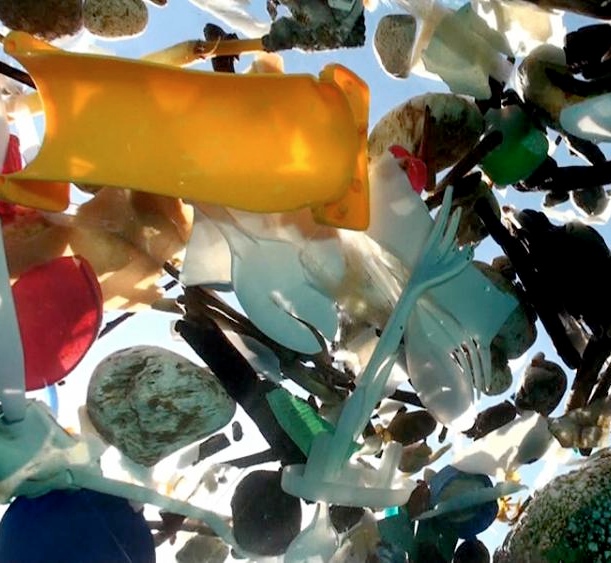
    Plastic trash floats in the waters off the Smithsonian’s Carrie Bow Cay field station in Belize. Photo by Laurie Penland

    Plastic, plastic, everywhere 

    Americans produced 31 million tons of plastic trash in 2010, and only eight percent of that was recycled. Where does the remaining plastic go? A lot of it ends up in the ocean.

    Since last World Oceans Day, trash has reached the deep-sea and the remote Southern Ocean, two of the most pristine areas on Earth. Most of the plastic trash in the ocean is small—a few centimeters or less—and can easily be consumed by animals, with damaging consequences. Some animals get hit on two fronts: when already dangerous plastic degrades in their stomachs it leaches toxic chemicals into their systems. Laysan albatross chicks are fed the bits of plastic by their parents in lieu of their typical diet and one-third of fish in the English Channel have nibbled on plastic.

    Where have all the fish gone?

    A perennial problem for the ocean, overfishing has only gotten worse with the advent of highly advanced gear. Despite fishing fleets going farther and deeper, the fishing gains are not keeping up with the increased effort.

    Our brains can’t keep up either: even as we catch fewer fish, we acclimate to the new normal, adjust to the shifting baseline, and forget the boon that used to be, despite the fact that our memories are long enough to realize that most of the world’s fisheries (especially the small ones that aren’t regulated) are in decline.

    Thankfully, those responsible for managing our fisheries are aware of what’s at stake. New knowledge about fish populations and their role in ecosystems can lead to recovery. A report from March 2013 shows that two-thirds of U.S. fish species that are closely managed due to their earlier declines are now considered rebuilt, or on their way.

     Learn more about the ocean from the Smithsonian’s Ocean Portal. This post was co-authored by Emily Frost and Hannah Waters.

    ***

    Sign up for our free email newsletter and receive the best stories from Smithsonian.com each week.

    Read more: http://blogs.smithsonianmag.com/science/2013/06/warming-rising-acidity-and-pollution-top-threats-to-the-ocean/#ixzz2VbY32AZg
    Follow us: @SmithsonianMag on Twitter

  • ABC to have full coverage of Federal Election Results on 14 September

    June 08, 2013

    ABC to have full coverage of Federal Election Results on 14 September

    For most people, the above headline may sound like an assertion of the obvious.

    However, in the discussion over recent weeks as to whether television networks will host their election coverages from the National Tally Room, some people have become confused and thought that if the ABC does not attend the National Tally Room, then the ABC will not be doing a coverage of the results.

    This is not correct. The ABC will have its usual full coverage of the results from 6pm on 14 September, including me, Kerry O’Brien and other ABC hosts, as well as a panel of party politicians. There will be electorate results, graphics, calls of the board and live crosses including the victory and concession speeches.

    In short, everything you would expect from an election coverage.

    The National Tally Room is arranged and run by the Australian Electoral Commission (AEC). Already the commercial television networks have announced they will not be attending the tally room. At this stage the ABC is close to announcing officially whether it will host from the National Tally Room or not, with the likelihood it will host from elsewhere.

    What the AEC chooses to do with the National Tally Room if the television networks including the ABC do not attend is a matter entirely for the AEC. The AEC proposed to get rid of the National Tally Room after the 2004 election, but withdrew the proposal when both the commercial networks and federal politicians requested it be continued.

    Whatever happens, the ABC will be providing a full coverage of the 14 September election results, whether there is a tally room or not.

    You can read an article I wroteb three years vago on the future of the National Tally Room via this link.

    Posted by on June 08, 2013 at 01:26 PM in Federal Politics and Governments | Permalink

  • Bangladesh – Climate Displacement

    Bangladesh – Climate Displacement

    Few countries are under as much threat from climate change as Bangladesh. DS is working with our partners in Bangladesh Young Power in Social Action to find viable housing, land and property solutions to those displaced by climate change.

    Activities of the Initiative

    Publications

    DS report on Climate Displacement in Bangladesh: The Need for Urgent Housing, Land and Property Rights Solutions, May 2012

    Displacement Solutions has recently published a ground-breaking new report on climate displacement in Bangladesh.

    This 36-page report comprehensively examines the scope and causes of climate displacement across Bangladesh. Drawing on extensive fieldwork, the report highlights that climate displacement is not just a phenomenon to be addressed at some point in the future, it is a crisis that is unfolding across Bangladesh now. Sea-level rise and tropical cyclones in coastal areas, as well as flooding and riverbank erosion in mainland areas, are already resulting in the loss of homes, land and property and leading to mass displacement. Further, all of the natural hazards that are causing displacement are expected to increase in both frequency and intensity as a result of climate change – almost inevitably leading to the displacement of many millions more across Bangladesh.

    This report comprehensively examines current and future causes of climate displacement in Bangladesh. The report also examines existing and proposed Government and civil society policies and programmes intended to provide solutions to climate displacement. The report highlights a number of protection gaps in the response of both the Government of Bangladesh and the international community to the plight of climate displaced persons. The report emphasises that rights-based solutions, in particular, housing, land and property rights solutions must be utilised as the basis for solving this crisis.

    The report concludes by proposing a number of concrete recommendations that could be utilized to provide solutions to climate displacement.

    The report can be downloaded here.


    New article on “The Management of Climate Displacement”, written by Scott Leckie, the Director of Displacement Solutions, in the December 2012 issue of Forced Migration Review.

    In his article, Scott Leckie concludes that “climate change has forced those who care about displacement into the unfamiliar position of seeking solutions before displacement occurs: in effect, becoming land seekers for future displaced communities and active advocates for resettlement when remaining in place fails to be a viable option“. 

    The article is available here.


    Article on “Domestic Land Solutions for Bangladesh” published in May 2012 on the New Internationalist Blog.

    Read Scott Leckie and Ezekiel Simperingham’s recent observational piece on the climate displacement situation in Bangladesh, published by a highly acclaimed independent monthly not-for-profit magazine/blog that reports on actions in support of global justice. The New Internationalist believes in putting people before profit, in climate justice, tax justice, equality, social responsibility and human rights for all, views shared by Displacement Solutions. To access it, click here.


    DS Photo Booklet on Climate Displacement in Bangladesh, Kadir van Lohuizen Photography, April 2011


    In January 2011, a team from Displacement Solutions visited Khulna District in Bangladesh – the ground zero of climate change. DS and its partners the Association for Climate Refugees visited some of the world’s most destitute locations affected by large-scale climate-induced displacement in the world today. Climate Displacement in Bangladesh, catalogues images captured by world renowned photo journalist Kadir Van Lohuizen during the DS mission to the southwestern delta region of Bangladesh.

    This publication is available to download here.

    The people pictured in the booklet are just some of the 6.5 million who have already been displaced by climate change in Bangladesh – people who desperately need their housing, land and property rights met, not some time in the future, but today. Their faces and circumstances of life tell a tale of both hope and despair.


    DS Article – Bangladesh’s Climate Displacement Nightmare, April 2011

    This article, published by the Ecologist and written by Scott Leckie, Ezekiel Simperingham and Jordan Bakker after their DS field trip to Bangladesh in January 2011, discusses the crisis that climate change poses for Bangladesh and stresses the need for action to be taken now to protect the human rights of all current displaced persons in Bangladesh, and to prevent mass human rights violations in the future. To read this article, click here.


    DS Missions to Bangladesh

    In January, October and November 2011 and April 2012, DS visited areas affected by climate displacement across Bangladesh.

    Working closely with the Association for Climate Refugees (ACR) and Young Power in Social Action (YPSA), DS has visited climate displacement and relocation sites throughout Bangladesh, conducted trainings on the human rights dimensions of climate displacement with civil society representatives and community leaders, met with government officials and representatives, from the local Union to the national Ministerial level and has held numerous meetings with climate affected individuals and communities to better understand the situation and scope of the climate displacement crisis in Bangladesh.

    DS remains committed to working with our partners and the Government of Bangladesh to find urgent housing, land and property rights solutions for the current and future millions of climate displaced people across Bangladesh.

    In January 2011, DS sent a five-person team to visit climate-affected areas in Bangladesh – read about it here and see the mission report.

    In October and November 2011, DS visited Bangladesh focusing on the scope and causes of river erosion across the country.

    In April 2012, DS again visited Bangladesh, focusing on the causes and scope of climate displacement across Chittagong Division. A report on this visit prepared by Young Power in Social Action can be read here.


    Further Resources

    In this part of the website you will find links to articles, reports and films about how climate change is causing displacement in Bangladesh:

    The Dhaka Declaration of the Climate Vulnerable Forum

    Bangladesh is the current chair of the Climate Vulnerable Forum, a partnership of countries most affected by global warming.

    The Government of Bangladesh hosted a ministerial meeting of the Climate Vulnerable Forum on November 13-14, 2011 in Dhaka, Bangladesh.

    The outcome of the meeting was the Dhaka Ministerial Declaration of the Climate Vulnerable Forum (the full text of the Declaration is available here).

    The declaration expressly recognises the challenge of climate displacement and states:

    Aware that climate change induced displacement of people is a major concern and their relocation puts enormous pressure on infrastructures and service facilities; and furthermore, large-scale displacement has the potential to transform into security concerns;

    Recognising that migration is a viable adaptation strategy to ensure that populations are not compelled to reside in high risk and affected areas, and to manage risks during displacement; and furthermore a planned strategy in the long-term to offer displaced populations with enhanced options for dignified and diversified livelihood.


    Association for Climate Refugees (ACR) Progress Report

    This report was released by ACR in January 2011. It outlines ACR’s work in relation to the recent DS mission to Bangladesh. To access, click here.


    Films from the Guardian

    Here are links to three extraordinary films from the Guardian on climate displacement in Bangladesh; displacement that is happening not 30 years in the future, but today. All of these are highly recommended viewing to better understand the scale and tragedy of climate displacement, as well as in developing solutions to this immense challenge.

    For the film about Bangladesh climate migration, click here here.

    For the film about Bangladesh climate migrants in Dhaka, click here.

    For the film about Bangladesh climate aid, click here.


    Bangladesh NAPA

    The Government of Bangladesh’s National Adaptation Programme of Action (NAPA) from 2005 is available here.


    Bangladesh Climate Change Strategy and Action Plan (BCCSAP)

    In 2008, to carry forward the work of the NAPA, the BCCSAP was designed. Click here to access it.


    The Dhaka Solution

    The article “The Dhaka Solution” by Sebastian Strangio provides a brief overview of the challenges facing Bangladesh caused by climate change. It can be accessed
    here.


    EACH-FOR Bangladesh

    The EACH-FOR project, funded by the EU, investigated a number of environmental change and forced migration scenarios, including a case study in Bangladesh. To access, click here.


    The Constitution of Bangladesh

    To access the Bangladesh Constitution and view the relevant HLP provisions, click here.


    Bangladesh risks becoming failed state, retired general says

    The text of this article by Laurie Goering, published on 3 February, 2010, is available here.


    Climate Refugees in Bangladesh – Answering the Basics: The Where, How, Who and How Many (as at May 2010)

    Extreme climate events – be it the result of environmental destruction by people, or naturally occurring changes in climate – are forcing people to flee their traditional place of residence with enormous sufferings in points of transit and the points of destination without any support from aid agencies or Government authorities. ACR (Association for Climate Refugees), a network of NGOs have been making some efforts in seeking answers to basic questions, like how and where the people have been made refugees, who the refugees are, and how many they are.

    Where and how: Mass scale forced displacement has been caused by tidal floods in the exposed coastal area and loss of land due to erosion in the main land river basins

    The population in the South and South-East Asia coastline extending from the east coast of India to the coast of Myanmar have been tasting the salt taste of annual cyclones from the Bay of Bengal with ever increasing tidal floods. Due to its existence in the middle of the coastline, Bangladesh is either the worst or the common victim irrespective of the locations where the cyclones make the landfall. Cyclones are not only resulting in human casualties and destruction of properties but also leaving behind perpetual tidal floods. The cyclone Sidr of 2007, Nargis of 2008, Aila of 2009 and Laila of 2010 are the annual extreme events among a number of other hazards. Bangladesh had to endure the entire attack of Sidr while sharing that of Nargis with Myanmar and Aila plus Laila with India. An indigenous research in Dakshin Bedkashi (Koyra Upazila) reveals that tidal flood water level had risen by 1 meter during 5 years (2004 to 2008) but it rose by an additional 1 meter in 2009 alone and in 2010 it continues to rise further. The prevailing hazards and the vulnerability alarm a grave risk to the coast dwellers, with particular emphasis on those in the exposed areas in 12 districts at the south of Bangladesh namely Satkhira, Khulna, Bagerhat, Pirojpur, Barguna, Patuakhali, Bhola, Laxmipur, Feni, Noakhali, Chittagong and Cox’s Bazar.

    Around one million people have been rendered homeless due to river erosion in the mainland river basins over the last three decades as the mighty Brahmaputra-Jamuna continues to widen due to decrease in its depth for heavy rush of sediments from the upstream and poor erosion management in the downstream. Official statistics show that the Brahmaputra-Jamuna, a major river system in Bangladesh, has widened to 11.8 km now from 8.3 km in the early ’70s, eroding about 87,790 hectares of land. (CEGIS, 2006). NGOs affiliated with ACR working in the mainland river basin report observing people forced to flee their traditional place of residence due to river erosion at a greater pace. Hotspots of such incidence encompass 10 districts namely Kurigram, Gaibandha, Jamalpur, Bogra, Sirajganj, Rangpur, Lalmonirhat, Nilphamari, Mymensingh and Netrakona.

    Bangladesh comprises of 64 districts out of which 22 are major climate refugee generating districts.

    Who and how many: The poorer people who used to live in exposed locations are the climate refugees and they are 6 million in number

    The poorer people who used to live in the extremely exposed locations in the coastal belt and the main land river basins of Bangladesh are the first to become climate refugees in recent years.

    Tidal floods have already badly affected 56% of the 422 unions (lowest unit in the local government) of the 48 upazilas (sub-districts) in the exposed coastal zone of Bangladesh. Most of the villages in the badly affected 236 unions are being flooded by tidal saline water twice a day for the last 3 years. Houses, Land and Properties (HLP) of 2,462,789 people (32%) of the 7,693,331 inhabitants (in the affected unions alone) have been destroyed by repeated cyclones and king tides. Of them, 1,568,980 (64%) are languishing as Local Climate Refugees (LCR) on remainings of embankments or higher grounds in the exposed zone, 675,113 (27%) squatter as Internal Climate Refugees (ICR) in cities including Dhaka and 218,656 (9%) are earning wages by modern slavery as Global Climate Refugees (GCR) across the country borders. Situation in the exposed coast is worsening and it is predicted that the number of climate refugees from the coast will be raised to 3 million by the end of 2010.

    River bank erosions have already badly affected 44% of the 407 unions (lowest unit in the local government) of the 36 upazilas (sub-districts) in the exposed main land river basins of Bangladesh. Most of the villages in the badly affected 179 unions are being eroded by onrush of flash flood waters every year during the last 3 decades. Houses, Land and Properties (HLP) of 1,452,588 people (42%) of the 3,490,500 inhabitants (in the affected unions alone) have been destroyed by annual river erosion often coupled with devastating floods. Of them, 951,531 (66%) are languishing as Local Climate Refugees (LCR) on neighboring embankments or higher grounds in the exposed zone, 375,793 (26%) squatter as Internal Climate Refugees (ICR) in cities including Dhaka and 125,264 (8%) are earning wages by modern slavery as Global Climate Refugees (GCR) across the country borders. Situation in the exposed river basin is worsening and it is predicted that the number of climate refugees from the river basin will be raised to 2 million by the end of 2010.

    The remaining non-exposed 397 upazilas have sporadically generated another 2.1 million climate refugees. Thus altogether the total number of climate refugees in Bangladesh as of May 2010 stands at 6 million out of which at least 1 million are living in Dhaka Mega City. The total number of climate refugees in Bangladesh is expected to be raised to 7.5 million by the end of 2010.

    Hotspots of climate refugees at the point of origin: Island upazilas of Koyra, Shyamnagar and Dacope in the west, and Kutubdia, Hatiya and Swandip in the east of the coastal belt of Bangladesh

    In one way or another, all exposed upazilas are generating climate refugees, but some are more immediately and particularly exposed. The middle coast (Barisal Division) enjoys the comparative advantage of being an active delta with land formation in progress as well as a sweet water ecosystem but the west (Khulna Division) and east (Chittagong Division) coast have been unlawfully deprived of that active delta privilege by India’s unilateral interception in international river course originating from the Himalayas. Hence the west coast has 3 hotspots i.e. Koyra and Dacope in Khulna district, and Shyamnagar in Satkhira district. The east coast also has 3 hotspots i.e. Kutubdia in Cox’s Bazar district, Swandip in Chittagong district and Hatiya in Noakhali district.

    Response to the plight of the Climate Refugees

    The Finance Minister of Bangladesh Government has a clear response by saying “We are asking all our development partners to honour the natural right of persons to migrate. We can’t accommodate all these people – this is already the densest [populated] country in the world.” in a video interview with the Guardian. Repeated cyclones and tidal floods have substantially destroyed the life line of the coast dwellers – the embankments – which is eating up huge resources but yielding no signs of revival.

    More than 200 NGOs in Bangladesh are working for resettlement of the climate refugees. They had participated, as a finalist, in the World Bank’s Global Competition on Climate Adaptation held on 10-13 November 2009 in Washington, D.C. but could not win a grant except the World Bank Institute’s Innovation Practice Manager writing “We are indeed working on a range of ideas in which we can communicate with your host governments, other funders in the space, and like-minded partners who can support your projects and perhaps find ways to work with you.”  while responding to a post of the NGOs’ Team Leader in World Bank’s DM Blog. NGOs are negotiating projects with potential donors on climate refugee issues.

    Conclusion

    Climate change is likely to lead to increasing rates of generation of climate refugees, and it is vital that evolving frameworks for climate change adaptation address issues for compliance by national and international communities to peacefully resettle those climate refugees. Climate change is ignoring country borders making it a global problem; we may not ignore country borders now but can surely begin to work regionally and globally for mutual benefits and interests. We welcome suggestions and assistance for effective and efficient resettlement of climate refugees.

    Md. Arifur Rahman Muhammad Abu Musa

    Chairperson, ACR and Founder & Chief Executive, ACR and

    Chief Executive, YPSA President, CRC (Coastal Resource Center)

  • Q+A: Bill McKibben crunches Australia’s climate numbers

    5 June 2013, 3.42pm EST

    Q+A: Bill McKibben crunches Australia’s climate numbers

    US environmentalist and scholar, Bill McKibben, has crunched the numbers: we can emit 565 more gigatons of carbon dioxide worldwide if we want to stay below 2°C of warming, he says. However, the world is on track to burn enough fossil fuels to emit 2,795 gigatons of carbon dioxide. McKibben, who founded…

    3rt67nx9-1370402957
    McKibben has calculated that the world can emit 565 more gigatons of carbon dioxide and stay below 2°C of warming — anything more than that risks catastrophe for life on earth, he says. http://maths.350.org/
    T34fjv3g-1370403178
    McKibben founded the 350.org environmental movement. http://www.flickr.com/photos/350org/

    US environmentalist and scholar, Bill McKibben, has crunched the numbers: we can emit 565 more gigatons of carbon dioxide worldwide if we want to stay below 2°C of warming, he says.

    However, the world is on track to burn enough fossil fuels to emit 2,795 gigatons of carbon dioxide.

    McKibben, who founded the environmental movement 350.org and is pushing companies to get rid of investments in fossil fuels, is currently touring Australia.

    He spoke to The Conversation about what the numbers tell us about climate change and Australia.

    You say the world can emit only 565 gigatons worldwide if we want to stay below 2 degrees C. Have you done the calculations for how much Australia can afford to contribute to that 565 gigatons?

    Here’s one way to do the numbers. If Australia builds out the coal mines it’s currently talking about, then it will release about a third altogether of that 565 gigatons. So that gives you some sense of the scale. Australia constitutes much less than a third of the world population. You begin to sense the problem we are running into.

    Truthfully, if you wanted to figure out some sense of what Australia’s allowance of that 565 gigatons should be, you would figure out what percentage of world population is Australian, which has got to be less than 1% of the world population, and that would be your share. You’d also have to back calculate if it’s fair for Australia to use even that, given it’s probably already used more than its fair share, just like the United States, Canada and other countries.

    If we were allotting space in the atmosphere based on fairness, we would be letting Indians and Africans use most of it from here on in.

    In realistic terms, what we have to do is take these large carbon deposits in Australia, Canada, Venezuela, the Powder River Basin in the US, these seven or eight huge deposits of carbon around the world, and keep them under ground.

    If they ever get out and get burnt, then you can’t make the maths work at all.

    Investment in fossil fuel still gets a pretty good return in Australia. Are you having any luck convincing Australian investors to divest?

    It looks like most of the big miners are starting to head for the exits. BHP is trying to sell much of its coal.

    There are Australians who are beginning to take up these questions. The Uniting Church has divested its shares. We are on our way to the Australian National University today where the students have a powerful divestment movement underway. It’s early days but if I were a coal mining baron in this country, I would be a little bit worried about the upsurge of awareness of what their plans for the planet really are.

    Is your argument that investment in fossil fuels is wrong because it may destroy the world or wrong because one day those investments may be worthless because the world will have moved on from fossil fuels?

    I have to say I worry about the first of those things more than the other. But I do think it’s clear that if you invest in these stocks, you are making a bet that we will never take climate change seriously.

    HSBC ran the numbers a couple of months ago and said that if the world did anything to try to meet its 2 degree Celsius target that everybody, including Australia, has solemnly agreed to then you would have to cut the valuation of all these shares in half.

    So if we ever took climate change seriously, everybody is sitting on a big bubble.

    Who are the biggest investors in Australia in fossil fuels?

    As I understand it, the biggest pools of money are in pension and superannuation funds. We were meeting in Sydney yesterday with people who control some of the big funds in Australia and they are paying more attention for practical reasons and because they understand the science.

    As one of these leading fund guys said yesterday, “Who are we to doubt the science? All of our other investments are based on science and technology, we understand what is going on.”

    The meeting was at the Goldman Sachs office yesterday with a bunch of people running various super funds from around the country, there were about 150 people there with a link up to the Goldman Sachs office in Melbourne.

    Most of our fossil fuels are exported and some argue argue that if we don’t sell fossil fuels to India and China, they’ll either get them elsewhere or their development will slow down. What’s your response to that?

    It is true that, at this point, cheap fossil fuel can be a useful thing but at a certain point you can move from good to bad. It’s like drinking beer all night. There is a point at which it’s not fun any more.

    To judge from the health statistics coming out of China, we are reaching that point. In fact, the Chinese are trying hard to figure out how the hell to get off coal and they are moving aggressively toward renewable energy.

    All these countries have entrenched fossil fuel interests just like Australia does.

    A big study came out last September funded by 20 of the poorest countries on Earth. It showed that by 2030, fossil fuels, between climate change and straight air pollution, would claim about 100 million lives.

    So I think, at this point, the idea that the Australia mining barons are engaged in their work for humanitarian reasons is somewhat suspect.

    Are offset schemes and emission trading schemes a serious way to mitigate against climate change?

    There’s no way to offset the huge volumes of carbon that would come out of these Australian coal mines.

    If everyone in Australia set to work doing nothing but planting trees between now and the end of the century, I don’t think you would have enough trees to soak up the carbon that comes out of these new coal mines.

    One valley, the proposed coal mine for the Galilee Basin, is enough to fill up about 6% of the atmospheric space that we have got.

    In the end, it’s a math problem and the math is pretty daunting.

    It’s not that we should not be planting trees. It’s that we already have too much carbon in the atmosphere. We have already raised the temperature a degree. We have already melted the Arctic. So we should be in an emergency effort right now to deal with that, not adding to the problem.

    Are you seeing much movement to wind back fossil fuel subsidies?

    There’s more attention to and it is more visible and it’s becoming more of an issue all the time. In the United States, it is one of the things Obama is trying to do, to cut those subsidies but they are jealously guarded. In our political system, that financial power translates too easily into political power.

    But that is one of the reasons we build movements, to try and equal the power of the fossil fuel industry with people power.

    Do you think your argument stands a chance against the entrenched place coal has in the Australian economy?

    My sense is that Australians overestimate the amount of their economy based on coal.

    Because it generates outsize returns for a few people, they are able to use it to their political ends.

    But I am pretty sure that a country as blessed with the resources of sun and wind and 21st century fuels doesn’t need to stay completely wedded to 18th century technology. A country as affluent and educated as Australia could figure out something else to do with its people rather than just keep digging up black rocks and burning them.