Category: Uncategorized

  • More buoys keeping watch on Pacific weather & currents

    More buoys keeping watch on Pacific weather & currents

    Updated 4 June 2013, 8:35 AEST

    Scripps Institute of Oceanography and the US navy have joined forces in a buoy drop to creat a better observation network in the event of natural disasters.

    More buoys keeping watch on Pacific weather & currents (Credit: ABC)

    Ten global drifter buoys have been released from the Navy’s the amphibious dock landing ship, “Pearl Harbor”.

    The buoys measure ocean currents up to 15 metres in depth, sea surface temperatures and atmospheric pressure. All are important elements in creating an observation network, allowing for more accurate weather forecasts.

    Luca Centurioni from the Scripps physical oceanography research division talks about their efforts to maintain and improve observations in the Pacific.

    Presenter: Geraldine Coutts

    Speaker: Luca Centurioni, Scripps Physical Oceanography research division, University of Southern California

     2

    Share this story

           
  • Acceleration of Ocean Denitrification During Deglaciation Documented

    Acceleration of Ocean Denitrification During Deglaciation Documented

    June 3, 2013 — As ice sheets melted during the deglaciation of the last ice age and global oceans warmed, oceanic oxygen levels decreased and “denitrification” accelerated by 30 to 120 percent, a new international study shows, creating oxygen-poor marine regions and throwing the oceanic nitrogen cycle off balance.


    Share This:

    By the end of the deglaciation, however, the oceans had adjusted to their new warmer state and the nitrogen cycle had stabilized — though it took several millennia. Recent increases in global warming, thought to be caused by human activities, are raising concerns that denitrification may adversely affect marine environments over the next few hundred years, with potentially significant effects on ocean food webs.

    Results of the study have been published this week in the journal Nature Geoscience.

    “The warming that occurred during deglaciation some 20,000 to 10,000 years ago led to a reduction of oxygen gas dissolved in sea water and more denitrification, or removal of nitrogen nutrients from the ocean,” explained Andreas Schmittner, an Oregon State University oceanographer and author on the Nature Geoscience paper. “Since nitrogen nutrients are needed by algae to grow, this affects phytoplankton growth and productivity, and may also affect atmospheric carbon dioxide concentrations.”

    “This study shows just what happened in the past, and suggests that decreases in oceanic oxygen that will likely take place under future global warming scenarios could mean more denitrification and fewer nutrients available for phytoplankton,” Schmittner added.

    In their study, the scientists analyzed more than 2,300 seafloor core samples, and created 76 time series of nitrogen isotopes in those sediments spanning the past 30,000 years. They discovered that during the last glacial maximum, the Earth’s nitrogen cycle was at a near steady state. In other words, the amount of nitrogen nutrients added to the oceans — known as nitrogen fixation — was sufficient to compensate for the amount lost by denitrification.

    A lack of nitrogen can essentially starve a marine ecosystem by not providing enough nutrients. Conversely, too much nitrogen can create an excess of plant growth that eventually decays and uses up the oxygen dissolved in sea water, suffocating fish and other marine organisms.

    Following the period of enhanced denitrification and nitrogen loss during deglaciation, the world’s oceans slowly moved back toward a state of near stabilization. But there are signs that recent rates of global warming may be pushing the nitrogen cycle out of balance.

    “Measurements show that oxygen is already decreasing in the ocean,” Schmittner said “The changes we saw during deglaciation of the last ice age happened over thousands of years. But current warming trends are happening at a much faster rate than in the past, which almost certainly will cause oceanic changes to occur more rapidly.

    “It still may take decades, even centuries to unfold,” he added.

    Schmittner and Christopher Somes, a former graduate student in the OSU College of Earth, Ocean, and Atmospheric Sciences, developed a model of nitrogen isotope cycling in the ocean, and compared that with the nitrogen measurements from the seafloor sediments. Their sensitivity experiments with the model helped to interpret the complex patterns seen in the observations.

    This study was supported by the National Science Foundation.

    Share this story on Facebook, Twitter, and Google:

    June 3, 2013 — As ice sheets melted during the deglaciation of the last ice age and global oceans warmed, oceanic oxygen levels decreased and “denitrification” accelerated by 30 to 120 percent, a new international study shows, creating oxygen-poor marine regions and throwing the oceanic nitrogen cycle off balance.


    Share This:

    By the end of the deglaciation, however, the oceans had adjusted to their new warmer state and the nitrogen cycle had stabilized — though it took several millennia. Recent increases in global warming, thought to be caused by human activities, are raising concerns that denitrification may adversely affect marine environments over the next few hundred years, with potentially significant effects on ocean food webs.

    Results of the study have been published this week in the journal Nature Geoscience.

    “The warming that occurred during deglaciation some 20,000 to 10,000 years ago led to a reduction of oxygen gas dissolved in sea water and more denitrification, or removal of nitrogen nutrients from the ocean,” explained Andreas Schmittner, an Oregon State University oceanographer and author on the Nature Geoscience paper. “Since nitrogen nutrients are needed by algae to grow, this affects phytoplankton growth and productivity, and may also affect atmospheric carbon dioxide concentrations.”

    “This study shows just what happened in the past, and suggests that decreases in oceanic oxygen that will likely take place under future global warming scenarios could mean more denitrification and fewer nutrients available for phytoplankton,” Schmittner added.

    In their study, the scientists analyzed more than 2,300 seafloor core samples, and created 76 time series of nitrogen isotopes in those sediments spanning the past 30,000 years. They discovered that during the last glacial maximum, the Earth’s nitrogen cycle was at a near steady state. In other words, the amount of nitrogen nutrients added to the oceans — known as nitrogen fixation — was sufficient to compensate for the amount lost by denitrification.

    A lack of nitrogen can essentially starve a marine ecosystem by not providing enough nutrients. Conversely, too much nitrogen can create an excess of plant growth that eventually decays and uses up the oxygen dissolved in sea water, suffocating fish and other marine organisms.

    Following the period of enhanced denitrification and nitrogen loss during deglaciation, the world’s oceans slowly moved back toward a state of near stabilization. But there are signs that recent rates of global warming may be pushing the nitrogen cycle out of balance.

    “Measurements show that oxygen is already decreasing in the ocean,” Schmittner said “The changes we saw during deglaciation of the last ice age happened over thousands of years. But current warming trends are happening at a much faster rate than in the past, which almost certainly will cause oceanic changes to occur more rapidly.

    “It still may take decades, even centuries to unfold,” he added.

    Schmittner and Christopher Somes, a former graduate student in the OSU College of Earth, Ocean, and Atmospheric Sciences, developed a model of nitrogen isotope cycling in the ocean, and compared that with the nitrogen measurements from the seafloor sediments. Their sensitivity experiments with the model helped to interpret the complex patterns seen in the observations.

    This study was supported by the National Science Foundation.

    Share this story on Facebook, Twitter, and Google:
  • Floods inundating central Europe kill at least seven people

    Floods inundating central Europe kill at least seven people

    Czech Republic declares state of emergency after five die, with at least two killed in Austria and thousands of people evacuated

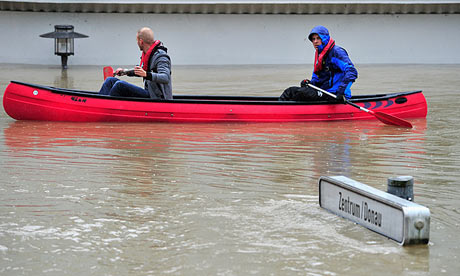
    A canoe is steered past a street sign for the Danube river and the city centre of Passau, Germany,

    A canoe is steered past a street sign for the Danube river and the centre of Passau, Germany, as flood levels neared 2002’s historic highs. Photograph: Lennart Preiss/Getty

    Volunteers piled up sandbags in an effort to keep the Vltava river from swamping the Czech capital’s historic centre after floods across central Europe forced factories to close and drove thousands from their homes. At least seven people have been killed.

    Five people were killed at the weekend in the Czech Republic, where the flooding was the worst in a decade and a state of emergency was declared, while in Austria two people died and another two were missing.

    Officials in Prague, which is listed by the UN as a World Heritage Site, shut the metro system, and in streets near the river soldiers put up flood defences.

    Tigers at Prague zoo were tranquilised and moved out of an enclosure at risk from flooding. The Charles bridge, a favourite spot for tourists that dates back to the 14th century, was closed.

    Officials hoped the flood defences in Prague should hold, but said the river level was likely to rise again on Tuesday morning. “The story is not yet over here,” said the environment minister, Tomáš Chalupa.

    Tree trunks floated by in the muddy brown water. A riverside path, usually populated with cyclists and people sitting at cafes, was under water on Monday.

    “We left England yesterday and it was sunny and warm. We didn’t expect this; we don’t even have our raincoats,” said a British tourist, Alison Tadman, who came to Prague with her husband, Adrian, to celebrate her 47th birthday. She and her husband were sheltering in a McDonald’s restaurant. “We’re pretty disappointed,” she said.

    Some of the worst flooding was around the Danube river, which starts in Germany and snakes its way through countries including Austria, Slovakia and Hungary on its way to the Black Sea. The river was swollen by heavy rain at the weekend.

    In Germany, the interior minister flew to the flood-hit regions on Monday and the chancellor, Angela Merkel, was preparing to go on Tuesday, a government spokesman said.

    Shipping was stopped on parts of the Danube and Rhine rivers in Germany, and along the whole Austrian stretch of the Danube, because of the high waters. The rivers are important arteries for moving grain, coal and other commodities.

    Thousands of people living in low-lying areas in Austria and the Czech Republic had to be evacuated from their homes.

    The death toll in Austria rose on Monday after a man listed as missing was found dead in the province of Vorarlberg, local police said. The 58-year-old had failed to return home from a party on Saturday.

    In the Austrian city of Salzburg, 160 passengers were put up overnight in army barracks after the floods stranded their train. The Austrian foreign minister, Michael Spindelegger, told reporters the situation in some areas was very fraught.

    The risk on Monday was that the flood danger could follow the course of the Danube river downstream to other European countries along its route.

    Workers put up flood barriers along the banks of the Danube where it passes through the Slovak capital, Bratislava, and police shut several roads.

    “We are getting bad news from Germany and Austria. We have to do all we can to protect … the capital,” the Slovak prime minister, Robert Fico, said.

    In Hungary, where the capital, Budapest, is also built on the banks of the Danube, state media quoted György Bakondi, head of the national disaster authority, as saying that 400 people were working on flood defences.

    He said water levels in the river could reach or even exceed the height seen in the record flooding of 2002.

    Daily Email

    close

    Sign up for the Guardian Today

    Our editors’ picks for the day’s top news and commentary delivered to your inbox each morning.

    Sign up for the daily email

    Daily Email

    close

    Get the Guardian’s daily US email

    Our editors’ picks for the day’s top news and commentary delivered to your inbox each morning. Enter your email address to subscribe.

    Sign up now
    Daily Email
  • Abbott’s tree-planting plan not enough to combat climate change, study says

    Abbott’s tree-planting plan not enough to combat climate change, study says

    Climate scientists’ study says carbon storage schemes must be accompanied by cuts to Australia’s fossil fuel emissions

    A report says there is public confusion over the offsetting of carbon emissions by carbon 'sinks' such as forests
    A report says there is public confusion over the offsetting of carbon emissions by carbon ‘sinks’ such as forests. Photograph: Theo Allofs/Getty Images

    The federal Coalition’s policy of planting millions of new trees will do little to offset Australia’s carbon dioxide emissions, a study by leading climate change scientists has found.

    The report warns that an absence of significant cuts to fossil fuel emissions would undermine any attempt to store carbon in trees and soils.

    The report, entitled Untangling the Confusion Around Land Carbon Science and Climate Change Mitigation Policy, says that there is public confusion over the offsetting of carbon emissions by carbon “sinks” such as forests.

    It states: “There are strict, environmentally determined limits on the maximum amount of carbon that can be restored to land carbon stocks, and good reasons why this maximum will not be achieved.

    “Avoiding emissions by protecting high-carbon ecosystems from land-use change that depletes their carbon stocks is an important part of a comprehensive approach to greenhouse gas mitigation. The mitigation value of forests lies not in their present net uptake of CO2, but in the longevity of their accumulated carbon stocks.

    “Consistent with our understanding of the lifetime of the airborne fraction of a pulse of CO2, the most effective form of climate change mitigation is to avoid carbon emissions from all sources.”

    Although the report shows that Australia ranks seventh in the world in terms of forested land – at 149.3m hectares – this carbon storage is dwarfed by the country’s annual emissions of 575m tonnes of CO2.

    “This means that there is no option but to cut fossil fuel emissions deeply, and not to continue these emissions under the erroneous assumption that they can be offset in the long term by the uptake of CO2 in land systems,” the study says.

    While the report does not specifically mention the Coalition’s “direct action” climate change policy, it is clear that further activity, other than sequestering carbon, is required to meet Australia’s commitment to reduce emissions by 5% by 2020, from 2000 levels.

    The Coalition’s plan is based on a $2.55bn emission reduction fund, which will provide financial incentives for businesses and landowners to lower their emissions.

    The strategy, which will replace the carbon-pricing scheme, will also involve the planting of 20 million trees by a “green army”, in a bid to store more carbon.

    The Coalition predicts that soil sequestration alone will account for up to 355m tonnes of emissions by 2020. This, along with uptake of solar and energy efficiency programs, will, the opposition states, reduce Australia’s emissions by 140m tonnes a year until 2020, ensuring the nation meets its 5% reduction goal.

    The direct action plan has come under fire from conservationists and economists, many of whom predict the plan would be expensive, insufficient and place the burden on taxpayers, rather than polluters, to fund emissions cuts.

    “A lot of people have the miscomprehension that you can plant trees to offset emissions, but we are pumping out emissions at a higher rate than we can soak it up,” said Prof Brendan Mackey of Griffith University, the lead author of the report.

    “Carbon circulates in the atmosphere and ocean, and a small amount is drawn into the deep ocean and taken out of circulation. But that takes thousands of years to happen.

    “Let’s be clear: we think carbon sequestration is a good thing. It’s good to plant trees back in areas that have been deforested. But it can’t be the only policy.”

    “There’s a finite amount of carbon stored in forests and Australia only has a small amount of land where it can grow forests, so you can’t do this infinitely.”

    The sheer scale of Australia’s potential emissions was underlined by recent analysis by the Climate Institute, which found that mining companies had access to coal reserves in Australia that would add around 150 gigatonnes of CO2 to the atmosphere. This figure is 75% of the total global emissions “budget” that could be released by 2050 if the world is to keep to under two degrees in warming.

    Separate research, released on Tuesday by WWF and Monash University, found that Australia could lift its emissions cut target from 5% to 25% with a GDP cost of just 0.01%.

  • the survey of GetUp members everywhere that will set our agenda this election year.

    to me
    Dear NEVILLE,

    There’s so much at stake this year. What we campaign on in 2013 will have lasting impacts on the future of Australia. So I’m inviting you to take part in the largest independent political survey of its kind in Australia – the survey of GetUp members everywhere that will set our agenda this election year.

    Want to ensure the issues you care the most about are on the national agenda this year? Then click here to help set GetUp’s course: www.getup.org.au/yourelectionsurvey2013

    Building on the results of our recent GetTogethers – when thousands of GetUp members met in homes, churches and halls around the country – your answers to this online survey will determine what issues are prioritised. Your participation will provide the mandate our movement needs to go big. It’s also a chance for you to tell us more about yourself, what interests you and what unique skills or services you might want to contribute.

    At the last election, GetUp members championed climate action, took a case to the High Court that allowed 100,000 young Australians to get on the electoral roll and pushed for a massive increase in funding for mental health, and ran what were recognised as some of the most effective TV advertisement during the election period – among many other achievements. This is your chance to shape our direction this time around.

    Click here to have your say this election: www.getup.org.au/yourelectionsurvey2013

    It’s good to have you on board,
    Sam McLean, National Director – GetUp

    PS. GetUp’s power comes from you. There are no petitions without your names. There are no calls to our nation’s leaders without your voice on the other end of the line. There are no ads without your donations. There are no rallies without your presence. There is no movement without the hundreds of thousands of members who make it up. Be heard now.


    GetUp is an independent, not-for-profit community campaigning group. We use new technology to empower Australians to have their say on important national issues. We receive no political party or government funding, and every campaign we run is entirely supported by voluntary donations. If you’d like to contribute to help fund GetUp’s work, please donate now! If you have trouble with any links in this email, please go directly to www.getup.org.au. To unsubscribe from GetUp, please click here. Authorised by Sam Mclean, Level 2, 104 Commonwealth Street, Surry Hills NSW 2010.

  • Innocent Until Proved Dead (MONBIOT)

    Innocent Until Proved Dead

    Posted: 03 Jun 2013 12:14 PM PDT

    If assassinating suspects makes sense overseas, why not at home?


    By George Monbiot, published in the Guardian 4th June 2013

    Did the FBI execute Ibragim Todashev? He appears to have been shot seven times while being interviewed at his home in Orlando, Florida about his connection to one of the Boston bombing suspects.. Among the shots was the assassin’s hallmark: a bullet to the back of the head(1). What kind of an interview was it?

    An irregular one. There was no lawyer present. It was not recorded(2). By the time Todashev was shot, he had apparently been interrogated by three agents for five hours(3). And then? Who knows? First, we were told, he lunged at them with a knife(4). How he acquired it, five hours into a police interview, was not explained. How he posed such a threat while recovering from a knee operation also remains perplexing.

    At first he drew the knife while being interviewed. Then he acquired it during a break from the interview(5). Then it ceased to be a knife and became a sword, then a pipe, then a metal pole, then a broomstick, then a table, then a chair(6,7,8). In one account all the agents were in the room at the time of the attack, in another, all but one had mysteriously departed, leaving the remaining officer to face his assailant alone.

    If – and it remains a big if – this was an extrajudicial execution, it was one of hundreds commissioned by US agencies since Barack Obama first took office. The difference in this case is that it took place on American soil. Elsewhere, suspects are bumped off without even the right to the lawyerless interview Ibragim Todashev was given.

    In his speech two days after Todashev was killed, President Obama maintained that “our commitment to Constitutional principles has weathered every war”(9). But he failed to explain which Constitutional principles permit him to authorise the killing of people in nations with which the United States is not at war. When his Attorney General, Eric Holder, tried to do so last year, he got himself into a terrible mess, ending with the extraordinary claim that “’due process’ and ‘judicial process’ are not one and the same … the Constitution guarantees due process, not judicial process.”(10) So what is due process if it doesn’t involve the courts? Whatever the president says it is?

    Er, yes. In the same speech Obama admitted for the first time that four US citizens have been killed by US drone strikes in other countries. In the next sentence he said “I do not believe it would be constitutional for the government to target and kill any U.S. citizen – with a drone, or a shotgun – without due process.”(11) This suggests he believes that the legal rights of those four people had been respected before they were killed.

    Given that they might not even have known that they were accused of the alleged crimes for which they were executed, that they had no opportunities to contest the charges, let alone be granted judge or jury, this suggests that the former law professor’s interpretation of constitutional rights is somewhat elastic. If Obama and his nameless advisers say someone is a terrorist, he stands convicted and can be put to death.

    Left hanging in his speech is the implication that non-US citizens may be executed without even the pretence of due process. The many hundreds killed by drone strikes (who, civilian or combatant, retrospectively become terrorists by virtue of having been killed in a US anti-terrorism operation) are afforded no rights even in principle(12,13).

    As the process of decision-making remains secret, as the US government refuses even to acknowledge – let alone to document or investigate – the killing by its drones of people who patently had nothing to do with terrorism or any other known crime, miscarriages of justice are not just a risk emerging from the deployment of the president’s kill-list. They are an inevitable outcome. Under the Obama doctrine, innocent until proved guilty has mutated to innocent until proved dead.

    The president made his rejection of habeas corpus and his assumption of a godlike capacity for judgement explicit later in the speech, while discussing another matter. How, he wondered, should the US deal with detainees in Guantanamo Bay “who we know have participated in dangerous plots or attacks, but who cannot be prosecuted – for example because the evidence against them has been compromised or is inadmissible in a court of law”? If the evidence has been compromised or is inadmissable, how can he know that they have participated? He can suspect, he can allege, but he cannot know until his suspicion has been tested in a court of law.

    Global powers have an antisocial habit of bringing their work back home. The British government, for example, imported some of the methods it used against its colonial subjects to suppress domestic protests and strikes. Once an administrative class becomes accustomed to treating foreigners as if they have no rights, and once the domestic population broadly accepts their justifications, it is almost inevitable that the habit migrates from one arena into another. If hundreds of people living abroad can be executed by US agents on no more than suspicion, should we be surprised if residents of the United States began to be treated the same way?

    George Monbiot’s book Feral: searching for enchantment on the frontiers of rewilding is published by Allen Lane.

    References:

    1. A picture of the head wound has been reproduced here: http://www.guardian.co.uk/world/2013/may/30/father-chechen-man-killed-fbi-inquiry

    2. http://www.nytimes.com/2013/05/31/us/man-tied-to-boston-suspect-said-to-have-attacked-fbi-agent.html

    4. http://articles.orlandosentinel.com/2013-05-22/news/os-who-is-ibragim-todashev-20130522_1_boston-marathon-bombings-chechen

    5. http://www.nytimes.com/2013/05/23/us/officer-involved-in-shooting-of-man-tied-to-tsarnaev.html

    6. http://www.theatlantic.com/national/archive/2013/05/yet-another-explanation-for-the-killing-of-ibragim-todashev/276421/

    7. http://www.nytimes.com/2013/05/31/us/man-tied-to-boston-suspect-said-to-have-attacked-fbi-agent.html

    8. http://www.bostonglobe.com/metro/2013/06/01/days-later-fbi-shooting-orlando-remains-shrouded-government-secrecy/inhTL8hsidG0Tgy5PGKtnM/story.html

    9. http://www.guardian.co.uk/world/2013/may/23/obama-drones-guantanamo-speech-text

    10. http://www.justice.gov/iso/opa/ag/speeches/2012/ag-speech-1203051.html

    11. http://www.guardian.co.uk/world/2013/may/23/obama-drones-guantanamo-speech-text

    12. International Human Rights and Conflict Resolution Clinic at Stanford Law School and Global Justice Clinic at NYU School Of Law, September 2012. Living Under Drones: Death, Injury and Trauma to Civilians from US Drone Practices in Pakistan. http://livingunderdrones.org/wp-content/uploads/2012/10/Stanford-NYU-LIVING-UNDER-DRONES.pdf

    13. http://www.thebureauinvestigates.com/category/projects/drones/

    You are subscribed to email updates from George Monbiot
    To stop receiving these emails, you may unsubscribe now.
    Email delivery powered by Google
    Google Inc., 20 West Kinzie, Chicago IL USA 60610