Category: Uncategorized

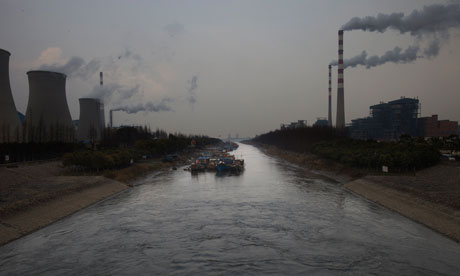
  • China’s cities: push for ‘green’ centres creates suburban ‘cancer villages’

    China’s cities: push for ‘green’ centres creates suburban ‘cancer villages’

    Cities shunt polluting plants to areas where damage is less visible as proof linking cancer rates to pollution remains elusive

    chinese cities

    Rapid development of China’s cities has coincided with the promotion of urban sustainability while factories are moved to remote areas where their environmental impact is less visible. Photograph: Lu Guang/Greenpeace

    In most Chinese cities, the environmental cost of rapid development is obvious: unbreathable air and undrinkable water. Less obvious is the cost of cleaning them up.

    Since the late 1990s, the “National model city for environmental protection programme” has accredited at least 76 cities nationwide as exemplars of urban sustainability, based on criteria including clean air, rubbish-free streets and ample public parks.

    Yet China is also home to hundreds of cancer villages, and a US-based academic has spent years drawing a link between the two. “I think a majority of model cities also have cancer villages, one or two or three of them,” said Lee Liu, a geography professor at the University of Central Missouri.

    Liu argued in a recent book that China’s quest for green cities has created cancer villages on their fringes, as ambitious municipal governments shunt factories to areas where their environmental impact is less visible.

    But scientific proof linking disease rates with factory pollution is elusive: “How can you prove that a dirty factory caused your cancer? You can’t,” Liu said. “So the link is indirect. But if you map it, you see clusters around these cities.”

  • Report questions economic benefit of shale gas extraction

    5 June 2013, 12.06am EST

    Report questions economic benefit of shale gas extraction

    Australia may have over 1000 trillion cubic feet in undiscovered shale gas resource but the enormous cost of infrastructure needed to extract it may outweigh its economic benefit unless shale gas prices rise, a new report has found. Shale gas, which is buried further below the surface of the ground…

    Nvrsdy44-1370327649
    A hydraulic fracturing drill rig in Pennsylvania. Fracking involves injecting huge amounts of water, sand, and chemicals at high pressure thousands of feet beneath the earth’s surface to extract reserves of natural gas. EPA/JIM LO SCALZO

    Australia may have over 1000 trillion cubic feet in undiscovered shale gas resource but the enormous cost of infrastructure needed to extract it may outweigh its economic benefit unless shale gas prices rise, a new report has found.

    Shale gas, which is buried further below the surface of the ground than coal seam gas, is abundant in the United States and in Australia, and is extracted using similar techniques, including fracking.

    The new report, written by the Australian Council of Learned Academies, is part of Securing Australia’s Future, a series of research programs selected by the Prime Ministers Science, Engineering and Innovation Council and the Chief Scientist.

    The study looked at shale gas and resources, technology, monitoring, infrastructure, human and environmental impacts, issues communication, regulatory systems, economic impacts, lessons learned from the coal seam gas industry, and impacts on greenhouse gas reduction targets.

    Not a cheap gas

    The report found that shale gas production costs in Australia are likely to be significantly higher than those in North America.

    “Shale gas will not be cheap gas in most circumstances. It will require a relatively high price to make it profitable to produce,” the report said.

    In Australia, shale gas will require a price of the order of $6 to $9 a gigajoule to make its production and transport profitable, the report said.

    “By comparison, the wholesale gas price for long-term contracts of gas for the domestic market in eastern Australia is around $4 per gigajoule while current eastern Australia domestic wholesale prices are about $6 per gigajoule,” the report said.

    “Based on these estimates, development of Australian shale gas marketed on the east coast is unlikely to occur until domestic and international netback prices (around $10 per gigajoule) are equalised.”

    Dr Vaughan Beck, one of the authors of the report and a fellow of the Australian Academy of Technological Sciences and Engineering, said developers would also have to allow for the extra cost of transmission and processing of the product.

    “So it’s not currently economical in Australia, in general terms,” he said.

    Road and pipeline networks in North America are more developed than in Australia and the cost of developing such infrastructure would need to be factored in, the report said.

    Social licence

    The report said it was crucial for shale gas developers to gain community support to operate and may involve negotiating agreements with indigenous land owners.

    “In order to develop effective relationships with communities potentially impacted by shale gas developments, it will be necessary to have open dialogue, respect and transparency,” the report said.

    Water and environment

    More water may be needed for shale gas fracking than is used for coal seam gas extraction, the report said, warning that “contamination of freshwater aquifers can occur due to accidental leakage of brines or chemically-modified fluids during shale gas drilling or production; through well failure; via leakage along faults; or by diffusion through over-pressured seals.”

    “The petroleum industry has experience in managing these issues and remediating them, but in a relatively new shale gas industry, unanticipated problems may arise and it is important to have best practice in place, to minimise the possibility of this risk,” the report said.

    Using shale gas in gas turbines to produce electricity creates 20% more greenhouse gas emissions than conventional gas but between 50% and 75% of the emissions of black coal, the report found.

    “Some people have raised the question ‘Why extract shale gas? Why not spend the money on cleaner renewable energy?’ But that is not a question that was in the terms of reference of this Review,” the report said.

    Uncertainty

    Vlado Vivoda, a shale gas expert and Research Fellow at Griffith University said the report was timely but said he thought it was unlikely gas prices will rise.

    “If massive volumes of US shale gas enters the international market as liquid natural gas (LNG) over the next decade (and mainly gets imported by Asian countries), this may challenge the prevailing LNG pricing structure in Asia, where LNG price is indexed to crude oil,” he said.

    “This, in fact, may be a crucial development which may affect the prospects for Australian shale gas, which is more expensive than North American shale gas.”

    Dr Vivoda said that given the high infrastructure costs and uncertainty about LNG prices in the region “it will be risky for investors to enter into this game.”

    Alarm bells

    Colin Hunt, Honorary Fellow in Economics at University of Queensland said the report was a comprehensive outline of the risk and benefits of shale gas extraction in Australia.

    “Alarm bells will be set ringing because of the Australian experience with the way that companies have conducted environmental impact assessments for their coal seam gas and coal mining projects. Best practice in controlling the volume of water use from aquifers, contamination of aquifers with produced water and fracking chemicals is advocated in the report,” he said.

    “However, it is worrying that a recent survey found that most environmental impact assessments were deficient in their analysis of how a project would contribute to cumulative environmental impacts of water use and disposal associated with gas and coal mining.”

    Dr Hunt also warned of habitat fragmentation and biodiversity risks presented by the development of shale gas infrastructure.

  • Accelerating Ice Sheet Melt Is Raising Sea Levels, Says New Study Accurately Reported By Wall Street Journal

    Accelerating Ice Sheet Melt Is Raising Sea Levels, Says New Study Accurately Reported By Wall Street Journal

    By Joe Romm on Jun 3, 2013 at 5:31 pm

    Sea level rise last century versus the last two decades via Jet Propulsion Lab.

    Is it big news that “Rising Sea Level Tied to Faster Melt,” as the Wall Street Journal reported today?

    Back in 2011, JPL researchers concluded that polar ice sheet mass loss is speeding up, threatening a 1 foot sea level rise by 2050. Last year, the most comprehensive analysis of all observational data found that Greenland ice sheet melt is up nearly five-fold since mid-1990s.

    Changes in global sea level due to ice sheet melting since 1992. Credit: NASA via NBC.

    But I think it qualifies as news when the Wall Street Journal actually does an original piece on one of the more worrisome threats from global warming — and gets it right.

    Indeed the Wall Street Journal reporters and editorial page editors are kind of like Edward Norton and Brad Pitt (respectively) in Fight Club (spoiler alert) raging a schizophrenic war with one another (literally). The WSJ editors set the first rule of global warming fight club — don’t talk about the threat of manmade global warming (see Not The Onion: Wall Street Journal Hits ‘Rock Bottom’ With Inane Op-Ed Urging ‘More Atmospheric Carbon Dioxide’)

    The more sane half of the WSJ reported on a new study in Nature Geoscience, whose abstract explains:

    … we conclude that most of the change in ocean mass is caused by the melting of polar ice sheets and mountain glaciers. This contribution of ice melt is larger than previous estimates, but agrees with reports of accelerated ice melt in recent years.

    Here is how a rogue reporter at the WSJ covered it:

    Accelerated melting of polar ice sheets and mountain glaciers was the driving factor behind a rise in the global sea level of 16.8 millimeters, or about two-thirds of an inch, between 2005 and 2011, according to a study published Sunday in Nature Geoscience.

    The findings are consistent with observed longer-term trends, but the study encompasses only a few years of observations, limiting its conclusions, scientists said. The study, funded by the National Science Foundation and the National Aeronautics and Space Administration, does resolve long-standing discrepancies that arose from different methods of measuring sea levels.

    Scientists want to establish how much of the sea-level change relates to increased melt water, and how much relates to the water expanding as it warms up. Previous calculations indicated that melting might contribute about half of the increase. The latest study concludes that for the period 2005-2011 the contribution was closer to 75%.

    “There was an increase in the melting rate in Greenland starting in 2005 and that is probably the underlying story why” a larger quantity of melt water has poured into the oceans in recent years, said Clark R. Wilson, geophysicist at the University of Texas at Austin and co-author of the study.

    Can’t argue with any of that — unless, of course, you are a denier writing for the WSJ who sees only benefits from more carbon pollution.

    By the way, you may have noticed that seas only rose about 2.4 millimeters a year from 2005 to 2011. The study picked an endpoint that corresponds to a dip in sea level rise that NASA explained in late 2011 (see “It Rained So Hard the Oceans Fell“).

    The short-term dip certainly drew the attention of the climate science deniers, who said absurd things like “The fact that CO2 levels have been higher in the last 5 years that have the lowest rate of rise than the years with lower CO2 levels is a strong indicator that the claims of CO2 are grossly exaggerated.”

    Needless to say, the dramatic rebound in sea level rise has not gotten similar attention. See
    Has The Rate Of Sea Level Rise Tripled Since 2011?

    Related Post:

    • Wall Street Journal: “More Droughts, Floods, Extreme Weather Expected With Warming Climate”

  • Ice Probes to Measure Melting Polar Ice, Rising Seas

    Ice Probes to Measure Melting Polar Ice, Rising Seas

    Denise Chow, LiveScience Staff Writer
    Date: 03 June 2013 Time: 05:27 PM ET
    inShare1
    Meltwater stream on the Greenland ice sheet.
    Meltwater stream on the Greenland ice sheet.
    CREDIT: Roger Braithwaite via NASA

    Special instruments installed in Greenland and Antarctica to measure melting ice may help scientists more accurately predict the rate of rising sea levels in the future.

    Earlier this year, David Holland, a professor of mathematics at the Center for Atmosphere Ocean Science at New York University, spent two months installing devices on the Greenland Ice Sheet and the West Antarctic Ice Sheet.

    These instruments, which are all roughly the size of a large suitcase and weigh about 100 pounds (45 kilograms), will study the atmosphere by collecting information on wind, air temperature and humidity. Other water-based devices will gather data on ocean temperatures, enabling the researchers to track the movement of warm ocean currents that melt portions of the ice sheets.

    “Right now, there seems to be more melting going on than before,” Holland told LiveScience. “By measuring the melting glaciers, we can see how much water is going into the ocean and raising sea levels.” [Photos of Melt: Glaciers Before and After]

    When ice melts, the water flows down slopes and eventually empties into the ocean, causing sea levels to rise. But, understanding why these changes are happening — and how much sea levels are rising — remains challenging, Holland said.

    This is partly because researchers do not have enough data on melting ice in Greenland and Antarctica. Currently, most of the changes in the ice sheets have been observed by satellites in space.

    “We can see that the ice is getting lower, and the oceans are rising higher,” Holland said. “But, there is only so much we can see from space. We cannot see into the ocean, or below the ice surface, so that’s why we go to these locations and put instruments into the ocean.”

    With more precise measurements, scientists may be able to determine the extent that human activities are contributing to the dwindling ice sheets, he added.

    “Right now, we don’t have enough data to really distinguish if what’s going on is completely natural, or related to human activity in a changing climate,” Holland said. “We need sustained measurements for several years in order to separate natural changes from possible anthropogenic changes.”

    As more and more information is collected, researchers will be able to feed data into complex mathematical formulas to develop computer models of rising global sea levels, Holland explained. He intends to use these instruments indefinitely to track long-term changes in the polar ice sheets.

    “You can’t build a model until you have observations of what you’re trying to build,” Holland said. “Polar regions, particularly Antarctica, are very difficult to access, which is why we hope this will really benefit our researchers and, really, the entire international community.”

    Follow Denise Chow on Twitter @denisechow. Follow LiveScience @livescience, Facebook & Google+. Original article on LiveScience.com.

  • Govt moves changes to Gonski reforms

    Govt moves changes to Gonski reforms

    AAPUpdated June 4, 2013, 8:13 pm

    States that don’t agree to the federal government’s plan for schools will be funded in line with the present model but will be allowed to sign on after the June 30 deadline.

    School Education Minister Peter Garrett has introduced amendments to the Australian Education Bill 2012 to address gaps in the legislation from last November.

    They detail how states and the non-government sector will be paid and how they would be held accountable under the national education reform agreement (NERA).

    Mr Garrett said school results just weren’t good enough, and if Australia was to win the economic race it needed to improve the “broken” school funding system.

    “The amendments … ensure that we right a moral wrong, and that we secure our economic future,” he told the House of Representatives.

    “The purpose of the amendments is to enshrine in law a national approach to funding school education that ensures that schools are funding according to the needs of their students.”

    The government wants the amendments to pass parliament by June 27, the last sitting day before the September 14 election.

    A June 30 deadline was set for states and territories to agree to the new funding model, which is based on the schools review headed by businessman David Gonski.

    But the legislation does not prohibit them signing up later.

    If they don’t sign up, they will lose money once time-limited national partnerships end. Most of these are due to wind up within 12 months.

    States and territories would have to enact national school education policy initiatives and pass on non-government schools funding to approved authorities as a condition of grants under the new plan.

    The bill includes the current funding model for schools so states and territories that don’t sign up to the new plan will keep their present indexation.

    Schools below a set schooling resource standard (SRS) would receive 4.7 per cent growth a year in commonwealth funding.

    Schools above the SRS would receive 3.0 per cent annually until they are in line with a new, higher standard for all.

    Once schools reach the SRS, their funding would increase at 3.6 per cent a year.

    Schools will receive extra loadings for size, location, indigenous students, students from low socio-economic backgrounds or with a disability.

    The minister would be able to cut or delay payments if a state or territory failed to comply with any conditions of funding.

    Schools would have a greater ability to appeal their funding loadings under the new bill.

    There would be a two-stage step, with the first appeal to be assessed by a senior education departmental officer while a second review would be done by the Administrative Appeals Tribunal (AAT) if needed.

    NSW and the ACT have signed up.

    A future government would have to amend the legislation to scrap the funding package and scrap the bi-lateral agreement between the commonwealth and state.

    The amendments were agreed after the house voted down, by a single vote, a long opposition amendment.

    That amendment was essentially a manifesto about the need for all students to have a quality education.

    With its amendment defeated, the opposition didn’t oppose the bill.

    However the final stages of its passage were adjourned to later on Tuesday night.

  • PM urged to personally sell asylum message

    PM urged to personally sell asylum message

    By Ehssan Veiszadeh, AAPUpdated June 4, 2013, 8:40 pm

    Prime Minister Julia Gillard has been urged by one of her strongest supporters to do a better job selling her party’s asylum seeker policies or risk losing the debate to the Liberals.

    Government MP Laurie Ferguson reportedly told Ms Gillard in a caucus meeting on Tuesday Labor would be “dead” in western Sydney seats if she didn’t personally take up the public debate on asylum seeker policies.

    His warning comes after a Newspoll, published in The Australian, showed the coalition’s lead over the government increasing to 16 points.

    If the 58-42 per cent opinion poll result was repeated at the September 14 election, Labor’s representation in parliament would be nearly halved to 37 seats.

    Mr Ferguson, who is one of Ms Gillard’s strongest supporters, says Labor can recover “very strongly” in western Sydney if the prime minister personally engages with the electorate on boats.

    “I believe this message is far more central than people might think,” Mr Ferguson told reporters in Canberra.

    “This issue cuts across and causes us credibility issues.”

    Mr Ferguson said asylum seeker policy was a major concern for people in his western Sydney electorate.

    “I want to emphasise this is not just racist rednecks (who are concerned with asylum boats),” he told ABC television.

    “These are Muslims, these are Buddhists, these are people from Malaysia, these are people from Bangladesh who convey this to me.”

    He said Labor had not successfully explained to the electorate how difficult it was to manage refugee policies.

    “Quite frankly, on default, the Liberals are going to win on this issue because people have somehow got a view that they’ve got some solution,” Mr Ferguson said.

    Ms Ferguson said Ms Gillard was the best person to lead Labor into the September election, particularly on the area of asylum seekers.

    “I think that Julia Gillard is one person that people know she’s a tough nut,” he said.