Category: Uncategorized

  • Renew Economy editor@reneweconomy.com.au via mail36.atl111.rsgsv.net

    1 of 3
    Why this ad?
    EnergyAustraliaenergyaustralia.com.au/electricity – Great Energy Deals Online. Switch Online. Get a Quote in 30sec

    Daily update: Abengoa mulls 20MW solar tower + storage plant in WA

    Inbox
    x

    Renew Economy editor@reneweconomy.com.au via mail36.atl111.rsgsv.net

    2:04 PM (5 minutes ago)

    to me
    Abengoa mulls solar tower+storage plant in WA, Abbott says new tax critical to send consumers pricing signal, NSW wants LRET & cuts to rooftop solar incentives, Greens say 1–% renewables in NSW affordable & essential, US emissions jump as coal returns, What will solar industry look like in 2025, Visualizing life in Salem after massive coal generator closed, and Carbon offsets can do more harm than good.
    Is this email not displaying correctly?
    View it in your browser.
    RenewEconomy Daily News
    The Parkinson Report
    Abengoa considers 20MW solar tower plant with storage and gets ARENA funds for feasibility study. Australia is finally awaking to solar technology of the future.
    Five years after stating his preference for a tax to help reduce Australia’s growing emissions, Tony Abbott is once again embracing price signals.
    Victoria is allocating huge subsidies to connect regional households to expensive, outdated gas. But there’s a much cheaper, greener option.
    NSW breaks ranks with other conservative governments, saying RET is good and should be retained. But it suggests changes, including delaying large scale component and reducing incentives for rooftop solar.
    The Greens’ plan to shift NSW to 100% renewables by 2030 introduced to parliament as ‘possible’, ‘affordable’ and ‘in the best interests of the state.’
    With the EPA’s draft carbon standards hanging over US power sector, increased coal-fired power has caused US emissions to rise dramatically.
    Which nations? Which technologies?  Which companies? Some of the questions explored by a group of 20 of the top solar executives in the world at Stanford.
    When coal plants close, communities face painful transitions. Debate over one Massachusetts plant shows the local impacts of a national shift to cleaner power.
    Globally and across consumer companies, carbon offsets are not only green-washing, but
  • The Impossibility of Growth MONBIOT

    1 of 48
    Why this ad?
    VW TransporterThe Versatile Original – Big jobs. Tall jobs. All jobs. Discover the Volkswagen Transporter Range. Download a Brochure Today.

    Monbiot.com

    Inbox
    x

    George Monbiot news@monbiot.com via google.com

    5:05 PM (7 minutes ago)

    to me

    Monbiot.com


    The Impossibility of Growth

    Posted: 27 May 2014 10:25 AM PDT

    Why collapse and salvation are hard to distinguish from each other.
    By George Monbiot, published in the Guardian 28th May 2014

    Let us imagine that in 3030BC the total possessions of the people of Egypt filled one cubic metre. Let us propose that these possessions grew by 4.5% a year. How big would that stash have been by the Battle of Actium in 30BC? This is the calculation performed by the investment banker Jeremy Grantham(1).

    Go on, take a guess. Ten times the size of the pyramids? All the sand in the Sahara? The Atlantic ocean? The volume of the planet? A little more? It’s 2.5 billion billion solar systems(2). It does not take you long, pondering this outcome, to reach the paradoxical position that salvation lies in collapse.

    To succeed is to destroy ourselves. To fail is to destroy ourselves. That is the bind we have created. Ignore if you must climate change, biodiversity collapse, the depletion of water, soil, minerals, oil; even if all these issues were miraculously to vanish, the mathematics of compound growth make continuity impossible.

    Economic growth is an artefact of the use of fossil fuels. Before large amounts of coal were extracted, every upswing in industrial production would be met with a downswing in agricultural production, as the charcoal or horse power required by industry reduced the land available for growing food. Every prior industrial revolution collapsed, as growth could not be sustained(3). But coal broke this cycle and enabled – for a few hundred years – the phenomenom we now call sustained growth.

    It was neither capitalism nor communism that made possible the progress and the pathologies (total war, the unprecedented concentration of global wealth, planetary destruction) of the modern age. It was coal, followed by oil and gas. The meta-trend, the mother narrative, is carbon-fuelled expansion. Our ideologies are mere subplots. Now, as the most accessible reserves have been exhausted, we must ransack the hidden corners of the planet to sustain our impossible proposition.

    On Friday, a few days after scientists announced that the collapse of the West Antarctic ice sheet is now inevitable(4), the Ecuadorean government decided that oil drilling would go ahead in the heart of the Yasuni national park(5). It had made an offer to other governments: if they gave it half the value of the oil in that part of the park, it would leave the stuff in the ground. You could see this as blackmail or you could see it as fair trade. Ecuador is poor, its oil deposits are rich: why, the government argued, should it leave them untouched without compensation when everyone else is drilling down to the inner circle of hell? It asked for $3.6bn and received $13m. The result is that Petroamazonas, a company with a colourful record of destruction and spills(6), will now enter one of the most biodiverse places on the planet, in which a hectare of rainforest is said to contain more species than exist in the entire continent of North America(7).

    The UK oil company Soco is now hoping to penetrate Africa’s oldest national park, Virunga, in the Democratic Republic of Congo(8); one of the last strongholds of the mountain gorilla and the okapi, of chimpanzees and forest elephants. In Britain, where a possible 4.4 billion barrels of shale oil has just been identified in the south-east(9), the government fantasises about turning the leafy suburbs into a new Niger delta. To this end it’s changing the trespass laws to enable drilling without consent and offering lavish bribes to local people(10,11). These new reserves solve nothing. They do not end our hunger for resources; they exacerbate it.

    The trajectory of compound growth shows that the scouring of the planet has only just begun. As the volume of the global economy expands, everywhere that contains something concentrated, unusual, precious will be sought out and exploited, its resources extracted and dispersed, the world’s diverse and differentiated marvels reduced to the same grey stubble.

    Some people try to solve the impossible equation with the myth of dematerialisation: the claim that as processes become more efficient and gadgets are miniaturised, we use, in aggregate, fewer materials. There is no sign that this is happening. Iron ore production has risen 180% in ten years(12). The trade body Forest Industries tell us that “global paper consumption is at a record high level and it will continue to grow.”(13) If, in the digital age, we won’t reduce even our consumption of paper, what hope is there for other commodities?

    Look at the lives of the super-rich, who set the pace for global consumption. Are their yachts getting smaller? Their houses? Their artworks? Their purchase of rare woods, rare fish, rare stone? Those with the means buy ever bigger houses to store the growing stash of stuff they will not live long enough to use. By unremarked accretions, ever more of the surface of the planet is used to extract, manufacture and store things we don’t need. Perhaps it’s unsurprising that fantasies about the colonisation of space – which tell us we can export our problems instead of solving them – have resurfaced(14).

    As the philosopher Michael Rowan points out, the inevitabilities of compound growth mean that if last year’s predicted global growth rate for 2014 (3.1%) is sustained, even if we were miraculously to reduce the consumption of raw materials by 90% we delay the inevitable by just 75 years(15). Efficiency solves nothing while growth continues.

    The inescapable failure of a society built upon growth and its destruction of the Earth’s living systems are the overwhelming facts of our existence. As a result they are mentioned almost nowhere. They are the 21st Century’s great taboo, the subjects guaranteed to alienate your friends and neighbours. We live as if trapped inside a Sunday supplement: obsessed with fame, fashion and the three dreary staples of middle class conversation: recipes, renovations and resorts. Anything but the topic that demands our attention.

    Statements of the bleeding obvious, the outcomes of basic arithmetic, are treated as exotic and unpardonable distractions, while the impossible proposition by which we live is regarded as so sane and normal and unremarkable that it isn’t worthy of mention. That’s how you measure the depth of this problem: by our inability even to discuss it.

    www.monbiot.com

    References:

    1. http://www.theoildrum.com/node/7853

    2. Grantham expressed this volume as 1057 cubic metres. In his paper We Need To Talk About Growth, Michael Rowan translated this as 2.5 billion billion solar systems. (http://persuademe.com.au/need-talk-growth-need-sums-well/). This source gives the volume of the solar system (if it is treated as a sphere) at 39,629,013,196,241.7 cubic kilometres, which is roughly 40 x 1021 cubic metres. Multiplied by 2.5 billion billion, this gives 1041 cubic metres. So, unless I’ve got the wrong figure for the volume of the solar system or screwed my units up, which is eminently possible, Michael Rowan’s translation looks like an underestimate. I’ll stick with his figure though, as I don’t have much confidence in my own. Any improvements, comments or corrections via the contact form gratefully received.

    3. EA Wrigley, 2010. Energy and the English Industrial Revolution. Cambridge University Press.

    4. http://www.theguardian.com/environment/2014/may/12/western-antarctic-ice-sheet-collapse-has-already-begun-scientists-warn

    5. http://www.theguardian.com/environment/2014/may/23/ecuador-amazon-yasuni-national-park-oil-drill

    6. http://www.entornointeligente.com/articulo/2559574/ECUADOR-Gobierno-concede-licencia-para-la-explotacion-de-dos-campos-del-ITT-23052014

    7. http://www.theguardian.com/world/2013/aug/16/ecuador-approves-yasuni-amazon-oil-drilling

    8. http://www.wwf.org.uk/how_you_can_help/virunga/

    9. http://www.theguardian.com/environment/2014/may/23/fracking-report-billions-barrels-oil-government-cynicism

    10. http://www.telegraph.co.uk/earth/energy/fracking/10598473/Fracking-could-be-allowed-under-homes-without-owners-permission.html

    11. http://www.theguardian.com/environment/2014/may/23/fracking-report-billions-barrels-oil-government-cynicism

    12. Philippe Sibaud, 2012. Opening Pandora’s Box: The New Wave of Land Grabbing by the Extractive Industries and the Devastating Impact on Earth. The Gaia Foundation. http://www.gaiafoundation.org/opening-pandoras-box

    13. http://www.forestindustries.fi/industry/paper_cardboard_converted/paper_pulp/Global-paper-consumption-is-growing-1287.html

    14. https://www.globalonenessproject.org/library/articles/space-race-over

    15. Michael Rowan, 2014. We Need To Talk About Growth (And we need to do the sums as well.) http://persuademe.com.au/need-talk-growth-need-sums-well/

    You are subscribed to email updates from George Monbiot
  • Daily update: Why Big Oil just doesn’t get it

    1 of 1
    Why this ad?
    From $20M to $5.6 BNnextoilrush.com – Can He Do It Again At New Company? Multiple Catalysts In Weeks!

    Daily update: Why Big Oil just doesn’t get it

    Inbox
    x

    Renew Economy editor@reneweconomy.com.au via mail63.atl51.rsgsv.net

    2:53 PM (31 minutes ago)

    to me
    Carbon bubble? Stranded assets? Not according to Big Oil. Plus: Greenearth Energy’s CO2-to-fuel solar win; Coal mining named as Australia’s biggest polluter; Silex reassures on ARENA funding, share price stops falling; CO2 passes 400ppm milestone; RET Roadtrip heads to Victoria’s Great Ocean Road; why notion’s of ‘saving the earth’ no longer apply; and the world’s greenest carmaker.
    Is this email not displaying correctly?
    View it in your browser.
    RenewEconomy Daily News
    The Parkinson Report
    Global oil majors aren’t buying in to the theories of carbon bubbles and stranded assets. Could this be because much of the $30trn of fossil-fuel revenues said to be at risk in this warming world is in the oil industry?
    Greenearth Energy says its Israeli partner’s CO2 to fuel technology now has two proven paths to market, using concentrated solar as well as waste heat.
    Report names coal as lead cause of declining Oz air quality; Vic govt puts CSG on hold; Abbott climate policy ‘uncertain’; Solco to sell solar assets.
    Uncertainty created by the Abbott government’s axing of ARENA named as a factor behind the ‘unexpected erosion’ of Silex Systems’ share price.
    C02 measurements in the northern hemisphere were above 400 parts per million for the month of April, the first time that’s been recorded in human history.
    RET Roadtrip # 6 – Seaside town of Anglesea is known for its surf and vacations, less known for its open-cut brown coal mine and an ageing coal power plant.
    New science has shown that long-held notions about trying to “save the planet” and preserve the life we have today no longer apply.
    Hyundai-Kia is the Greenest Automaker, though all automakers have improved their
  • An Early Double Dissolution? Don’t Hold Your Breath!

    « JSCEM Recommends Optional Preferential Voting for the Senate | Main | Queensland set for another By-Election »

    May 19, 2014

    An Early Double Dissolution? Don’t Hold Your Breath!

    The tedious topic of a double dissolution seems to be doing the rounds again. In particular, there seems to be quite a lot of badly informed commentary on political blog sites on how a double dissolution would be brought on.

    Let me quote one website commentator who manages to encapsulate these misunderstandings in two sentences.

    “There will be a DD in early 2015 whether Abbott wants it or not (he very unlikely to want it as by then 2PP polling will be something like 60-40 against him!). Shorten will deny him supply, and rightly so.”

    This comment is wrong for two fundamental constitutional reasons. First, a Prime Minister may choose to call a double dissolution election but they cannot be forced to call one. Second, you cannot get a double dissolution from blocking a supply bill, though a government may choose to call a double dissolution on other grounds because supply is blocked.

    So let me go through the mechanism of a double dissolution and also clear up this issue with supply bills.

    The key point to make is that a double dissolution of the House and the whole Senate, followed by an election and possibly a joint sitting, is a significant constitutional event, not some euphemism for an early election.

    The double dissolution mechanism is set out in section 57 of the Constitution. It was drafted and endlessly debated in the 1890s constitutional conventions. It was a constitutional mechanism that allowed a government with a majority in the House of Representatives to overcome the blocking power of the Senate.

    The need for some method to resolve deadlocks between the House and Senate was created by the decision to give the Senate virtually co-equal powers with the House, something that was unworkable under the Westminster model of responsible government unless a deadlock provision was provided.

    As it was envisaged, Section 57 was a mechanism that would allow the population of the larger states as represented by the majority government in the House of Representatives to overcome the blocking power of the smaller states in the Senate. While the Senate never became the state assembly imagined by the constitutional drafters, the double dissolution power was still an important mechanism and has been used six times.

    The double dissolution power is unique to the Commonwealth constitution. It was a power created for the Governor-General to use in their name, not as the representative of the Queen. It is a power created by the Constitution and is not a reserve power inherited from the British Monarch.

    Putting the double dissolution mechanism in dot points, it consists of the following steps –

    • A bill must first pass the house and then be rejected, fail to pass or be unacceptably amended by the Senate.
    • After a period of three months, the bill may be re-presented to the House. After its passage through then House, if it is again rejected, fails to pass or is unacceptably amended by the Senate, then the legislation has become a ‘trigger’ for a double dissolution.
    • The Prime Minister may choose to use one or more triggers as ground for a double dissolution of both chambers followed by an election for the House and the whole Senate. This is not allowed to take place in the last six months of the House’s term.
    • After the election the legislation must be presented to the new House, and after its passage, must be presented to the new Senate.
    • If the Senate again rejects, fails to pass or unacceptably amends the legislation, then the Prime Minister can request that the Governor-General summon a joint sitting of the two chambers sitting and voting as one on the legislation. At the joint sitting, a simple majority of those members and senators present can pass the legislation which is then signed into law by the Governor General. A legislative (as opposed to ceremonial) joint sitting cannot occur without a double dissolution election having first taken place, and no other legislation can be considered at a joint sitting.

    The originally drafted Section 57 contained a requirement that three-fifths support was required for a bill to pass at a joint sitting. This was part of the draft constitution that failed to pass in NSW at the 1898 referendum. NSW Premier George Reid had the provisioned weakened to requiring a simple majority, one of several changes that strengthened the power of the Commonwealth government and the power of the larger states and led to the acceptance of the Constitution at a second referendum in 1899.

    This mechanism can be used for normal legislation but is almost impossible to be used in relation to appropriation and supply bills.

    The term ‘supply’ has a specific meaning for the parliament, but in its common use means the main Appropriation Bills that sets out how much money has been set aside for the normal working of each department in the next 12 months.

    The current appropriation bills were introduced with the budget speech last Tuesday. They specify how much money each government department can spend between 1 July 2014 and 30 June 2015. These bills are in the process of passing the House, will soon go to the Senate, and have to be passed by by both houses before 30 June this year or government will cease to function on 1 July.

    That is why the blockage of the Appropriation bill cannot be a trigger for a double dissolution. As currently formulated, it is not possible for the Appropriation bills to be defeated and the parliament come back and debate them again in three months time. The government would have run out of money by then.

    Budgets usually include other pieces of legislation covering detail of the budget. For instance the current budget will require legislation or regulation changes that cover pensions, tax rates, Medicare and the like. Any legislation of this type could be used as a double dissolution trigger after a second blockage, though regulation disallowance couldn’t. Oppositions tend to be selective in deciding which budget measures to oppose, the least popular measures being least likely to become double dissolution triggers.

    Unless there is other legislation that the government can use as a trigger to obtain a double dissolution, the blockage of supply can only force a House of Representatives election. There is no ability for the blockage of Appropriation bills as currently formulated to be used as a double dissolution trigger.

    So what happened to produce double dissolutions in 1974 and 1975 following the blockage of budget bills?

    The answer is that both of those double dissolutions had a background in the blockage of supply or appropriation bills, but in both cases it was triggers created by other blocked legislation that permitted double dissolutions to take place.

    A key point of difference between today and the Whitlam government is the timing of the budget. Today the budget is in May and the appropriation bills cover the whole of the next financial year. Until the mid-1980s the budget was in August, and what is more correctly known as a ‘supply’ bill was passed in May to authorize government expenditure between 1 July and 30 November, pending the passage of the budget.

    In 1974 it was the blockage of the interim supply bill that saw Gough Whitlam advise for a double dissolution based on six other pieces of legislation. Whitlam warned the Senate he would do this if it blocked supply, and the holding of the election was made easier as the election replaced an already announced separate half-Senate election.

    In 1975, the Opposition controlled Senate deferred the passage of the budget bills, demanding the government first announce the holding of an election. The government had interim supply to get it through to 30 November, perhaps longer if it saved money on its spending.

    In the end the Governor-General Sir John Kerr intervened to resolve the on-going deadlock before the supply period ran out. He appointed Opposition Leader Malcolm Fraser as Prime Minister, who promptly authorized his Senate members to pass the budget, and then requested a double dissolution based on other Whitlam government legislation. The subsequent Fraser government made no attempt to revive the legislation used as the basis for the double dissolution.

    If the budget bills had not been passed by the Senate on 11 November 1975, then Kerr and Fraser would have been in a very messy constitutional pickle by being unable to fund the holding of an election. But that is a scenario for alternative histories rather than relevant to today.

    For historical reasons I do not believe the Labor Party will even consider blocking the appropriation Bills. The Labor Party has demonized conservative controlled upper houses that blocked supply against Labor governments in Tasmania in 1925 and 1947, the Cain Labor government in Victoria in 1947, and the Whitlam government in 1974 and 1975.

    That using upper houses to block supply and bring on an election is a last resort weapon can be shown by the reticence of Coalition controlled Legislative Councils in the early 1990s to block supply and bring down the Lawrence Labor government in WA or Kirner Labor government in Victoria.

    The only time the Labor Party has voted against supply in an upper house in a situation where it would bring down a government was in Victoria in 1952, and that was a much more complex case involving a government that also lacked a lower house majority.

    But let me assume for a moment that the Labor Party would go against its history and vote with the Greens in the Senate to defeat the Appropriation Bills. What happens next?

    First, if the government chose to call an election of any sort, an interim supply bill would have to be passed allowing government to continue functioning from 1 July until a new parliament could convene.

    When the Hawke government announced its intention to call a double dissolution election for early July 1987, it had to continue with the sitting of parliament until supply had been passed to cover the period until after the election.

    But what election could the government call? At this stage the only option is for a separate House election. There couldn’t be a half-Senate election and there could not be a double dissolution because no trigger exists that would permit Section 57 to come into play.

    There are several pieces of legislation concerning the repeal of the Gillard’s climate change legislation that could become triggers in the near future. (You can see a full list of possible future triggers via this link.)

    Of these bills, the only one that has passed back through the House and been re-presented to the Senate is the Clean Energy Finance Corporation (Abolition) Bill 2013. If this were defeated in the next month, it would permit the calling of a double dissolution once interim supply was arranged.

    But using this bill as a double dissolution trigger would be the Prime Minister’s choice. If supply was blocked and the government was forced to an election, the Prime Minister could call a House election. Even if the Prime Minister had a double dissolution trigger, it is his choice to use it. The government can be forced to an election but it can’t be forced to a double dissolution.

    But two final political points also need to be kept in mind.

    First, any attempt to hold a double dissolution under the Senate’s current electoral system would be almost impossible. There would be even more parties and candidates contesting given the near halving of the quota for election. There will not be another election until changes are made to the Senate’s electoral system. Those changes can be legislated quickly but will need time to be implemented before an election can be held.

    A second political point is that the Abbott government’s budget is not the sort of budget you introduce if you desire an early election. It is the classic tough first term budget introduced in the hope that in three years time the anger will have subsided and the economy and budget would be in a better position.

    So everyone should just calm down and understand that in all likelihood the current government will be in place until the second half of 2016.

    Even if the government gets multiple double dissolution triggers, it will not use those triggers unless it thinks it can win the subsequent election.

    It is noteworthy that having floated the idea of a double dissolution last week, the government has quickly talked down the suggestion.

    In my opionion there is not going to be a double dissolution in the near future, and even in the more distant future, I cannot see any possibility of a double dissolution before late 2015 or the first months of 2016. Even then, a double dissolution will not occur unless the government thinks it will win.

    Posted by on May 19, 2014 at 02:28 PM in Double Dissolutions,

  • Hansen Web Page and Reports. Posted in Uncategorized By Neville On March 23, 2014

    Posted in Uncategorized By Neville On March 23, 2014

    Hansen Web Page and Reports. Posted in Uncategorized By Neville On March 23, 2014

    Posted in Uncategorized By Neville On April 24, 2014

    23 Mar 2014
    Home  »  Uncategorized   »   Hansen Web Page and Reports.

    Hansen Web Page and Reports.

    Posted in Uncategorized By Neville On March 23, 2014

    Home  »  Uncategorized   »   Hansen Web Page and Reports.

    Hansen Web Page and Reports.

    Posted in Uncategorized By Neville On March 17, 2014

    Home  »  Uncategorized   »   Hansen Web Page and Reports.

    Hansen Web Page and Reports.

    Posted in Uncategorized By Neville On March 13, 2014

    Home  »  Uncategorized   »   Hansen Web Page and Reports.

    Hansen Web Page and Reports.

    Posted in Uncategorized By Neville On March 1, 2014

    Dr. James E. Hansen

    Columbia University
    Earth Institute
    475 Riverside Drive
    New York, NY 10115 USA
    E-mail: jeh1@columbia.edu

    “Storms of My Grandchildren”, by James Hansen

    On the webpage “Updating the Climate Science: What Path is the Real World Following?”, Drs. Makiko Sato and James Hansen update figures in the book Storms of My Grandchildren (see LA Times review) and present updated graphs and discussion of key quantities that help provide understanding of how climate change is developing and how effective or ineffective global actions are in affecting climate forcings and future climate change. A few errata in Storms are also provided.

    Near Future Presentations

    Recent Communications

    Dr. Hansen periodically posts commentary on his recent papers and presentations and on other topics of interest to an e-mail list. To receive announcements of new postings, please click here.

    Go to older postings

    Recent Scholarly Publications

    Hansen, J., P. Kharecha, M. Sato, V. Masson-Delmotte, et al., Assessing “Dangerous Climate Change”: Required Reduction of Carbon Emissions to Protect Young People, Future Generations and Nature. PLOS ONE, 8, e81468.


    Hansen, J., M. Sato, G. Russell, and P. Kharecha, 2013: Climate sensitivity, sea level, and atmospheric carbon dioxide. Phil. Trans. R. Soc. A, 371, 20120294, doi:10.1098/rsta.2012.0294.

    Go to older publications

    Other Recent Publications

    Apr. 4, 2013: Keystone XL: The pipeline to disaster. Op-ed in the Los Angeles Times.

    Go to older publications

    Recent Presentations

    February 2014: Symposium on a New Type of Major Power Relationship: Presentation given at Counsellors Office of the State Council, Beijin, China on Feb. 24.
    + Download PDF (3.5 MB)

    December 2013: Minimizing Irreversible Impacts of Human-Made Climate Change: Presentation given at AGU Fall Meeting on Dec. 12.
    + Download PDF (4.3 MB)

    September 2012: A New Age of Risk: Presentation given at Columbia University on Sep. 22.
    + Download PDF (2.1 MB)
    + Download PPT (2.5 MB)

    Go to older presentations

    Recent TV Appearance

    in Recent News

    Recent Video

    December 2012: Discussion at Climate One about Superstorm Sandy and Carbon Pricing.

    Go to older video

  • Antarctica’s ice collapse threatens metres of sea level rise within decades

    The Ecologist

    Home | News | News

    SEARCH

    Antarctica’s ice collapse threatens metres of sea level rise within decades

    Dady Cherry

    26th May 2014

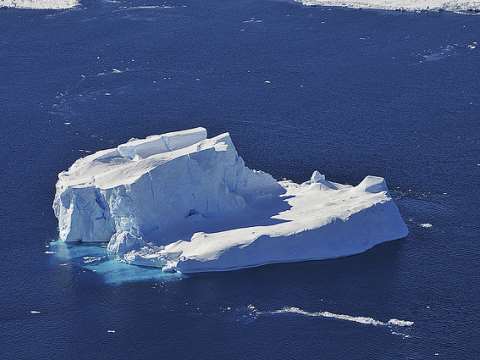
    Scientists know that if Antarctica’s ice sheets and glaciers collapse, sea levels could rise 5 metres. But the idea that it will take 200 years to happen is based on a linear model, writes Dady Cherry. In fact, the process is exponential – and could take place ‘within decades’.

    We conclude that this sector of West Antarctica is undergoing a marine ice sheet instability that will significantly contribute to sea level rise in decades to come.

    Imagine Antarctica. Imagine an island, with mountains, peaks, ridges, and valleys.

    Imagine further that a thick layer of ice covers, not only the surface of the island that lies above the sea but also an extensive portion of the perimeter that is beneath the sea.

    The peaks are higher above sea level than on any continent. In winter, the sea freezes because temperatures drop to less than -80 degrees Celsius (-112 degrees Farenheight), and the island’s area grows to about 10 million square miles.

    In summer when some of the ice melts, the ice cover remains on average more than a mile thick, although the overall surface area of the island shrinks to about 5 million square miles. Even in summer, however, the island is still larger than Europe or Australia. It is Antarctica, and it is impossible to imagine.

    When glaciers no longer rest on bedrock, they are doomed

    So let us instead consider an island that is a large glacier with a thick cover of ice that extends outward, well beyond its land area. The island is shaped roughly like an infinity symbol, with the right (east) side much larger than the left (west).

    The west side is really a peninsula and archipelago that share a common bedrock, but this is invisible because of the ice cover. What we can see is that even at the perimeter, where there is no land above sea level, there is ice. In some places, the ice reaches down, well beneath the water surface, all the way to the bedrock.

    This situation is unstable, because in principle, the mass of ice that is beneath the sea and in continuous contact with liquid water should eventually melt. When it does, this initially leaves an overhanging shelf of ice over the water at the island’s perimeter.

    Being less dense than water, this shelf will want to float up and, given enough time, will eventually break away from the more interior ice that is pinned to land above sea level. Indeed, about 40% of Antarctica’s perimeter consists of such ice shelves. In another 40% of the perimeter, the ice cover reaches all the way down to the bedrock.

    An uncomfortable equilibrium is coming to an end

    Island, ice and sea have coexisted for millennia in an uncomfortable equilibrium. In particular, the sea temperatures have not grown sufficiently warm to erode the ice edge irreversibly.

    Furthermore, the mass of ice on the surface has remained relatively constant, with the seasonal flows of water out to sea in the summer being replaced by deposits of ice in winter.

    The ice shelves have not thinned sufficiently to become so weak that they would snap and float away out to sea. This was all before the one-degree Celsius warming in the Earth’s surface since around 1980.

    Currently, the warmer seawater is eroding the island’s submerged perimeter of ice. Simultaneously, the warmer air is also melting the ice cover at such an accelerated rate that it cannot be entirely replaced in the winters.

    The process is irreversible

    As humans continue to pour more carbon dioxide (CO2) from burning of fossil fuels into the air and more methane (CH4) from operations such as fracking, the intensified greenhouse effect, and continued warming, will accelerate yet further the erosions of both the surface and edge of the island.

    Once both kinds of erosion become irreversible, meaning that no net ice is replaced, the ice mass will shrink and become more and more bare, in a process that will accelerate out of control until the ice appears suddenly to vanish.

    This is more or less the story that Eric Rignot and his colleagues reported about West Antarctica in a Geophysical Research Letters article that was accepted for publication on May 12, 2014.

    They used satellite-based radar interferometry to map the edges of a series of glaciers that drain into a large bay called the Amundsen Sea Embayment, and combined their data with the results of other kinds of surveys.

    Beating a rapid retreat

    They discovered that between 1992 and 2011:

    • Thwaites Glacier retreated 8.7 miles (14 km) at its core and zero to six miles (1 to 9 km) at its edges,
    • Haynes Glacier retreated 6 miles (10 km) at its edges,
    • Smith / Kohler Glacier retreated about 22 miles (35 km), and its ice shelf is barely pinned to the surface.
    • Pine Island Glacier retreated 19 miles (31 km) at its center and snapped and detached from the ground.

    All these retreats occurred mostly between 2005 to 2009. The authors note that they must have had a common cause and that the most reasonable explanation is the general warming of the ocean. They further explain that there is no natural land mass to prevent the movement of the massive glaciers out to sea. They conclude:

    “The retreat is proceeding along fast-flowing, accelerating sectors that are thinning, become bound to reach floatation and un-ground from the bed.

    “We find no major bed obstacle upstream of the 2011 grounding lines that would prevent further retreat of the grounding lines farther south.

    “We conclude that this sector of West Antarctica is undergoing a marine ice sheet instability that will significantly contribute to sea level rise in decades to come.”

    In other words, the disappearance of West Antarctic ice is well under way, and it is irreversible.

    The melting is exponential, not linear

    It is notable that this research was done under difficult circumstances. For example, the authors write that, since 2001, the ERS-2 satellite has operated without its gyroscopes, and “This made it difficult to control the antenna pointing … “.

    They further observe that “In July 2011, ERS-2 terminated its mission after 16 years of services, far exceeding its planned operational lifespan.”

    In addition, they make a point of acknowledging “two anonymous reviewers for their comments.” Possibly, the report was delayed, and some of its more frightening arguments had to be removed before publication.

    In a later publication for the general public, Rignot stressed that the estimate of 200 years for the Radmunsen sea collapse, which has been repeated again and again in the press, is based on the melting continuing at its current rate.

    This we know to be impossible because the melting is an exponential process that has been accelerating all the time and will continue to accelerate even more.

    How long before sea rise is catastrophic?

    The acceleration is driven, among other things, by an accelerated warming of the atmosphere and sea surface, continued expansion of the ozone hole, strengthening of currents that bring greater masses of warm waters from the tropics to Antarctica, weakening of the ice shelves due to accelerated melting of the surface ice, weakening of the attachment of the ice below sea level due to an accelerated erosion, and decreasing reflectivity of the Earth.

    With regard to climate change, again and again, exponential processes have been treated as if they would develop linearly, despite scientists knowing quite well that they would not. Consider for example, a storm that is approaching your house from six miles away.

    The storm is currently moving at five miles per hour, but it is expected to double its speed with every new mile. Do you make sure to have cover within one hour and 12 minutes, or within about 22 minutes?

    Again and again, scientists have done the equivalent of feigning surprise when their timelines, based on a completely bogus linearity, have turned out to be too long. Things have gone much too far for us to continue to play such numbers’ games.

    West Antarctic ice sheet could raise sea levels 5m ‘within decades’

    Rignot blames carbon emissions, which have tripled since the Kyoto Protocol, for the current state of affairs, and he categorically says that the collapse of the ice cover from “the Amundsen sea sector of West Antarctica [is] unstoppable, with major consequences – it will mean that sea levels will rise one metre [more than 3 feet] worldwide.

    “What’s more, its disappearance will likely trigger the collapse of the rest of the West Antarctic ice sheet, which comes with a sea level rise of between three and five metres [10 to more than 16 feet]. Such an event will displace millions of people worldwide.”

    The sea-level rise of 10 to 16 feet will come in decades, rather than 200 years. It will submerge essentially every port city in the world, including Guangzhou, Mumbai, Shanghai, Ho Chi Minh City, Kolkata, Osaka-Kobe, Alexandria, New York, New Orleans, Miami, and indeed all of South Florida.

    This will likely displace over 300 million people, many of them in countries that have equated development with movement of the majority of their populations to low-elevation coastal zones in port cities.

    What other impacts will follow?

    The displacement and homelessness from the changes in sea level might be the least of humanity’s problems.

    Being a geophysicist, Rignot does not address the possible effects of the changes in ocean salinity on sea life, but one can expect that such a huge influx of fresh water into the oceans will cause radical changes in the areas of high primary productivity (i.e. that feed those at the lowest levels in the food chain) and result in massive fish kills.

    Other changes of the oceans are likely to ensue, the details of which we cannot begin to imagine. One of these, for certain, will be a change in the ocean currents.

    The report on Antarctica by Rignot and colleagues has been characterized as a “holy shit” and “point of no return” moment for humanity.

    But it is a report on data that were collected years ago about a process that accelerates with each passing year. What does one call a holy-shit-point-of-no-return moment that happened three years ago?