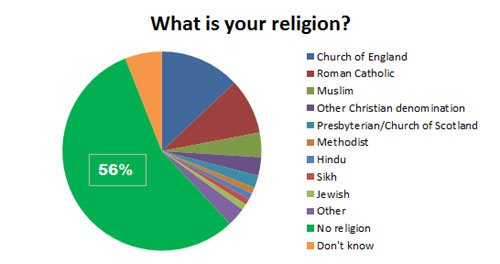
Christians are no longer in the majority in the UK
Controversy mounts around religion and identity in the 2016 Australian Census. Political parties, activists and religious leaders have robustly criticized the Australian Government for collecting the names and IP addresses of people who complete the Census online this year. The government insists this is simply to verify the accuracy of the data and the names and addresses will not be used for any other purpose. Other groups have expressed concern at the inclusion of a “no religion” category in the question about religion. Athiests have actively lobbied for the category to minimize the influence of right wing Christians. Hate speak groups have used the controversy to promote their misinformation campaigns.
Render therefore unto Caesar the things that are Caesar’s and unto God the things that are God’s. – Matthew 22:21
A blue-eyed Christ delivers his famous riposte to a Semitic Pharisee
As debate around the privileged position of the christian church in Australian society slowly grinds its way into the mainstream discourse, it becomes increasingly important to clarify the fundamental issues.
Those of us who believe firmly in the need for a secular state are often shouted down for being amoral, immoral, anti-religious or worse.
It is worth taking a little time to understand the distinction between secularism and atheism.
Justice Michael Kirby spoke about this often, noting that the two terms are often used interchangeably; not just in common usage but also in political and scholarly discourse. The most important part of the distinction is that atheism refers to the beliefs of an individual where as secularism refers to the political principle that the state should be separate from the church.
Pulling together the work of English liberal humanist philosophers Hume and Locke, Kirby puts it succinctly.
Secularism is a principle by which society and its lawmakers ensure that religion does not enter the public sphere in an active way. The object of these principles is not only to stop an excessive interference of religion in the lives of the people but to ensure that people of different faiths (and those of no religious faith) can co-exist peacefully.
Thus India is a society with a huge emphasis on secular government, not because the members of the government do not hold, or respect, religious beliefs but because the diversity of religious belief in India demands secularism. It demands that government define rules around how religions interact and that avoid one religious group interfering with the human rights of another.
The problem with most governments is that they are not truly secular.
One reason for this is that they pander to the majority of their citizens to ensure their popularity. This is as true in dictatorships as it is in democracies.
Another reason is that institutional religion is a handy tool for ensuring the compliance of the population. This may be used overtly, as it is in religious states such as Saudi Arabia, or more subtly as it is in the USA. The truth is that organised religion in is largely a tool of the state invented to harness faith and govern people without the requirement of forceful coercion. The divine right of kings is one expression of this, Emperor Constantine’s latter day conversion to Christianity is a classic example of cynical manipulation and appropriation of religious ritual to empower the state.
As a result of this legacy, a modern democracy such as Australia has a number of regulations and laws in Australia that cross this boundary and confuse the issue. Four examples:
Churches are exempt from paying tax because they provide a public good
Church agencies are actively involved and supported in providing welfare services
Church based educational organisations are actively funded
Commercial activity is banned on Good Friday and Christmas day
Parliament prays to a Christian God
Witnesses in court generally swear on a Christian bible
While atheists actively campaign against the inherent injustice in this favouritism, that does not mean that only atheists oppose the state support of a particular religion, or religious institutions in general.
Indeed, one would expect competing religions to be unhappy with state support of a particular religion, on the grounds of unfairness, if nothing else. The requirement for the state to be even-handed when it comes to dealing with citizens of different religions is the most easily understood requirement for secularism in government. The phrase “regardless of faith” or its equivalent is present in many declarations of rights from the Magna Carta, the US Constitution through to the UN declaration of Human Rights.
The handling of disputes between religions, though, is much more complicated and philosophically much more fundamental. Whether you are religious or not, it is patently obvious, that if religions have different and competing rules over some aspect of behaviour then an untractable dilemma emerges.
Either the differing religions acknowledge the other religion’s right to do things differently, or they go to war to enforce the will of one religion over the other. Secularism is an agreement by the citizens of a state to allow the government to set the rules such that war does not break out. What it effectively does is put the law of the land, above religious law.
This is where the confusion enters the debate. Religious fundamentalists argue that the state has no right to limit any group’s beliefs on the basis that the law of God is above the laws of humanity. Religious moderates accept that the outcome of such fundamentalism is endless hostility and that tolerance involves compromise.
In terms of juggling the tension between fundamentalism and moderation, atheism is just one more belief system. The anti-theists who actively attack religion as a set of false beliefs do just as much to destroy harmonious governance of religious morality as any fundamentalist preacher.
For the sake of clarity, it is critically important that we get the anti-theism out of the advocacy for secular government so we can build the broadest and strongest coalition possible.
The aim of that coalition must be to reclaim the billions in lost tax that we squander on empowering and enriching religions. To achieve that believers and non-believers will have to work together to create a truly secular state that respects one’s right to be religious or not, to follow any god, or cultural practice that does not contravene the laws of the land. It should arguably be a secondary aim of that project to get the religious institutions out of the delivery of welfare and education services, with the possible exception of ministering to their own congregations.
Inherent in the broader project is the requirement to change those laws and regulations that are implicitly or explicitly religious. It does not imply that the laws should undermine the realm of the spirit or pit scientific evidence against faith. Those belong in a different realm and deserve their own discussion.
Why pay billions of taxpayer dollars to christian welfare groups when they have been exposed as Criminal Gangs. Not only has the Royal Commission into Abuse Sexual identified the repeat offending of those organisations, it has shown that they closed ranks to protect their members in an organised manner, abusing their political influence to avoid prosecution. These gangs can no longer be allowed to provide welfare services.
The evidence thrown up at the commission is more than enough to justify kicking a large proportion of the so called christian operators of schools, orphanages and other institutions for ever. We must curtail the power they have abused by taking welfare out of their hands and putting it in the hands of the community. Right now, the opposite is happening. The community sector is being starved of funds and the money is being poured into the churches.
This argument is not anti-theism.
For a start, my targets are the institutions not the faithful. It is the institutions that have the money and the power to hire managers and staff of the organisations that house the homeless, protect the vulnerable and feed and clothe the poor.
Second, my charge is not that religious institutions have no place in welfare. That place, though, should be limited to the wishes of its members and their capacity to fund those wishes. To put the church in charge of taxpayer funded programs of government is to grant them inappropriate privilege. To do that at a time when they have failed their flock so criminally is simply insane.
Third, I am not arguing that organisations should be denied funding on the basis of their belief patterns. That would be discrimination of the worst kind. It is appropriately discriminating, however, to conclude that legally incorporated bodies that have repeatedly broken the law and used their institutional power to avoid prosecution are inappropriate bodies to receive public funding to deliver public services.
I am not claiming that religion is evil. Indeed, greed and lust for power is not the exclusive province the christian church. Private operators in the welfare sector have been notorious since Dickens penned Oliver Twist. The religions institutions who have now been exposed as harbouring the most heinous criminals while also being largely responsible for the welfare sector in Australia for a very long time reflect the make-up of society at the time. Had the penal colony been founded by Zoroastrian imperialists, I am sure they would have gone through a similar bout of cruelty.
Our problem is not the religiosity of these institutions it is that they are being handed ever more money and power as the ideological drive to get rid of the public service pushes more and more victims into their care.
Ponder this as you next take up your burden. May righteous anger leaven your pain.