Author: admin

  • Forest mortality and climate change: The big picture

    Forest mortality and climate change: The big picture

    Posted: 09 Sep 2012 12:04 PM PDT

    Over the past two decades, extensive forest death triggered by hot and dry climatic conditions has been documented on every continent except Antarctica. Forest mortality due to drought and heat stress is expected to increase due to climate change. Although research has focused on isolated incidents of forest mortality, little is known about the potential effects of widespread forest die-offs.
    You are subscribed to email updates from ScienceDaily: Severe Weather News
    To stop receiving these emails, you may unsubscribe now.
    Email delivery powered by Google
    Google Inc., 20 West Kinzie, Chicago IL USA 60610
  • How Population, Energy Supply, and the Economy Depend on Each Other

    How Population, Energy Supply, and the Economy Depend on Each Other
    OilPrice.com
    Population growth rate prior to the year 1 C. E. based on McEvedy & Jones, “Atlas of World Population History”, 1978; later population as well as GDP based on Angus Madison estimates; energy growth estimates are based on estimates by Vaclav Smil in
    See all stories on this topic »

  • Mysterious Changes in Ocean Salt Spur NASA Expedition

    Mysterious Changes in Ocean Salt Spur NASA Expedition
    LiveScience.com
    Many oceanographers have a hunch about what is going on: Climate change, Ray Schmitt, a senior scientist at the Woods Hole Oceanographic Institution, told journalists during a news conference Wednesday (Sept. 5). “Climate is changing all the time, and
    See all stories on this topic »
    Ocean Institute to Present Surfscience Teen Conference
    Dana Point Times
    Teens will have the opportunity to meet researchers and students of Scripps Institution of Oceanography in San Diego, test oceanographic equipment used in surf zone experiments, explore the Hydraulics Lab and learn about ongoing research projects and
    See all stories on this topic »


    Tip: Use a minus sign (-) in front of terms in your query that you want to exclude. Learn more.

    Delete this alert.
    Create another alert.
    Manage your alerts.

  • Caught in the cross fire of futility and cant

    Caught in the cross fire of futility and cant

    Mike Carlton :

    THE scene is now all too familiar. There is the coffin draped in the Australian flag and topped by a slouch hat and medals, borne from the aircraft by solemn young men in khaki.

    A chaplain in vestments and a lone piper walk before it, past the saluting colonels and captains. Somewhere in the background there are grandparents struggling to hold it together for the sake of a grieving widow and her stricken, bewildered children.

    The rest of us watch this on television for our one minute, 45 seconds of couch compassion and then get on with the really important news: the Roosters have sacked their coach, a celebrity chef has lost a Good Food Guide hat, and halfwits have trolled a TV star on Twitter.

    When are we going to cry out that enough is enough? When are we going to rise up to demand that not one more husband, father, brother, mate, should die in this bloody, treacherous and futile war in Afghanistan?

    When will we, the Australian people, shout with one voice that the war is lost and it’s time to bring our soldiers home, not in 2014 but now. I have seen too much of this in my lifetime. In World War II we fought for a noble cause, the defeat of German Nazism, Italian Fascism and Japanese militarism.

    Since then, from Korea to Afghanistan via Vietnam and Iraq, we have become enmeshed in failed conflicts fomented in folly and ignorance, and buttressed by the lies and deceit of politicians, generals and, yes, the media.

    Korea, the so-called forgotten war, was to stop the march of godless communism.

    It ended with 340 Australian dead, although not in a permanent peace but an armistice in which great armies still confront each other.

    Vietnam, you will remember, was justified by the domino theory, which held that if South Vietnam fell the rest of south-east Asia would topple to communism as well, all the way to Indonesia. Better to stop them there than here, was the cry.

    We lost 521 men killed for that lie.

    In Iraq, it was to wipe out al-Qaeda and to seize Saddam Hussein’s weapons of mass destruction. It would be a “cakewalk”; the US Marines would be garlanded with flowers in the streets of Baghdad, “greeted like liberators”, we were told. Australia’s chief contribution to that war was to pump $221.7 million into Saddam’s bank account for “transportation costs” in the still-unpunished Australian Wheat Board scandal.

    Afghanistan was to go after al-Qaeda yet again. When Osama bin Laden was caught not there but, magically, a stone’s throw down the road from the Pakistan Military Academy, the war somehow morphed into a fight against the Taliban, a murderous bunch of Islamic fanatics to be sure, but of no conceivable security threat to Australia. So far it’s 38 Australians killed and counting – dying not for their country, as our mealy-mouthed leaders would have us believe, but in defence of the venal and thuggish Karzai regime.

    The cant and the hypocrisy keep coming. We are there to get the job done, to see the mission through. But we learn nothing from history. When we eventually quit Afghanistan, as the British did in the 19th century and the Soviet Union in the 20th, the place will revert to what it always was , a violent wasteland of warlords growing opium poppies. What fools we are.

    IT’S not only the dead. It’s the wounded, too, the hundreds if not thousands of men who carry the physical and mental scars of battle for life.

    At Christmas 1966 I was an ABC war correspondent in Vietnam, tape-recording greetings from our Diggers to be broadcast to their families on their hometown radio stations.

    There was one bloke lying in an American military hospital outside Saigon. Drips and drains trailed from the bed covers tented over him and he was groggy from the painkillers, but he was glad to hear an Australian accent among all the Yanks and he managed to mumble a cheerful greeting to mum and dad and his little sister somewhere in the Riverina. Don’t you worry, getting better, be home soon.

    When I left his room I asked a nurse what had happened to him. “His balls were blown off by a landmine,” she said. “But he doesn’t know it yet.”

    I saw worse in that war. Corpses fried by napalm; a village well in Cambodia filled with a reeking stew of human remains; dying soldiers crying out for their mothers, as dying soldiers do. But I am haunted today by the memory of that young man because he was my own age, just 20, and I have wondered ever since what happened to him. Perhaps he made it OK. Perhaps he committed suicide like so many of his fellow Vietnam vets. I do not know.

    We treat our wounded veterans differently these days. They and their families are better cared for. But the terrible toll accumulates still, hidden from our sight and our minds. In a couple of weeks, one of our former commanders in Afghanistan, retired Major-General John Cantwell, will publish a book of his memoirs, Exit Wounds.

    I’ve seen an advance copy. Read it and weep.

  • Big shortfall tipped for NSW transport

    Big shortfall tipped for NSW transport

    AAPSeptember 10, 2012, 9:53 am

    NSW Transport Minister Gladys Berejiklian has brushed aside reports of a $74 billion shortfall for the state’s new transport master plan.

    Leaked cabinet documents show the cost of the plan is now $137 billion, which includes the $74 billion shortfall, News Ltd reported on Monday.

    It said the document was a cost plan presentation for the masterplan marked “cabinet-in-confidence” and also tipped that road users face paying at least $22 billion in tolls over 20 years.

    Ms Berejiklian said on Monday she had not seen the document and did not know what it was referring to.

    “We’re a government that delivers what we announce,” she told Macquarie Radio.

    “When we announced the Transport Master Plan last week, we backed it up, we demonstrated the projects’ funding that we have in the next three or four years.”

    The document recommends deferring a second harbour crossing until at least 2023.

  • Why business is locked into unsustainable and carbon-heavy cycles

    Why business is locked into unsustainable and carbon-heavy cycles

    Worldwide cynicism about official inaction over sustainability was hardly surprising, but capitalism locks us all into a system that feeds our carbon-hungry lives

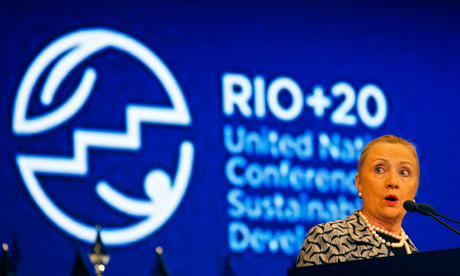
    US Secretary of State Hillary Clinton at Rio+20

    Hillary Clinton at Rio+20. The world has become very cynical about what such conferences can achieve. Photograph: Paulo Whitaker/Reuters

    After disappointing results in Copenhagen (2010) and Durban (2011), the world awaited Rio+20 with far less anticipation than we had for the Euro 2012 semi-finals, the successful crossing of Niagara Falls by Nik Wallenda, or the return of lunch blogger Martha Payne. Sustainable business, like all other business, has been riveted by the electoral politics of Greece and France and the more or less fictional pronouncements of G20 finance ministers. It was never likely that Rio+20 would change anything.

    We know that the international discourse about sustainability will not reverse decades of inaction, that governments will not likely guide us from economic and environmental disaster into a new world order of hope and quality of life. Our deep cynicism is well founded; we have seen too many pronouncements fail.

    Yet there is no human who does not prefer to live in hope. No business wants to discount its calculations of the net present value of future income streams by the absence of a future. No political leader wants to see the local impact of economic and environmental decline.

    How is it that time and again we are unable to achieve what so many of us want? Why can we not achieve an agenda which is likely the only way forward into prosperity?

    At the recent conference of the International Society of New Institutional Economists, Shi-Ling Hsu presented a paper looking at why we cannot get the answer right. In Physical, Human, and Social Capital as Barriers to Environmental Policy Change, he theorises that “environmentally harmful products and practices persist because firms and people have so much invested in their persistence”. We lock in unsustainable technologies and ways of life because capital is too expensive to write off without threatening the viability of a firm or a consumer. Oil companies and coal mine operators cannot afford to lose the value of their investments. State-owned enterprises are no less dependent on the value of carbon deposits than are for-profit companies.

    Fishing villages and logging towns around the world want to maintain their livelihoods which depend on the extraction of decreasingly available stocks. Families who are making large mortgage and loan payments on suburban homes and cars are not easily convinced to leave their commitments and reinvest in housing and transport with a smaller carbon footprint.

    Hsu suggests that we are locked into our carbon-hungry lives and our extractive livelihoods by specific and pervasive public policies which favour the creation and stability of capital. Grandfathering the use of old technology allows firms and their customers to get by with processes and equipment which are far worse than their replacements. Tax credits for extractive industries slow the movement of our economies into more sustainable industries. Capital gains taxes provide incentives to retain capital long past its “best before date” to avoid triggering tax penalties.

    Too often firms must retain their holdings in assets that unnecessarily deplete natural resources or burn carbon in order to maintain healthy balance sheets. They cannot easily invest in new capital when governments allow them generous tax concessions on outdated technology.

    We can better align incentives so that business will move out of the status quo and into more sustainable methods. Governments need not continue to support and subsidise outdated industries and processes. Instead, they might identify “environmentally-stranded capital” and let it be written down to zero over a relatively short period of time – if it is taken out of operation forever. If we really want companies to change, we must demand accelerated write-off schedules for investments in coal mines and trawlers.

    One way forward is through better accounting standards. GDP+, the UK environment minister’s proposal to enter natural resources into a national chart of accounts, had the potential to resolve some of the tension between the desire of business to innovate and capital policies which lock us into old technology. When a nation assigns a value to its natural resources, it may be more likely to drop incentives which encourage resource depletion. Nick Clegg took the proposal to Rio. After appeals by Clegg and Joseph Stiglitz, the final text of the conference recognised the need for “broader measures of progress to complement GDP”. It referred the problem to the UN Statistical Commission.

    Until our various legislators and regulators reconsider their capital-related policies, we will have fewer financial incentives than we need. Until we stop being rewarded for maintaining old equipment, investments and industries, we have little reason to reinvest or to favour the substantive change which Rio+20 might have brought. Without fixing financial regulations and accounting schemes, we cannot easily fix the earth.

    Alison Kemper teaches management at York University and has worked with the Michael Lee-Chin Institute for Corporate Citizenship at the Rotman School since 2005. Her professional background is in advocacy and NGO management.

    Roger Martin is dean of the University of Toronto’s Rotman School of Management and is academic director of the school’s Michael Lee-Chin Family Institute for Corporate Citizenship. His research work is in integrative thinking, business design, corporate social responsibility and country competitiveness. His most recent book is Fixing the Game.

    This content is brought to you by Guardian Professional. Become a GSB member to get more stories like this direct to your inbox