Alert Name: CLIMATE CHANGE NEWS
August 12, 2012 Compiled: 1:26 AM
August 12, 2012 Compiled: 1:26 AM
By JEFF HIMMELMAN (NYT)
The future of solar belongs to whoever can convince consumers that it’s not just for tree-huggers and rich people.
By JEFF HIMMELMAN (NYT)
The future of solar belongs to whoever can convince consumers that it’s not just for tree-huggers and rich people.
Australia faces serious trouble from climate change unless our politicians can reach consensus on the issue and lead the global fight to reduce emissions, the new CEO of Greenpeace says.
David Ritter has urged Opposition Leader Tony Abbott to rethink his promise to repeal the carbon tax if he becomes prime minister, and says Australia must follow its tradition of punching above its weight when it comes to finding solutions to climate change.
Tackling climate change must also involve Australia exerting diplomatic pressure on other nations, he says.
Perth-born Mr Ritter has returned to Australia after five years working for Greenpeace in the UK, to take up the position as CEO of Greenpeace Australia Pacific.
The former commercial lawyer first developed a passion for native title issues before turning his focus to the environment.
In London, he worked for Greenpeace on global campaigns on oceans, rainforests and climate change.
There the tone of debate on climate change is “very, very different”, with a push for action from all major political parties, he says.
As leader of the opposition, now British Prime Minister David Cameron once launched a policy from the Greenpeace warehouse.
Mr Ritter is urging Mr Abbott to follow the UK Conservatives’ bipartisan approach and not repeal the carbon tax.
“Obviously I hope whoever leads the Liberal Party, whether it is Abbott or anyone else, if they do succeed in becoming prime minster I obviously hope they don’t repeal the carbon tax,” he told AAP.
“I know that statements have been made to that effect, but you would like to hope that a different view would be taken in government.”
Instead, Mr Ritter hopes Australia can be a leader in the global response to climate change.
“I’d like to see an Australia which takes an ambitious view on climate change, not only in terms of targets but in terms of things that people feel much more tangibly,” he said.
“I would like to see an Australia that took on foreign policy initiatives that were about saying `Look, if climate change is not halted, is not tackled effectively, Australia is in really serious trouble.’
As Greenpeace CEO, Mr Ritter hopes to continue to do as he did in the UK and work with big companies on environmental issues.
During his time in London he built working relationships with retail giants Marks and Spencer and Sainsbury’s.
“You can’t expect people to act outside of their role,” he said.
“People who work within companies will always have to put the company first. But there’s an awful lot of room to look for solutions and to look for where we can make progress.
“I see the role of Greenpeace as tapping into the extraordinary energy, emotion and willingness and goodwill that exists among people to really get moving and change things.”
|
 |
Click here to Reply, Reply to all, or Forward
|
New satellite images show polar ice coverage dwindling in extent and thickness
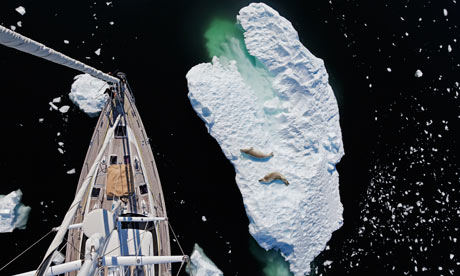
Sea ice in the Arctic is disappearing at a far greater rate than previously expected, according to data from the first purpose-built satellite launched to study the thickness of the Earth’s polar caps.
Preliminary results from the European Space Agency‘s CryoSat-2 probe indicate that 900 cubic kilometres of summer sea ice has disappeared from the Arctic ocean over the past year.
This rate of loss is 50% higher than most scenarios outlined by polar scientists and suggests that global warming, triggered by rising greenhouse gas emissions, is beginning to have a major impact on the region. In a few years the Arctic ocean could be free of ice in summer, triggering a rush to exploit its fish stocks, oil, minerals and sea routes.
Using instruments on earlier satellites, scientists could see that the area covered by summer sea ice in the Arctic has been dwindling rapidly. But the new measurements indicate that this ice has been thinning dramatically at the same time. For example, in regions north of Canada and Greenland, where ice thickness regularly stayed at around five to six metres in summer a decade ago, levels have dropped to one to three metres.
“Preliminary analysis of our data indicates that the rate of loss of sea ice volume in summer in the Arctic may be far larger than we had previously suspected,” said Dr Seymour Laxon, of the Centre for Polar Observation and Modelling at University College London (UCL), where CryoSat-2 data is being analysed. “Very soon we may experience the iconic moment when, one day in the summer, we look at satellite images and see no sea ice coverage in the Arctic, just open water.”
The consequences of losing the Arctic’s ice coverage, even for only part of the year, could be profound. Without the cap’s white brilliance to reflect sunlight back into space, the region will heat up even more than at present. As a result, ocean temperatures will rise and methane deposits on the ocean floor could melt, evaporate and bubble into the atmosphere. Scientists have recently reported evidence that methane plumes are now appearing in many areas. Methane is a particularly powerful greenhouse gas and rising levels of it in the atmosphere are only likely to accelerate global warming. And with the disappearance of sea ice around the shores of Greenland, its glaciers could melt faster and raise sea levels even more rapidly than at present.
Professor Chris Rapley of UCL said: “With the temperature gradient between the Arctic and equator dropping, as is happening now, it is also possible that the jet stream in the upper atmosphere could become more unstable. That could mean increasing volatility in weather in lower latitudes, similar to that experienced this year.”
CryoSat-2 is the world’s first satellite to be built specifically to study sea-ice thickness and was launched on a Dniepr rocket from Baikonur cosmodrome, Kazakhstan, on 8 April, 2010. Previous Earth monitoring satellites had mapped the extent of sea-ice coverage in the Arctic. However, the thickness of that ice proved more difficult to measure.
The US probe ICESat made some important measurements of ice thickness but operated intermittently in only a few regions before it stopped working completely in 2009. CryoSat was designed specifically to tackle the issue of ice thickness, both in the Arctic and the Antarctic. It was fitted with radar that can see through clouds. (ICESat’s lasers could not penetrate clouds.) CryoSat’s orbit was also designed to give better coverage of the Arctic sea.
“Before CryoSat, we could see summer ice coverage was dropping markedly in the Arctic,” said Rapley. “But we only had glimpses of what was happening to ice thickness. Obviously if it was dropping as well, the loss of summer ice was even more significant. We needed to know what was happening – and now CryoSat has given us the answer. It has shown that the Arctic sea cap is not only shrinking in area but is also thinning dramatically.”
Sea-ice cover in the Arctic varies considerably throughout the year, reaching a maximum in March. By combining earlier results from ICESat and data from other studies, including measurements made by submarines travelling under the polar ice cap, Laxon said preliminary analysis now gave a clear indication of Arctic sea-ice loss over the past eight years, both in winter and in summer.
In winter 2004, the volume of sea ice in the central Arctic was approximately 17,000 cubic kilometres. This winter it was 14,000, according to CryoSat.
However, the summer figures provide the real shock. In 2004 there was about 13,000 cubic kilometres of sea ice in the Arctic. In 2012, there is 7,000 cubic kilometres, almost half the figure eight years ago. If the current annual loss of around 900 cubic kilometres continues, summer ice coverage could disappear in about a decade in the Arctic.
However, Laxon urged caution, saying: “First, this is based on preliminary studies of CryoSat figures, so we should take care before rushing to conclusions. In addition, the current rate of ice volume decline could change.” Nevertheless, experts say computer models indicate rates of ice volume decline are only likely to increase over the next decade.
As to the accuracy of the measurements made by CryoSat, these have been calibrated by comparing them to measurements made on the ice surface by scientists including Laxon; by planes flying beneath the satellite’s orbit; and by data supplied by underwater sonar stations that have analysed ice thickness at selected places in the Arctic. “We can now say with confidence that CryoSat’s maps of ice thickness are correct to within 10cm,” Laxon added.
Laxon also pointed out that the rate of ice loss in winter was much slower than that in summer. “That suggests that, as winter starts, ice is growing more rapidly than it did in the past and that this effect is compensating, partially, for the loss of summer ice.” Overall, the trend for ice coverage in Arctic is definitely downwards, particularly in summer, however – a point recently backed by Professor Peter Wadham, who this year used aircraft and submarine surveys of ice sheets to make estimates of ice volume loss. These also suggest major reductions in the volume of summer sea ice, around 70% over the past 30 years.
“The Arctic is particularly vulnerable to the impact of global warming,” said Rapley. “Temperatures there are rising far faster than they are at the equator. Hence the shrinking of sea-ice coverage we have observed. It is telling us that something highly significant is happening to Earth. The weather systems of the planet are interconnected so what happens in the high latitudes affects us all.”
Two earthquakes strike northwest Iran killing more than 150 people and flattening four villages.
TEHRAN: Rescuers in northwest Iran are striving to dig survivors from the rubble of twin earthquakes that have levelled villages and killed at least 180 people and injured 1300 others.
The scale of the disaster is still emerging with emergency teams in the devastated zone northeast of the city of Tabriz pushing through the night after the Saturday quakes.
With telephone communications interrupted, officials say they’re relying on radios and travelling in person to hard-hit villages to assess and rescue.

Victims are tended in a hospital courtyard after an earthquake hit the city of Ahar, northwestern Iran. Photo: AP
The quakes, which struck within 11 minutes of each other, measured 6.2 and 6.0 on the moment magnitude scale, according to Tehran University’s Seismological Centre.
The US Geological Survey, which monitors seismic activity worldwide, ranked them as more powerful than that, at 6.4 and 6.3, respectively.
“Unfortunately, the toll is mounting and we are now at 180 dead and some 1300 injured,” Khalil Saie, the head of the regional natural disasters centre, told state television on Sunday morning.

Rubble in the city of Varzaqan, northwestern Iran, after the huge quake. Photo: AP
“Up to now, there are no deaths reported in the cities and all the victims come from rural areas,” he said.
Earlier he told the television: “We are asking people to not panic. Help is arriving and rescuers are already at the scene.”
President Mahmoud Ahmadinejad’s office has posted a statement on its website expressing condolences to those in the disaster zone and calling on authorities to “mobilise all efforts to help the affected populations”.

Residents spend the night outside their homes after an earthquake struck the city of Varzaqan. Photo: AP
An emergency services official said 66 rescue teams were at work, using 40 devices and seven dog squads to detect buried survivors. He said 185 ambulances had been sent to the area.
Those hurt were taken to hospitals in Tabriz and Ardebil, the two biggest nearby cities, both of which escaped relatively unscathed by the temblors.
Villages outlying the towns of Ahar and Varzaqan, 60 kilometres from Tabriz, were decimated, being closest to the epicentres of the two quakes.
Dwellings close to Heris, another town close by, were also badly shaken.
Residents in the region were terrified as their homes shook around them when the quakes hit and they fled into the streets for safety, according to reports.
Tehran University Seismological Centre said the first earthquake happened at 4:53 pm (2223 AEST) with an epicentre just 60 kilometres from Tabriz, close to Ahar, and at a depth of 10 kilometres.
The second – actually a big aftershock – rumbled through from nearly the same spot. A series of more than 17 smaller aftershocks rating 4.7 or less rapidly followed.
The disaster zone is located around 90 kilometres from the borders with Armenia and Azerbaijan and around 190 kilometres from the border with Turkey.
Iran sits astride several major fault lines and is prone to frequent earthquakes, some of which have been devastating.
The deadliest was a 6.6-magnitude quake which struck the southern city of Bam in December 2003, killing 31,000 people.
AFP
Overpopulation is everyone’s problem
Los Angeles Times
Nations also tend to view population growth within their borders as a force for their own economic well-being; ever-larger numbers of younger people mean enough workers to build up businesses and help support retirees. This view is shortsighted …
See all stories on this topic »
 Email
Email


