Unusual weather events identified during 2009 Black Saturday bushfires in Victoria, Australia
Posted: 08 Aug 2012 07:45 AM PDT
Unusual weather events identified during 2009 Black Saturday bushfires in Victoria, Australia
Posted: 08 Aug 2012 07:45 AM PDT
With US politics paralysed by the partisan divide on climate change, public concern about extreme weather cannot bear fruit

As the US faces record drought and an Old Testament-level pestilential heatwave in the midwest, American environmental denialism may be starting to change. The question is: is it too late?
America has led the world in climate change denial, a phenomenon noted with amazement by Europeans, not to mention thinking people around the world. Year after year, the US has failed to sign global treaties or curb emissions, even as our status as a source of a third of the world’s carbon emissions goes unchanged.
It is fairly well-known what has been behind that climate change denial in America: vast sums pumped into an ignorance industry by the oil and gas lobbies. Entire thinktanks to obfuscate manmade climate change have been funded by these interests, as have individual congressmen and women. Entirely typical, for instance, is Louisiana Representative John Fleming, whose campaigns, according to blogger John Henry, accept about $200,000 a year from oil and gas lobbyists, and who uses his social media pages to deny global warming.
It is weird to live inside that US denial about climate change. Last year, for example, as tropical storm Irene approached New York, we duly boarded up windows, put in emergency supplies, and heard endless alarming bulletins from the mayor’s office about which neighborhoods were likely to be submerged if the tides surged – without ever hearing from local officials or the media a word connecting rising sea levels with manmade global warming. All the more weird because New Yorkers weren’t writing off portions of their downtown neighborhoods to overflowing seawater a century ago.
It is weird, too, to watch the leaves turn red earlier and earlier in the fall in the American northeast and have absolutely everyone say, “the weather is strange” – yet never see mainstream media reflect any interest in the connection between human industrial activity and that strangeness. And this weather map shows how widespread and extensive that extreme weather is in the US.
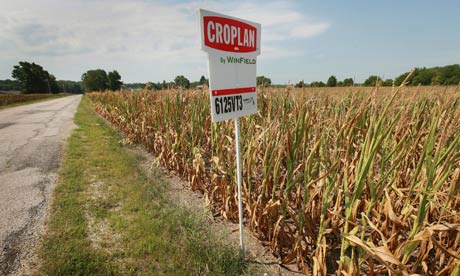
But could our denial be cracking, this summer, as, in the heartland – that most iconic of American landscapes – broiling temperatures injure humans and cook fish in the water? This summer a crisis has occurred (though one that, again, is seldom reported on in terms of our outsize contribution to the disaster), as midwestern farmers lost vast swaths of their corn crop to scalding heat and drought. In the American unconscious of wishful ignorance, this disaster and loss was to be borne, as usual, by other people far away.
But we face some serious problems in rising out of our torpor. In “Shifting Public Opinion on Climate Change: An Empirical Assessment of Factors Influencing Concern over Climate Change in the US, 2002–2010”, John Wihbey shows that Gallup surveys reveal Americans’ level of concern varying widely:
“In 2004, 26% of respondents said they worried “a great deal” about the issue; in 2007 that number rose to 41%; by 2010, it had fallen to 28%. This variation comes despite consensus among scientists about the underlying data patterns and virtual unanimity of scientific opinion.”
Wihbey and colleagues’ study found that this fluctuation was caused by, among other factors, political polarization. In other words, when one party says global warming is a crisis and the other says all that is nonsense, and there is no cooperation between political elites at both ends of the spectrum, the net result is apathy.
“The two strongest effects on public concern are Democratic congressional action statements and Republican roll-call votes, which increase and diminish public concern, respectively. This finding points to the effect of [a] polarized political elite that is emitting contrary cues, with resulting (seemingly) contrary levels of public concern.”
They found, ominously, that the level and quality of good information in the general media at large had little effect on people’s levels of concern – indeed, weather events themselves had little bearing on people’s levels of climate-related anxiety or interest. Only the combination of media coverage and expressed alarm from political leaders bumped up public concern.
With the oil and gas lobbies pumping money into Congress to blunt any professed concern among the political class, that motivating union of genuine concern and honest messaging can scarcely be relied on. The authors conclude, dispiritedly:
“Given the vested economic interests reflected in this polarization, it seems doubtful that any communication process focused on persuading individuals will have much impact.”
I spent part of this summer looking at glaciers in Alaska; in Juneau, in Tongass National Forest, park rangers expect that a glacier there will withdraw, from effects of anticipated climate change, in 50 years. So, the federal government is planning for the effects of manmade climate change, even as the White House and US Congress remain paralysed from doing anything to arrest the warming: the very definition of denial. If we don’t snap out of this stasis of stupidity, nothing can change for good.
Almost six weeks after the controversial carbon tax was introduced, few businesses have done anything to integrate its real or potential impact into their long-term strategies.
A survey from the international freight company DHL shows 90 per cent of businesses have put the carbon price into the ‘too hard basket’, put off by the lack of detail from the government.
The annual export barometer from DHL spoke to 785 companies – ranging from small home businesses through to large corporations.
Seven out of 10 had a familiar complaint – that the $23 per tonne carbon price is too high – with three in 10 worried the impact would hurt their exports.
But one result stands out.
Despite the profile of the carbon tax debate in the lead up to July 1, just one in every 10 companies has bothered to make it part of their business plan.
DHL senior vice-president Gary Edstein says the survey detected more than just a little carbon apathy.
“Most of them said that there should be some government intervention or regulation when it came to the carbon tax but it seems that most of the respondents haven’t planned or they obviously haven’t increased the cost of their products or the price of their products,” Mr Edstein said.
More education
“I think the government can do a lot more education in making the exporters more aware of the impact of the carbon tax.”
Economist Tim Harcourt, formerly of Austrade and now at the University of New South Wales, says businesses have badly underestimated the importance of having a carbon plan.
“I was surprised because they were ready for a higher dollar, they were ready for various legislative changes, but on the biggest political issue of the day, it hadn’t sunk in on an operational level,” Mr Harcourt said.
“I think a lot of companies have thought, ‘Well, it is about consumers, it’s about electricity prices,’ but they haven’t realised that it could actually affect their business operations.
“Having said that, most were supportive of action to do with climate change. This idea of growing more trees was not appealing to them at all.”
Business are also worried about the high Australian dollar, which broke through 106 US cents earlier this week.
Companies say that factor is continuing to put pressure on their ability to compete, with manufacturing and agriculture taking the brunt.
While the carbon price and the dollar remain critical, the survey says exporters think profits will increase over the next year with Indonesia joining China and New Zealand as
|
|
0% full
Using 0 GB of your 10 GB
©2012 Google – Terms & Privacy
Last account activity: 9 hours ago
Details |
|
|
|||||||||||||||||||||||
Pollution is poisoning the farms and villages of the region that processes the precious minerals
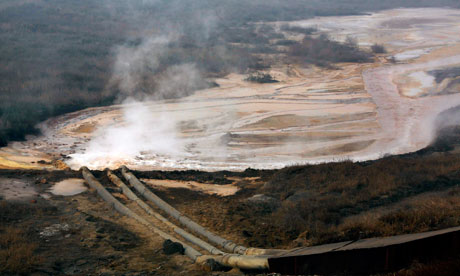
From the air it looks like a huge lake, fed by many tributaries, but on the ground it turns out to be a murky expanse of water, in which no fish or algae can survive. The shore is coated with a black crust, so thick you can walk on it. Into this huge, 10 sq km tailings pond nearby factories discharge water loaded with chemicals used to process the 17 most sought after minerals in the world, collectively known as rare earths.
The town of Baotou, in Inner Mongolia, is the largest Chinese source of these strategic elements, essential to advanced technology, from smartphones to GPS receivers, but also to wind farms and, above all, electric cars. The minerals are mined at Bayan Obo, 120km farther north, then brought to Baotou for processing.
The concentration of rare earths in the ore is very low, so they must be separated and purified, using hydro-metallurgical techniques and acid baths. China accounts for 97% of global output of these precious substances, with two-thirds produced in Baotou.
The foul waters of the tailings pond contain all sorts of toxic chemicals, but also radioactive elements such as thorium which, if ingested, cause cancers of the pancreas and lungs, and leukaemia. “Before the factories were built, there were just fields here as far as the eye can see. In the place of this radioactive sludge, there were watermelons, aubergines and tomatoes,” says Li Guirong with a sigh.
It was in 1958 – when he was 10 – that a state-owned concern, the Baotou Iron and Steel company (Baogang), started producing rare-earth minerals. The lake appeared at that time. “To begin with we didn’t notice the pollution it was causing. How could we have known?” As secretary general of the local branch of the Communist party, he is one of the few residents who dares to speak out.
Towards the end of the 1980s, Li explains, crops in nearby villages started to fail: “Plants grew badly. They would flower all right, but sometimes there was no fruit or they were small or smelt awful.” Ten years later the villagers had to accept that vegetables simply would not grow any longer. In the village of Xinguang Sancun – much as in all those near the Baotou factories – farmers let some fields run wild and stopped planting anything but wheat and corn.
A study by the municipal environmental protection agency showed that rare-earth minerals were the source of their problems. The minerals themselves caused pollution, but also the dozens of new factories that had sprung up around the processing facilities and a fossil-fuel power station feeding Baotou’s new industrial fabric. Residents of what was now known as the “rare-earth capital of the world” were inhaling solvent vapour, particularly sulphuric acid, as well as coal dust, clearly visible in the air between houses.
Now the soil and groundwater are saturated with toxic substances. Five years ago Li had to get rid of his sick pigs, the last survivors of a collection of cows, horses, chickens and goats, killed off by the toxins.
The farmers have moved away. Most of the small brick houses in Xinguang Sancun, huddling close to one another, are going to rack and ruin. In just 10 years the population has dropped from 2,000 to 300 people.
Lu Yongqing, 56, was one of the first to go. “I couldn’t feed my family any longer,” he says. He tried his luck at Baotou, working as a mason, then carrying bricks in a factory, finally resorting to selling vegetables at local markets, with odd jobs on the side. Registered as farmers in their identity papers, the refugees from Xinguang Sancun are treated as second-class citizens and mercilessly exploited.
The farmers who have stayed on tend to gather near the mahjong hall. “I have aching legs, like many of the villagers. There’s a lot of diabetes, osteoporosis and chest problems. All the families are affected by illness,” says He Guixiang, 60. “I’ve been knocking on government doors for nearly 20 years,” she says. “To begin with I’d go every day, except Sundays.”
By maintaining the pressure, the villagers have obtained the promise of financial compensation, as yet only partly fulfilled. There has been talk of new housing, too. Neatly arranged tower blocks have gone up a few kilometres west of their homes. They were funded by compensation paid by Baogang to the local government.
But the buildings stand empty. The government is demanding that the villagers buy the right to occupy their flat, but they will not be able to pass it on to their children.
Some tried to sell waste from the pond, which still has a high rare-earth content, to reprocessing plants. The sludge fetched about $300 a tonne.
But the central government has recently deprived them of even this resource. One of their number is on trial and may incur a 10-year prison sentence.
This article originally appeared in Le Monde
The Federal Government has released a tender calling for concept designs for Australia’s first radioactive nuclear waste dump.
The Government has previously announced its preferred site for the dump is on Muckaty Station in the Northern Territory, about 120 kilometres north of Tennant Creek.
The tender says the concept design will be appropriate for a site in arid to semi-arid areas of Australia.
It says the facility should be designed to accommodate waste for at least 100 years, and equipment at the site may be required to repackage the radioactive waste.
Nat Wasley from the Beyond Nuclear Initiative is campaigning against the dump.
Ms Wasley did not know the tender was being released.
“It came as quite a surprise, but once again it’s an indication of the completely secretive and very un-transparent [sic] process that the Government’s been using,” she said.
Submissions for the tender close in September.