Author: admin

  • After Rio, we know. Governments have given up on the planet (MONBIOT)

    After Rio, we know. Governments have given up on the planet (MONBIOT)

    The post-summit pledge was an admission of defeat against consumer capitalism. But we can still salvage the natural world

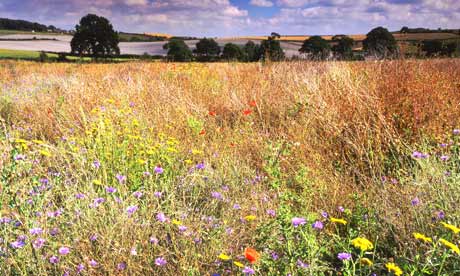
    Wildflower meadow in Cheshire

    Our children must ‘experience something of the delight in the natural world and of the peaceful, unharried lives with which we have been blessed’. Photo: Alan Novelli/Alamy

    It is, perhaps, the greatest failure of collective leadership since the first world war. The Earth’s living systems are collapsing, and the leaders of some of the most powerful nations – the United States, the UK, Germany, Russia – could not even be bothered to turn up and discuss it. Those who did attend the Earth summit in Rio last week solemnly agreed to keep stoking the destructive fires: sixteen times in their text they pledged to pursue “sustained growth“, the primary cause of the biosphere’s losses.

    The efforts of governments are concentrated not on defending the living Earth from destruction, but on defending the machine that is destroying it. Whenever consumer capitalism becomes snarled up by its own contradictions, governments scramble to mend the machine, to ensure – though it consumes the conditions that sustain our lives – that it runs faster than ever before.

    The thought that it might be the wrong machine, pursuing the wrong task, cannot even be voiced in mainstream politics. The machine greatly enriches the economic elite, while insulating the political elite from the mass movements it might otherwise confront. We have our bread; now we are wandering, in spellbound reverie, among the circuses.

    We have used our unprecedented freedoms – secured at such cost by our forebears – not to agitate for justice, for redistribution, for the defence of our common interests, but to pursue the dopamine hits triggered by the purchase of products we do not need. The world’s most inventive minds are deployed not to improve the lot of humankind but to devise ever more effective means of stimulation, to counteract the diminishing satisfactions of consumption. The mutual dependencies of consumer capitalism ensure that we all unwittingly conspire in the trashing of what may be the only living planet. The failure at Rio de Janeiro belongs to us all.

    It marks, more or less, the end of the multilateral effort to protect the biosphere. The only successful global instrument – the Montreal Protocol on substances that deplete the ozone layer – was agreed and implemented years before the first Earth Summit in 1992. It was one of the last fruits of a different political era, in which intervention in the market for the sake of the greater good was not considered anathema, even by the Thatcher and Reagan governments. Everything of value discussed since then has led to weak, unenforceable agreements, or to no agreements at all.

    This is not to suggest that the global system and its increasingly pointless annual meetings will disappear, or even change. The governments which allowed the Earth Summit and all such meetings to fail evince no sense of responsibility for this outcome, and appear untroubled by the thought that if a system hasn’t worked for 20 years, there’s something wrong with the system. They walk away, aware that there are no political penalties; that the media is as absorbed with consumerist trivia as the rest of us; that, when future generations have to struggle with the mess they have left behind, their contribution will have been forgotten. (And then they lecture the rest of us on responsibility.)

    Nor is it to suggest that multilateralism should be abandoned. Agreements on biodiversity, the oceans and the trade in endangered species may achieve some marginal mitigation of the full-spectrum assault on the biosphere that the consumption machine has unleashed. But that’s about it.

    The action – if action there is – will mostly be elsewhere. Those governments which retain an interest in planet Earth will have to work alone, or in agreement with like-minded nations. There will be no means of restraining free riders, no means of persuading voters that their actions will be matched by those of other countries.

    That we have missed the chance of preventing two degrees of global warming now seems obvious. That most of the other planetary boundaries will be crossed, equally so. So what do we do now?

    Some people will respond by giving up, or at least withdrawing from political action. Why, they will ask, should we bother, if the inevitable destination is the loss of so much of what we hold dear: the forests, the brooks, the wetlands, the coral reefs, the sea ice, the glaciers, the birdsong and the night chorus, the soft and steady climate which has treated us kindly for so long? It seems to me that there are at least three reasons.

    The first is to draw out the losses over as long a period as possible, in order to allow our children and grandchildren to experience something of the wonder and delight in the natural world and of the peaceful, unharried lives with which we have been blessed. Is that not a worthy aim, even if there were no other?

    The second is to preserve what we can in the hope that conditions might change. I do not believe that the planet-eating machine, maintained by an army of mechanics, oiled by constant injections of public money, will collapse before the living systems on which it feeds. But I might be wrong. Would it not be a terrible waste to allow the tiger, the rhinoceros, the bluefin tuna, the queen’s executioner beetle and the scabious cuckoo bee, the hotlips fungus and the fountain anenome to disappear without a fight if this period of intense exploitation turns out to be a brief one?

    The third is that, while we may have no influence over decisions made elsewhere, there is plenty that can be done within our own borders. Rewilding – the mass restoration of ecosystems – offers the best hope we have of creating refuges for the natural world, which is why I’ve decided to spend much of the next few years promoting it here and abroad.

    Giving up on global agreements or, more accurately, on the prospect that they will substantially alter our relationship with the natural world, is almost a relief. It means walking away from decades of anger and frustration. It means turning away from a place in which we have no agency to one in which we have, at least, a chance of being heard. But it also invokes a great sadness, as it means giving up on so much else.

    Was it too much to have asked of the world’s governments, which performed such miracles in developing stealth bombers and drone warfare, global markets and trillion-dollar bailouts, that they might spend a tenth of the energy and resources they devoted to these projects on defending our living planet? It seems, sadly, that it was.

    Twitter: @georgemonbiot
  • US wildfires are what global warming really looks like, scientists warn

    US wildfires are what global warming really looks like, scientists warn

    The Colorado fires are being driven by extreme temperatures, which are consistent with IPCC projections

    Colorado Springs wildfire

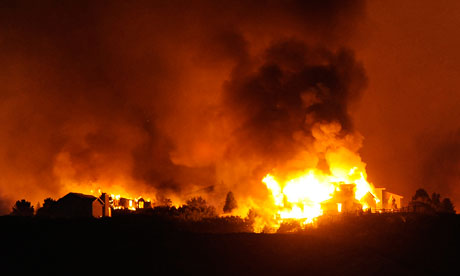
    Homes are destroyed by the Waldo Canyon fire in the Mountain Shadows area of Colorado Springs. Scientists say the fires offer a preview into the kind of disaters that climate change could bring. Photograph: Jerilee Bennett/AP

    Scorching heat, high winds and bone-dry conditions are fueling catastrophic wildfires in the US west that offer a preview of the kind of disasters that human-caused climate change could bring, a trio of scientists said on Thursday.

    “What we’re seeing is a window into what global warming really looks like,” said Princeton University’s Michael Oppenheimer, a lead author for the UN’s climate science panel. “It looks like heat, it looks like fires, it looks like this kind of environmental disaster … This provides vivid images of what we can expect to see more of in the future.”

    In Colorado, wildfires that have raged for weeks have killed four people, displaced thousands and destroyed hundreds of homes. Because winter snowpack was lighter than usual and melted sooner, fire season started earlier in the US west, with wildfires out of control in Colorado, Montana and Utah.

    The high temperatures that are helping drive these fires are consistent with projections by the UN Intergovernmental Panel on Climate Change (IPCC), which said this kind of extreme heat, with little cooling overnight, is one kind of damaging impact of global warming.

    Others include more severe storms, floods and droughts, Oppenheimer said.

    The stage was set for these fires when winter snowpack was lighter than usual, said Steven Running, a forest ecologist at the University of Montana.

    Mountain snows melted an average of two weeks earlier than normal this year, Running said. “That just sets us up for a longer, drier summer. Then all you need is an ignition source and wind.”

    Warmer-than-usual winters also allow tree-killing mountain pine beetles to survive the winter and attack western forests, leaving behind dry wood to fuel wildfires earlier in the season, Running said.

    “Now we have a lot of dead trees to burn … it’s not even July yet,” he said. Trying to stop such blazes driven by high winds is a bit like to trying to stop a hurricane, Running said.

    Fires cost about $1bn or more a year, and exact a toll on human health, ranging from increased risk of heart, lung and kidney ailments to post-traumatic stress disorder, said Howard Frumkin, a public health expert at the University of Washington.

    “Wildfire smoke is like intense air pollution,” Frumkin said. “Pollution levels can reach many times higher than a bad day in Mexico City or Beijing.”

    Older people, the very young and the ill are most vulnerable to the heat that adds to wildfire risk, he said. The strain of fleeing homes and living in communities in the path of a wildfire can trigger ailments like post-traumatic stress disorder, depression and anxiety.

    The briefing was convened by the science organisation Climate Communications, with logistical support by Climate Nexus, an advocacy and communications group. An accompanying report on heat waves and climate change was released simultaneously.

  • Curvy mountain belts

    ScienceDaily: Earth Science News


    Curvy mountain belts

    Posted: 29 Jun 2012 06:19 PM PDT

    Mountain belts on Earth are most commonly formed by collision of one or more tectonic plates. The process of collision, uplift, and subsequent erosion of long mountain belts often produces profound global effects, including changes in regional and global climates, as well as the formation of important economic resources, including oil and gas reservoirs and ore deposits. Understanding the formation of mountain belts is thus a very important element of earth science research.

  • Barack Obama visits Colorado Springs neighbourhood destroyed by wildfires

    Barack Obama visits Colorado Springs neighbourhood destroyed by wildfires

    President praises firefighters and announces federal disaster relief to devastated region as blaze continues to burn

    obama colorado wildfires

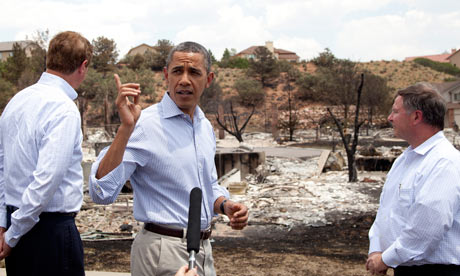
    President Barack Obama tours the Mountain Shadow neighborhood devastated by raging wildfires Colorado Springs. Photograph: Carolyn Kaster/AP

    Barack Obama toured smouldering districts of Colorado Springs on Friday, offering federal disaster funds to the “heartbroken community” as it struggles to contain wildfires that have already claimed at least two lives and destroyed hundreds of homes.

    As the Waldo Canyon fire continued to rage on the edge of the city, the president praised the firefighters battling to bring it under control and said Americans would come together to support the tens of thousands forced to flee.

    During a tour of the Mountain Shadows neighbourhood, where houses were left blackened and ruined when the blaze reached it three days ago, Obama appeared stunned by the random nature of the devastation.

    “You have a house that’s cinders, next to it, it’s untouched,” he said.

    Later, in a brief statement outside the city’s fire station number nine, he described the devastation from the fires as enormous but said officials were “starting to see progress”.

    “When natural disasters hit, all of America comes together,” he said. “We all realise: ‘there but for the grace of God, go I.’”

    Paying tribute to the firefighters, Obama added: “We can provide all the resources … what we can’t do is provide them with the courage and the determination and professionalism” to fight the fires.

    Mountain Shadows is one of the worst hit districts, and the scene of the first confirmed fatality. On Thursday night, human remains were discovered in one of the homes, and it was confirmed that remains of a second person had been found on Friday.

    The deaths cast a sombre shadow over a day in which the news was more positive on efforts to contain the wildfire.

    Ahead of Obama’s arrival, fire officials said they were now making “great strides” in controlling the wildfire, which exploded out of the foothills earlier this week destroying nearly 350 homes and forcing more than 30,000 to flee.

    Evacuation orders were lifted on a number of areas, and normal operations resumed at the air force academy, a portion of which had been evacuated because of the wildfire.

    Fire officials said they hoped to lift more evacuation orders later on Friday though residents would not be able to return permanently to neighbourhoods until electricity and other services was restored.

    “We made great strides yesterday. We were able to up our containment to at least 15%, and 15% is a lot,” said Jerri Marr of the US forest service. “We feel with a lot of confidence, based on the weather, that we are going to be able to up that number by the end of the day. We are going to make a lot of progress.”

    Later on Friday, it was confirmed that firefighters had contained 25% of the fire.

    Some 1,100 firefighters were now working to beat back the wildfire behind containment lines. The effort got additional aerial support on Friday in the form of four more US air force C-130s. The planes have been dropping thousands of gallons of bright orange flame retardant on the containment lines.

    Some fire officials were so hopeful as to suggest the wildfire could be entirely contained within a few days. For others, however, the ordeal is just beginning.

    Hundreds of residents got their first definitive confirmation on Thursday night that they had lost their homes in the wildfire. “We had seen some pictures, but the meeting, and seeing so many others in the same situation, just made it all seem real,” said Rebekah Largent.

    Her family was renting their apartment in the Mountain Shadows neighbourhood. But she said she lost her wedding dress and the rocking chair she used to put her baby to sleep.

    One reporter who accompanied the president on his visit described the scene which greeted him in Mountain Shadows. “Homes were burned to their foundation with water still spewing out of pipes, an orange Saab was half burned in one driveway and a Toyota was melted down to the frame and shelling at another house,” he wrote in a pooled dispatch.

    The White House said Obama’s visit was intended to offer some support to families in a similar predicament, as well as to thank firefighters who are struggling against record wildfires.

    The funds announced on Friday will be used to help the state cope with the aftermath of the fire, and also include job and psychological counselling, the White House said.

    But the visit to a battleground state just months before the elections was politically sensitive. Local television is already running blanket campaign ads. Colorado Springs, because of the air force base, is seen as a Republican stronghold.

    Local officials were insistent that the security preparations for Obama’s visit, which was to include a tour of affected areas and visits with firefighters, would not distract from that progress.

    “Colorado Springs does not have the assets to help with the presidential visit,” Steve Cox, an adviser to the city’s mayor told reporters.

    He said there would be limited road blocks and no interruption in airborne fire operations because of the visit.

  • Big clean-up begins after storms leave thousands without electricity UK

    Big clean-up begins after storms leave thousands without electricity  UK

    Flood alerts remain in force after streets are submerged and ‘golf ball’ hail stones fall

    police car gateshead

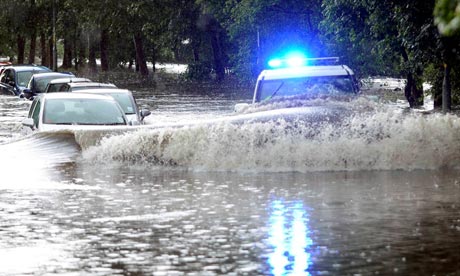
    A police vehicle struggles through floods in Gateshead after storms left streets submerged. Photograph: Craig Connor / NNP/North News & Pictures Ltd

    A vast clean-up operation got under way on Friday after heavy rain and storms left thousands of homes without electricity. Many people were evacuated, with severe disruption on the road and rail networks.

    Severe summer storms have caused flash floods that saw streets submerged. More than 111,000 lightning strikes were detected across the country, while hail stones “the size of golf balls” caused damage in Leicestershire.

    In Shropshire, a man who died after being caught in heavy flooding was named on Friday. Mike Ellis, a maths teacher, died after being swept away by floodwater in a stream at Bittlerley, near Ludlow. A 90-year-old man was among people rescued from vehicles by fire crews after flash flooding in the Bridgnorth area.Mr Ellis’s wife described him as “a gentle caring man” and the “most wonderful husband”.

    More rain is forecast but not torrential downpours, though there will be heavy showers – some in flood-hit areas including northern England, the Midlands, Scotland and Northern Ireland. The Environment Agency has flood alerts in place in 10 areas of the UK including East Anglia, the Midlands, the north-eastand the north-west.

    Thousands of homes were left without electricity in the north, with 3,000 customers still without power on Fridayyesterday, down from 23,000 on Thursday, according to Northern Powergrid. The worst hit areas include Consett, Whitley Bay, Prudhoe, Shiremoor and Stanhope.

    Northern Ireland and the Irish republic were also hit by floods, with a loss of power to more than 10,000 homes in the Cork area and 1,000 in Northern Ireland. Hundreds of homes and businesses were damaged by flooding in the Cork suburb of Douglas, while parts of Belfast and County Antrim were also badly affected.

    On Thursday heavy rains caused landslides which forced the cancellation of all East Coast trains between Newcastle and Edinburgh, with limited services resumed by Friday afternoon. Some passengers travelling from London to Glasgow endured journeys of up to 15 hours.

    A London to Glasgow Virgin Trains service was stranded between two landslides in the Lake District for more than two hours before being evacuated near Lockerbie after a fire broke out in the front coach of the train. In Newcastle, the city’s metro was underwater, submerged cars were left abandoned on flooded streets and care home residents with learning disabilities had to be evacuated.

    On Friday one of the main railways between Scotland and England was closed for the second time in 24 hours, with trains unable to run between Glasgow and Carlisle on the West Coast mainline because of a problem with overhead wires. The three-day Godiva Festival in Coventry was cancelled on Friday, with 100,000 revellers told not to turn up at the city’s War Memorial Park to see acts such as Echo and The Bunnymen and Cast. A statement on the festival website said: “We’re really sorry but finally beaten by devastating weather.”

    The cancellation comes after the Isle of Wight festival was hit by torrential rain last weekend, which saw the site flooded causing traffic jams around the island.

    The Midlands was hit by intense downpours, with some parts receiving 22mm of rain in one hour – a third of the average rainfall for the month. “We are not going to see the type of heavy rainfall we have seen in the last couple of days, but unfortunately the weather continues to look quite unsettled,” said Sarah Holland from the Met Office. “It will be mainly dry with some heavy showers, with the south-east getting the best of the weather while the worst will hit parts of Wales, the south-west and Yorkshire.”

    Sunday is expected to be drier but will remain dull. She added: “As people go back to work on Monday it will remain unsettled with more heavy showers expected in Tuesday.” Wales has seen the wettest June since records began, while this is the second wettest June on record in England. “It has been a disappointing month on all fronts – with many areas being exceptionally wet, very dull and cooler than average,” said Holland.

  • Asylum seekers could die during recess

    As Greens Senator Sarah Hanson Young stated. ” WHAT HAVE WE BECOME-  WHERE IS OUR COMPASSION???? Fair enough comment. If any more die the Govt. and most MP/s will take their full share of the blame and shame for the negativity they have displayed. What is human life worth???? An agreed policy is urgently needed.

    Asylum seekers could die during recess

    Updated: 08:44, Saturday June 30, 2012

    Immigration Minister Chris Bowen has conceded there’s a risk more asylum seekers could die over the next six weeks while parliament is in winter recess.

    Mr Bowen says until the issue is resolved and offshore processing is in place the risks are high.

    Parliament this week failed to pass a bill to restore the government’s power to send asylum seekers offshore despite about 100 people dying in twin boat disasters in the past 10 days.

    Opposition Leader Tony Abbott says the Coalition will stick with its asylum seeker policy even if the expert panel appointed by the prime minister decides the Malaysian deal is the best option.

    Mr Abbott says their policy worked when they were in government last time and it will work again if they’re re-elected and the panel won’t be deciding policy for them.