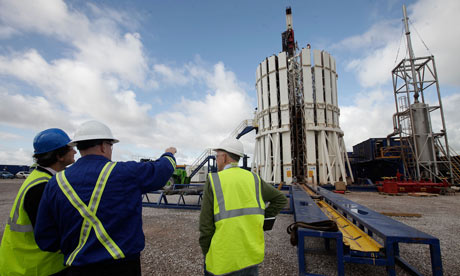
Engineers look at the Cuadrilla shale fracking facility in Preston, Lancashire. Photograph: Matthew Lloyd/Getty Images
Rarely a day goes by, it seems, when “fracking” isn’t in the news. It’s either being hailed as a miracle energy source, or it is being condemned as yet another polluting fossil fuel.
Today’s headlines largely focus on the findings of a joint report (pdf) by the Royal Society and the Royal Academy of Engineering which concludes that hydraulic fracturing of shale gas – “fracking” – should be allowed to proceed in the UK, but only with tight regulation and monitoring. Published ahead of the government’s anticipated “green light” for fracking later this summer, the report calls for a long parade of checks and balances, as you might expect it to:
Monitoring should be carried out before, during and after shale gas operations to inform risk assessments. Methane and other contaminants in groundwater should be monitored, as well as potential leakages of methane and other gases into the atmosphere. The geology of sites should be characterised and faults identified. Monitoring data should be submitted to the UK’s regulators to manage potential hazards, inform local planning processes and address wider concerns. Monitoring of any potential leaks of methane would provide data to assess the carbon footprint of shale gas extraction.
But what is missing from much of today’s media coverage is mention of – for me at least – the most important paragraph in the whole report:
This report has analysed the technical aspects of the environmental, health and safety risks associated with shale gas extraction to inform decision making. Neither risks associated with the subsequent use of shale gas nor climate risks have been analysed. Decision making would benefit from research into the climate risks associated with both the extraction and use of shale gas. Further benefit would also be derived from research into the public acceptability of all these risks in the context of the UK’s energy, climate and economic policies.
Yes, there are plenty of concerns about the possible localised environmental impacts of fracking, such as earth tremors, aquifer contamination, and surface leaks. As the report concludes, these need constant and tightly-regulated assessment if extraction is to get under way on a commercial scale. But this is a side salad compared to the picnic hamper of unanswered questions that still hang over fracking when it comes to its possible contribution to climate change.
With nice timing – but largely ignored by the media – is a report out today by the Committee on Climate Change, a statutory body set up to advise the UK government on greenhouse gas emissions. It urges the government to give up on its “dash for gas” in order to help avoid dangerous levels of greenhouse gas emissions. Its chief executive, David Kennedy, said:
[Ministers] must rule out the dash for gas, and set clear carbon objectives in the context of draft energy legislation and the forthcoming gas generation strategy. Our analysis shows that power sector decarbonisation is economically sensible, even in a shale gas world.
To frack, or not to frack, is arguably the most pressing environmental decision facing the “greenest government ever” at present. There are clearly huge temptations to proceed: its advocates say it is an abundant and cheap source of energy that could help to re-ignite our flailing economy. And voices such as James Lovelock say that fracked gas is a lesser evil than coal so we should use it as a bridging technology to “buy us some time”.
But there are plenty of legitimate environmental concerns, too, not least that the climate risks have yet to be fully analysed or face democratic scrutiny. And there are worries that fracking will likely hinder or damage the fledgling renewables sector.
Visit the Department for Energy and Climate Change’s webpage on shale gas and there is no mention of climate risks. The only direct reference I can find is an archived article by the former energy secretary Chris Huhne from last November:
Every national scientific academy in the world agrees: climate change is a real and growing threat. We face ambitious, legally binding carbon emissions and renewable energy targets. Yes, gas will help us meet them. But we should not bet the farm on shale.
He didn’t say, though, how this was to be achieved, other than earlier stating: “With carbon capture and storage technology, [shale gas] can provide a significant amount of low-carbon electricity in the long term.” And we all know how well CCS is coming along, don’t we?
Is the UK government really going to breezily “green light” fracking, as seems highly likely, given what the Committee on Climate Change has said today? Is it really going to push ahead, without having fully investigated and discussed the possible climate implications of fracking?
I, for one, don’t feel we have even begun having this important national debate.
Japanese nuclear officials have apologised to Fukushima residents for withholding maps showing dangerous radiation areas after last year’s meltdowns.
The US maps were compiled from aerial surveys and given to the Japanese government and its nuclear safety agency immediately after the Fukushima nuclear disaster.
But instead of releasing the maps, officials withheld them.
The officials have now apologised to the mayor of Kawauchi, a village near the nuclear plant which is now abandoned.
But mayor Yuko Endo rejected the apology, saying it was too late.
He says if his village had been given the maps they could have avoided evacuating into areas of high radiation.
Former Defence Force chief Angus Houston says he is “under no illusions” as to how challenging his task will be to navigate a way through the border protection policy impasse.
On Thursday the Senate struck down a bill from independent MP Rob Oakeshott which tried to restore the Government’s ability to process asylum seekers offshore.
In response, Prime Minister Julia Gillard formed a three-member expert panel to reassess Australia’s approach to border protection issues.
It is the latest bid to end the political stalemate that has gripped Parliament since two asylum seeker boats capsized killing almost 100 people.
Air Chief Marshal Houston, along with former head of Foreign Affairs and Trade Michael L’Estrange and immigration lawyer Paris Aristotle, have been given six weeks to come up with a solution to the current deadlock – preferably one which will be acceptable to the Parliament.
Air Chief Marshal Houston has told the ABC’s PM program that he believes the panel will be able to navigate through the tough policy issue.
“I think we know where the high ground is and we will work that in the way that enables us to come up with the best options that we can think of after we’ve gone through all the material that’s available to us,” he said.
But he says his is aware the task will be challenging.
“I’m under no illusions. This is going to be a very challenging and very difficult task and I think that view is shared certainly by Michael L’Estrange, who I’ve had quite a bit of discussion with,” he said.
The Coalition has already vowed to stick to its own border protection policy regardless of the panel’s findings, but Air Chief Marshal Houston does not think that will restrict his job.
“I don’t think my hands are tied. One of the things that’s been emphasised by the Prime Minister is that we will provide independent advice. It won’t be partisan in any way,” he said.
“But clearly we will look at all of the issues, we’ll look at all of the policy options and we will provide independent advice.”
New ‘opportunity’
The former Defence Force chief says his experience with the issues from a Defence point of view will bring something to the table.
“As the chief of Defence Force I was involved in a number of the committees that considered some of these difficult issues for a considerable period of time. I have had that experience,” he said.
“But I think what we’re looking at here is an opportunity; I’ve been away from it for 12 months, Michael L’Estrange has been away from those closer to this for a little more bit more than that and I think we have an opportunity to go back and perhaps start from a lower level and work through the policy.”
Air Chief Marshal Houston would not be drawn on his opinion of the Opposition’s policy to tow back boats to Indonesia, which has been criticised as being impractical.
“I’m not going to make any prejudgments at this stage. It would be very inappropriate of me to say ‘well I think this, I think that’ and so forth,” he said.
“We are going to be looking at all of the issues; all of the options and, in the fullness of time, the views of the panel will become very clear and very evident.”
He says the issue of border protection is complex and he does not expect to be able to find a quick fix.
“There is no magic bullet here and we will have to work through [the issues] and hopefully we’ll be able to provide constructive input into the resolution of the very difficult issues in a context which is extremely challenging,” he said.
Boat disasters
Air Chief Marshal Houston says he is yet to sit down with the other panellists to discuss how to tackle the task they have been given.
“I think it’s important that we give it our best shot; 500 people dying at sea attempting to get to Australia is 500 too many. And I feel that very personally,” he said.
“I’ve been involved in a couple of the disasters that involved asylum seekers when I was the CDF and I’d just like to see those risks eliminated.
“We’ll give it our best shot to try and achieve an outcome where we can dissuade people jumping into unseaworthy boats to come to Australia.”
Opposition Leader Tony Abbott has described the members of the expert panel as people of “great distinction” but says his party already has a boarder protection policy.
He has criticised the Government for outsourcing responsibility for its policy to the panel.
Air Chief Marshal Houston disagrees.
“I think the Government has to use every option available to it to resolve these difficult issues,” he said.
“What we bring to this is independence. We’re not partisan and we can make a considered decision on the advice that we will provide to government at the end of the process.”
“And hopefully – I know it’s going to be difficult and I don’t want to raise any expectations – but hopefully we will be able to make the positive and constructive contribution in the very difficult, intractable area.”
Radical plans to overhaul Sydney’s rail system may come at a cost of comfort and convenience, writes Jacob Saulwick.
Sydney’s train system was built for places like Beecroft. It was built to allow people to live many kilometres north, west and south of the city centre and be able to hop onto trains near their homes and hop off where they work.
It was built so people could move from the Depression-era slums of The Rocks, Surry Hills and Paddington, and live where trees still grew and the air was clean.
These were the principles on which John Bradfield built the Harbour Bridge and ripped up the CBD to build the City Circle more than 80 years ago.
Advertisement: Story continues below
“Part of the problem we have today is that we have a clumsy 19th-century-focused double-deck system that keeps trying to have Band Aid solutions” … Gladys Berijiklian has launched a new model rail system to accomodate the system’s worsening crush of commuters. Photo: Brendan Esposito
The Bridge came to define the look of the city. But the Circle would also define the way people moved through it, allowing commuters from outer suburbs to enter the city on trains that would loop around, and then head to more suburbs.
At Beecroft station, about 35 kilometres north-west of the CBD and one of the suburban stations for which the network was designed, commuters this week told the Herald what they liked about the system.
”You want to be comfortable; it is about 50 minutes on the way in and I’ll usually study or look through work emails,” said Katie Pearce, a law clerk and student who commutes to either her city job or Sydney University.
”A longer commute than an hour would be quite an annoyance” … Alex Jones commutes to Alexandria. His trip, which involves changing trains at Epping for an express to Central and then a bus to Alexandria, would not change. Photo: Brendan Esposito
”I’ll go earlier if it means I will get a seat, I would rather not stand,” she said. ”I definitely don’t like to change trains.”
But this model, according to plans being developed by the state government, could be a thing of the past.
At a press conference last week to unveil the latest design for a rail line to the transport-deficient Hills district, the Premier, Barry O’Farrell, and his Transport Minister, Gladys Berejiklian, discussed changes to Sydney’s train system that run deeper than one new line.
“I’ll go earlier if it means I will get a seat – I would rather not stand” … Katie Pearce commutes to either the city or Redfern. Would need to change at Epping and Chatswood to get to the city. Photo: Brendan Esposito
”Part of the problem we have today is that we have a clumsy 19th-century-focused double-deck system that keeps trying to have Band-Aid solutions,” Berejiklian said.
And so she foreshadowed new operating patterns for Sydney’s rail network that would mark a philosophical break with the way it has worked since Bradfield’s day.
The changes are designed to accommodate the system’s worsening crush of commuters. But if implemented they will also mean a different sort of commute for tens of thousands of Sydney residents.
The promise will be more frequent trains. The downside will be less seating, fewer direct trains to the city, and more need to get off and change.
”I’ve been to Hong Kong; I haven’t been to some of the other cities that have fantastic public transport, but why shouldn’t we have that in Sydney?,” Berejiklian said. ”Unless we take the steps now it will never ever happen.”
The plan might be progress. But the risks involved have some wondering if Berejiklian and co really know what they are getting into.
It was only the quirks of NSW Labor history that meant O’Farrell and Berejiklian were the first politicians to announce this sort of overhaul of Sydney’s train system.
In late 2007, a former chief executive of state rail, Simon Lane, was brought back into the fold by the then Director-General of Transport, Jim Glasson.
Lane’s job was to review CityRail’s oft-delayed expansion plans.
The government’s then policy was to continue with the traditional CityRail model, but to supplement it with new lines to the south-west and north-west eventually connected by a second harbour rail crossing.
But Labor had an atrocious record of finding and allocating the money to these projects. So Lane, a British-born former rail executive in Singapore, looked for ways to prevent the need for a second harbour crossing.
And, with the backing of the RailCorp boss Rob Mason, he started work on schemes to try to turn Sydney’s railway system into something more like Singapore or Hong Kong.
The basic idea of what became known as the ”Simon Lane plan” was to stop running heavy double-deck trains that could run only every three minutes over the Harbour Bridge.
Instead, Lane argued in reports for Mason, RailCorp should convert to smaller single-deck that could run every two minutes, frequent enough to not require a timetable.
The new model could push more people over the bridge in peak hour, he argued, meaning the second crossing could be put off for decades.
Lane left, but the concepts took hold to the extent that the day Nathan Rees was deposed as premier in December 2009, he was to have released a transport “blueprint” that included converting about a third of the CityRail network to single-deck trains as recommended under the Lane plan.
Rees’s blueprint called them “metro-style” trains. Last week, when O’Farrell and Berejiklian went public with them, they branded them “rapid-transit”.
Under Rees’s blueprint, as with O’Farrell and Berejiklian’s plan, the north-west rail link would be built for single-deck services.
Under Rees’s blueprint, as with O’Farrell and Berejiklian’s plan, the Illawarra Line to Hurstville and the Bankstown Line to Cabramatta would be converted to single-deck trains running at a higher frequency.
The main difference between the two plans is that O’Farrell and Berejiklian are actually going to build the north-west rail link.
And they have also committed, some day in the future, that there will be a second harbour rail crossing on which to run these single-deck trains.
But all these plans involve more than just replacing double-deck trains with single-deck. They also necessitate unpicking the historical model of Sydney’s train system that has allowed commuters to board trains in the suburbs and alight in the city.
Take, for instance, the O’Farrell government’s model for the north-west rail link, to be opened in about 2019.
The line will be built as a private shuttle between Rouse Hill and Chatswood, meaning the existing Epping to Chatswood line will be handed over to a new private operator. The concept means everyone on that line wanting to get to the city will have to change at Chatswood to get into town.
But it will also mean residents of suburbs north of Epping, places such as Cheltenham, Thornleigh and Beecroft, will have to catch three trains instead of one to get to the lower north shore and the city.
They will get one train to Epping, another on the new private line to Chatswood and a third train south from Chatswood. Commuters are unlikely to get seats on these last two.
Of course, forcing a few thousand people to change is not a disaster. Particularly when you are building a new rail line to suburbs that have never enjoyed one before. But Berejiklian’s department is also drawing up proposals for further interchange at other spots on the network.
Documents obtained by the Herald, and previously reported, reveal plans to force thousands of commuters on the Richmond Line to change at Seven Hills to continue to the city, and thousands of commuters at stations south of Epping to change at Central to continue to the city.
The idea is to require fewer lines to merge. Instead, the lines will run in simpler, shuttle patterns, just like they do in Hong Kong.
Dr Dick Day, a former general manager of planning and timetable development at RailCorp who was responsible for planning and development of the timetable for the Olympics, says the north-west plan might work if the second crossing was eventually built.
But in the meantime, there will be plenty of political heat when passengers are forced to stand up and change onto already crowded trains.
”The adverse impact on the very large number of passengers forced to interchange makes the minister’s decision to support the metro alternative without detailed public discussion truly heroic,” Day says.
Day is less impressed with the proposals to force passengers to interchange off the Richmond Line and from south of Epping. On his reckoning, these plans would have dubious benefit but could each affect about 4000 passengers an hour.
Dr Paul Mees, a senior lecturer in planning at the Royal Melbourne Institute of Technology, is particularly scathing of attempts to try to make Sydney’s train system more like Hong Kong.
He has seen it happen in Melbourne. The operator of Hong Kong’s metro, MTR, was appointed in 2009 to run the city’s train system. It attempted to simplify Melbourne’s train patterns and provoked a furore.
”What happens is that people go to Hong Kong and they say: ‘Aren’t the people that run the system brilliant’,” Mees says.
”But they’re not, the way the Hong Kong system was designed was brilliant, which meant that idiots could run it. It is a completely inappropriate model to be using in a city that already has a legacy suburban rail system. What we should be doing is looking at comparable cities that manage to get their trains to run reliably.”
Mees nominates Paris, Zurich and Copenhagen as examples.
In the meantime, Berejiklian and her advisers, many of whom are the same people in senior positions under the previous government, continue to pursue the goal of a 21st-century railway for Sydney.
The chairman of Infrastructure NSW, the former premier Nick Greiner, has embraced the new model for the north-west as a victory for common sense.
”There is not and there will not be a god-given right for people to go to the corner of their street and get on something and get off where they work in the city,” Greiner said last week.
A NASA-sponsored researcher has developed a way for spacecraft to hunt down hidden magnetic portals in the vicinity of Earth. These gateways link the magnetic field of our planet to that of the sun, setting the stage for stormy space weather.
 Email
Email