Author: admin

  • Experts warn of another disaster awaiting at Fukushima

    Experts warn of another disaster awaiting at Fukushima
    ABC Online
    Japanese and US nuclear experts warn that another earthquake hitting The nation’s Fukushima nuclear reactors were inside the disaster zone. We’ve not heard much about them for a while, but the danger certainly hasn’t passed. Experts
    See all stories on this topic »
    Experts warn of nuclear fire danger at Fukushima
    Radio Australia
    While much has been made of the meltdowns in reactors one, two and three at Japanese and US nuclear experts say if another large earthquake hits
    See all stories on this topic »

  • Economic climate has not affected views on global warming – poll

    Economic climate has not affected views on global warming – poll

    Guardian/ICM poll reveals public perception of climate change remains consistent despite political shift during financial crisis

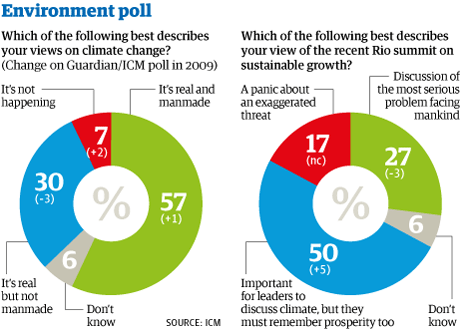
    ICM climate poll

    A new Guardian/ICM poll reveals the public view of man-made climate change has remained consistent in the last three years, despite a change in Conservative party priorities in the financial climate. Photograph: Antonio Lacerda/EPA Photograph: Graphic

    The cold financial climate of the last three years has made little impact on public attitudes towards global warming, according to a new Guardian/ICM poll.

    As the world assembled for the Rio+20 UN sustainable development conference at the end of last week, the survey found that most British voters (57%) accept that man-made climate change is happening. That is one point more than the 56% who took the same view when ICM posed a near-identical question just before the Copenhagen climate conference of 2009.

    The poll identified a hardcore of 7% of respondents who deny the planet is getting warmer, two points more than the 5% who said the same at the time of Copenhagen. The proportion who accept the planet is warming but insist this is not principally due to human factors has dwindled slightly, from 33% in December 2009 to 30% today.

    The results suggest a remarkable pattern of stability in acceptance of climate change as established fact, a finding which may surprise politicians who have been lowering their environmental ambitions for fear of appearing out of step with hard times. The leaders who went to Rio were so resigned to an insubstantial outcome that they allowed their sherpas to agree the basic communique before they had even arrived.

    A follow-up question on impressions of the summit also revealed more continuity than change. Only 17% of voters dismissed the Rio summit as a panic about an exaggerated threat – exactly the same proportion who said the same of Copenhagen.

    But if the voters have not moved much, the same cannot be said of politicians. Whereas David Cameron had hailed Copenhagen’s “historic importance” as opposition leader, in the months running up to Rio, he licensed his chancellor to argue that “we’re not going to save the planet by putting our country out of business“.

    One thing that may help understand this shifting political positioning is a sense that – among that majority of voters who do acknowledge a climate change problem – the subject has slipped a little down the list of priorities. After three years of squeezed living standards, more of the people who accept carbon emissions need curbing warn leaders not to “lose sight of the need to maintain human prosperity”. The number taking this view has edged up from 45% to 50% since Copenhagen. Meanwhile, the most committed environmentalists – those who describe the climate as “the most serious threat facing mankind” – have dwindled somewhat. Before Copenhagen, 30% were in that camp; today its strength has fallen back to 27%.

    The modest swing towards putting economics before the environment is somewhat more marked among Tory supporters and backers of minor parties, and it could be that Conservative high command fear that excessively green positions could see the party surrendering some rightwing voters to Ukip. On the basic facts, however, a plurality of the supporters of all three parties are in agreement: 49% of Conservatives, 61% of Labour supporters and 67% of Lib Dems believe in man-made climate change. Even if some differences in the rhetoric between different political leaders is emerging, most voters appear to accept climate science, regardless of their own party affiliation.

    ICM Research interviewed a random sample of 1,002 adults aged 18+ by telephone on 22-24 June 2012. Interviews were conducted across the country and the results have been weighted to the profile of all adults. ICM is a member of the British Polling Council and abides by its rules.
  • Increasing levels of carbon dioxide in Arctic coastal seas

    ScienceDaily: Oceanography News


    Significant sea-level rise in a two-degree warmer world

    Posted: 24 Jun 2012 10:49 AM PDT

    Even if global warming is limited to two degrees Celsius, global mean sea level could continue to rise, reaching between 1.5 and four meters above present-day levels by the year 2300, with the best estimate being at 2.7 meters, according to a new study. However, emissions reductions that allow warming to drop below 1.5 degrees Celsius could limit the rise strongly.

    Some forecasters predict second-smallest Gulf of Mexico ‘dead zone’

    Posted: 21 Jun 2012 12:13 PM PDT

    A dry spring in portions of the Midwest is expected to result in the second-smallest Gulf of Mexico “dead zone” on record in 2012, according to a newly released forecast.

    New deglaciation data opens door for earlier First Americans migration

    Posted: 21 Jun 2012 11:13 AM PDT

    A new study of lake sediment cores from Sanak Island in the western Gulf of Alaska suggests that deglaciation there from the last Ice Age took place as much as 1,500 to 2,000 years earlier than previously thought, opening the door for earlier coastal migration models for the Americas.

    Increasing levels of carbon dioxide in Arctic coastal seas

    Posted: 18 Jun 2012 12:37 PM PDT

    The Arctic coastal seas absorb the greenhouse gas carbon dioxide to an ever-decreasing extent. This leads to an increase in the level in the atmosphere and an increase in the rate of warming in the Arctic.
    You are subscribed to email updates from ScienceDaily: Oceanography News
    To stop receiving these emails, you may unsubscribe now.
    Email delivery powered by Google
    Google Inc., 20 West Kinzie, Chicago IL USA 60610
  • Interactive: how would a rise in sea-level affect US cities?

    Interactive: how would a rise in sea-level affect US cities?

    This interactive map, designed by Stamen for Climate Central, models the likely impacts of sea-level rise on selected American cities. Users can see how storm surges and tides of various heights would affect urban areas for any of the cities shown. Regions at risk of flooding are highlighted on the map. For a more detailed breakdown of vulnerability including statistics on land area, number of houses and population, click through to a larger version of the tool on the Climate Central website. The figures used in the model come from this peer-reviewed scientific paper, and Climate Central provide further details about the map here.


  • Scientists warn US east coast over accelerated sea level rise

    Scientists warn US east coast over accelerated sea level rise

    Study says sea level is rising far faster than elsewhere, which could increase incidence of New York flooding

    Damian on sea levels rising on North East Cost of US : Hurricane Irene Crosses North Carolina Coast

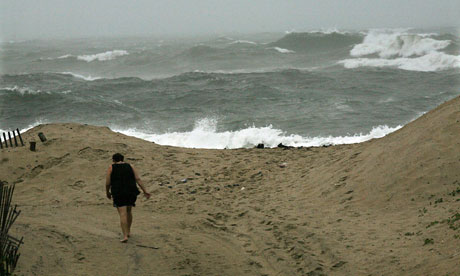
    A stormy Atlantic ocean hits the coast of Buxton, North Carolina. Photographer: Ted Richardson/Bloomberg via Getty Images

    Sea level rise is accelerating three to four times faster along the densely populated east coast of the US than other US coasts, scientists have discovered. The zone, dubbed a “hotspot” by the researchers, means the ocean from Boston to New York to North Carolina is set to experience a rise up a third greater than that seen globally.

    Asbury Sallenger, at the US geological survey at St Petersburg, Florida, who led the new study, said: “That makes storm surges that much higher and the reach of the waves that crash onto the coast that much higher. In terms of people and communities preparing for these things, there are extreme regional variations and we need to keep that in mind. We can’t view sea level rise as uniform, like filling up a bath tub. Some places will rise quicker than others and the whole urban corridor of north-east US is one of these places.”

    The hotspot had been predicted by computer modelling, but Sallenger said: “Our paper is the first to focus on using real data to show [the acceleration] is happening now and that we can detect it now.”

    The rapid acceleration, not seen before on the Pacific of Gulf coasts of the US, may be the result of the slowing of the vast currents flowing in the Altantic, said Sallenger. These currents are driven by cold dense water sinking in the Arctic, but the warming of the oceans and the flood of less dense freshwater into the Arctic from Greenland’s melting glaciers means the water sinks less quickly. That means a “slope” from the fastest-moving water in the mid-Atlantic down to the US east coast relaxes, pushing up sea level on the coast.

    “Coastal communities have less time to adapt if sea levels rise faster,” said Stefan Rahmstorf, at the Potsdam Institute Germany, who published a separate study in the same journal, Nature Climate Change, on Sunday. Rahmstorf’s team showed that even relatively mild climate change, limited to 2C, would cause global sea level to rise between 1.5 and 4 metres by the year 2300. If nations acted to cutting carbon emissions so the temperature rise was only 1.5C, the sea level rise would be halved, the researchers found.

    The impacts of the rising seas are potentially devastating, said the scientists. “As an example, 1 metre of sea level rise could raise the frequency of severe flooding for New York City from once per century to once every three years,” said Rahmstorf, adding that low lying countries like Bangladesh are likely to be severely affected. His colleague Michiel Schaeffer, at Wageningen University in the Netherlands, said: “Sea level rise is a hard to quantify, yet a critical risk of climate change. Due to the long time it takes for the world’s ice and water masses to react to global warming, our emissions today determine sea levels for centuries to come.”

    Sallenger’s work on the hotspot off the US east coast showed that the extreme acceleration in sea level rise could add 20-30% to the rise seen globally. “If this turns out to be a metre by 2100, it would add 20 to 30cm.” In May, North Carolina legislators drew ridicule from experts by proposing a law that would require estimates of sea level rise to be based solely on historical data and to rule out any acceleration in future rises.

    Rahmstorf said: “Sallenger’s paper shows that, far from being spared accelerating sea level rise, [the coast here] has been over the past decades a hotspot of accelerating sea level rise.” But he added that the cause of the hotspot was not fully understood, meaning it was uncertain whether the acceleration would continue.

    Sallenger said: “We came up with a very clear correlation between the acceleration of sea level rise and rising temperature in the hotspot area. That suggests to me that as long as temperature continues to rise the hotspot will continue to grow.”

  • Palmer seeks permission to pollute reef: Burke

    Palmer seeks permission to pollute reef: Burke

    ABCJune 25, 2012, 3:02 pm

    The Federal Government says an application to pump waste water from a north Queensland nickel refinery into the Great Barrier Reef is not being taken lightly.

    Mining magnate Clive Palmer is seeking approval from the Great Barrier Reef Marine Park Authority to take contaminated water held in tailing tanks at his nickel refinery plant near Townsville, and release it into nearby Halifax Bay.

    The waste water would only be released if levels in tailing tanks reached crisis levels.

    Federal Environment Minister Tony Burke says Mr Palmer is effectively applying for “permission to pollute” the Great Barrier Reef.

    He says the level of nutrients in the water tanks is significantly below the standard required for the marine park.

    “Nitrogen levels, when they get too high, can in the extreme levels cause fish kills and take away all the oxygen that’s needed for marine life,” he said.

    The Marine Park Authority does have scope to allow the nutrient-rich water into the reef under strict guidelines, if it can be proved the waste water being held is at crisis levels.

    Mr Burke says that should only happen as a last resort.

    “There’s specific equipment that can be used in trying to get the water to a better standard,” he said.

    “There’s issues of raising dam walls but there’s questions whether that can be done in time.

    “And then as I said there’s options if the water were to be released whether it could be done at very, very slow pace, but none of it’s easy.”

    He says it is up to the Marine Park Authority to decide if it is possible to do so and not compromise the reef.

    “Is there such a thing where it could be done more slowly at lower volumes and not have a negative impact on the marine park?” he said.

    “Those sorts of questions are being considered. But if it was all to go out to the marine park in a short amount of time, the potential impact of this could be extraordinary.”

    Libby Connors from the Queensland Greens says the release of nickel tailings would have a detrimental effect on the reef.

    “It’s pretty insulting for him to claim that there is the jobs of 1,000 of his employees at risk because what the people of Queensland have to weigh up is the damage to the reef – which employees 60,000 people through tourism and related industries – versus Mr Palmer’s nickel refinery,” she said.

    The refinery, Queensland Nickel, has declined to comment.